Showing posts with label U.S Census. Show all posts

Friday, June 17, 2022

Wood and pellet appliance sales surge amid demographic heating changes

Fuel prices, extreme weather & heat pumps driving changes

By John Ackerly & Caroline Solomon


With rising gas, oil and electricity prices, wood and pellet stove manufacturers are struggling to keep up with a demand not seen in more than a decade. In Europe, demand for stoves is even larger, with lines forming outside hearth stores in hopes of getting one installed before the next heating season.


This recent surge comes on the heels of major demographic shifts already underway in wood and pellet heating in America. Households in southern states are retiring old stoves and not buying as many new ones, while in many northern states, demand has been surging. And while wood and pellet stoves are far more dominant in rural areas, there has been significant growth in some urban areas in recent decades. 


From 2000 to 2020, the number of U.S. homes using wood and pellets as a primary heating fuel grew very slightly, from 1.68% in 2000 to 1.70% in 2020, based on U.S. Census data. In real numbers, that means 2,075,845 households are using wood or pellets as a primary fuel. An additional 8 to 9 million homes use wood or pellets as a secondary heat source, making it the most popular secondary heating fuel after electricity. (The US Census gathered this data in 2000 and 2020 by asking the following question: “Which FUEL is used MOST for heating this house, apartment, or mobile home?”) 

However, this national data obscures some important local and regional trends. In some urban areas, wood heating is growing rapidly, while in some states it is falling rapidly. This is one of the first analyses based on US Census data to identify these trends in wood heat, which have been playing out over the last 20 years.  

Nationally, electricity continues its ascent and will likely become the most common heating fuel by 2030, if not before. In 1940, when the US Census began tracking heating fuel, wood was the second most common household heating source after coal. Wood heat steadily dropped, bottoming out in 1970 at 1.3% of homes, and then peaking at 3.9% in 1990. Primary wood and pellet heat could see a dramatic rise again if oil and gas prices stay high, for example going from 1.7% of homes back to 2.5% or even 3%, but that would still barely register on national graphs like the one above.


Overall, the only sources of heating that are rising between 2000 and 2020 are electricity, solar and wood, although wood only had a tiny rise. Fuel oil, propane, coal and gas all fell. 

Based on US Census Data. Compiled by the Alliance for Green Heat.

Urban vs. rural wood heat trends


On average, urban areas in the US saw an increase of 7.05% in wood heat, while rural areas saw an increase of 5.58%. But in 3 states, the number of homes using wood or pellets in urban areas more than doubled, and nearly doubled in 2 other states.  

Based on US Census Data. Compiled by the Alliance for Green Heat.

Michigan and Pennsylvania are both in the top 5 states for wood heating growth in urban and rural areas. Interestingly, the fastest growth in rural areas is not in the states where wood heating is most common. It’s important to note that the rapid increase in wood heat in some states does not always correlate with stove sales. One possible explanation is that many homes that used their stoves as a secondary heater in 2000 are using it as a primary heater in 2020. 


For the Northeast and Midwest, the urban change is much higher than the rural change; and in the South, urban wood heat usage is decreasing at a slower rate than rural wood heat usage. The West is the only region in which urban wood heat usage is falling more quickly than rural usage. 


But wood and pellet heating remains mainly a rural phenomenon. About four times the number of homes heat primarily with wood or pellets in rural areas than they do in urban areas. As a percentage, in 2020 less than half a percent of urban homes heat with wood but nearly 7% of rural ones do. 


More than 80% of Americans live in areas classified as “urban” by the US Census, which includes thousands of towns and suburban areas around cities. In 2010, Census data found 57% of households who primarily heat with wood live in rural areas, 40% in suburban areas and only 3% in urban areas.


The growth of wood heat in urban areas may reflect a much faster growth of pellet stoves, compared to wood stoves. In some states, hearth retailers sell more pellet stoves than wood stoves. Nationally, experts often say that about a one quarter to one third of all stove sales are pellet stoves, but there is no reliable data indicating exact percentages or where they are installed. Some urban areas, in addition to areas that experience frequent weather inversions, are beginning to ban the new installation of wood fireplaces and wood stoves. This is an effective way to ensure wood smoke does not get much worse where wood stoves are already common. For the smoke issues that do remain in more urban areas, wood smoke is primarily driven by outdoor fire pits, chimmneys and fireplaces.

In one of the only academic studies of U.S. wood heating trends published in 2012, the authors identified changes in wages and other energy prices as key drivers of demographic shifts in wood heat usage. That study, Analysis of U.S. residential wood energy consumption: 1967–2009, is an excellent overview of many factors impacting wood heat, and was done at the end of a 4-decade period of gradual decline in wood heat. This was before wood heat began trending up in 2000, ending its decades-long decline. 

Little research has been done in recent years on wood and pellet heat usage in urban and rural areas. One of the very few comprehensive analyses of U.S. wood heat usage, a report from 2012, called its lack of a breakdown of urban vs. rural wood heat as a “shortcoming” that was due to a “lack of time series data corresponding to urban/rural areas.” 


State and regional wood and pellet heat trends 


The states with the highest percentage of homes using wood or pellets as a primary heating fuel have remained relatively steady over the years. New Mexico was ranked sixth in 2010, quickly rose to third place in 2019, and then dropped back to fourth in 2020. One potential reason there could be more rapid changes in primary heating with wood and pellets is that a stove can be a primary heater one year and a secondary heater the next, which is usually not the case with central heating systems using oil, gas or electricity for fuel.

Based on US Census data. Compiled by the Alliance for Green Heat.

Many states experienced dramatic increases in wood heat usage from 2000 to 2020, while others saw declines in wood heat. The majority of the states which saw an increase in wood heat were not in New England and the Pacific Northwest where it is most popular, but in second tier states a bit further south. States where wood heat dropped the most are the warmest, southernmost states in the country.


Based on US Census Data. Compiled by the Alliance for Green Heat.

Aggregating by region, the general trend seen with states located in northern vs. southern regions holds. The two regions that saw increases in wood heat were the Northeast (+51.05%) and the Midwest (+27.73%), while the South and the West both saw overall decreases (-28.31% and -9.94%, respectively). 

Based on US Census Data. Compiled by the Alliance for Green Heat.


Selected state graphs


The residential heating mix in each state tells a different story over the years and presents different challenges to lowering the greenhouse gas intensity of heating fuel.

Wood and pellet heating has typically been the second most common primary heating fuel in Maine after oil. Wood did not prove to be any more popular in Maine in 1970 than it did in the rest of the country, but when heating oil costs rose, wood heating bounced back in a much dramatic way.

Wood heating in Washington state closely parallels Maine, starting at over 50%, diving to under 2% in 1970 and then rebounding in 1990. Electricity, however, has been extremely popular in Washington, probably due to milder winters, and local, cheaper hydroelectricity.
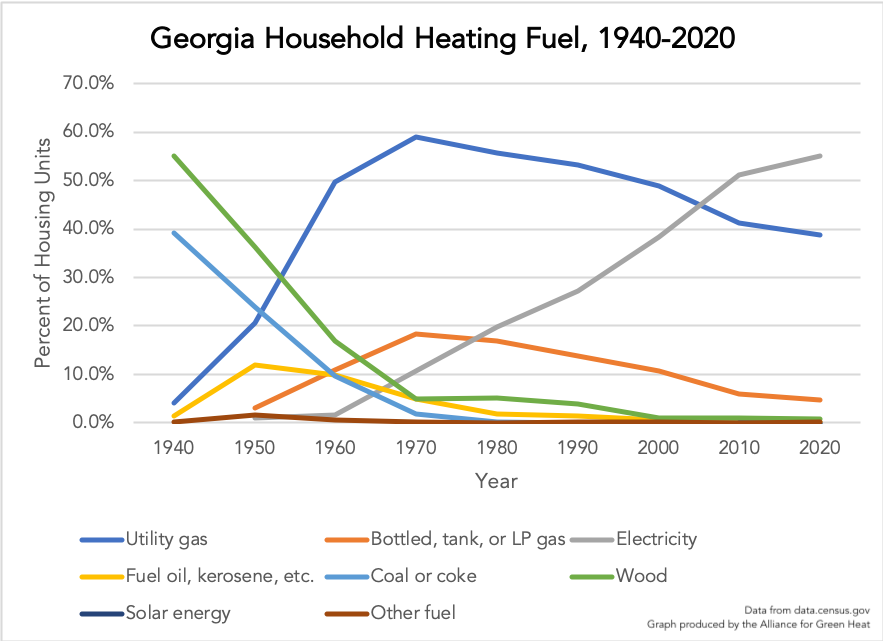
One of the largest, unknown stories about wood heat is that it was far more popular in the south in the 1950s, 60s and 70s than the rest of the country, including New England. This was largely because many rural Black communities were not included in gas or electricity infrastructure projects that enabled wealthier communities to get off wood and coal. Many households that rely on wood heat to this day do so not out of choice but out of necessity, and represent a significant, though little-noticed, energy justice issue.


Policy considerations


The rapid rise of wood heat presents a number of policy considerations that are frequently overlooked. Wood and pellet heating is often seen more of a public health nuisance in some circles, an energy lifeline in others, and a solution to shed fossil fuels in others. All of these narratives are valid and must be balanced at the local, state and federal level. 


Lack of understanding of the issues is a major barrier, as many policymakers and organizations often confound the issue of burning industrial pellets to make electricity with the sustainable use of premium pellets for local heat. And many still assume wood heat primarily involves cutting live trees, instead of sourcing wood that is already down or dead and has no other use. There is little awareness that pellet heat is consistently far cleaner than cord wood heat. Finally, there is still a lack of awareness that wood smoke, which may smell good to many people, is a serious health issue. 


If utilizing the cleanest and most modern wood and pellet heating to reduce fossil fuel use was the goal, federal and state governments could focus tax incentives and rebates on pellet stoves and boilers, as some states already do. Already in Vermont and other areas, the high rate of wood and pellet heat reduces stress on the grid during winter peak load periods, which are likely to get worse as more of our energy needs are electrified. If the federal government wanted to support rural low-income families to utilize free local wood, it could drastically increase its R&D funding to jumpstart the production of automated wood stoves that use computer chips to regulate air supply and prevent smoldering.


We can expect some cities and states to restrict new installations of wood heaters in densely inhabited areas and others to expand modern, automated heat at the commercial and residential level. Such outcomes are not inconsistent but require more educated debate among policymakers and the public. Already some of these policies are helping to shape the rise and fall of wood and pellet heat across America, but are likely a small influence compared to market forces. 


Conclusion


While wood and pellet heating has changed little in the last 20 years at the national level, regional and state changes have been significant. At a national level, studies show that reductions in household size, growth in heated floor area per house, and increased access to space cooling are the main drivers of increases in energy and GHG emissions after population growth. Improved generation efficiency and decarbonization of electricity supply are bringing about GHG emission reductions. Wood and pellet heat may be on the rise again, meaning it could factor more into national discussions of energy security and decarbonization.


This paper looks at the size of primary wood and pellet heating at the national and state level, but the role of secondary wood and pellet heating is equally, if not more, important in terms of sheer BTU output and reductions in fossil fuels.  Similar challenges of understanding, guiding and managing the pros and cons of wood heat are emerging across the northern and southern hemisphere and particularly in Europe, where the energy implications of Russian’s invasion of Ukraine are most acute. 


The next 20 years will likely see an even more rapid shift in residential heating fuel, as climate change becomes a more urgent issue. Electrification is emerging as the dominant, most obvious solution to home heating but wood and pellet heating may emerge as larger factor in the Northeast region and in various other states.


Thursday, June 28, 2018

West Penn Power Energy Fund to support a design competition that pairs automated, electricity producing wood stoves with solar PV


June 27, 2018- The Alliance for Green Heat received a $5,000 grant from West Penn Power Sustainable Energy Fund (WPPSEF) to support the 2018  Wood Stove Design Challenge, a competition to automate and make electricity from wood stoves from November 9 - 13.

The grant funds will be used to test and promote stoves that are automated and produce electricity, both of which could be popular in Western Pennsylvania as they become more commercially available in the next few years. Twelve teams are competing and they will be rigorously tested for emissions, efficiency, electricity output and other qualities.,

Automated wood stoves can enable consumers to “load and leave” and get a high efficiency clean burn through sensors that can adjust by the minute and are far more effective than a human operator. Electricity producing stoves can recharge cell phones, power light bulbs in the event of a short or longer power outage caused by storms, grid failure or any other reason.  Within 3 – 5 years, electricity producing wood stoves may also be a more common option in the northern US to complement low wintertime solar PV output. In the future, thermoelectric wood stoves may be able to produce half as much electricity as a residential solar PV installation in December and January in northern states.

Wood is a popular residential heating source in Pennsylvania. According to the latest Census figures, Pennsylvania has the highest number of households heating with wood outside New York and California. Approximately 3% of all homes in the Commonwealth use wood as a primary heating source, but in 16 counties, 10% or more of households use wood or pellets as a primary heat source according to the US Census: Fulton (20%), Sullivan (20%), Juniata  (19%), Forest (16%),  Potter (16%), Tioga (15%), Susquehanna (15%) and Bradford (14%), Bedford, (13%), Huntington (13%), Mifflin (13%), Perry (13%), Crawford (11%),Wayne (11%) and Warren (10%).  More than half a million Pennsylvanians use it as a primary or secondary heat source.  

“Woody biomass is an abundant renewable heat feedstock which has been used by generations to provide low-cost heating for homes across Pennsylvania.  WPPSEF seeks to better understand how modern, innovative wood stoves can affordably help meet energy needs while operating far more cleanly than traditional wood stoves,” says Joel Morrison, Director of the WPPSEF.

The Alliance for Green Heat promotes modern wood and pellet heating systems as a low-carbon, sustainable and affordable energy solution. The Alliance works to advance cleaner and more efficient residential heating technology. The Wood Stove Design Challenge in November 2018 will the fourth Design Challenge hosted by the Alliance for Green Heat. Founded in 2009, the Alliance is an independent non-profit organization and is tax-exempt under section 501c3 of the tax code. 

The West Penn Power Sustainable Energy Fund (WPPSEF) is a 501(c)(3) nonprofit organization that invests in the deployment of sustainable energy technologies that benefit West Penn Power ratepayers in Pennsylvania. WPPSEF investments are focused in three broad categories:
✓     Deployment of sustainable and clean energy technologies; 
✓     Deployment of energy efficiency and conservation technologies; and 
✓     Facilitating economic development, environmental betterment, and public education as they relate to sustainable energy deployment in the WPP service region.
-->
Visit http://www.wppsef.orgfor further information.

Contact John Ackerly, 
Alliance for Green Heat, 301-204-9562
jackerly@forgreenheat.org

Contact Barbara Robuck, 
West Penn Power Sustainable
Energy Fund, 814-865-7380
wppsef@ems.psu.edu

Friday, June 1, 2018

Households heating with wood or pellets declined by nearly 10% between 2011 and 2016


By Melissa Bollman, Alliance for Green Heat

In 2011, the Alliance for Green Heat reported a significant rise in the number of U.S. homes using wood or pellets as a primary source of heat. According to the U.S. Census’ American Community Survey, residential wood and pellet heat grew 34% between 2000 and 2010, faster than any other heating fuel. Propane and oil heat experienced the greatest declines during the time period, leading the Alliance to speculate that the rise of wood and pellet heating was driven by the economic recession, rising oil prices, and support for renewable energy.

Wood and pellet heating continued to rise during the next few years (see AGH analyses for 2011 and 2012) at an average rate of about 1-2% per year with some states experiencing higher growth. In 2014, the Census reported that an estimated 2.5 million U.S. households used wood or pellets as a primary heating fuel. Since then, however, the number and percentage of U.S. homes primarily heating with wood and pellets leveled off and saw a modest decline. According to the newest American Community Survey, around 2.2 million homes of U.S. homes primarily heated with wood and pellets in 2016—a nearly 12% decline from 2014 and a 9.4% drop from 2011.

Census figures suggest that wood and pellet use has fallen the most in the Southern states of North Carolina (down 17% from 2011), South Carolina (-25%), and Louisiana (-20%). Wood and pellet heat also appears to be on the decline in the Northeastern states of Maine, Connecticut, New Hampshire, and Massachusetts, which may be the result of more homes installing electric heat pumps. While nearly all states reported fewer homes heating with wood and pellets between 2011 and 2016, the largest increases were reported in Delaware (+20% between 2011 and 2016), New Jersey (14%) Utah (11%), and North Dakota (7%).

While wood and pellet use has declined in recent years, electric heat pumps and solar thermal systems are on the rise. American Community Survey results show that U.S. electric heating rose 10.4% between 2011 and 2016, with the largest increases occurring in Utah (+48%), Maine (+36%), Nebraska (+30%), and Vermont (+30%). About 39% of U.S. homes used electricity as a primary heating source in 2016, making it the second-most common source behind utility gas, which is used in nearly half of U.S. homes.

Warmer winters likely contribute to a longer-term decline in wood and pellet stove sales. According to annual data from NOAA, average U.S. winter temperatures increased between 2014 and 2016, which coincided with a decrease in the number of homes heating mainly with wood or pellets. But the big event during the years of this analysis was the economic recession, which lasted from 2007 to 2009. During these years, the number of U.S. homes heating with wood and pellets rose 15%. The use of stoves as primary heater usually goes up when the economy slows down, as people turn on their fossil fuel central heaters less and rely more on cheap wood. When economy is good, families tend to burn more fossil fuels and less wood. Pellet usage may also follow that trend, but tends to be even more volatile than cord wood.


While wood and pellet use has declined in recent years, electric heat pumps and solar thermal systems are on the rise. American Community Survey results show that U.S. electric heating rose 10.4% between 2011 and 2016, with the largest increases occurring in Utah (+48%), Maine (+36%), Nebraska (+30%), and Vermont (+30%). About 39% of U.S. homes used electricity as a primary heating source in 2016, making it the second-most common source behind utility gas, which heats nearly half of U.S. homes.

Less than 0.5% of U.S. households obtain their heat from solar energy, but the number of American homes using solar thermal technologies more than doubled between 2011 and 2016. The Census estimated that over 150,000 U.S. homes used solar energy as a primary heat source in 2016, while only approximately 122,728 households (50% of which are in Pennsylvania) used coal. This marks the first time solar surpassed coal as a primary U.S. residential heating source in Census estimates. Maryland, Oklahoma, and Louisiana had the largest increases in solar heating between 2011 and 2016. However, solar thermal remains the most popular in California, Arizona, and Hawaii.
The percentage of U.S. homes using other heating sources, namely, utility gas, propane, and fuel oil, has remained fairly constant over the past few years. Although the number of U.S. homes using wood or pellets as a primary heat source grew significantly during the 2000s and early 2010s, the overall percentage of U.S. homes remained fairly constant at around 2%.
Since the U.S. Census Bureau started tracking heating data in 1950, wood heating has had wide swings. Starting at 10% of the population in 1950, it dropped to 1.3% in 1970, an all-time low. By 1990, wood had climbed back to 3.9%, only to drop back to 1.6% in 2000. The recent decline in wood and pellets as a primary heat source could indicate that wood use is starting to level off. However, this is complicated by the enduring popularity of wood and pellets as a supplementary heating source. The newest Residential Energy Consumption Survey by the EIA estimates that an additional 9.3 million U.S. households used wood as a secondary heat source in 2015.

This analysis is based on 1-year estimates from the American Community Survey. The decennial Census, which is used primarily for redistricting, provides the most accurate statistics. The 2017 American Community Survey results will be released in September.

-->

Wednesday, December 7, 2016

Mapping wood heating and wood smoke in the United States

Updated, Dec., 2020: Wood heating has made a comeback in the United States and has been the fastest growing heating fuel for most years between 2005 and 2015, according to US Census figures. Currently, 2.36 million homes in the United States use wood as a primary heating fuel (ACS, 2015, 1-year estimates). And 8.8 U.S. million homes use it as a secondary heating fuel (EIA, RECS, 2009). Wood was the dominant residential heating fuel in the United states until coal began to take over in the 1880s. After that, heating oil and then gas became popular. The percent of the population primarily heating with wood dropped from 23% in the 1940s, when the US Census first began tracking heat, to a low point of 1.3% in 1970, when fossil fuels were cheap and popular.

Wood smoke follows wood heater installations and the first map shows shows county level particulate matter from residential wood combustion based on the 2011 National Emissions Inventory, Version 1.5.  The EPA should be releasing data from the 2014 National Emissions Inventory this year, so that residential wood smoke changes can be compared from 2011 to 2014.  Emissions from fireplaces - and more recently from outdoor fire pits - mix with smoke from residential wood heaters, and complicate assessing the impact of wood stoves and boilers.


This second map also shows PM 2.5 emissions from residential wood combustion by county, but its on a per capita basis according to the 2008 National Emissions Inventory, in this  EPA report, "New Methodology for Estimating Emissions from Residential Wood Combustion." It appears to show the densest per capita concentrations of PM2.5 in Wisconsin and Minnesota where the most outdoor wood boilers are made and installed.

The third map, from the same 2008 EPA, report provides further detail on the source of PM 2.5 emissions by appliance type. Each appliance type is represented by a different color. Red represents fireplaces, green represents fireplaces with inserts, dark blue represents woodstoves, light blue represents indoor furnaces, magenta represents outdoor hydronic heaters, and yellow represents wax/sawdust firelogs. While the terminology is somewhat confusing, the map shows some interesting trends.  For instance, wood stoves emit the majority of PM in the Northeast, while outdoor hydronic heaters are the largest source in the Great Lake states (outdoor wood boilers continued their popularity in these states after the 2008 EPA report). Fireplaces with inserts are the largest emitter in most of the south and California. Indoor furnaces are the most common source of PM pollution in Ohio, Indiana, and Illinois.

The next map was produced by the Census Bureau, showing per capita use of wood stoves. It shows 17.8% of homes in Vermont use wood or pellets as a primary heat source in 2012. Maine had the second highest percentage at 13.7% of homes. Out West, Montana has the highest percentage with 9.2% of homes, followed by Idaho at 7.9% and Oregon at 7.1%. On the US mainland, the states with the least wood heating are predictably Florida, at 0.2% of the population and then Texas at 0.4%.


The Alliance for Green Heat produced a map using Census data to show the continued growth of wood heating between 2000 and 2012. By 2010, the growth trend was well established, due in part to the housing crisis and recession. In that period, wood heat doubled in about 10 states, mostly in the Northeast.


This map below, made the Alliance for Green Heat, also uses Census data but breaks down primary wood heating households by Congressional districts. This provides a much more detailed look at the geography of wood heating compared to state level details. Presumably, a map showing wood usage at the county level could also be produced.  


This last map shows a curious phenomenon in 1950 where the Census Bureau found higher rates of primary wood heating in southern states than in many northern ones. This is likely due to the quicker penetration of fossil fuels in northern states, whereas room heaters in southern states, including those in many poor, rural black and white households, continued to operate on cordwood.


This map shows a per capita use of primary wood heat in impoverished counties.  Note the hot spots in northern Maine, West Virginia, Arkansas and the Navajo reservation in New Mexico.  We are unclear if Native American populations are among the hot spots in Washington, Oregon, and Northern California.


This final map of oil and gas heating use per capita generally correlates with heating costs, or at least it did before gas and oil prices plunged in 2019 - 2020.  Where there is high use of oil and gas, there is generally high use of wood heat in rural areas.


Wednesday, September 25, 2013

2012 Census Shows Wood Heating Continues Growth Streak

Alliance for Green Heat, Sept. 25, 2013 - According to recently released U.S. Census statistics, 63,566 more families used wood or pellets as a primary heating fuel in 2012 compared to 2011, which amounts to an increase of 2.6%, making wood again the fastest growing heating fuel in America.
From 2000 to 2010, wood and pellet home heating grew by 34%, faster than any of the other heating fuels, including solar and natural gas. Oil and propane use declined between 2000 and 2010, and the decline continued in 2012.
Today, 2.1% of Americans use wood or pellets as their primary heating fuel, up from 1.6% in 2000. An additional 7.7 % of U.S. households use wood as a secondary heating fuel, according to the 2009 EIA Renewable Energy Consumption Survey.
Nearly 2.5 million households use wood as a primary heating fuel, making it, by far, the dominant residential source of renewable energy in the United States. In comparison, only about 500,000 of U.S. homes have solar panels and less than 50,000 use solar thermal heating. Solar thermal heating dropped by 2% in 2012 from 2011, according to the new Census numbers.
The states with the biggest growth in wood heat from 2011 - 2012 are Delaware (35.1%), Rhode Island (29.6%), Nebraska (24.6%), New Hampshire (18.5%) and New Jersey (17.7%). However, other states experienced declines. Among the important wood heating states of Washington, Oregon and California, the decline was very small, but there were more significant declines in Illinois (5.2%), Idaho (5%) and Colorado (4.8%). Over a 12-year period, the prevalence of wood heating has increased, often very significantly, in every state except Louisiana, Mississippi, Florida and Hawaii.

Since the U.S. Census Bureau started tracking heating data in 1950, wood heating has had wide swings. Starting at 10% of the population in 1950, it dropped to 1.3% of the population in 1970, an all-time low. By 1990, wood had climbed back to 3.9%, only to drop back to 1.6% in 2000. The biggest growth story in heating fuel is electricity, which went from under 1% in 1950 to 36% today.
The environmental costs of using electricity for heating is high in most states, where the majority of electricity is still made with coal. The environmental cost of drilling and transporting other fossil fuels like oil and gas can also be high. Wood heating has an environmental cost from the particulate matter in the smoke, particularly from older stoves in more densely inhabited areas, and, in some states, from growing numbers of outdoor wood boilers. The EPA has proposed stricter emission standards for wood and pellet stoves and boilers and the Office of Management and Budget is reviewing them now.
Some of the growth in wood heating can be attributed to households that already had stoves, but now use them as primary heaters, instead of a secondary ones. Other households may have bought and installed stoves they found on the second hand market, which is legal in all states except Washington and Oregon.
The trend towards greater use of wood and pellets is mainly due to the lower operating costs compared to oil, propane and electricity. Three states – New Hampshire, Massachusetts and Maine – have provided generous rebates for pellet boilers to help residents replace costly oil heating systems and keep their heating dollars local. Maryland recently established a rebate for the cleanest wood and pellet stoves for rural homes that do not have access to natural gas.

For more info on 2012 U.S. Census data and on trends from 2000 - 2010, and more details about wood heat in the 2000 – 2010 Census.
