Showing posts with label EIA. Show all posts

Friday, June 28, 2024

Survey: Pellet stove owners love their stoves – and are also interested in heat pumps and solar panels

 Pellet stove adoption is growing and reached 25% of market compared to wood stoves in New England 

A survey taken by 486 people who use pellet stoves revealed some predictable and some unpredictable results. For instance, an overwhelming majority of pellet stove owners, 85%, said they would buy another pellet stove if theirs broke and 90% say their stove is reliable or very reliable, challenging a perception that pellet stoves are not very dependable. 


Pellet stoves are cleaner and more efficient than wood stoves and make up 25% of the stove market in New England, and 10% nationally, according to the US Energy Information Administration (EIA), Table CE7.1.  Until recently, likely around 5 years ago, American homes still made more renewable energy from wood and pellets than they did from residential solar photovoltaics, which have since surged past wood and pellet heat. 


The survey was undertaken between April and June of 2024 by the Alliance for Green Heat, an independent non-profit. AGH chose the Survey Monkey platform and circulated it through scores of social media pages, newsletters and neighborhood listservs. Thus, the survey is not rigorously scientific and likely over-represents pellet stove enthusiasts. Keeping that in mind, the data offers a glimpse into an important demographic of pellet stove users. By segmenting the data, we were also able to compare the views and values and pellet stove users based on income, region, motivation to buy a pellet stove and other characteristics. 


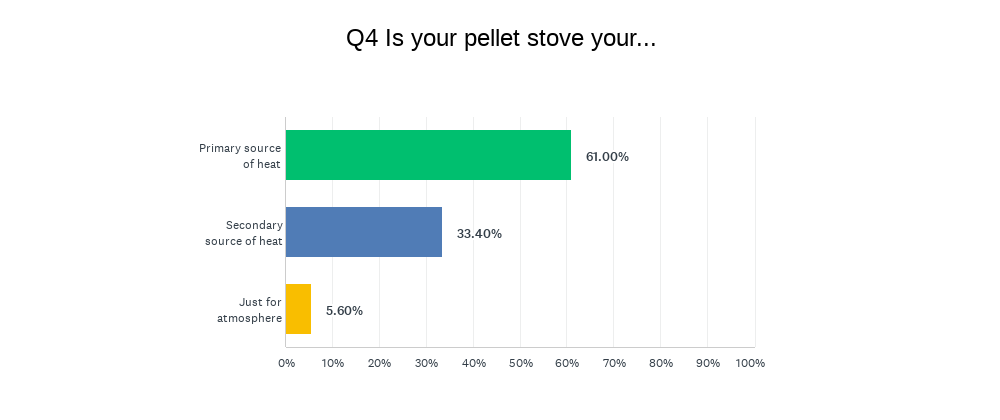
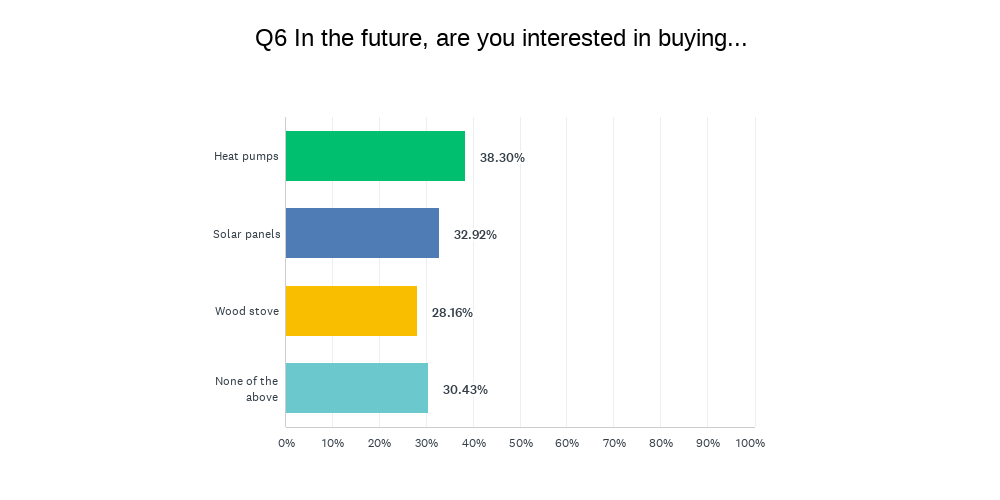
Of this group, 61% of the 486 respondents used their stoves for primary heat and in the future 38% were interested in buying heat pumps and 33% were interested in buying solar panels. Unlike households adopting solar panels, the primary reason homes adopt pellet stoves is for the substantial short term cost saving.  In the survey, all income groups except one listed “saving money” as the most common reason to heat with pellets.


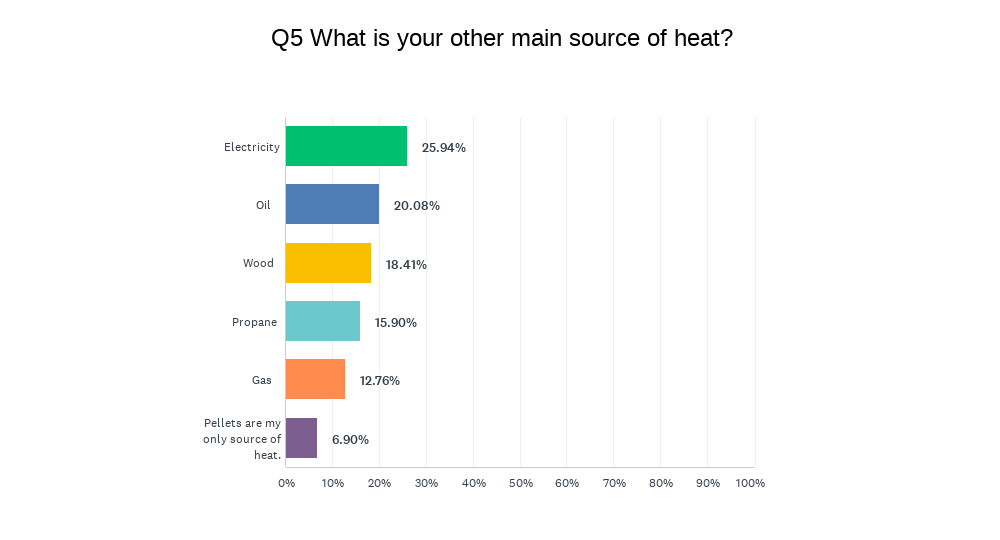
Twenty-six percent of households with pellet stoves displaced electric heat (both resistance and heat pumps) 20% displaced oil, and 18% displaced wood, 16% displaced propane and 13% displaced gas. This along with several other questions showed a high crossover with wood and pellet stoves, as many households that used to heat with wood have moved to pellet heat. In some cases, the reverse also happens with homes moving from pellets to wood fuel. 


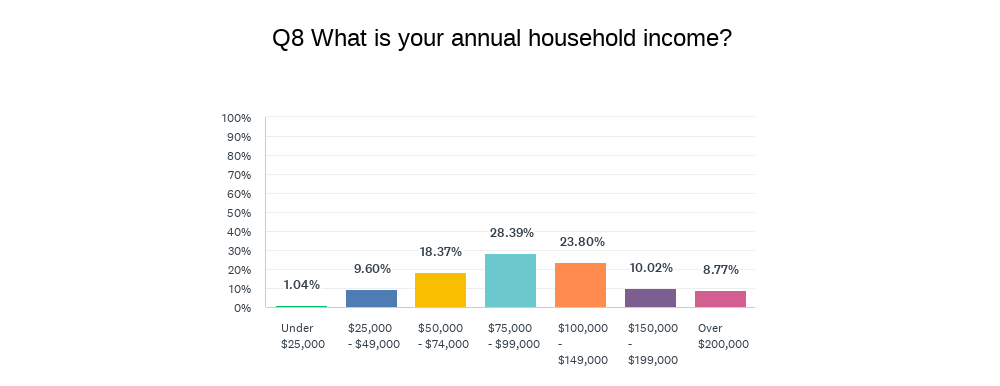
The median annual household income group was $75,000-$99,000, higher than than the national median ($74,580), and significantly lower than the median average income of homes with solar panels ($117,000 in 2022). The number of people per household was close to the national average with an average of 2.58. The national average is 2.51.


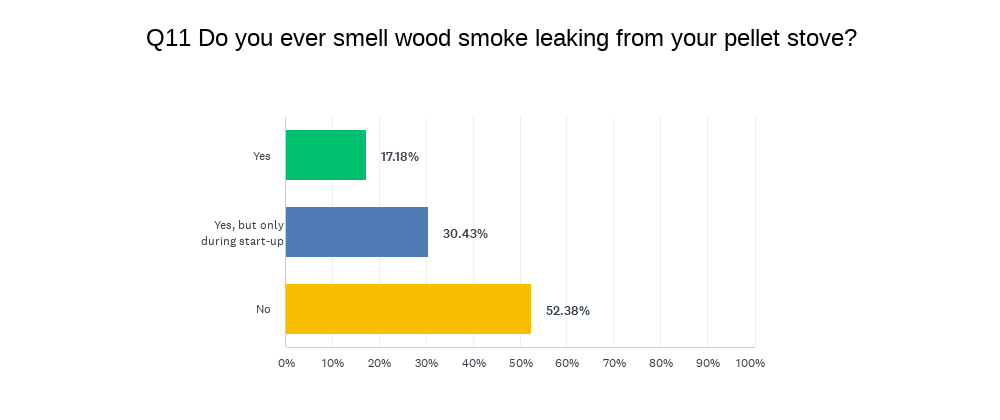
The survey also asked if pellet stove owners smelled smoke from their stoves and 17 % said they did, and 52% said they didn’t. In between those groups, 30% said they only smelled it during start-up which in most homes is no more than once a day. 


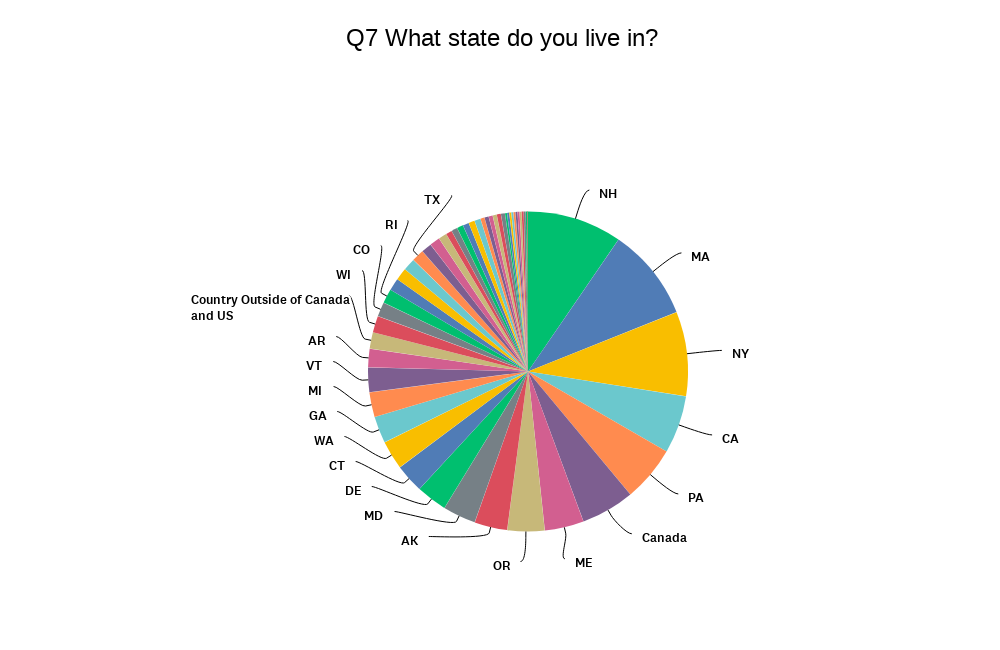
Survey respondents were from across the county, with respondents from every state except five, mostly in the deep south. The top 5 states were New Hampshire (10% of responses), Massachusetts (9%) and New York (9%), California (6%) and Pennsylvania (6%). Canada and countries outside of Canada and the US had 7% of responses. 


Scores of state and national studies show that small scale wood and pellet heat is enormously important to the transition away from fossil fuels both here and throughout Europe, in part because it does not strain the grid in the winter, and complements available renewable electricity.


Pellet heating has grown considerably in America, but public education lags, and there remains a lot of confusion about the export of pellets to make electricity versus the use of pellets for domestic heating.  The US Energy Information Administration publishes vital data about pellet production in America that can help clear up some of this confusion. 


Data from Each Question
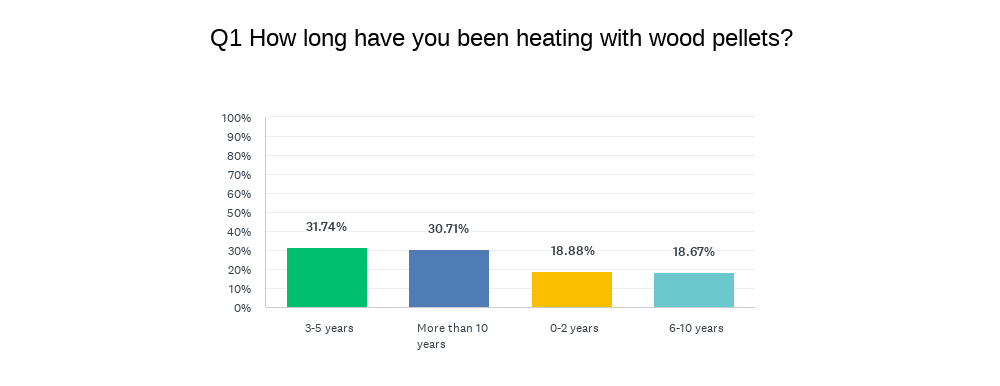
Q1. How long have you been heating with pellets? The responses show a range of households who are just starting to use a wood stove, to those who have used them for a long time. That indicates that there is continued interest by new people in starting to use pellet stoves.

Q2. What is the main reason you heat with pellets? Respondents were only allowed to pick one answer. Predictably, “saving money” was the leading reason, with 43% choosing this as their main motivation. But the surprising aspect is that so many people chose avoidance of fossil fuel as their main motivation (23%). The 18% choosing “as a back-up” could either be a regular or periodica back-up to another heating system or an emergency back-up if their other heating system broke down. Or, it could be people who have battery back-ups or generators so they can use a pellet stove during a power outage.
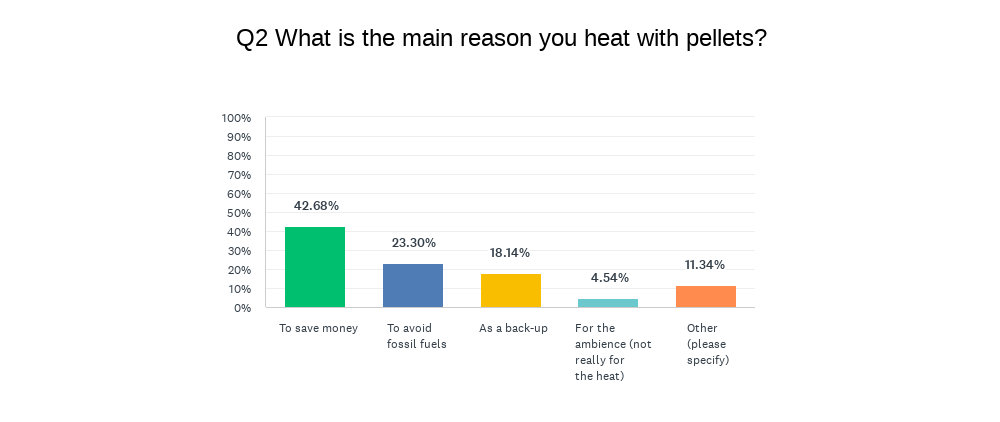
The three most common “Other (please specify)” comments were related to the following categories:

  1. The ease of use and consistency of pellet heat over log wood heat with comments such as, “Switched from firewood. Easier to deal with,” “Wood-fired heat, but more controllable than a wood stove,” and “Too old for firewood.”

  2. It’s popularity in supplementing other heat or areas of home with comments like, “Heat compensation, my furnace doesn’t keep up with a big drafty house,” and “Supplement heat for my basement.”

  3. Those heating with pellets because they are associated with the industry (pellet stove dealers, engineers, etc.)


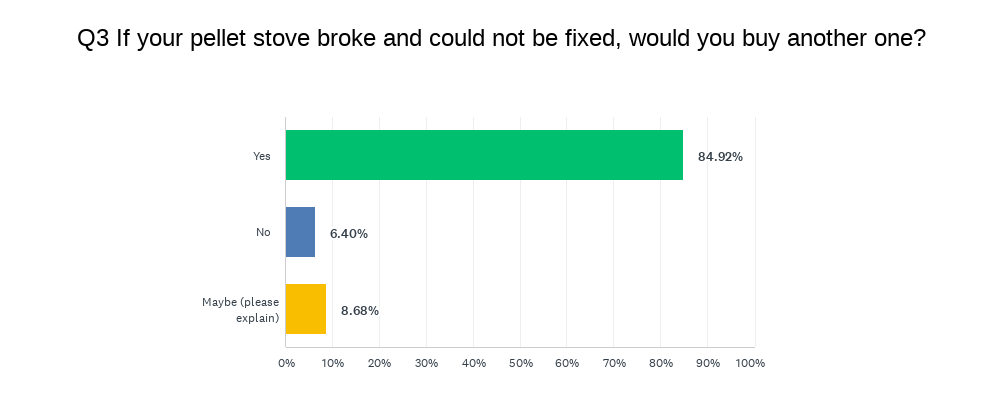
Q3. Would you buy another? This may be one of the most surprising results: 85% said they would buy another pellet stove if their current one could not be fixed, with another 9% choosing “Maybe.” This indicates a strong loyalty to the appliance. For those who selected “Maybe (please explain),” their answers were concerned with whether the price of pellets remained reasonable and if their health still allowed them to deal with the physicality of pellets. Another popular reason for explaining further was that they were confident they could fix their pellet stove if it ever stopped working: “I’d probably just fix it because they’re easy to repair.” 
Q4. Primary or Secondary Heat? That 61%so many respondents use their pellet stove as a primary heater is somewhat surprising, since nationally, the number of people who use wood or pellet as a secondary heat source is higher than primary heat source. This may be because we tapped into a more enthusiastic demographic, or it may be an indication that pellet stove users use their stove for primary heating more than wood stove users. We also didn’t ask about house size, though we did ask about the number of people in the household, which averaged only 2.58. Thus, it may be that people who completed this survey have smaller homes, possibly close to the national median of 2,299 square feet for a single family home.
Q5. Other Main Source of Heat? Nothing surprising here. Electricity is the highest percentage with 26%, and many of those are likely homes with electric resistance heat or early model heat pumps which are not nearly as efficient as modern ones. It may come as a bit of a surprise to some that 18% of pellet stove users have cord wood as their other main source of heat. Cord wood is the third most common “other main source of heat” after electricity and oil, another indication that we may have reached a more hardcore, dedicated biomass heat demographic.
Q6. Interest in Heat Pumps or Solar Panels. Respondents could choose multiple answers on this one. On average, a respondent chose 1.3 options. We found it somewhat surprising to see such high interest in heat pumps and solar panels.
Q7.State of residence. No surprises here. The fact that we had such a good demographic diversity shows that our data doesn’t just represent one part of the country. 
Q8. Household income. According to the US Census, the median household income was $74,580 and the average was $74,755 in 2022. Both fall right below the median income bracket of the respondents of our survey ($75,000 - $99,000). This shows a lower household income for this group compared to homes that have solar panels, or drive electric cars.

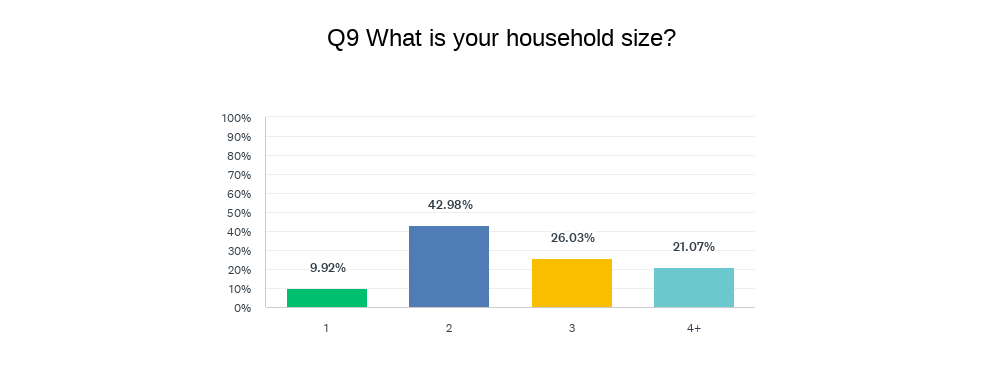
Q9.Household size. The average household size is 2.58, slightly larger than the national average of 2.51.
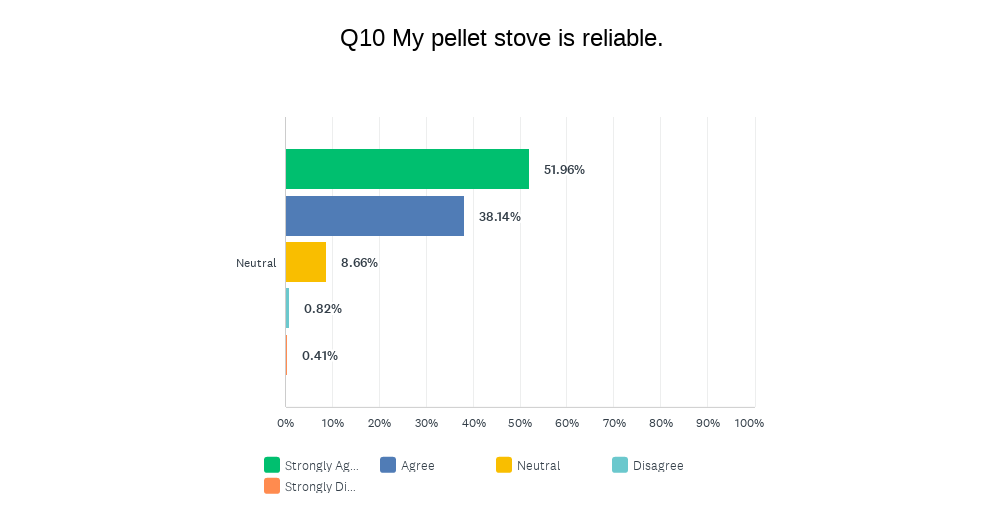
Q10. Is your stove reliable? The number of households who strongly agreed or agreed that their pellet stove is reliable is remarkably high (90.1%). 
Q11. Do you smell wood smoke? While a majority did not smell any smoke in their house, 30% smelled some on start-up. And the fact that 17% of this group say they smell it more regularly is significant enough to warrant further study into this problem. AGH has done some at-home testing and found start-up smoke to produce about the same amount of PM as making breakfasts or dinners that involve frying, using a griddle or making well-done toast. While this was not an in-depth study, AGH believes that the very small amount of smoke during start up could be partially caused by stoves not being sufficiently cleaned, or it may be a design flaw in some stoves that are not completely airtight and can leak.
Q12. Concern about health impacts of wood smoke. This question was not worked as well as it could have been, because it could be interpreted two ways: first, are you concerned about the health effects of wood smoke generally, or are you concerned about the health effect of wood smoke from your own pellet stove. Thus, someone could be extremely concerned about the health implications but answered that they weren’t concerned because they didn’t smell it in their own home. 


All of these tables can also be viewed on the Survey Monkey platform.


Overlaying Responses from Two Different Questions


Survey Monkey allows you to take the individual answers of a question and see how those people answered another question, because all answers are attached to an IP address. Thus, we were able to see how different demographics answered different questions.


Income and main reason to heat with pellets
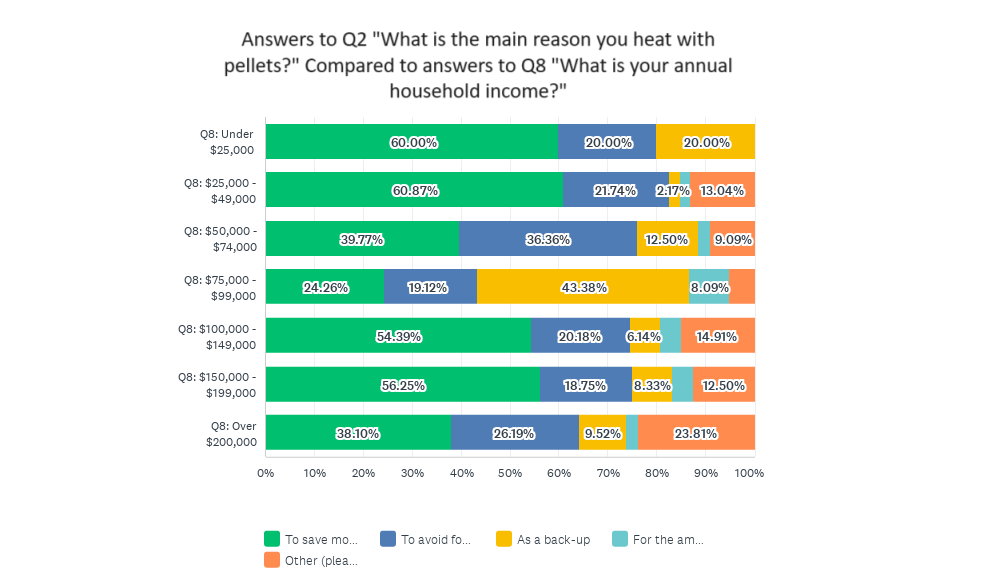

On Q2 overlaid with Q8, reasons for heating with pellets vs. income, saving money was the top rationale for all income categories exempt the middle, median income bracket. Lower income brackets favored saving money to some extent, and no one in the lowest bracket used their stove for ambience. As for being motivated to reduce fossil fuels, there is no clear pattern based on this sample of 486 people. 


Main reason to heat with pellets and interest in buying other appliances
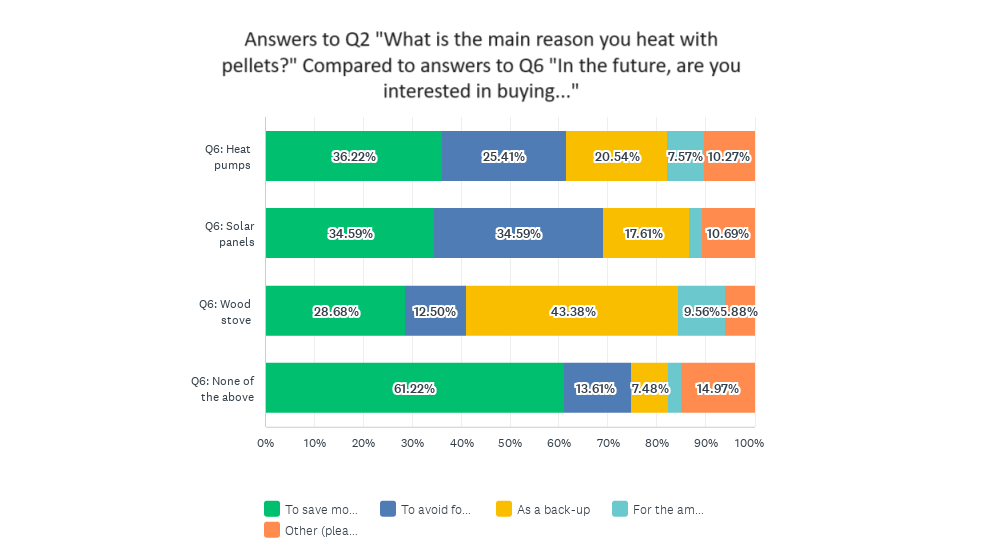


Comparing Q2 and Q6 unsurprisingly shows that people who heat with pellets who are more motivated to reduce fossil are the most likely to be interested in buying solar panels. And people who are more motivated to save money least interested in solar or heat pumps.


Reliability vs. interest in buying another pellet stove 
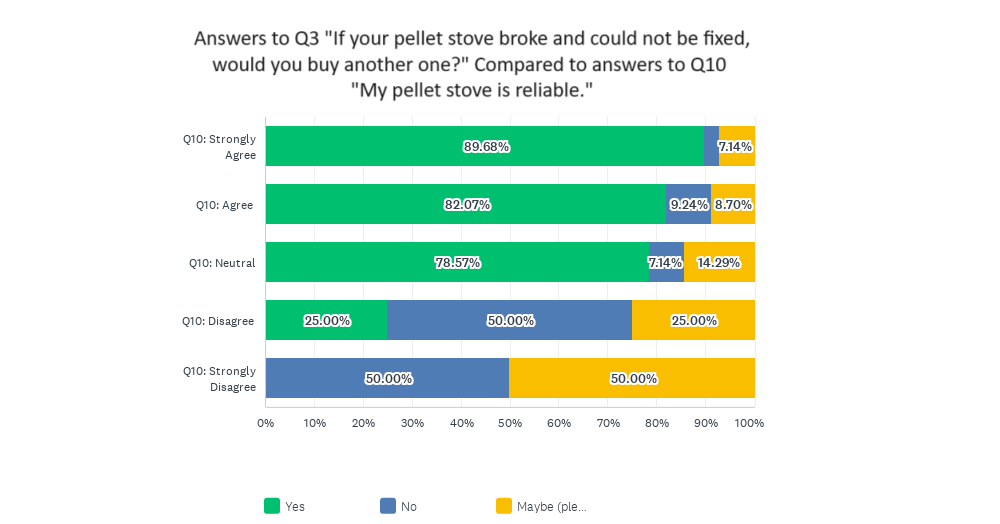


Unsurprisingly, overall those who agreed or strongly agreed that their pellet stove was reliable were most likely to want to buy another one if it broke down. Those who strongly agreed that their pellet stove was reliable were more than twice as likely to want to buy another. 


Reliability and length of ownership
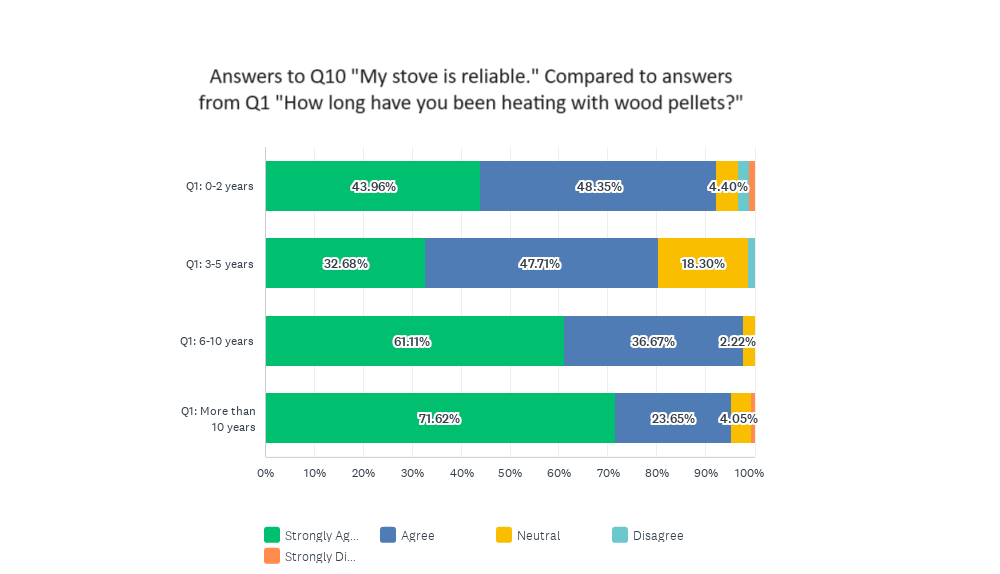

In this comparison, those who had their stove for longer than 10 years reported higher levels of satisfaction with reliability. And it was the group who owned stoves for 3 - 5 years who reported lower levels of satisfaction with reliability, possibly indicating that this is the period that repairs may be the highest.


Smelling smoke and length of ownership
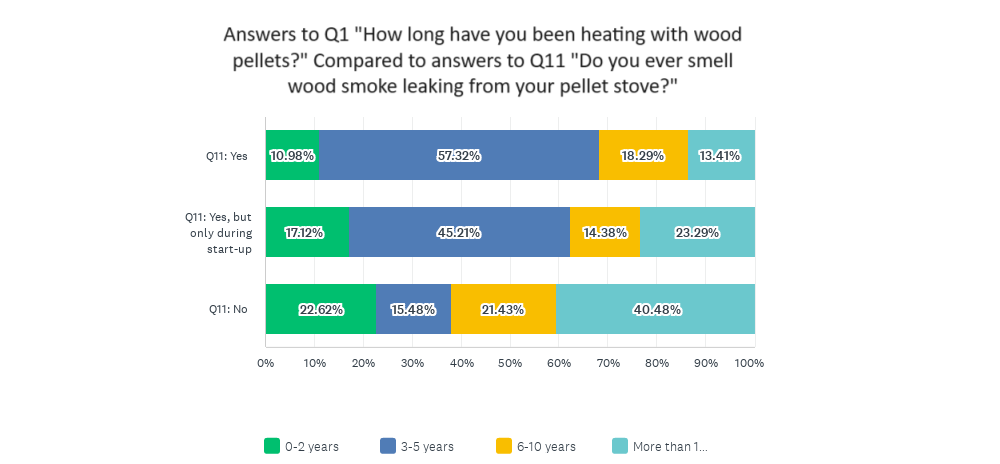

This indicates that the group who smells smoke the most is 3 - 5 year ownership and that the longer you own a stove the less smoke you report smelling. 


Overlap between smelling wood smoke and being concerned about it 
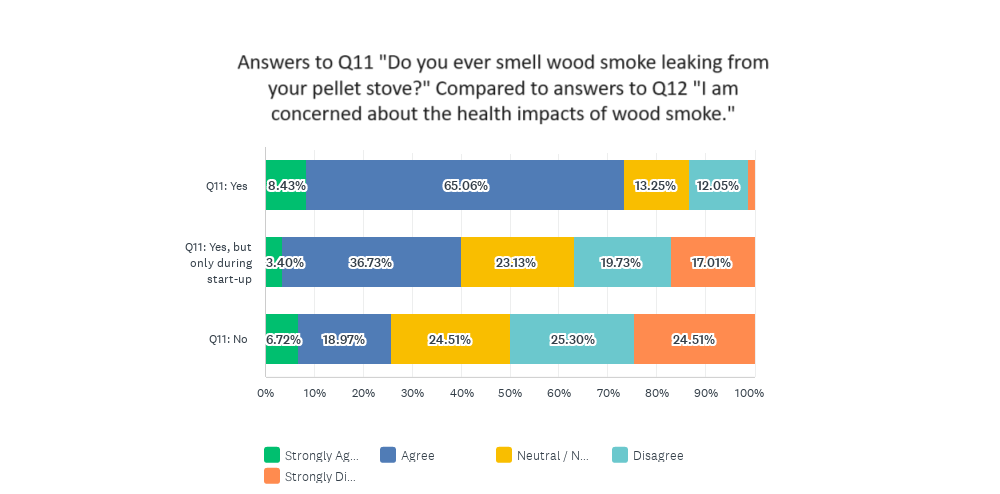

When comparing the answers of concern to those having reported that they were smelling smoke, a majority of those smelling smoke were also concerned about the impacts of wood smoke. Those who did not smell wood smoke from their stove were least likely to consider it a health issue. (Again, the ambiguous wording of Q12 makes this comparison less useful.)


Issues and Limitations of the Survey Data


AGH intentionally created a short and simple survey to increase respondent activity but this also naturally made it more susceptible to bot activity. In addition, we offered two $75 gift cards which likely increased bot activity even more. Survey Monkey also did not have an option to include a CAPTCHA at the end of the survey, which would have been a simple tool that could have stopped some bot activity. 


Where IP addresses were repeated, and where the states also differed, the data was excluded from the analysis. Out of the original 626 responses, 140 of these were excluded on that basis. Bot activity appeared to be especially prevalent from batches of respondents identifying as being from Guam that also consistently submitted the same answer, with only one variation, for each submission. The exclusion of these responses did not significantly alter the results of any of the answers. 


Thursday, May 9, 2024

Pellet stove owners needed for survey on pellet heating

 The Alliance for Green Heat has designed  a new survey to gain insight into how and why people use pellet stoves,  and what they like and don’t like about them.  Compared to the more traditional cord wood stoves, less is known about pellet stove users. Many studies and government agencies do not even distinguish between the two when discussing wood heat.  

If you used a pellet stove for home heating in the past year, please take the  Pellet Stove Survey.


The US Census does not distinguish between wood stoves and pellet stoves, but the US Energy Information Agency (EIA) began publishing basic information on the number of households using pellet stoves in 2009.  According to the EIA, one million Americans use pellet stoves.  Unlike the US Census, the EIA does not ask whether households use an appliance for primary or secondary heat, so it is unknown if pellet stove owners use their stove for primary heat more than wood stove users.  


This  survey was designed to be short to encourage maximum participation, and cover key issues.  Respondents may participate anonymously. Respondents who leave an email address, are eligible for a $75 gift card and/or have the results sent to them when the survey closes.  


Please take the  Pellet Stove Survey if you use one.

Monday, April 22, 2024

Wood pellet data is vital to understand contribution of pellet heating in America

 The Alliance for Green Heat submitted a public comment on the EIA's Densified Biomass Fuel Report earlier today. The EIA was gathering comments on a proposed three-year extension on the report along with specific questions on its function and use.

"The Alliance for Green Heat (AGH) would first like to thank the U.S. Energy Information Administration (EIA) and the Department of Energy (DOE) for giving the public an opportunity to submit comments on the proposed three-year extension to Form EIA-63C, “Densified Biomass Fuel Report.” As a national nonprofit that advocates for the reduction of fossil fuel heating through the responsible and sustainable use of wood and pellet heat, we are deeply invested in the outcome of the EIA and DOE’s decision to continue to collect data on pellets.

Summary: The EIA does not need to collect more information from pellet manufacturers. However, it does need to publicly release much more of the information it is gathering.

It is important for policymakers, environmental organizations, and the public to have a far more accurate understanding of the differences between how utility pellets are made, how premium heating pellets are made, and the carbon impacts of how they are used. Utility pellets have biodiversity, equity, and carbon impacts that are more serious than premium heating pellets based on their feedstock, the size and location of their manufacturing plants, and the enormous amount of waste heat that is lost when making electricity. Data gathered by the EIA provides some of the underlying metrics to understand those different impacts.

Wood pellets are an excellent low-carbon heating fuel for homes, businesses, and institutions. They will likely become an even greater complement to heat pumps in the future, based on the different pros and cons of each heating pathway as our energy grid seeks to keep up with increasing electric demand. Wood pellet production and use are also extremely important for better understanding air quality and whether states and air quality agencies have been able to increase the percentage of pellet stoves compared to wood stoves. Also, EIA data from their housing survey, part of the Residential Energy Consumption Survey, shows that wood pellets serve many very low-income homes. The 2020 data shows the income bracket with the highest reliance on pellet stoves compared to wood stoves is the $10,000 - $19,000 household income bracket. This makes wood pellets very relevant to the energy equity community.

Our industry and stakeholders have become used to seeing top-level data such as the wood pellet production capacity by region, overall production of heating vs. utility pellets, and domestic vs. foreign pellets. But to really appreciate the various roles this industry plays in providing renewable heating in America, we should all be versed in more granular detail.

For example, it is very important for government agencies, pellet stove manufacturers, pellet fuel distributors, retailers, and consumers to know the volume of:

• PFI certified domestic heating pellets made year-by-year,

• Non-PFI certified pellets made year-by-year if the percentage of bagged vs. bulk domestic heating pellets is trending up or down,

• Utility pellets used domestically,

• ENPlus A1 or A2 bulk heating pellets are made in the US (these would likely be bagged in Europe for residential distribution), and

• Compressed bricks, compressed logs, and briquettes made, year-by-year.


The EIA could also provide more detail about where wood comes from. It provides summary, top-level data, but we believe there is more data available that does not infringe on confidentiality.


A breakdown by state also tells an important story of pellet production in the United States. North Carolina, the top producer of industrial pellets for export, makes nearly as many pellets as the bottom 20 states combined - which produce heating pellets.

Response to EIA questions:

1. In response to the invitation to comment on the following statement: “(a) The proposed collection of information is necessary for the proper performance of agency functions, including whether the information will have a practical utility,” AGH would like to highlight the value that the Densified Biomass Fuel Report provides to hundreds of stakeholders in the renewable energy space who need this information to assess the capacity of this sector. The data provided through the reports helps track trends in pellet production and increases the ability to produce accurate, science- based assessments on pellet heating. Without the Fuel Report, organizations would lose one of their most reliable and unbiased information sources on pellet data.

In the energy transition landscape that our nation is currently undertaking, being able to account for, and have accurate information on, all forms of renewable energy is paramount. If our nation’s leading agency on energy information is missing data and research on a large, mainstream, and established renewable energy source like biomass, the agency is failing to carry out its mission.

2. In response to the invitation to comment on the following statement: “(c) EIA can improve the quality, utility, and clarity of the information it will collect,” AGH would like to suggest that the EIA publish more of the data that it collects. Assuming no confidentiality conflicts, we believe publishing all gathered “Product Type” information is essential (e.g. amount of “Wood Pellets Premium (PFI certified) Bagged,” Wood Pellets Premium (PFI certified) Bulk”, etc.). Similarly, publishing data on “FeedStock Type” (e.g. “Roundwood,” “Sawdust,” “Waste Wood,” etc.) would be helpful when explaining to policymakers and the public the different supply chains in the pellet industry. This is particularly important for policymakers and the public to differentiate how heating vs. utility pellets are made. This would also provide industry and organizations with a clearer vision of the current capacity of biomass for heating, helping provide decision- makers with valid, data-driven information. Because this information is already gathered in the monthly reports, this would not add any time burdens on the pellet manufacturing companies.

Wood is a diverse and vital renewable energy source for America. Many Americans do not seem to know that up until 2015, wood produced more renewable energy than any other renewable source. Since 2016, biofuels have been the top producer, but the intensive process of converting solid biomass to biofuels sharply reduces its carbon benefits.

Many Americans may also be surprised that wood still produces more renewable energy than hydroelectric solar and geothermal combined. As recently as 2015, wood produced more energy than hydroelectric, solar, geothermal, and wind combined. It is a vital part of America’s transition to renewable energy to know that the use of wood as a renewable energy has been relatively stable but shrinking since 1985, and the amount of solar and wind energy has been rapidly growing. Part of this story is understanding and managing all the different feedstocks that go into wood energy - mainly pellets, wood chips, and wood logs.

The EIA can do a better job using the data that it collects from pellet manufacturers to tell a more detailed story about wood pellets made in America and pellet heating in America."

Friday, July 9, 2021

Vermont and Maine retain top rank in residential wood heat, while New Mexico climbs to #3

Wood heat provides resilience, benefits to utilities as climate change quickens

An analysis of U.S. Census data by the Alliance for Green Heat shows that wood heating is expanding in some states and shrinking in others between 2009 and 2019.  Generally, it is expanding in northern New England and shrinking in the Pacific Northwest. In areas that experience frequent weather inversions causing excessive smoke build up, like Oregon and Washington, fewer homes heating with wood is good news for local air quality. In New England states where it is expanding, it's good news for agencies and groups that want to more aggressively reduce fossil fuel heating, and invest heating dollars in the local economy. 

Overall, the number of homes that use wood or pellets as their primary heat source dropped from 2% to 1.6%, with low fossil heating fuel prices likely being the top factor.  From 2000 until about 2012, wood and pellets were the fastest growing heating fuel in the United States. According to the U.S. Energy Information Agency, 8 states experienced more than 100% growth and 7 states experience between 50 and 100% growth from 2005 to 2012.

Vermont and Maine have long been ranked #1 and #2 for per capita primary wood heating with 9% and 13% of homes as of 2019.  New Mexico rose from #6 in 2009 to #3 in 2019, passing Montana, Idaho and Oregon.  It experienced a 14% rise in primary heating during that decade whereas Montana, Idaho and Oregon dropped 14%, 10% and 17% respectively.  Poor economic conditions in Native American Reservations may account for some of New Mexico’s per capita rise.


Wood and pellet heating is widespread and culturally accepted – it is used in about 10 million homes – and consistently offsets a significant amount of fossil heating fuel every year. Now, the electrification movement is leading to more and more homes heating with heat pumps. In the coming decades, until renewable electricity is more available, wood and pellet heat can help utilities by lowering wintertime peak demand.

Census data on the rise or fall of per capita primary wood and pellet heating only tells parts of the story. Stoves are used far more often as secondary heaters and can be a secondary heater one year and a primary one the next, depending on fossil fuel prices or a household’s ability to pay for fossil fuels. It also doesn’t necessarily reflect the sale of stoves, or how many people buy new stoves to replace old ones, buy stoves for secondary homes, or switch from wood to pellet stoves, for example. According to the Energy Information Administration (EIA), about 3 times more homes use wood as a secondary fuel than a primary one.

It is still unclear how climate change and slowly warming winters will impact wood heat. The federal government and states may increase rebates for the cleanest and most efficient units, since wood and pellet stoves are a very cost-effective way to reduce fossil heating fuels. Additionally, stoves that used to be secondary heaters may now become primary heaters as more and more households need to use their furnace or boiler less.  Other factors that are expected to lead to more stove sales include the increasing severity of major storms and blackouts and the widespread switch to electric heat pumps.  Many households with heat pumps want back-up heat, cheaper heat during the coldest months, and a more intensive heat source.

Northern New England states have already started to incentivize more pellet heating to invest in local energy jobs, reduce reliance on carbon-intensive oil and propane heat and help build the infrastructure for modern pellet heating systems. Those states do not have the level of wood smoke problems that some western U.S. areas have.

The list of the per capita top 10 wood heating states has also seen some reshuffling over the past decade. The popularity of wood relative to other home heating fuels increased in some states and declined in others. 


State

2009 Rank

2019 Rank

Change in Percentage of Homes Heating Mainly with Wood 

(2009-2019)

Vermont

1

1

▲+10%

Maine

2

2

▲+7%

New Mexico

6

3

▲+14%

Montana

3

4

▼ -14%

Idaho

4

5

▼ -10% 

New Hampshire

8

6

▲ +18%

Oregon

5

7

▼ -17%

West Virginia

7

8

▼ -10%

Alaska

12

9

▲ +9%

Wyoming

9

10

▼ -23%

Washington

10

11

▼ -24%

Arkansas

11

12

▼ -12%

In the past ten years, New Mexico overtook Montana, Idaho, and Oregon to become the state with the 3rd highest percentage of homes heating with wood. Wood’s popularity has declined in West Virginia, Wyoming, and Washington, while increasing in Alaska, Vermont, New Hampshire and Maine. 


The home heating question has been a Census question since 1996, and the question and definitions have not changed since then. As a result, pellets are not specifically mentioned, though the Census definition says: “This category includes purchased wood, wood cut by household members on their property or elsewhere, driftwood, sawmill or construction scraps, or the like.” Therefore, we assume that people answering this question today will say they use wood if they use pellets.

Regarding older Census data, it is difficult to find historical annual state-level data that are 10 years or older. Data from 1999 is available for download online but in aggregate form with unlabeled questions. The 2020 Census data will be released starting in September, though some of the data will not be released until January of next year. The data used to compare household wood heating 2009 and 2019 is from the American Community Survey (ACS), which the Census Bureau conducts every year. One-year ACS wood heating estimates are less accurate because the respondents are fewer than the official decennial “Census,” which only happens once every 10 years. 


Further reading:


Households heating with wood or pellets declined by nearly 10% between 2011 and 2016

EIA: 2014 Increase in wood heating most notable in the Northeast

2012 Census Shows Wood Heating Continues Growth Streak

2011 Census Shows Wood Heat Continues to Rise in U.S.

2010 Census Shows Wood is Fastest Growing Heating Fuel in US

Coal Heating in the United States (June 2017)
