Showing posts with label primary heat source. Show all posts

Friday, June 28, 2024

Survey: Pellet stove owners love their stoves – and are also interested in heat pumps and solar panels

 Pellet stove adoption is growing and reached 25% of market compared to wood stoves in New England 

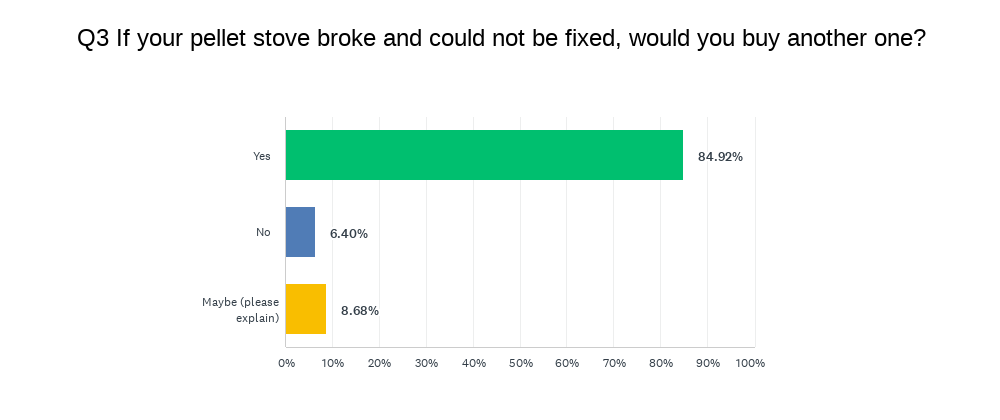
A survey taken by 486 people who use pellet stoves revealed some predictable and some unpredictable results. For instance, an overwhelming majority of pellet stove owners, 85%, said they would buy another pellet stove if theirs broke and 90% say their stove is reliable or very reliable, challenging a perception that pellet stoves are not very dependable. 


Pellet stoves are cleaner and more efficient than wood stoves and make up 25% of the stove market in New England, and 10% nationally, according to the US Energy Information Administration (EIA), Table CE7.1.  Until recently, likely around 5 years ago, American homes still made more renewable energy from wood and pellets than they did from residential solar photovoltaics, which have since surged past wood and pellet heat. 


The survey was undertaken between April and June of 2024 by the Alliance for Green Heat, an independent non-profit. AGH chose the Survey Monkey platform and circulated it through scores of social media pages, newsletters and neighborhood listservs. Thus, the survey is not rigorously scientific and likely over-represents pellet stove enthusiasts. Keeping that in mind, the data offers a glimpse into an important demographic of pellet stove users. By segmenting the data, we were also able to compare the views and values and pellet stove users based on income, region, motivation to buy a pellet stove and other characteristics. 


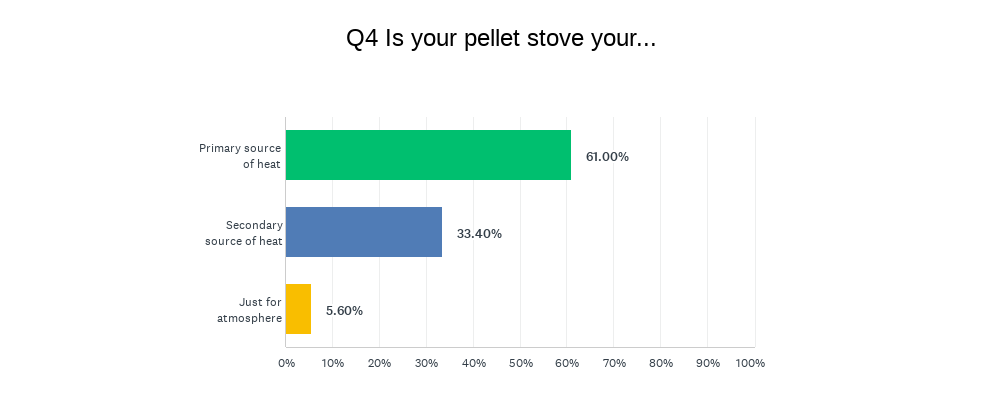
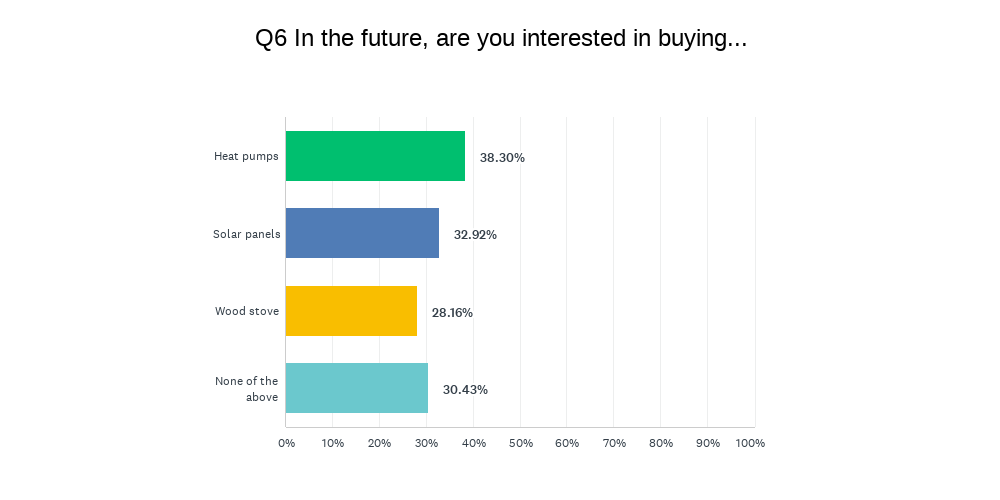
Of this group, 61% of the 486 respondents used their stoves for primary heat and in the future 38% were interested in buying heat pumps and 33% were interested in buying solar panels. Unlike households adopting solar panels, the primary reason homes adopt pellet stoves is for the substantial short term cost saving.  In the survey, all income groups except one listed “saving money” as the most common reason to heat with pellets.


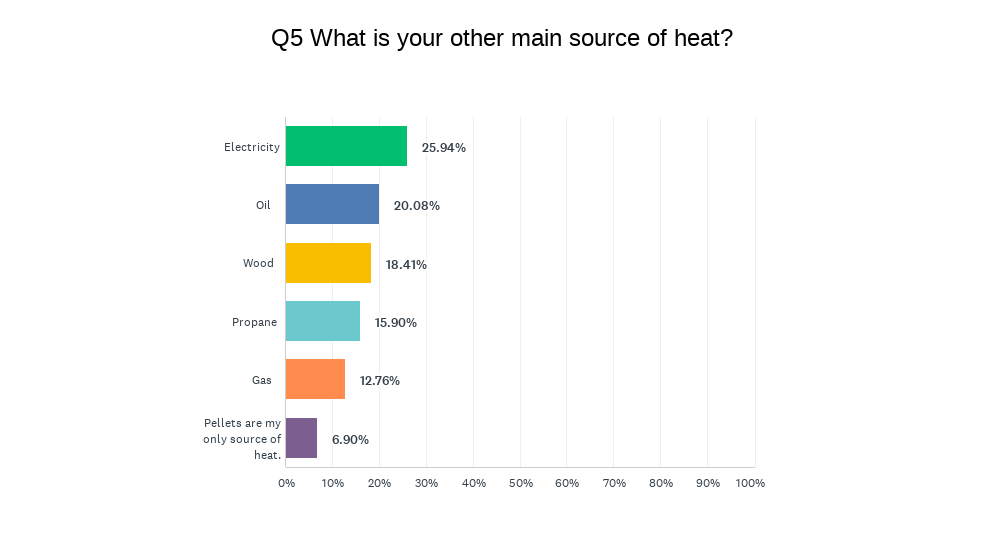
Twenty-six percent of households with pellet stoves displaced electric heat (both resistance and heat pumps) 20% displaced oil, and 18% displaced wood, 16% displaced propane and 13% displaced gas. This along with several other questions showed a high crossover with wood and pellet stoves, as many households that used to heat with wood have moved to pellet heat. In some cases, the reverse also happens with homes moving from pellets to wood fuel. 


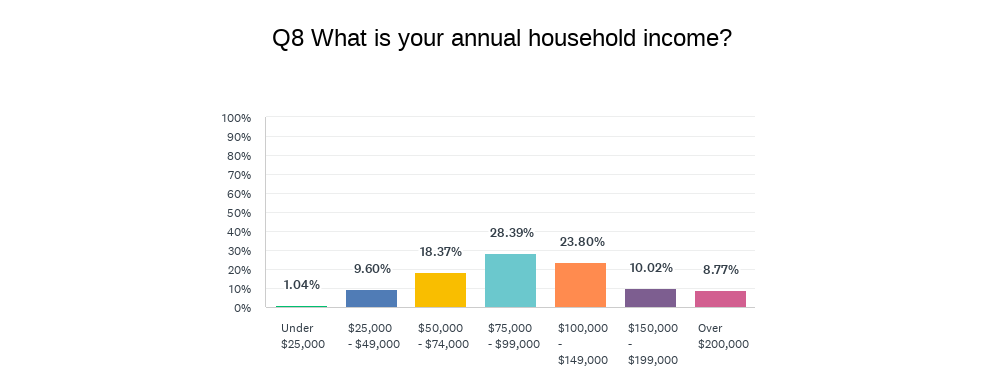
The median annual household income group was $75,000-$99,000, higher than than the national median ($74,580), and significantly lower than the median average income of homes with solar panels ($117,000 in 2022). The number of people per household was close to the national average with an average of 2.58. The national average is 2.51.


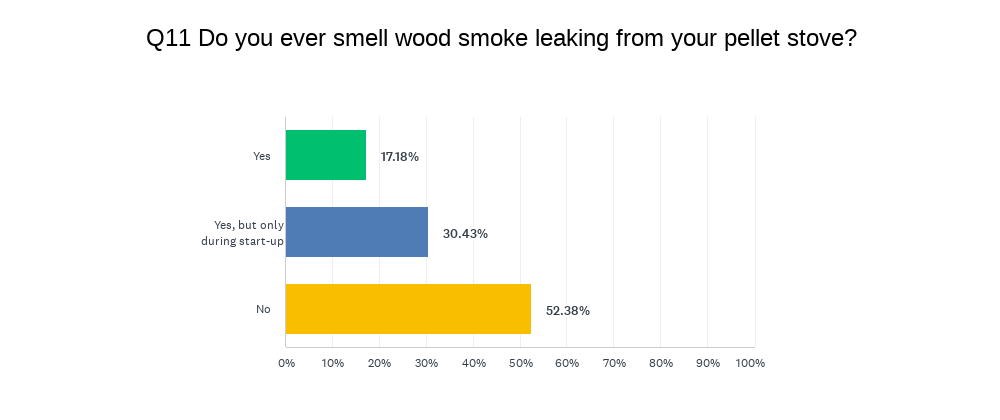
The survey also asked if pellet stove owners smelled smoke from their stoves and 17 % said they did, and 52% said they didn’t. In between those groups, 30% said they only smelled it during start-up which in most homes is no more than once a day. 


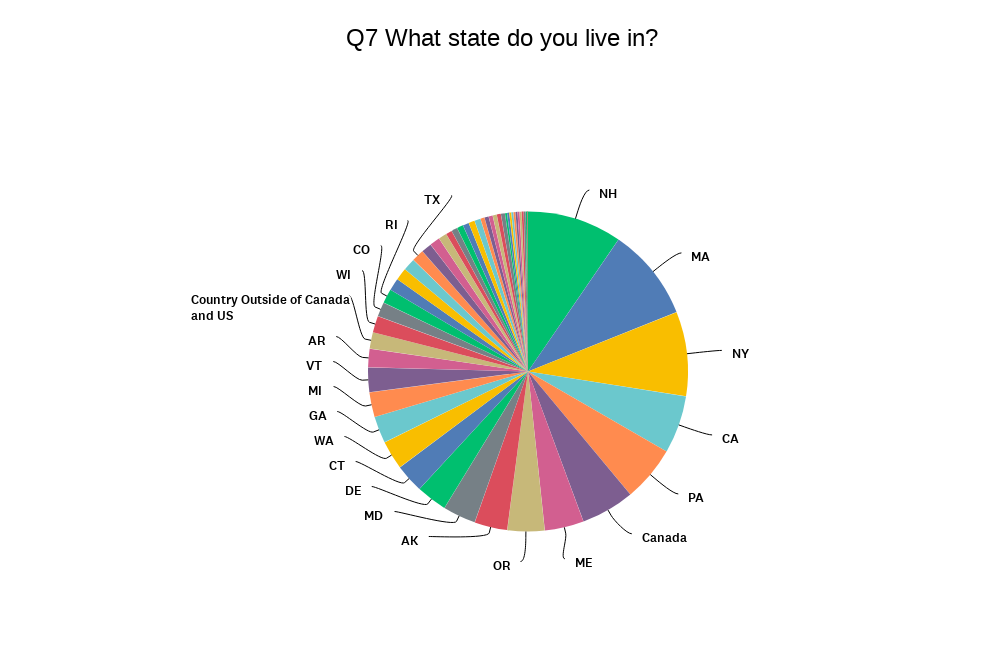
Survey respondents were from across the county, with respondents from every state except five, mostly in the deep south. The top 5 states were New Hampshire (10% of responses), Massachusetts (9%) and New York (9%), California (6%) and Pennsylvania (6%). Canada and countries outside of Canada and the US had 7% of responses. 


Scores of state and national studies show that small scale wood and pellet heat is enormously important to the transition away from fossil fuels both here and throughout Europe, in part because it does not strain the grid in the winter, and complements available renewable electricity.


Pellet heating has grown considerably in America, but public education lags, and there remains a lot of confusion about the export of pellets to make electricity versus the use of pellets for domestic heating.  The US Energy Information Administration publishes vital data about pellet production in America that can help clear up some of this confusion. 


Data from Each Question
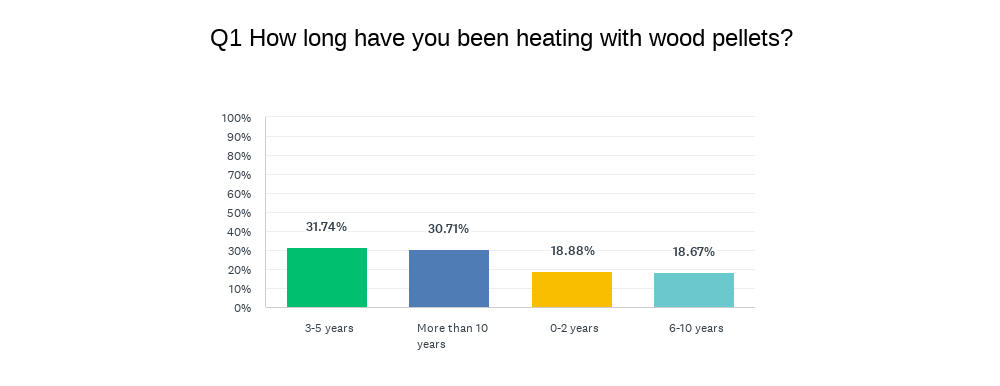
Q1. How long have you been heating with pellets? The responses show a range of households who are just starting to use a wood stove, to those who have used them for a long time. That indicates that there is continued interest by new people in starting to use pellet stoves.

Q2. What is the main reason you heat with pellets? Respondents were only allowed to pick one answer. Predictably, “saving money” was the leading reason, with 43% choosing this as their main motivation. But the surprising aspect is that so many people chose avoidance of fossil fuel as their main motivation (23%). The 18% choosing “as a back-up” could either be a regular or periodica back-up to another heating system or an emergency back-up if their other heating system broke down. Or, it could be people who have battery back-ups or generators so they can use a pellet stove during a power outage.
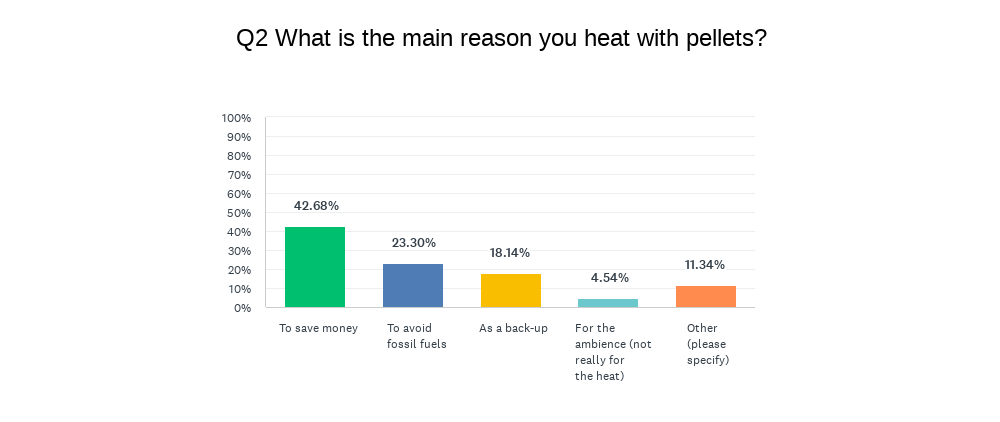
The three most common “Other (please specify)” comments were related to the following categories:

  1. The ease of use and consistency of pellet heat over log wood heat with comments such as, “Switched from firewood. Easier to deal with,” “Wood-fired heat, but more controllable than a wood stove,” and “Too old for firewood.”

  2. It’s popularity in supplementing other heat or areas of home with comments like, “Heat compensation, my furnace doesn’t keep up with a big drafty house,” and “Supplement heat for my basement.”

  3. Those heating with pellets because they are associated with the industry (pellet stove dealers, engineers, etc.)


Q3. Would you buy another? This may be one of the most surprising results: 85% said they would buy another pellet stove if their current one could not be fixed, with another 9% choosing “Maybe.” This indicates a strong loyalty to the appliance. For those who selected “Maybe (please explain),” their answers were concerned with whether the price of pellets remained reasonable and if their health still allowed them to deal with the physicality of pellets. Another popular reason for explaining further was that they were confident they could fix their pellet stove if it ever stopped working: “I’d probably just fix it because they’re easy to repair.” 
Q4. Primary or Secondary Heat? That 61%so many respondents use their pellet stove as a primary heater is somewhat surprising, since nationally, the number of people who use wood or pellet as a secondary heat source is higher than primary heat source. This may be because we tapped into a more enthusiastic demographic, or it may be an indication that pellet stove users use their stove for primary heating more than wood stove users. We also didn’t ask about house size, though we did ask about the number of people in the household, which averaged only 2.58. Thus, it may be that people who completed this survey have smaller homes, possibly close to the national median of 2,299 square feet for a single family home.
Q5. Other Main Source of Heat? Nothing surprising here. Electricity is the highest percentage with 26%, and many of those are likely homes with electric resistance heat or early model heat pumps which are not nearly as efficient as modern ones. It may come as a bit of a surprise to some that 18% of pellet stove users have cord wood as their other main source of heat. Cord wood is the third most common “other main source of heat” after electricity and oil, another indication that we may have reached a more hardcore, dedicated biomass heat demographic.
Q6. Interest in Heat Pumps or Solar Panels. Respondents could choose multiple answers on this one. On average, a respondent chose 1.3 options. We found it somewhat surprising to see such high interest in heat pumps and solar panels.
Q7.State of residence. No surprises here. The fact that we had such a good demographic diversity shows that our data doesn’t just represent one part of the country. 
Q8. Household income. According to the US Census, the median household income was $74,580 and the average was $74,755 in 2022. Both fall right below the median income bracket of the respondents of our survey ($75,000 - $99,000). This shows a lower household income for this group compared to homes that have solar panels, or drive electric cars.

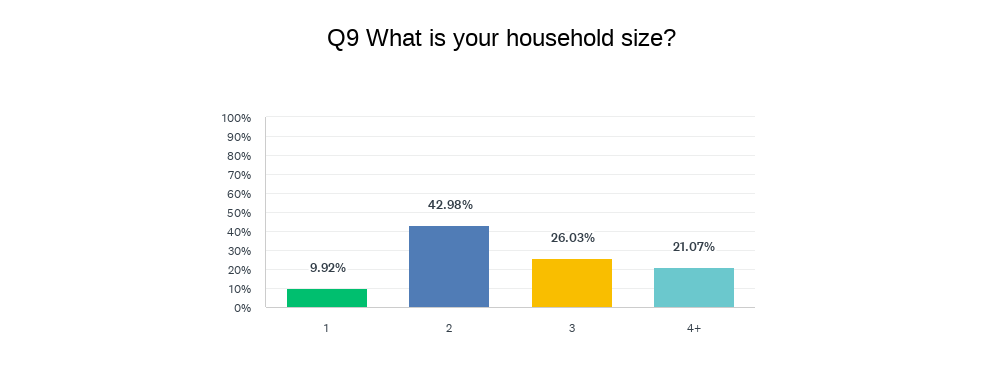
Q9.Household size. The average household size is 2.58, slightly larger than the national average of 2.51.
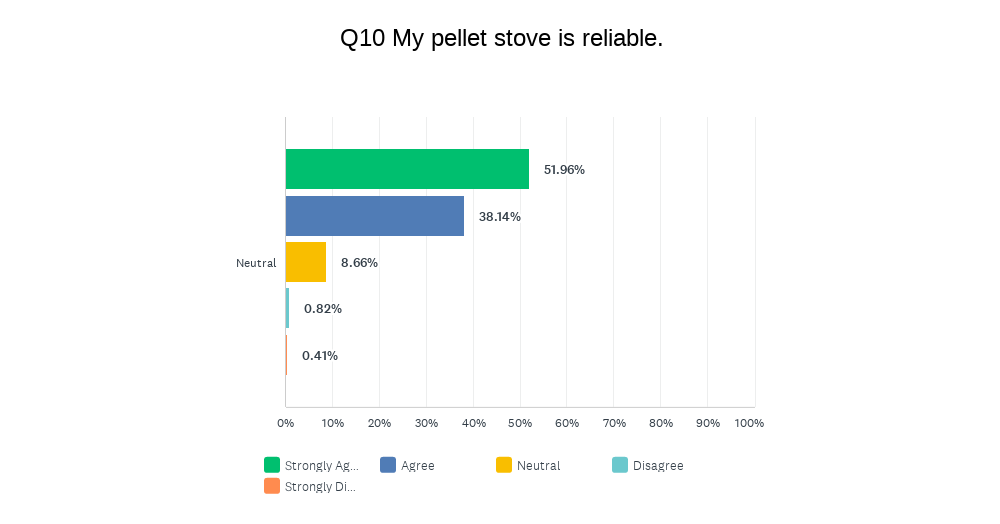
Q10. Is your stove reliable? The number of households who strongly agreed or agreed that their pellet stove is reliable is remarkably high (90.1%). 
Q11. Do you smell wood smoke? While a majority did not smell any smoke in their house, 30% smelled some on start-up. And the fact that 17% of this group say they smell it more regularly is significant enough to warrant further study into this problem. AGH has done some at-home testing and found start-up smoke to produce about the same amount of PM as making breakfasts or dinners that involve frying, using a griddle or making well-done toast. While this was not an in-depth study, AGH believes that the very small amount of smoke during start up could be partially caused by stoves not being sufficiently cleaned, or it may be a design flaw in some stoves that are not completely airtight and can leak.
Q12. Concern about health impacts of wood smoke. This question was not worked as well as it could have been, because it could be interpreted two ways: first, are you concerned about the health effects of wood smoke generally, or are you concerned about the health effect of wood smoke from your own pellet stove. Thus, someone could be extremely concerned about the health implications but answered that they weren’t concerned because they didn’t smell it in their own home. 


All of these tables can also be viewed on the Survey Monkey platform.


Overlaying Responses from Two Different Questions


Survey Monkey allows you to take the individual answers of a question and see how those people answered another question, because all answers are attached to an IP address. Thus, we were able to see how different demographics answered different questions.


Income and main reason to heat with pellets
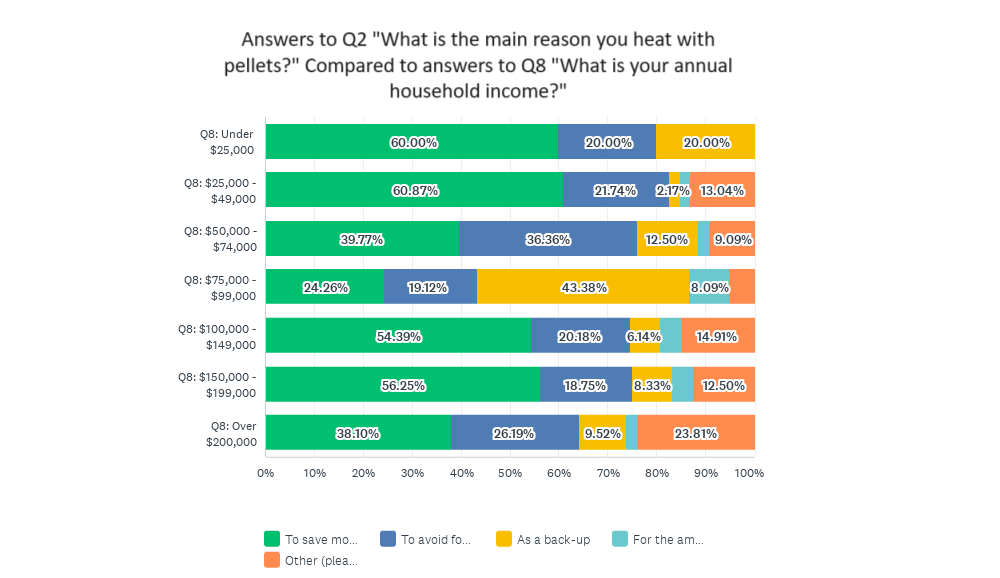

On Q2 overlaid with Q8, reasons for heating with pellets vs. income, saving money was the top rationale for all income categories exempt the middle, median income bracket. Lower income brackets favored saving money to some extent, and no one in the lowest bracket used their stove for ambience. As for being motivated to reduce fossil fuels, there is no clear pattern based on this sample of 486 people. 


Main reason to heat with pellets and interest in buying other appliances
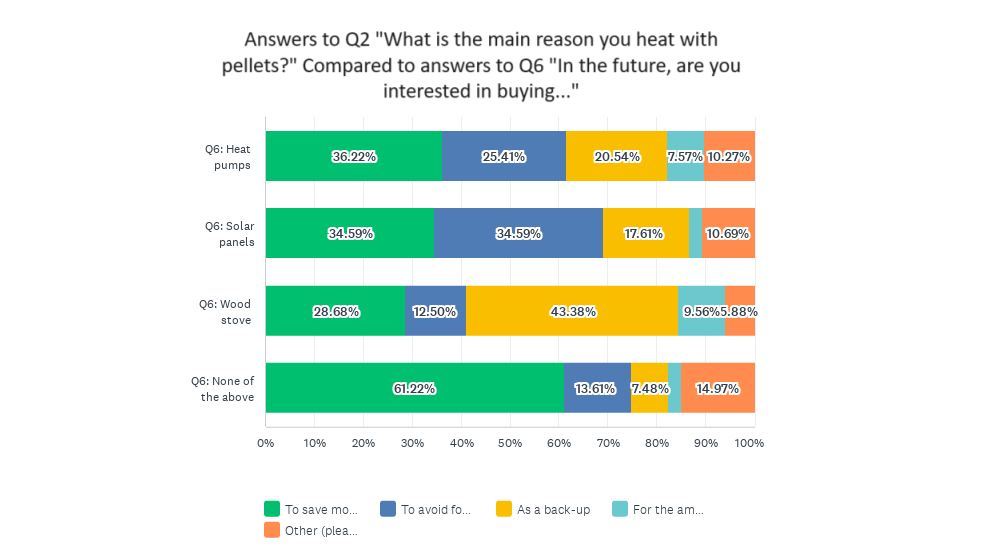


Comparing Q2 and Q6 unsurprisingly shows that people who heat with pellets who are more motivated to reduce fossil are the most likely to be interested in buying solar panels. And people who are more motivated to save money least interested in solar or heat pumps.


Reliability vs. interest in buying another pellet stove 
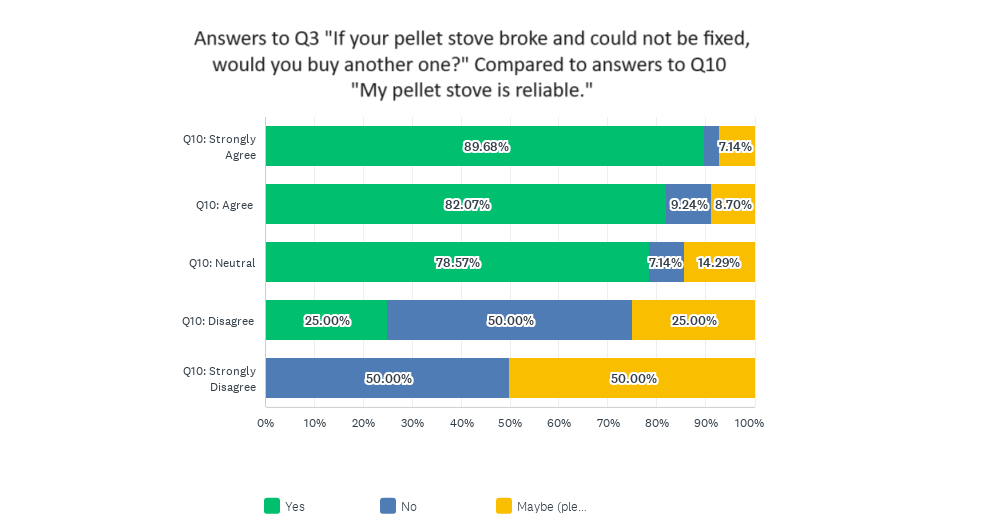


Unsurprisingly, overall those who agreed or strongly agreed that their pellet stove was reliable were most likely to want to buy another one if it broke down. Those who strongly agreed that their pellet stove was reliable were more than twice as likely to want to buy another. 


Reliability and length of ownership
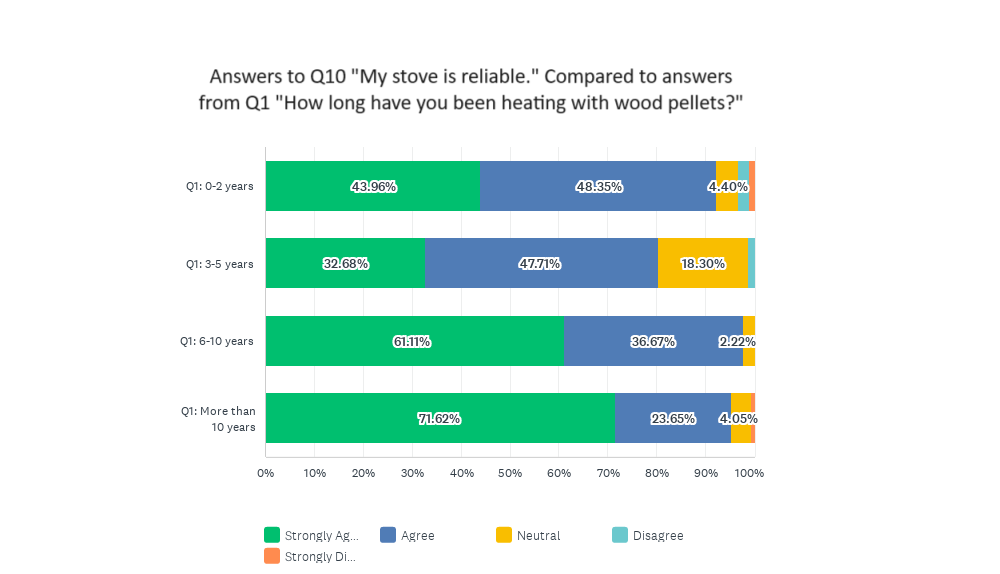

In this comparison, those who had their stove for longer than 10 years reported higher levels of satisfaction with reliability. And it was the group who owned stoves for 3 - 5 years who reported lower levels of satisfaction with reliability, possibly indicating that this is the period that repairs may be the highest.


Smelling smoke and length of ownership
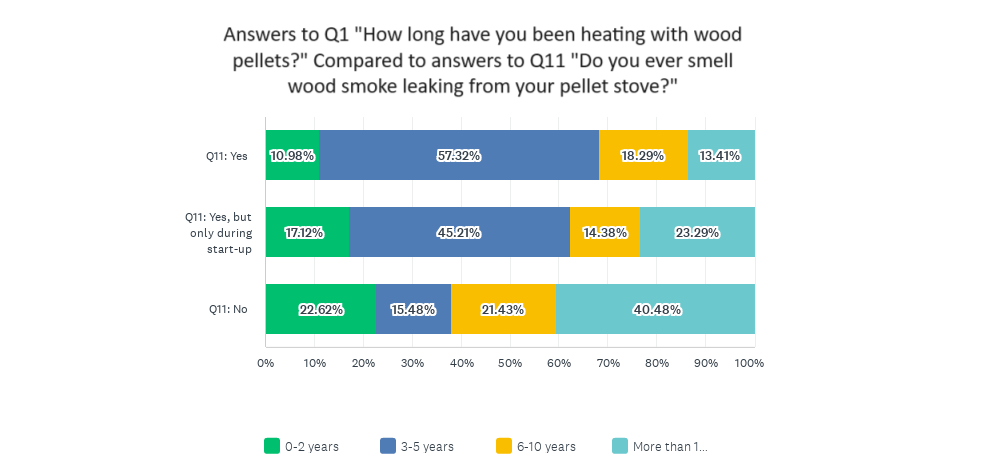

This indicates that the group who smells smoke the most is 3 - 5 year ownership and that the longer you own a stove the less smoke you report smelling. 


Overlap between smelling wood smoke and being concerned about it 
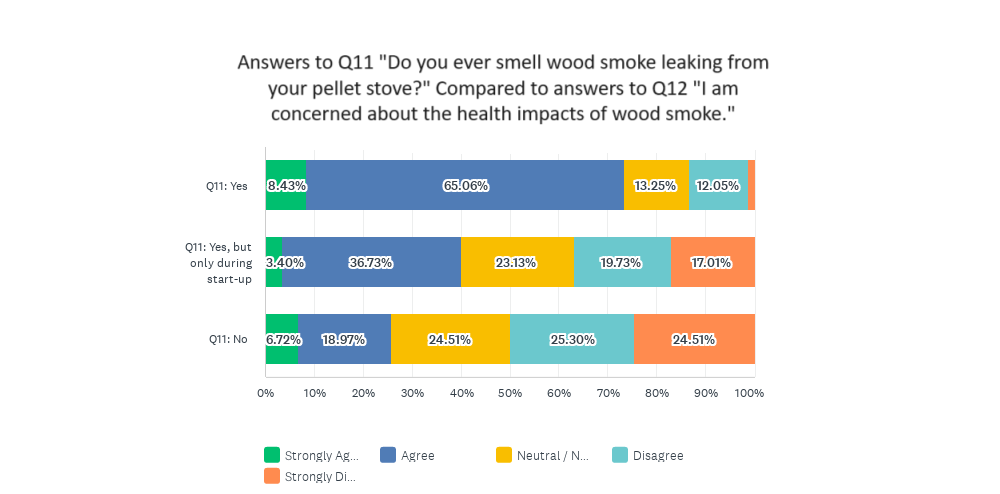

When comparing the answers of concern to those having reported that they were smelling smoke, a majority of those smelling smoke were also concerned about the impacts of wood smoke. Those who did not smell wood smoke from their stove were least likely to consider it a health issue. (Again, the ambiguous wording of Q12 makes this comparison less useful.)


Issues and Limitations of the Survey Data


AGH intentionally created a short and simple survey to increase respondent activity but this also naturally made it more susceptible to bot activity. In addition, we offered two $75 gift cards which likely increased bot activity even more. Survey Monkey also did not have an option to include a CAPTCHA at the end of the survey, which would have been a simple tool that could have stopped some bot activity. 


Where IP addresses were repeated, and where the states also differed, the data was excluded from the analysis. Out of the original 626 responses, 140 of these were excluded on that basis. Bot activity appeared to be especially prevalent from batches of respondents identifying as being from Guam that also consistently submitted the same answer, with only one variation, for each submission. The exclusion of these responses did not significantly alter the results of any of the answers. 


Friday, July 9, 2021

Vermont and Maine retain top rank in residential wood heat, while New Mexico climbs to #3

Wood heat provides resilience, benefits to utilities as climate change quickens

An analysis of U.S. Census data by the Alliance for Green Heat shows that wood heating is expanding in some states and shrinking in others between 2009 and 2019.  Generally, it is expanding in northern New England and shrinking in the Pacific Northwest. In areas that experience frequent weather inversions causing excessive smoke build up, like Oregon and Washington, fewer homes heating with wood is good news for local air quality. In New England states where it is expanding, it's good news for agencies and groups that want to more aggressively reduce fossil fuel heating, and invest heating dollars in the local economy. 

Overall, the number of homes that use wood or pellets as their primary heat source dropped from 2% to 1.6%, with low fossil heating fuel prices likely being the top factor.  From 2000 until about 2012, wood and pellets were the fastest growing heating fuel in the United States. According to the U.S. Energy Information Agency, 8 states experienced more than 100% growth and 7 states experience between 50 and 100% growth from 2005 to 2012.

Vermont and Maine have long been ranked #1 and #2 for per capita primary wood heating with 9% and 13% of homes as of 2019.  New Mexico rose from #6 in 2009 to #3 in 2019, passing Montana, Idaho and Oregon.  It experienced a 14% rise in primary heating during that decade whereas Montana, Idaho and Oregon dropped 14%, 10% and 17% respectively.  Poor economic conditions in Native American Reservations may account for some of New Mexico’s per capita rise.


Wood and pellet heating is widespread and culturally accepted – it is used in about 10 million homes – and consistently offsets a significant amount of fossil heating fuel every year. Now, the electrification movement is leading to more and more homes heating with heat pumps. In the coming decades, until renewable electricity is more available, wood and pellet heat can help utilities by lowering wintertime peak demand.

Census data on the rise or fall of per capita primary wood and pellet heating only tells parts of the story. Stoves are used far more often as secondary heaters and can be a secondary heater one year and a primary one the next, depending on fossil fuel prices or a household’s ability to pay for fossil fuels. It also doesn’t necessarily reflect the sale of stoves, or how many people buy new stoves to replace old ones, buy stoves for secondary homes, or switch from wood to pellet stoves, for example. According to the Energy Information Administration (EIA), about 3 times more homes use wood as a secondary fuel than a primary one.

It is still unclear how climate change and slowly warming winters will impact wood heat. The federal government and states may increase rebates for the cleanest and most efficient units, since wood and pellet stoves are a very cost-effective way to reduce fossil heating fuels. Additionally, stoves that used to be secondary heaters may now become primary heaters as more and more households need to use their furnace or boiler less.  Other factors that are expected to lead to more stove sales include the increasing severity of major storms and blackouts and the widespread switch to electric heat pumps.  Many households with heat pumps want back-up heat, cheaper heat during the coldest months, and a more intensive heat source.

Northern New England states have already started to incentivize more pellet heating to invest in local energy jobs, reduce reliance on carbon-intensive oil and propane heat and help build the infrastructure for modern pellet heating systems. Those states do not have the level of wood smoke problems that some western U.S. areas have.

The list of the per capita top 10 wood heating states has also seen some reshuffling over the past decade. The popularity of wood relative to other home heating fuels increased in some states and declined in others. 


State

2009 Rank

2019 Rank

Change in Percentage of Homes Heating Mainly with Wood 

(2009-2019)

Vermont

1

1

+10%

Maine

2

2

+7%

New Mexico

6

3

+14%

Montana

3

4

-14%

Idaho

4

5

-10% 

New Hampshire

8

6

+18%

Oregon

5

7

-17%

West Virginia

7

8

-10%

Alaska

12

9

+9%

Wyoming

9

10

-23%

Washington

10

11

-24%

Arkansas

11

12

-12%

In the past ten years, New Mexico overtook Montana, Idaho, and Oregon to become the state with the 3rd highest percentage of homes heating with wood. Wood’s popularity has declined in West Virginia, Wyoming, and Washington, while increasing in Alaska, Vermont, New Hampshire and Maine. 


The home heating question has been a Census question since 1996, and the question and definitions have not changed since then. As a result, pellets are not specifically mentioned, though the Census definition says: “This category includes purchased wood, wood cut by household members on their property or elsewhere, driftwood, sawmill or construction scraps, or the like.” Therefore, we assume that people answering this question today will say they use wood if they use pellets.

Regarding older Census data, it is difficult to find historical annual state-level data that are 10 years or older. Data from 1999 is available for download online but in aggregate form with unlabeled questions. The 2020 Census data will be released starting in September, though some of the data will not be released until January of next year. The data used to compare household wood heating 2009 and 2019 is from the American Community Survey (ACS), which the Census Bureau conducts every year. One-year ACS wood heating estimates are less accurate because the respondents are fewer than the official decennial “Census,” which only happens once every 10 years. 


Further reading:


Households heating with wood or pellets declined by nearly 10% between 2011 and 2016

EIA: 2014 Increase in wood heating most notable in the Northeast

2012 Census Shows Wood Heating Continues Growth Streak

2011 Census Shows Wood Heat Continues to Rise in U.S.

2010 Census Shows Wood is Fastest Growing Heating Fuel in US

Coal Heating in the United States (June 2017)


Wednesday, September 25, 2013

2012 Census Shows Wood Heating Continues Growth Streak

Alliance for Green Heat, Sept. 25, 2013 - According to recently released U.S. Census statistics, 63,566 more families used wood or pellets as a primary heating fuel in 2012 compared to 2011, which amounts to an increase of 2.6%, making wood again the fastest growing heating fuel in America.
From 2000 to 2010, wood and pellet home heating grew by 34%, faster than any of the other heating fuels, including solar and natural gas. Oil and propane use declined between 2000 and 2010, and the decline continued in 2012.
Today, 2.1% of Americans use wood or pellets as their primary heating fuel, up from 1.6% in 2000. An additional 7.7 % of U.S. households use wood as a secondary heating fuel, according to the 2009 EIA Renewable Energy Consumption Survey.
Nearly 2.5 million households use wood as a primary heating fuel, making it, by far, the dominant residential source of renewable energy in the United States. In comparison, only about 500,000 of U.S. homes have solar panels and less than 50,000 use solar thermal heating. Solar thermal heating dropped by 2% in 2012 from 2011, according to the new Census numbers.
The states with the biggest growth in wood heat from 2011 - 2012 are Delaware (35.1%), Rhode Island (29.6%), Nebraska (24.6%), New Hampshire (18.5%) and New Jersey (17.7%). However, other states experienced declines. Among the important wood heating states of Washington, Oregon and California, the decline was very small, but there were more significant declines in Illinois (5.2%), Idaho (5%) and Colorado (4.8%). Over a 12-year period, the prevalence of wood heating has increased, often very significantly, in every state except Louisiana, Mississippi, Florida and Hawaii.

Since the U.S. Census Bureau started tracking heating data in 1950, wood heating has had wide swings. Starting at 10% of the population in 1950, it dropped to 1.3% of the population in 1970, an all-time low. By 1990, wood had climbed back to 3.9%, only to drop back to 1.6% in 2000. The biggest growth story in heating fuel is electricity, which went from under 1% in 1950 to 36% today.
The environmental costs of using electricity for heating is high in most states, where the majority of electricity is still made with coal. The environmental cost of drilling and transporting other fossil fuels like oil and gas can also be high. Wood heating has an environmental cost from the particulate matter in the smoke, particularly from older stoves in more densely inhabited areas, and, in some states, from growing numbers of outdoor wood boilers. The EPA has proposed stricter emission standards for wood and pellet stoves and boilers and the Office of Management and Budget is reviewing them now.
Some of the growth in wood heating can be attributed to households that already had stoves, but now use them as primary heaters, instead of a secondary ones. Other households may have bought and installed stoves they found on the second hand market, which is legal in all states except Washington and Oregon.
The trend towards greater use of wood and pellets is mainly due to the lower operating costs compared to oil, propane and electricity. Three states – New Hampshire, Massachusetts and Maine – have provided generous rebates for pellet boilers to help residents replace costly oil heating systems and keep their heating dollars local. Maryland recently established a rebate for the cleanest wood and pellet stoves for rural homes that do not have access to natural gas.

For more info on 2012 U.S. Census data and on trends from 2000 - 2010, and more details about wood heat in the 2000 – 2010 Census.

Friday, August 23, 2013

Reduced buying power may lead to more reliance of wood to heat homes


Median household income has declined 4.4% since the official end of the recession in 2009, and is 6% lower than when we went into the recession in 2007. This enduring reduction in the buying power of the American consumer may lead to a continued increase in the use of wood and pellets, as more Americans seek cheaper alternatives to oil, propane, and electric heating.

Source: The Washington Post. Fletcher, Michael.
"Four years after end of recession, incomes remain depressed
It is likely that the surge in wood heating between 2000 and 2010 was partly due to reduced buying power and job loss. During that time, wood and pellets were the fastest growing heating fuel in America. States where unemployment was the highest typically saw even higher growth in wood heating.

New studies show that lower income families have locked in that reduced buying power since the end of the recession. Income growth in America over the past 10 years has disproportionately gone to the top and very top income groups. Those income groups may be installing high-end outdoor kitchens and fireplaces, but they rarely use wood or pellets as a primary heating source. Rather, the lower income groups are more likely to rely on wood as a primary heating fuel, according to Census Bureau statistics.

The long-term reduced buying power of Americans is also likely contributing to the growth in the sales of less expensive wood stoves such as those sold at big box stores.  Industry experts say sales of wood and pellet stoves at large hardware chains has grown significantly in the last 5 years.  It also may be leading to more sales of very cheap stoves that are exempt from EPA emission standards.  And, it is likely leading to more families continuing to rely on older stoves, instead of upgrading to newer, cleaner and more efficient stoves.

Inflation adjusted median household income is now about $52,000, compared to about $56,000 before the recession. What is notable is that while unemployment continues to drop, from a high of 10% to 7.5%, median income has not risen.  Energy costs take a much bigger bite out of the incomes of families who are below the median income range, leading to energy insecurity and reduced use of HVAC systems.
