Showing posts with label TEG. Show all posts

Monday, June 25, 2018

Meet the teams: Fighting global warming with a gravity fed, thermoelectric pellet stove

This post is the fifth in a series introducing the 12 teams participating in the 2018 Wood Stove Design Challenge in November.

By Ken Adler, and Shoshana Rybeck, Alliance for Green Heat 

Jill Elsner (CEO) and Fred Leavitt (VP) 
using a modified version of their
Greenway Power Stove to power a light bulb.
Fred Leavitt has been working in thermoelectrics since he graduated from college in 1982. He learned the technology from the team that developed the SNAP-27 thermoelectric generator left on the moon by the Apollo missions, as well as the team that developed the thermoelectric generators for the Voyager spacecraft. Now, as Vice President of Hi-Z Technology, he wants to bring that technology to your living room. 

Fred developed a thermoelectric pellet stove twenty years ago, but the thermoelectric modules were too expensive and the market wasn’t ready. With dramatically lower module costs, Fred is looking to do more than just “power lights.” Hi-Z, in collaboration with Northwestern’s Department of Material and Engineering Science, will be adding a custom made thermoelectric generator (TEG) to a WiseWay pellet stove for the 2018 Wood Stove Design Challenge.   

Hi-Z Technology is a powerhouse of thermoelectric expertise. Founded in 1988, it is a California R&D business of engineers and technicians who design, develop and manufacturer bulk thermoelectric modules and generator systems. Hi-Z, along with ASAT, another team in the Wood Stove Design Challenge, also received a $300,000 grant from the EPA to work on thermoelectric cook stoves.

Fred’s goal for the WiseWay is to produce about 100W of power, enough to recharge a home battery, supplement photovoltaics, power lights and small appliances, and provide potable hot water. 
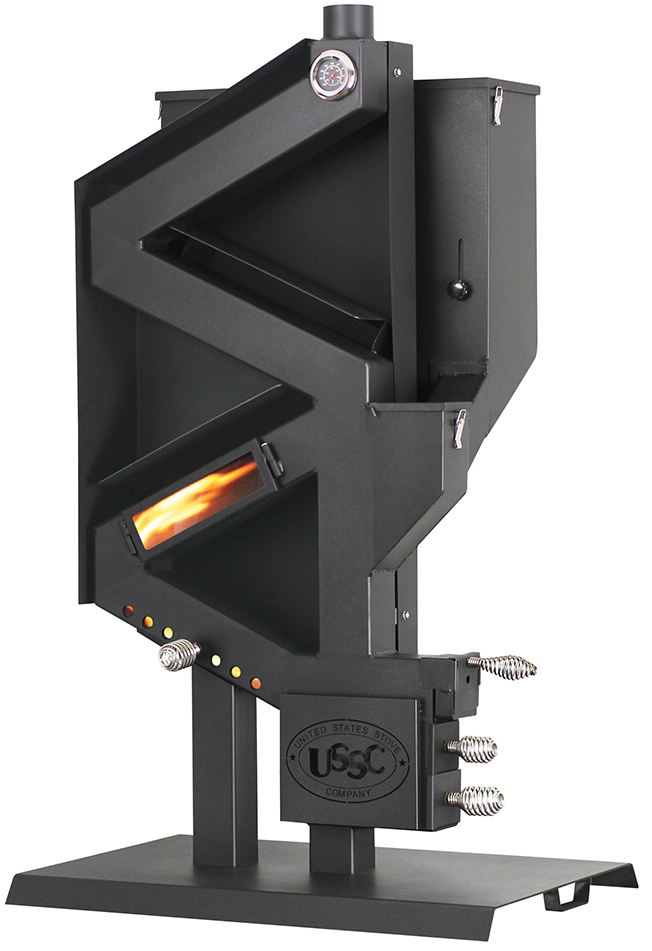
Wiseway stove prior to modification
The WiseWay, invented by Gary Wisener, was certified by the EPA in 2012 and later bought by US Stove. It was the first and remains the only gravity-fed pellet stove on the US market that does not need electricity. The stove is thus an ideal candidate to produce electricity as it's often used off-grid in homes that need more reliable electricity, particularly in the winter. 

Fred is adding a water-cooled TEG near the combustion chamber, technology that Fred says “is simple, but works.” He likes pellet stoves because the combustion chamber has less temperature fluctuations compared to cordwood stoves, which improves TEG power output and longevity. Fred plans to cool the water with a hydronic radiator, which would allow the WiseWay to heat more than one room in a home and provide hot water for cooking and cleaning. 

Come November, Hi-Z plans to bring their new and improved stove complete with a water-cooled electric generator to the challenge. Fred and his team are also working to eliminate the need for manually igniting the stove with a propane torch by adding a battery-powered heating element. They are also exploring the addition of a DC-powered exhaust fan to improve combustion.  
The Hi-Z team recharging a cell phone
from one of their cook stove designs.

The development of the thermoelectric WiseWay has had minimal technical struggles. However, Fred notes that the team has faced considerable challenges making the model “cheap enough to make it a commercially viable product.” The team is determined to showcase a thermoelectric pellet stove that is easier to operate, can reliably produce electricity, heat and hot water, and is affordable.  

Goals for the Team

Fred's career has consisted of many projects that aim to reduce human contributions to climate change and sees the Wood Stove Design Challenge as a major opportunity to help homeowners get off of fossil heating fuel. Bringing this stove to market is likely to spark the interest of homeowners looking to heat with pellets, secure a back-up or secondary electricity source and reduce their overall carbon footprint. That is why Fred and his team “firmly believe in making pellet burning stoves major players in the fight against climate change.”  


Contact the team 

Fred Leavitt

Monday, June 18, 2018

Meet the Teams: An aerospace university department tackles an earthly challenge: electricity from a wood stove


This post is the fourth in a series of blogs introducing the 12 teams participating in the 2018 Wood Stove Design Challenge in November.

By Ken Adler and Shoshana Rybeck, Alliance for Green Heat 

Alexus, Connor, and Jack
with the Englander-30 NC stove. 

With the 2018 Wood Stove Design Challenge taking place on the National Mall this November, it is only natural that one teams is only a couple metro stops away. Students from George Washington University School of Engineering and Applied Science’s Department of Mechanical & Aerospace Engineering (GWU SEAS MAE) have been hard at work  developing a thermoelectric stove. Students from this department are more likely to work on nanotechnology in solar panels or landing spacecraft on Mars, but it turns out, getting a steady flow of reliable electricity from a wood stove is just as challenging.


What started as a class assignment quickly became  an imperative learning experience for team members, Alexus Camero (‘18), Connor Itani (‘18), and Jack Eaton (‘19). As students in the Department of Mechanical & Aerospace Engineering, Alexus and Connor both took a thermo-systems design class taught by Professor Saniya LeBlanc.  With Connor’s interest in green electricity and Alexus’ major relating to heat transfer, the duo took on the task of creating a thermoelectric stove to bring to the competition this November. With the necessary grants in place, and a stove donated by England’s Stove Works the Team began designing their thermoelectric generator (TEG) stove  in the Fall semester of 2017.
Dr. Saniya LeBlanc in her lab 
at George Washington University.


Later, their Team grew a little larger, when Jack Eaton joined Alexus and Conner working in   Professor LeBlanc’s lab. Jack says that he was personally drawn to this project for two reasons, one being that “working in his advisor’s lab gives him a lot of autonomy”, something that is invaluable for an innovative college student, and second that he “spent every winter in middle school and high school in New Hampshire and knows many people that use wood stoves and struggle to pay their heating bill.” Jack, Alexus, and Connor all  have personal, academic, and innovative drives for this challenge, which has kept them determined throughout the development process.


The team has been working with Professor  Saniya LeBlanc to design and create the most efficient thermoelectric stove  possible. As of now, their model is using thermoelectric modules by TEGMART that are designed to produce a maximum of 200 watts of electricity under optimal heating and cooling conditions, which is 86° F (30° C) for the cold side and 572° F (300° C) for the hot side of the module. Achieving these optimal temperatures in real life applications is a major challenge so actual power output is expected to be substantially less than the rated power.  

The Englander 30-NC in the lab.
Launching their model


Not all their challenges are technical. Operating a wood stove in downtown Washington, DC required the  Team to maneuver through a number of school and local government hoops to get approval for testing their stove.  Nevertheless, the team has recently finished this taxing process and is on to the testing phase. But, the testing phase has its own challenges as well. The team  recognizes that their stove’s heating and cooling system will require substantial improvements if it is going to maximize the TEG’s power output. As of now, the TEGs  are located on the steel stove top. Steel is not as good a conductor of heat as aluminum, so the Team will be conducting tests to determine if there is sufficient heat flow through the steel stove top.  The cold side of the TEG is cooled by water that is pumped through a 3 foot long baseboard heater.  However, the team is exploring the option of adding a fan to improve cooling. In a home setting, the water could be pumped through baseboards located in multiple rooms, which would allow for a much greater release of heat to cool the return water.  
View of the Englancer-30 NC
from the top. 
The trio is excited to showcase their model at the challenge to show how they retrofitted the EPA certified Englander 30-NC stove  to make electricity, and “limit the amount of heat that is lost” to improve the overall efficiency of the stove.  However, this competition also has personal messages for them. With an academic focus on heat transfer, one of the team’s recent graduate’s, Alexus, has been especially motivated to learn about how thermoelectric modules can convert heat into electricity.  For Connor, the team’s other recent GW graduate, this project has been all about “taking a concept from the drawing board to reality, from conception to completion, and how to deal with unforeseen challenges along the way”. This summer is expected to be an important time for their final developments. With testing commencing within the next month, Alexus, Connor, and Jack are looking forward to being in the lab this summer, working to get their model ready for competition day.  


Contact the team
Alexus Camero


Connor Itani


Jack Eaton


Wednesday, May 30, 2018

Bill McGrath: A pioneer in making electricity from a pellet boiler


Bill McGrath
In 2007, Bill McGrath built a thermoelectric pellet boiler that heated his home for almost 10 years. The story, however, starts in 1998, when Bill and a group of other students at Vermont Technical College entered the “American Tour de Sol” Solar Challenge, a solar car competition sponsored by DOE, not unlike the Wood Stove Design Challenge. The competition taught him about solid state technologies and the important role DOE competitions can play in promoting innovation. 

Building on his own experience and Shuji Nakamura’s discovery of commercially viable LED lighting, Bill helped start LEDdynamics in 2000, an LED circuit and lighting manufacturer. However, in the back of his mind he was also thinking about how thermoelectric generators (TEGs--pronounced T-E-G, like L-E-D) could solve a major problem with pellet stoves and boilers: when the electricity goes out, unless you have a big battery or generator, the pellet stove stops operating.

Bill and his colleagues made the TEG powered pellet boiler from an old oil boiler, a washing machine and other various knickknacks. McGrath recalls turning the fire chamber of the old oil burner into a pellet stove, using metal cat food dishes from the dollar store as burn pans, and using an old washing machine as the hopper by shaping it into a funnel that connected to a DC auger that fed the pellets into the burn pans. The hot water coming from the boiler heated one side of the thermoelectric modules, while the cool water that circulated through the home’s radiator system cooled the other side of the modules. This temperature differential (known as the Seebeck effect) generated the electricity to power the auger, blowers and water pump for the heating system.  The thermoelectric pellet boiler produced up to 60 watts and kept him and his family warm for over 9 years, even during power outages. One goal of the Design Challenge is to improve on Bill’s TEG boiler so that a thermoelectric wood stove or boiler can produce substantially more electricity to help power lights, recharge batteries and augment solar power.
After 9 years of heating Bill's home and
making its own electricity, the home-
made boiler came out of the basement.

In 2013, Bill and his team created a thermoelectric energy generation division at LEDdynamics called TEGpro to share their expertise with everyone from large multinational corporations to small inventors. Surprisingly, the division has found many opportunities for their thermoelectric technologies’ in the petroleum and gas industry. With miles of piping, this industry has a large demand for TEG powered pressure sensors and wireless devices that measure liquid and gaseous chemicals and fuels as they move through the pipeline.  TEGpro is working with the petroleum and gas industry as an “intermediate step” until they can fund projects that hold larger implications for growth in thermoelectric wood and pellet stoves and boilers. 

TEGpro’s customers are already demonstrating the advantages of thermoelectric technology in residential applications across the world. For example, Bill references many instances of users in Alaska and Canada transferring wood stove heat through their cabins by putting TEGs on their central boiler systems, providing them a critical source of electricity without having to use a generator. 

Bill expects TEGs’ trajectory to be like what he experienced with the rise of LEDs since his start at LEDdynamics. Today’s modern LED light was discovered by Shuji Nakamura in 1994, who received the 2014 Nobel prize in physics for his work. Like the pre-Nakamura LEDs, Bill recognizes that the cost and efficiency of thermoelectric generators remains a challenge, but he believes that thermoelectrics will become as commonplace as LEDs.  With events like the Wood Stove Design Challenge, he is optimistic for the future of TEG power generation. However, commercializing energy alternatives like LED lights and solar power needs support from government agencies like DOE to fund the university research and competitions that can make TEGs as common as LEDs.


Wednesday, August 30, 2017

Lessons in building a 120-Watt thermoelectric wood stove

Guest Blog: We are reposting a 2012 blog from Instructables by Tecwyn Twmffatt at Goat Industries. It describes an early effort to build a thermoelectric wood stove.  This blog is part of a series of blogs providing information for the 2018 Wood Stove Design Challenge.

Introduction: Thermoelectric Power Generation (TEG) 


These videos document my first attempts at generating electricity from a thermoelectric peltier device in 2012. The TEG that I used is a high powered unit able to withstand high temperatures and specially made for electricity generation.

In terms of instructions, I don't think many people would want to build the 10 TEG system as it was ridiculously expensive, so I'm putting in a section for creating the 1 TEG arrangement, which is relatively easy and low cost.

Step 1: Part 2 of 3 


A ten unit Thermoelectric generator system is shown being constructed and then fitted to a wood burner. The theoretical maximum output is 200 watts. The video shows how the generator was put together and how the wood burner was modified to get maximum heat through the TEGs. The TEGs themselves are able to withstand a constant 325 degrees C on the hot side and require plenty of heat to get the 20 watts that each of them are capable of producing.

Step 2: Part 3 of 3 


In part 3 we successfully generate a significant amount of energy from the woodburning stove. In the first session, a circulation pump, a fan and 10 x 10 watt flood lights are powered up. In the second session, we attempt to get a more balanced load wired up to the tegs and measure a noticable increase in power output. The 10 tegs are wired up in 2 parallel strings and, from the manufacturer's specification, the optimum output voltage is 14.4v . The nearest that we manage is 13.8v, at which we generate 120 watts. The specifications suggest that 200 watts is possible when the load is matched.

Step 3: Full Playlist


31 Minutes of Thermoelectric video heaven!

Step 4: Creating the 1 TEG Generator


Here we are going to build the single TEG generator shown in the first video.

Step 5: Tools and Equipment  


Parts: 

Thermoelectric power generator TEG module (GM250 449 )
...... buy direct from China at: www.thermonamic.com/
Aluminium block 102 x 115 x 20 mm
Steel block 102 x 115 x 10 mm
1/4" BSP blanks x 6 of
1/4" BSP male stud push fit pneumatic fittings for 10 mm pipe x 2 of (See photo above)
5 mm Hex bolts x 40 mm x 2 of
25 litre water butt
OD 10 mm ID 8 mm nylon pneumatic pipe
12V water pump
12V LEDs, 1 watt x 20 of

Tools: 

1/4" threading tap
5 mm metric coarse threading tap
Drill 11.5 mm
Drill 5.5 mm
Drill 4.2 mm
Drill press
Torque wrench
MIG welder
Plasma cutter / Grinder with cutting discs
GM250-449-10-12.pdf

Step 6: Drilling and Tapping the Cooling Block


Use the engineering drawing to produce internal coolant passage ways in the aluminum block. I ended up drilling all the way through to the other side and using more of the 1/4" blanks.

Connect the 1/4" pipe fittings to the block and plumb in the pump. Add antifreeze to the water in the water butt if it's likely to get cold at all.

To create a 'sandwich' with the hot block (steel block), the TEG and the cooling block, drill and tap holes in the steel block for the 5mm bolts.

Weld the hot block into the side of the wood burner and recreate the TEG sandwich, tightening the bolts up with a torque wrench (see attached file).

Connect up LEDs on the TEG, turn on the pump, light the wood burner and off you go!
TEGinstallationandspecifications01.pdf

Step 7: 10 TEG Layout


If you really must build the 10 TEG generator, the photo above shows what is involved. I have got CAD drawings, PCB drawings etc. If anybody is interested. Not for the faint hearted!

PCB 03.pcb
PCB 01.zip
CAD files 02.zip

Tuesday, July 11, 2017

Could a Thermoelectric Wood Stove Pay for Itself?

By Ken Adler, AGH Senior Technical Advisor

Payback calculations are common in the residential solar photovoltaic industry where homeowners want to know how long it will take for them to recoup their initial investment. If you purchase panels outright, payback periods depend on a variety of factors including a utility’s price for electricity, tax incentives, and amount of daily sunlight hours. A range of 5 to 8 years is possible however, it can be as wide as 3 to 15 years.[1]

Answering the payback question for thermoelectric wood stoves is one of the objectives for the 2018 Wood Stove Design Challenge. In the meantime, there are several ways to begin answering this question with information already available. It is also useful to look at how use of a thermoelectric wood stove in combination with another energy-saving system, i.e., solar, could prove beneficial to the homeowner and thus both industries as well. For example, in northern states and Canada, a thermoelectric wood stove could reduce the number of residential panels needed and thereby save the homeowner thousands of dollars in panel costs.

Early Thoughts on Payback


The retail price of a thermoelectric module is around $57.50 for a 22-watt module, or $2.61 per watt.[2] One critical point to make here is that the power output of our 22-watt module assumes an optimal hot-side temperature of 300 C (572 F) and cool-side temperature of 30 C (86 F). This ideal temperature differential is very difficult to achieve in real world conditions, so the real-world cost per watt for thermoelectric modules will be higher. However, cost should decrease and efficiency improve with widespread adoption of thermoelectric modules, similar to what happened in the solar industry. For example, DOE estimated that the installed cost of a solar panel declined from $7.06 per watt in 2009 to $2.93 in 2016, a reduction of 60 percent.[3] If we go back to 1977, the cost of a solar panel was $77 per watt. It is not unreasonable to expect a decline for the cost of thermoelectric modules as economies of scale reduce production costs.

Of course, when a thermoelectric module is placed into a wood stove there are other associated costs. The primary cost by far is the heat exchange system. As I’ve discussed in a previous post, to generate at least 100 watts of power, it’s likely that a water-cooled heat exchange will be needed. The current retail price for a 100-watt water cooled thermoelectric generator, which includes eight thermoelectric modules, is $599, or $5.99 per watt. One question the competition will attempt to answer is how much this heat exchange will cost when it is integrated into the design of the wood stove.

Secondary cost considerations include the price of the wood stove, its installation, and fuel costs. The price for a larger size 50,000 BTU wood stove can range from $900 to over $4000, and the average consumer spends about $2,500. Since a thermoelectric wood stove would be providing both heat and electricity, it is difficult to separate out how much of the cost of the stove is for each function. The more crucial point for now is that many larger size stoves, which can generate up to 50,000 BTUs and meet the 2020 EPA NSPS standard, are available for as little as $1,300. While this does not include the cost of installation, it does suggest that the wood stove portion of the costs should not be a major obstacle.

The cost of installing a thermoelectric wood stove into a home should not necessarily be that much greater than the cost of installing a traditional wood stove. One additional cost will be attaching the power outputs from the thermoelectric wood stove to an inverter. However, if we assume that early adopters will already have or are planning to get a solar PV system (more on this below) the cost of the inverter would not be a major obstacle.

Finally, one can assume that the fuel cost for a thermoelectric wood stove is essentially zero because the wood stove is already being used to heat the home. A thermoelectric module will convert only 3 to 6 percent of the heat from a woodstove into electricity, while the remaining 94 to 97 percent passes through the module and is released as heat into the home. In other words, the module is only using a very small percentage of the heat generated by the stove to produce electricity.

Value in Combining Technologies

While more in-depth analysis is needed, it’s possible that a thermoelectric wood stove could help reduce the size and cost of solar PV systems in northern climates that have limited sunlight/solar radiation in winter. For example, a typical 5000 watt solar PV system in Vermont produces 6,280 kWh of electricity per year, while the same system produces 7,913 kWh in Los Angeles.[4] Most of this difference is due to the low winter time output in Vermont between October and February: For example, the Vermont system produces 239 kWh in December, as compared to the Los Angeles system’s 473 kWh. If the Vermont resident wanted to generate the same amount of power as in Los Angeles, they would need to increase the size of their solar PV system from 5000 watts to approximately 6300 watts. At the current cost of approximately $3.36[5] per watt installed for residential solar, this could cost the Vermont resident an additional $4,368 for additional solar panels.

Alternatively, instead of purchasing extra solar panels, the Vermont resident could invest in a thermoelectric wood stove to boost their winter time power output. As we mentioned in our previous blog, a wood stove with a 150 to 200-watt thermoelectric generator operating 16 - 20 hours per day could generate 93 to 124kWh of electricity per month, which would be a good boost to the Vermont output of 239 kWh in December. And, at 0.16 $/kWh for electricity in Vermont, the thermoelectric wood stove could save the homeowner an additional $15 to $20 per month.

While a real payback calculation for a thermoelectric wood stove will need to wait until prototypes go through more testing and we get results from the 2018 Wood Stove Design Challenge, the available information suggests thermoelectric wood stoves could help reduce the cost of residential solar installations, and potentially save homeowners thousands of dollars.


[1] http://solar-power-now.com/the-typical-solar-panel-payback-period/
[2] See our Resources page for a list of thermoelectric retailers.
[3] NREL. U.S. Solar Photovoltaic System Cost Benchmark. September 2016. In 1977, solar panels cost $77 per watt.
[4] NREL PVWatts Calculator
[5] EnergySage. Solar Marketplace Intel Report. April 2017.

Wednesday, June 14, 2017

Thermoelectric Wood Stove, Solar Power, and a Floating Cabin!


Guest blog post, by Margy Lutz

Finally this winter, our thermoelectric wood stove generator is fully operational. Following our test runs, we placed the pump to recycle cold water down in the lake water under the cabin. In winter, it gets about 5 degrees C (41 F). That's plenty cold for a good differential between the 300 degrees C on the hot side.

Most system owners don't live in a float cabin four feet with a constant cold water source under the floor. The typical user has to use a recycled liquid (usually including a water/antifreeze mixture) that runs through a radiator for cooling.

In addition, a charge regulator/controller is used to protect the batteries and prevent overcharging. The model that came with our system has lights to let you know the status of the charging process.

Wayne likes to know more about the charge we are getting. He installed an ammeter and a volt meter. The switch in the middle controls the water pump down below the cabin. To maximize the charge to our cabin battery bank, we've installed a separate solar panel and two six volt batteries wired in a series to run the pump.
Living off the grid has its challenges, but having an alternative power sources has made our winters much brighter (pun intended). Do you generate power? What are some of the solutions that have worked for you? -- Margy

Postscript by Ken Adler, AGH Technical Advisor: 

Congratulations to Wayne and Margy on their thermoelectric wood stove. In a follow-up communication with Wayne, he reported that they are no longer using the system because the thermoelectric modules failed. Wayne doesn’t know why they failed, however, the most common reason for failure is overheating.  The modules can also fail if Bellville washers are not used to allow the module to expand and contract during heating and cooling. Wayne also reports,

Even when I was partially (marginally) operational, I produced less than 2 amps at 12V DC (23 watts) to recharge my cabin battery bank. This would have been enough to put a top-off charge on my cabin batteries (normally recharged via my solar system), particularly valuable in the winter when solar power is minimal and my wood stove is operating nearly 24-7. The primary reason for the low amperage was the need for a 1,8 amp 12V (21.6 watts) water pump to feed the cold side of the modules. In many ways, I reside in the perfect test location for this thermoelectric system, since 

I have a nearly infinite supply of very cold water 4 feet below my wood stove. I live in a floating cabin on Powell Lake BC, and the lake is extremely deep and very cold in all seasons. What an opportunity to serve as a source of cold water through the cooling system! The pump only needed to pump the cold water up 4 feet and then outflow back into the lake. Even with this tremendous advantage, I couldn’t get everything fully operational.

Does this make me a non-believer in thermoelectric from a wood stove? Absolutely not — I still believe this is an important future source of electrical power in my cabin, since even a top-off voltage during the solar-depraved Canadian winter would be worth the price. I’d be one of the first in line if a recreational property thermoelectric system was available, and I’d be quick to try again. Thus, I wish you all of the best with your preparation for the 2018 conference. I’ll be following the results closely.

In an earlier post, Wayne reports that he is using three 25 watt thermoelectric generators for a total rated power of 75 watts of output, however, he’s only getting 23 watts of power for his battery. Part of this is due to his pump, which is drawing almost 22 watts of power. If you are interested in building your own thermoelectric wood stove, there are a few improvements that you may want to consider. First, TEG suppliers (see our resources page) now sell more efficient lower wattage pumps. Second, consider starting with a thermoelectric generator rated for 100 to 200-watts. While this is more expensive, if you go with a smaller system much of your power will be consumed by the pumps and/or fans you need to cool the modules. Third, Bellville washers are critical for allowing the modules to expand and contract.

If you are interested in designing a thermoelectric wood stove for our 2018 Wood Stove Design Challenge, please visit our web site for more information. For more information on Wayne and Margy’s life on a floating cabin, please visit their blog at Powell River Books Blog.


For an overview of the potential of thermoelectric wood stoves, click here.
