Showing posts with label wood stove design challenge. Show all posts

Tuesday, July 7, 2026

The Sensor Surge: Why Equipment Engineers Are Adding Sensors Everywhere — and Why the Wood Stove May be Next


MF Fire is the US industry leader in
integrating sensors into wood stoves
Over the last decade equipment engineers have been rapidly adding sensors to cars, HVAC systems, laundry machines, refrigerators and other household appliances. That trend isn’t just about bells and whistles — it’s driven by lower sensor costs, smarter processing at the edge, connectivity, regulatory and efficiency pressures, and real customer value. Below is a concise look at the benefits, the sensor types being deployed, why prices are falling, where the trend is headed, and how this sensor wave will likely soon be more widespread in something old-school: the wood stove.

Sensors have slowly started to enter the wood stove technology space and are catching on in Europe much faster than North America.  In the US, the Baltimore-based MF Fire made an after-market device with funding from the Department of Energy that represents the most sophisticated use of sensors for wood stoves.  At least one big European stove brand, Jotul, with a major footprint in the U.S. are releasing stoves with automated combustion control only in the European market. 

In 2025, Ecodesign suggested that automated combustion control (ACC) should become mandatory on all new stoves, a suggestion that presumably comes from studying the Blauer Engel (Blauer Engel, 2020) certification. This sent a kind of a shockwave through the stove manufacturing industry, and resulted in industry pushback.  The Nordic Ecolabelling system, representing five countries, is considering requiring ACC in new stoves, or other technology innovation. 

According to a 2025 report from Nordic Energy Research, "In Europe, fully automated stoves have been on the market for some time—for example, RIKA (AU) since 2007 (RIKA Rikatronic, 2025) and HWAM (DK) since 2012 (HWAM, 2025)—and are beginning to gain wider recognition amongst consumers and distributors. The Rikatronic technology (now Rikatronic4 as the latest version) was introduced by RIKA of Austria in 2007; it integrates temperature sensors and electronics to control the air supply and advises when another wood log should be put on the fire through a light visible at the front of the fireplace. This seems to be the most advanced technology for a batch fed or manual wood log burner in terms of automating the reloading and ensuring optimum firebox temperatures for reducing emissions."

There are now more than 10 wood stoves with ACC on the market in Europe, with many in the range of US$2,500 - $4,000.  The best selling automated stove in the world may be the Connect 556 made by Contura a major Swedish stove manufacturer.  Once wood stove certification tests become stricter than they are today in the US and Europe, automation is likely to be the safest way to pass the tests.  Otherwise, the inherent variability in combustion in manually operated stoves will not leave any comfortable margin to passing emission tests.  Currently, stove certification labs on both continents have been able to develop the expertise to pass emission tests without hardly any record of stoves failing the test.

European retailers are also starting to advertise the benefits of automated stoves, socializing the technology benefits to consumers, retailers and the wider community concerned about the health impacts of residential wood smoke. But wood stoves still lag far behind other heating and combustion devices when it comes to embracing the adoption of more and more sensors.

It is important to distinguish full automation in wood stoves from partial automation. Full automation means that the stove has no lever for the operator to adjust air flow, unless the onboard computers can override and optimize the stove for emissions, before responding to the user adjustment for more or less heat. With partial automation, the stove still has a lever or handle to adjust airflow, and the stove has some technology to make minor adjustments in air flow.  The bi-metal coils in Blaze King stoves could be considered partial automation, along with the valves in Pacific Energy Neo stoves. Partial automation, often achieved with the need for electricity, appears to only offer minor benefits compared to fully automated stoves.


Without automation, there is
virtually no way to predict the
performance of a stove 
once it leaves the lab.

Air quality agencies in the U.S. – from the EPA, to NESCAUM to state and local agencies – have been focusing on the shortcomings of the certification process and on designing a better testing protocol.  But US institutions are far behind Europe in studying and promoting automation in stoves.

One of the most obvious benefits of ACC is to prevent overnight smoldering along with speeding up the start-up of the stove. But it may be the safety aspects – producing less creosote and safety sensors that offer peace of mind to homeowners (and insurance companies) that will drive innovation.

From 2013 – 2023, the Alliance for Green Heat ran a series of Design Challenges with the Brookhaven National Lab, and funding from NYSERDA, the Department of Energy and Osprey Foundation that sought to accelerate research and production of automation in wood stoves. Some of the contestants, such as MF Fire, have gone on to get that technology into the marketplace with the Fire MAPS Smart Fire Assistant. 

Why sensors are being added:
  • Improved safety: early detection of hazards (overheat, leaks, CO) reduces fire and poisoning risk.
  • Energy efficiency and emissions: feedback lets systems run only as hard as needed (modulating burners, variable fans).
  • Predictive maintenance: sensors spot component wear and anomalies before failure, lowering downtime and service costs.
  • Better user experience: remote monitoring, diagnostics, adaptive settings, and automated schedules.
  • Regulatory and reporting needs: emissions, indoor-air-quality (IAQ) monitoring, and energy reporting demand measurement.
  • Data-driven product improvement and new services (e.g., subscription performance monitoring).

The use and benefits of sensors are different for each
application based on the risks that application faces.


Common sensor types now used in consumer equipment
  • Temperature sensors (thermistors, RTDs, digital temp ICs) — ubiquitous in HVAC and appliances.
  • Pressure sensors — used for refrigerant systems, combustion chambers, and airflow measurement.
  • Humidity sensors — for IAQ, laundry cycles, and HVAC control.
  • Gas sensors (CO, CO2, O2, NOx) — safety and emissions control in furnaces and cookers.
  • Particulate sensors (optical/laser) — measuring PM2.5/PM10 for IAQ and emission controls.
  • Flow sensors (air and liquid) — ensure correct ventilation, fuel, and coolant flow.
  • Vibration and accelerometers — detect mechanical faults in compressors, pumps, motors.
  • Current and voltage sensors — monitor electrical health and detect stalled motors or short circuits.
  • Optical and camera sensors — visual inspections, flame detection, and product state recognition.
  • Position and angle sensors — actuators, dampers, and valve control.

The steady growth in the use of sensors is driven by
safety, consumer appeal and benefits to manufacturers. 
Why sensor prices are falling
  • MEMS and semiconductor scaling: MEMS fabrication and CMOS integration drive down unit cost and size.
  • High-volume consumer markets: smartphones, wearables, and automotive volumes subsidize production for other markets.
  • Integration: multifunction sensor packages combine temperature, pressure, humidity, and motion on a single die, lowering BOM cost.
  • Standardization and modularity: off-the-shelf sensor modules and cloud-friendly firmware speed integration and reduce engineering cost.
  • Wireless and low-power tech: cheaper connectivity (BLE, LoRaWAN, Thread) reduces installation complexity and cost of retrofits.
Is the trend likely to continue? Yes. Expected drivers:
  • Continued unit-cost declines and richer sensor fusion capabilities.
  • Edge computing and tiny ML: more intelligence on-device reduces data bandwidth and privacy concerns.
  • Stricter efficiency and emissions standards worldwide.
  • Growing consumer demand for smart, connected products and services.
  • OEMs monetizing data and offering remote service/subscription models.
Expect more sensors per device, tighter integration with controls, and better diagnostics.
HVAC sensors are dominated by temperature sensors, which 
in wood stoves are usually Type K thermocouples that 
typically cost a dollar or two.


Is this trend likely to come to wood stoves? Yes — and in multiple practical ways:

The increased use of sensors in stoves is likely for many reasons, not least of which is that they should make it easier to pass new certification tests in the US and Europe. Automation directly address the IDC’s challenge of consistent, repeatable combustion across varied loads and user behavior. That could make automation an attractive technical route to meet performance targets reliably. However, many manufacturer don't have experience with sensors and will likely want to optimize passive design, secondary combustion, or catalytic systems rather than add electronics.

The biggest hurdle in the short term is that government regulators in the US and European countries often do not have the expertise, resources or clout to overcome resistance by industry to changes leading to improved test methods and stricter emission limits. The US currently has an industry friendly, anti-regulatory administration, which could mean individual states get more involved.

Politics aside, the sensor boom is applicable in wood stoves in obvious ways:
  • Combustion efficiency: O2, CO, and temperature sensors can enable feedback-controlled air supplies to keep burn in the optimal stoichiometric window, increasing heat output and reducing fuel use.
  • Emissions reduction: particulate sensors (optical) and CO monitors can detect smoldering or incomplete combustion and trigger corrective measures (adjust draft or alert the user), reducing smoke and creosote formation.
  • Safety: CO sensors and high-temp cutoffs can warn of dangerous conditions or auto-shutdown linked to ventilation failure.
  • Draft and airflow control: pressure or differential-pressure sensors across the stove and flue help manage draft for steadier burns.
  • Predictive maintenance: temperature profiles, and smoke signatures can indicate gasket wear, or creosote build-up.
  • Remote monitoring and automation: smartphone alerts, remote adjustments to air dampers or blower speeds, and usage logging for fuel optimization.

    In the US, the Department of Energy is
    also supporting important automated 
    stove research at Nordica McCarthy's
    lab at Oregon State University

Practical considerations and challenges for wood stoves

Wood stoves present unique challenges because they use a solid fuel with very diverse characters, unlike electricity liquid fuels. In addition:

  • Harsh environment: soot, ash, high temperatures and corrosive gases require rugged sensors and protective housings.
  • Sensor placement: measuring combustion gases accurately often needs sampling ports or heated lines to the sensor; fouling is a risk.
  • Power and connectivity: many stoves are off-grid or in remote cabins; low-power sensors and local edge logic are important. The ability of the stove to work without electricity/sensors is important.
  • Cost vs. value: retrofit kits must be affordable and simple; OEM integration at manufacture yields better reliability.
  • Certification and safety/regulatory acceptance: devices that influence combustion or safety need testing and standards compliance.
  • User behavior: alerts are useful only if users understand and act on them; automation helps and users are learning from all the other sensor interactions in their daily lives.
Jotul says this stove "continually
monitors  temperature  and
automatically  adjusts  air supply  to
optimize combustion — giving cleaner,  more
efficient burning  and reduced emissions."
How this could be deployed
  • OEM integration: manufacturers build sensors and control loops into new stoves (best performance and reliability).
  • Retrofit modules: compact sensor packs (temp, CO, O2, particulate) with a local controller and optional wireless gateway for older stoves.
  • Service-focused models: subscription diagnostics for stoves used in rentals, remote cabins, or commercial premises – or in any stove where the user wants greater peace of mind.
  • Simple consumer features: auto-damper control, burn-stage alerts, and CO alarms tied to phone notifications.
Bottom line: Falling sensor costs, smarter edge processing and connectivity are driving a widespread sensor adoption in vehicles and home equipment — and that momentum should continue. Wood stoves are a natural candidate for the next wave of sensor-driven improvements: safer, cleaner, and more efficient burning is technically feasible today, but practical rollout requires rugged sensors, thoughtful placement, simple user interfaces, and standards-compliant designs.

Innovation in stove technology will also be driven by public health concerns. If wood stoves continue to be popular or become more so due to rising heating fuels - electricity, gas and oil - there will likely be more pressure on governments to do a better job at certifying new stoves. However, global warming is making winters warmer, reducing heating bills, which typically reduces the use of wood stoves, which in turn may ease pressure on air regulators.

Monday, September 20, 2021

A DOE program that invests in next generation wood stoves


Prof. Nordica MacCarty, right, from 
Oregon State University, just won
a third round DOE grant.

The DOE just completed its third round of funding for novel and innovative wood heater designs, selecting teams from Oregon State University and the University of Alabama.  To date, the program has now invested about $11 million in the wood and pellet heating sector.  The program seeks to modernize the most common renewable energy technology in American homes – the traditional wood stove – which is in 10% of all households.

Wood stoves are often not included in the vision for clean renewable energy but they have done more than any other technology to reduce fossil fuel use in American homes in recent decades thus far.  The far more modern cousin of the wood stove, the pellet stove, is already automated in many ways and consistently cleaner and more efficient than the wood stove.  The DOE program is investing in novel wood stove technologies to address excessive wood smoke in many communities, particularly in western states where stoves are popular and weather inversions trap smoke near the ground.

Professor Nordica MacCarty, who just won a $2.5 million grant, says her team will make stove “prototypes operationalized with closed-loop sensors and control algorithms. Plans are in place for market transformation with regulatory oversight and open-source knowledge sharing among partner manufacturers and the industry at large.”  The DOE requires that teams work with existing stove manufacturers or develop other plans to get their inventions on the market. 

Taylor Myers, Chief Technical Officer
at MF Fire, doing very early testing on
movement characteristics of fire.


A review of the seven projects funded so far show that the DOE is focusing on automated controls and sensing technologies that mimic the controls in other combustion technologies, from the automobile to power plants. There is little published data to date about the results of the DOE investment and stoves supported by the DOE are just getting to the market.

MF Fire, a Baltimore based start-up company, got 2 awards the first year.  One is a “smart monitoring and real-time guidance” device that can be added to any stove.  The other is a stove with “swirling combustion technology” designed to reduce PM and be a novel, visual focal point in the room, according to Ryan Fisher, the company’s COO.


SBI’s grant from DOE is being used to build an automated stove which has been delayed due to Covid. Louis-Pierre Côté, SBI’s Director of Product Development, told AGH that the stove is designed to “burn efficiently even though the user makes operating mistakes, and it should be easier to light the stove and should then reduce the number of misfires.”

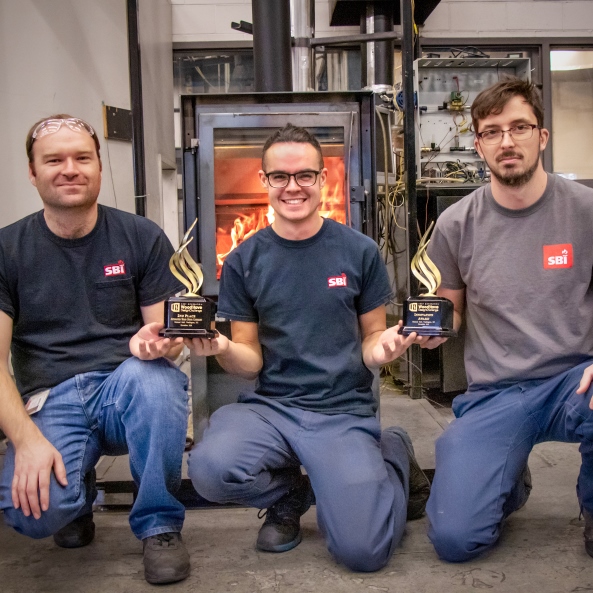
The SBI team that designed an early 
prototype of an automated stove that
won awards at the 4th Wood Stove 
Design Challenge in 2018.

The DOE program, part of larger grant cycle run by the Bioenergy Technology Office within the Office of Energy Efficiency and Renewable Energy (EERE) complements the efforts of the EPA to regulate the emissions of residential wood stoves.  The EPA has never invested in the R&D of cleaner stoves but its first set of regulations in 1988 resulted in a rapid and universal technology upgrade for all stoves.  Since then, many experts say technology has stalled. While stoves can perform well in the lab, they are all still manually operated so that in the hands of consumers, they can still perform poorly.


“There is a mismatch between the EPA’s regulations and the DOE programs because the EPA is still embroiled in the ongoing clash between industry and air quality agencies over how to test manually operated stoves,” said John Ackerly, President of the Alliance for Green Heat. The DOE is investing in the future - stoves with automated controls - but these stoves may be at a disadvantage using the EPA’s test protocols designed for manually controlled stoves.  Manufacturers have had little incentive to build automated stoves and must design their own alternative test protocols which need to be approved by the EPA.  


Each of the six projects are ambitious and highly innovative and they should start to hit the market in the next few years.  Until they pass EPA certification and are in the marketplace, its hard to prove that they are able to match their vision with a clean stove that consumers will want to buy.  Assuming the DOE maintains the program, over time it is likely to have a major impact on a technology sector that is not known for high-tech innovation.


MF Fire, Swirl Stove

SBI/ISB, Automated stove

Ohio State, Simulation drive automated stove

NTRE Tech, Fluid bed combuster

Oregon State, Forced air and automated controls

University of Alabama, Autonomous Stove 


The DOE is expected to announce its next round of wood heater grants early next year.

Wednesday, June 30, 2021

Myren Consulting and AGH apply for Department of Energy R&D Grant

Down drafting stove would be open-source

Myren Consulting and the Alliance for Great Heat, along with Stonybrook University and German experts from DBFZ (Deutsches Biomasseforschungszentrum) are seeking to build an open-source wood stove that can help any manufacturer adopt the innovative approaches used by this stove. The goal is to make an ultra-clean wood stove that will consistently burn around 1 gram an hour without a catalyst and 0.5 grams with a catalyst, regardless of who loads and starts the stove.


The stove will use a downdraft airflow that brings the flames through the coal bed, and it will have a fan that induces the draft until the flue gases are hot enough to shut it off. The team will employ Computational Fluid Dynamics (CFD) to optimize the design and the air flow. The stove will also have a robust, multi-purpose data logger that can engage the operator via lights on the stove or through a sophisticated smart phone app. The app will feature content from our partner groups and walk consumers through all stages of the purchase, installation, operation, troubleshooting and maintenance. The consumer can choose if they will be the only one with access to the data, or whether they are willing to share it with the manufacturer, the retailer and/or a chimney sweep, for example.

Throughout the entire project, if funded, the team will share R&D decisions, designs, and data with the stove industry, regulators, and the public. The team will also seek to “crowd-source” solutions to problems and issues that may emerge by regularly seeking input from a range of stakeholders, from industry players to public health and low-income advocates. The stove will undergo a series of rigorous tests in Ben Myren’s lab over a 3-year period because a novel, top-notch stove needs that amount of time to get the design, airflow and other features just right. The stove will be tested to the traditional EPA reference Method 28, and the more recently approved ASTM 303-5 and IDC protocols. The stove will also undergo in situ real world testing, round-robin lab testing and be tested to the rigorous Blue Angel standard in Germany (not with DOE funds) to understand how it can handle a variety of loading and testing methods. 


Current certified stove design configurations have been developed since the mid 1980’s and are all based upon the draft generated by an EPA freely communicated lab chimney that is 15 ±1 ft. These designs have been developed somewhat over the years using a vast number of prototypes that have had many design changes made to them during this multi-year, multi-prototype R&D process. However, R&D in the stove community has not been robust and most manufacturers simply follow a well-known design pattern that has proved to be successful enough. We are attempting to disrupt that design pattern by maximizing secondary combustion in the upper part of the firebox but then drawing the gases down through the coal bed for an even more efficient secondary (or tertiary) emission reduction process.


With the change in draft proposed in this proposal, that entire body of knowledge becomes questionable.  And the project’s timeframe doesn’t provide for the typical long, slow development of a stove that will meet the current emissions standards. Thus, we propose to build upon a technique that we have been successfully using where some stove components are bolted together, rather than being welded together. This technique will allow us to rapidly make design changes which will hasten the entire R&D process. It will also enable us to fine-tune the combustion system in the stove by changing known critical components, e.g., the internal cross-sectional area of secondary air side manifolds, to facilitate the reduction of particulate matter (PM) emissions. The following table contains a (partial) list of critical components known to affect emissions.  Almost all of these features will still be relevant for a downdraft stove, but their size, shape and placement may change based on the downdraft design and the results of computational fluid dynamics (CFD) analysis.


  • LPAO: Lower primary air orifice
  • Horizontal throat gap: shortest distance between the front edge of the baffle and the backside of the air wash
  • Vertical throat gap: shortest distance between the top of the baffle and the bottom of the top


All equipment used in the revised dilution tunnel system will be maintained and calibrated using current EPA criteria. Our stove will first assess how consistently we can operate under 1 gram an hour without a catalyst, but we plan on designing a model with a catalyst as well. Wood stoves are often not sufficiently optimized in terms of low-emission combustion, so that the catalyst is subjected to excessive overloading.


The initial group of expert advisors who wrote letters of commitment include the Tribal Healthy Home Network, the German Biomass Research Centre, the Danish Technological Institute, the Hearth, Patio & Barbecue Association (HPBA), the National Fireplace Institute, Industrial Chimney Company-Renewable Solid Fuel (ICC-RSF), Masonry Heater Association, Sunstein Intellectual Property Law Firm, and 509 Fabrications.


The $2 million price tag would include $1.3 million expenses at Myren lab, $300,000 at AGH, $215,00 at Stony Brook University, $125,000 by the German team working at Myren labs (no DOE funds will be spent abroad) and about $70,000 for other vendors and subcontractors.  We are requesting $1.6 from the DOE’s Bioenergy Technology Office.


In the spirit of this open source project and collaboration with other teams, the following materials can be downloaded:


The full technical volume 

Letters of commitment

Summary slide

Resumes

Diversity, Equity and Inclusion Plan

Saturday, December 1, 2018

A Test Protocol for Automated Wood Stoves

Tom Butcher of Brookhaven Lab using
the protocol on the Wittus stove.
Photo: Kittner for Brookhaven Lab.

The fueling protocol used at the Wood Stove Design challenge is like no other.  Instead of filling a pre-heated firebox with a consistent amount of wood, setting it on a single air setting and letting it burn until the fuel is gone, as the EPA does for certification tests, we took a radically different approach.  

We wanted a fueling protocol that included features of how stove operators likely use their stoves, which includes starting from a cold start and reloading several times. But we went beyond that to mimic extreme operator behavior, by loading the stove full of wood and then turning the heat/air setting all the way down, which can put a stove into a temporary or long term dirty, smolder mode.  Our goal was to evaluate whether an automated stove could outsmart its operator - or the lab technicians running the protocol and run cleanly.  

Getting an overnight burn at a low air setting without putting the stove into a short or long smolder mode is something that many good stove operators can do, and good stove design helps them.  Our protocol sought to mimic some extreme modes operators may encounter with their stoves to see how automation can mitigate negative consequences of those extremes . 

The protocol was provided to the teams two months in advance, enough time to make sure that the
Lisa Rector, demonstrating the full
IDC protocol at the Wood Stove
Design Challenge for EPA staff.
Photo, Kittner for Brookhaven National Lab
protocol worked and competitors could request modification but not so much time that it would allow competitors to design directly to the protocol. 
The goal was  “creating a single test run that incorporates typical use scenarios and incorporates variability both in the operational modes and the fuel use patterns.”  The protocol was not intended to be a predictor of actual overall field performance (as other test method attempt to do), mainly because of the abbreviated nature of the protocol.  Rather, key operational factors were included to evaluate the automated response of a particular stove.

The outlines and purpose of the protocol was discussed by the Organizing Committee of the Challenge and the intensive process of writing it and testing it a lab was done by NESCAUM and Hearthlab Solutions, with assistance from Brookhaven National Lab and funding and support from NYSERDA.  

The protocol was a short, three-hour protocol that includes several reloads, as operators normally reload their stoves during the first three hours.  We are not aware of any other protocol that includes reloads.  We chose three hours because we had numerous stoves that had to be tested multiple times during a five-day period.  If testing crews could complete three tests of each stove, it would enable us to analyze the reproducibility and repeatability of our test results.  

AGH prepared the fuel loads for each
stove the week before the event.
Photo: AGH
Our working proposition was that stoves engineered with automated controls and appropriate and robust response techniques produce more repeatable results than manually operated stoves.  It is still too soon to tell whether these stoves had better repeatability than manually operated stoves.  Data will become available in early 2019 to help us answer these questions.  For background on the testing protocols used at the Wood Stove Design Challenge, click here. For initial results of the Challenge, click here.

We hope that elements of this protocol help EPA, other agencies and industry think through the process of what test methods should try to achieve and how.


Wood Stove Design Challenge – Automated Stove Competition – Stove X

Stove:                          Stove X
Dimensions:                XL x XH x XW
Volume:                       Xft3
Fuel species – beech and/or maple 
Fuel length: X

Start-up 
Fuel load density 4 lb/ft3
Amount of kindling: total amount determined by fuel load calculator  (kindling = 8-10 pieces of kindling weighs 1 lb., length must be at least 50% of test fuel length).
Amount of starter fuel: X lbs. +/- 5% - weight of each piece scaled to stove by fuel load calculator
1.    Stove is empty – no ashes
2.    Amount of paper for starter – 6 full sheets
3.    Amount of kindling is x lbs.
4.    Amount of starter fuel is x lbs.
5.    Fuel loading pattern is defined by the manufacturer’s instructions.  If no instructions are provided, a top-down burn protocol will be used.  For the competition, the manufacturer can build the fuel charge in the stove but cannot light off and will be hands off during the stove testing.  For startup phase – fuel can be loaded in multiple batches, but all fuel must be loaded within the first ten minutes of the phase.
6.    Air settings will be determined by the manufacturer. Up to 2 changes in air settings can be used during the start-up phase. 
7.    Fire will be started with a torch.  Torch can be used for up to 30 seconds
8.    Door can remain open for up to 5 minutes.  Manufacturer will set time and door position prior to competition.
9.    For the first 15 minutes (time starts at light-off), the door can be opened, and fuel adjustments made. A maximum of four fuel adjustments can be made. Door can remain open for no more than 30 seconds per fuel adjustment.  Door must be closed as soon as fuel adjustment is complete. 
10. Phase ends 30 minutes from light off or when there is loss of yellow flame, whichever comes first.  If start-up ends before 30 minutes, it should be noted in the testing comments, but no loss of points will occur.

1stReload
Fuel load density 5 lb/ft3
The SBI managed to handle
the protocol quite well.
Photo: "Kittner for BNL"
Allowable Fuel piece weight: determined by fueling calculator
Target pieces for load: 4
Fuel load weight: determined by fueling calculator +/- 5% 
1.    Immediately after the end of start-up Phase, open stove door. 
2.    Chop existing wood with a fuel piece and to the extent possible smooth coalbed.
3.    Load 1stReload charge following the specifications for this phase provided above. 
4.    Fuel loading pattern defined by the manufacturer’s instructions. Options are:
a.    East/west
b.    North/south
c.    Criss-cross
5.    Close door immediately after loading fuel. Maximum time to reload 60 seconds.
6.    Air settings/thermostat immediately turned to low demand
7.    During 1streload phase one (1) fuel adjustment is allowed.  Additional fuel adjustments can be requested but the total score deduct 2 points for each additional fuel adjustment. Door can remain open for no more than 30 seconds for a fuel adjustment.  Door must be closed as soon as fuel adjustment complete.  
a.    Teams can make recommendations about when and how to make fuel adjustments.  
b.    Additional fuel adjustments interventions can be made at the request of the stove team.  Each additional fuel adjustment results in a loss of 1 points from scoring. 
8.    Air Adjustments - During the 1stReload phase no air adjustments can be made unless judge(s) determine an intervention is required. Each intervention results in a loss of 2 points from scoring for every x minutes the air settings differ from the protocol. Interventions that result in point loss, will be completed upon request by the stove team.
9.    1stReload Phase ends after 45 minutes (75 minutes from light-off).

2ndReload
Fuel load – 2 pieces
Allowable fuel piece weight: determined by fuel calculator
1.    Immediately after the end of 1stReload Phase, open stove door.
2.    Break up/chop/reposition remaining fuel to the extent possible.
3.    Load 2ndReload charge following the specifications for this phase provided above. 
4.    Fuel loading pattern defined by the manufacturer’s instructions. Options are:
a.    East/west
b.    North/south
c.    Criss cross
5.    Close door immediately after loading fuel.  Maximum time to reload 60 seconds.
6.    Air settings/thermostat immediately turned to high demand
7.    During 2ndReload phase no fuel adjustments are allowed. 
a.    Fuel adjustments can be requested but the total score deduct 1 point for each additional fuel adjustment. Door can remain open for no more than 30 seconds for a fuel adjustment.  Door must be closed as soon as fuel adjustment complete.
8.    Air Adjustments - During the 2ndReload phase no air adjustments can be made unless judges determine an intervention is required. Each intervention results in a loss of 2 points from scoring for every x minutes the air settings differ from the protocol.
9.    2ndReload Phase ends after 30 minutes (105 minutes from light-off).

3rdReload
Allowable Fuel piece weight: determined by fuel load calculator
The testing crew for the automated test
protocol.
Photo Sam Kittner for Brookhaven National Lab.
Target pieces for load: 4
Fuel load weight: determined by fuel load calculator
1.    Immediately after the end of 2ndReload Phase, open stove door.
2.    Break up/chop/reposition remaining fuel to the extent possible.
3.    Load 3rdReload charge following the specifications for this phase provided above. 
a.    Load large piece first, then small piece, large piece, small piece, etc until no more wood fits in the stove.
4.    Fuel loading pattern defined by the manufacturer’s instructions. Options are:
a.    East/west
b.    North/south
5.    Close door immediately after loading fuel. Maximum time to reload 90 seconds.
6.    Air settings/thermostat immediately turned to low demand
7.    During 3rdReload phase one (1) fuel adjustment is allowed within the first 10 minutes of the phase.  
a.    Additional fuel adjustments interventions can be made at the request of the stove team.  Each additional fuel adjustment results in a loss of 1 points from scoring. Door can remain open for no more than 30 seconds for a fuel adjustment.  Door must be closed as soon as fuel adjustment complete.
8.    Air Adjustments - During the 2ndReload phase no air adjustments can be made unless judges determine an intervention is required. Each intervention results in a loss of 2 points from scoring for every x minutes the air settings differ from the protocol.
9.    3rdReload Phase ends after 75 minutes (180 minutes from light-off).

Disruption Phase:
Optional Phase TBD by organizing committee
1.    No wood is loaded.
2.    Unit is placed in disruption mode, this could be: eliminating power, disengaging catalyst, etc.
3.    Disruption phase lasts 15 minutes.  
4.    Visible emissions may be the only measurement.
-->