|
| Jonathan Male, director of the DOE's Bioenergy Technology Office, announces the winners. Photo: Sam Kittner for Brookhaven National Lab. |
(Washington, D.C.) – Two companies with years of experience in electronics and stove design won coveted first and second prizes in the 2018 Wood Stove Design Challenge, held in Washington DC from November 9 – 13.
Manually operated wood stoves are extremely common throughout the northern US, Canada and Europe but no one has yet popularized a solution to prevent them from emitting excessive smoke in the hands of operators.
Wittus, a company based in Pound Ridge New York, teamed up with German engineers and won first prize for both the automated and thermoelectric categories with a living room unit that also heated water for space heating
and generated an average of 161 watts and a maximum of 268 watts over the 2.5-hour test period. Total power output over the test period, net of parasitic losses, e.g., pumps and fans, was 276 watt-hours of electricity. The use of thermocouple sensors and fans facilitated clean and efficient combustion.
 |
| The Wittus team who won first place in both the automated and thermoelectric categories. Photo: Kittner for BNL. |
 |
| Stove testers from Brookhaven National Lab and New York Department of Health. Photo: Kittner for BNL. |
Second prize went to Stove Builders International (SBI) a Quebec based company that designed a simple, affordable stove that allowed the operator to select high or low heat output and used a low-cost control board and thermocouple sensors to ensure that the stove burned cleanly.
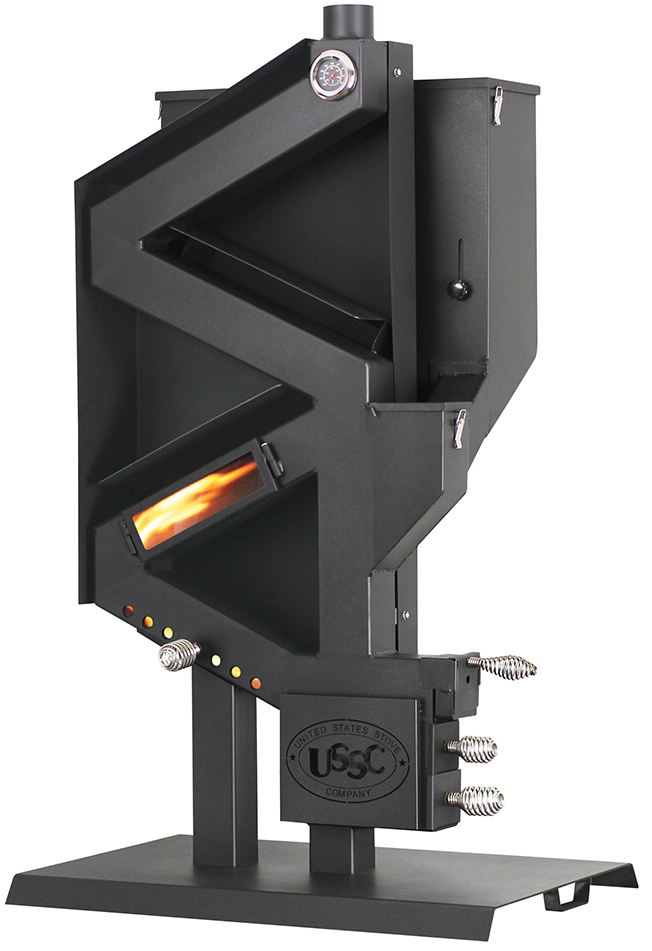
Second prize in the thermoelectric category went to California based Vulcan Energy, who
developed a thermoelectric generator for the gravity fed Wiseway pellet stove that generated an average of 123 watts, and a maximum of 139 watts, during the 2.5-hour test period. Total power output over the test period, net of parasitic losses, was 235 watt-hours.
 |
| SBI, a prominent Canadian stove manufacturer spent years developing automated features. Photo: Kittner for BNL. |
The People’s Choice award, based on votes from the general public, went to 509 Fabrications, for their unique gravity fed pressed log stove.
 |
| Key partners in the Challenge included Olympia Chimney, and CSIA, and NFI installers from Winstons Chimney and Sugarloaf Chimney. Photo Kittner for Brookhaven National Lab. |
The goal of the Woodstove Design Challenge is to demonstrate how improved designs including sensors and computer controls can make wood stoves cleaner and more efficient. The technology boom of the past few decades has largely missed the wood stove industry, yet innovation still holds great promise.
Researchers including Brookhaven National Lab, with support from the New York State
Energy Research and Development Authority (NYSERDA), have been developing new methods for the next generation of assessment protocols for wood heating appliances. Currently, most stoves in America are tested for EPA certification with standardized fuel pieces and spacing. Research has focused on in-home use operational practices, user fueling patterns, and new real-time measurement method techniques with random loading patterns and variability in piece size to better replicate real-life conditions.
 |
| Fred Leavitt won 2d prize in thermoelectric with Jonathan Male, DOE, Ramesh Koripella, Sandia National Lab and John Ackerly, AGH. Photo: Kittner for BNL |
Automated stoves that are designed and tested with this new robust cordwood test method can help improve woodstove designs and in-use performance leading to higher efficiency and lower emissions.
 |
| Les Otten of Maine Energy Systems with Julie Tucker of the USDA Forest Service. Photo: Kittner for Brookhaven National Lab. |
A team from Stony Brook University also competed in the event with a prototype that featured a unique wood drying and preheating chamber. The stove did not win a prize but offered students a rich opportunity to engage with national stove design and testing experts. A full list of the competing teams can be found here.
Partners for the Design Challenge include NYSERDA, the Department of Energy’s Bioenergy Technology Office, the U.S. Forest Service, the Osprey Foundation and Olympia Chimney. The automated stoves were tested by Brookhaven National Lab. A complete list of partners and sponsors can be found here.