Showing posts with label pellet stove reliability. Show all posts

Monday, March 2, 2026

How to buy high quality pellets - Advice from an expert

Scott Williamson
Scott Williamson has worked on pellet stoves for decades as a technician and retailer. He has burned just about every kind of pellet on the market and has seen firsthand what works and what does not in the homes of clients.

We asked to interview Scott because he is not affiliated with any stove or pellet brand. He also has a Facebook group called Pellet Stove Troubleshooting & Repair. The group has nearly 17,000 members and it’s likely to include every technician in the country that works on pellet stoves.

What’s your primary advice to people buying pellets?

Scott’s first piece of advice is simple. Do not buy in bulk until you have tried the fuel. “Buy whatever you can afford. Buy a little and test it.”

Even pellets labeled premium can perform very differently from brand to brand. The word premium typically just refers to ash content being under 1 percent. It does not guarantee high heat output, clean burning in your stove, or easy ignition. If it runs well in your stove, then it is worth stocking up.

Before committing to a large purchase, test a few bags and pay attention to:
  • How much ash is created?
  • Does the burn pot clog up?
  • Does the burn out empty itself during a shut-down?
  • Any unusual odors from the pellet fuel itself (off gassing)?

If you burn pellets long enough, you stop looking for the perfect brand and start looking for what works consistently in your stove. Pellets are fuel. Some are better made than others. Your stove will tell you pretty quickly which is which.

Softwood vs. Hardwood: Does It Matter?

Yes! Buy softwood if you can. Scott says, “Softwood pellets are generally cleaner and produce more usable heat per pound.”

Species matters, but manufacturing quality matters just as much, sometimes more.

Scott has made informal heat comparisons in his own stove and has seen dramatic differences between brands under the same conditions.

Which brands would you generally avoid?

“If a bag leans heavily on patriotic imagery”, Scott says stay away! “Words like, American, Patriot, Liberty…. ‘Freedom’ that’s a big one. Freedom fuel, Patriot fuel, Liberty fuel. It’s all absolute garbage, and that’s because they’re relying on a certain demographic of consumers to buy them. They don’t care.”

Should I look for the PFI Logo?

Some bags display the logo of the Pellet Fuels Institute (PFI) but it doesn't mean the pellets are
Only the logo on the left means the fuel is certified to
PFI standards.

PFI certified. A company can be a PFI member of have a Board seat without certifying their pellets through PFI. Even if it is PFI certified, certification also does not automatically mean that pellet will perform best in your stove. You may also see companies say that they are certified members of PFI, but their pellets are not certified.

I have seen excellent pellets with and without certification and poor pellets with and without PFI certification.

I have heard that some pellets smell like diesel fuel. Should people be concerned?

Yes. It’s rare, but there are some pellets out there now that smell terrible, like this one bag that was sold by Tractor Supply (see photo on left). If you open a bag and it smells like diesel fuel, that is not normal. Take it back.

“Sometimes pellets have a mild pine smell. That is normal. Douglas fir can have a sharper scent. But diesel is not normal.”

A strong fuel smell can point to contamination somewhere in the fiber stream or during handling. If something about the smell makes you uneasy, do not store two tons of it in your basement.


Extensive signs of paint in pellets almost
always come from recycled wood pallets.


How about pellets with a bit of color in them?

Bits of color in pellets usually come from manufacturers that reclaim old pallets to make their pellets. I don’t really know how bad it is. I suppose it depends on the extent of paint in your pellets and the degree to which you’re breathing it. Every home is different. Every situation is different. But I don’t think anyone should be buying pellets that have paint in them. I would not buy that brand again.

We know that some folks are finding a lot of paint in pellets recently made by Michigan Wood Fuels.

How about the eternal issue of fines (wood dust)? How bad are they for your stove?

The wood dust at the bottom of the bag is called fines. Every pellet bag has some. Too much can cause problems. Fines develop during manufacturing and transportation. The more pellets are moved, stacked, and jostled, the more they break down. In many stoves, fines settle at the bottom of the hopper. Over time, they can restrict the feed opening, contribute to missed ignitions, and reduce maximum heat output.

If your stove suddenly struggles to ignite and you have burned 40 or 50 bags without cleaning out the hopper, fines are often the reason.

The fix is usually simple. Once a month, let the hopper empty completely. Vacuum the bottom thoroughly. Then restart. Scott says it’s a simple thing to do but he often looks like a hero after fixing an issue by just vacuuming dust out.

Not all pellet stoves manage fines the same way. Harman stoves are known for being more tolerant of dust. Their bottom feed system, adapted from coal stove technology, helps push fines through the burn process rather than letting them accumulate as easily.

That does not mean you should ignore dust. Cleaner pellets are always better. But some stove designs are more forgiving.


Are Pellets Still Worth the Money?

Yes, if you heat with oil, propane or electric resistance heat. Pellets come out as the more practical and economical option, especially when bought in bulk in the spring, way before you need them, so that you can shop around for the best price.

I think that's the main reason that this industry still exists… Let's think of all the ways that it saves people money, right? Because it's not just on how much you pay for fuel or how much you use, but the pellet stove has long been a stop gap measure that fills a need that maybe prevents a more expensive repair in your central heater. Or you're building an addition, you can put a pellet stove in and that is a heat source for the bonus room. That is way cheaper than having to pull in duct work or infrastructure to bring heat to a system that you may have to update, because now it's not big enough, right? It's a stop gap.”

Scott’s Bottom-Line Advice
  1. Test the pellet before committing to buying a lot.
  2. Ignore patriotic marketing.
  3. Vacuum your hopper monthly.
  4. Don’t panic over a little dust—but don’t ignore it.
  5. Buy the pellets you can afford and manage.

“I’m 54 now. I don’t obsess over the type of pellets anymore. If you have a good enough stove, and keep up with maintenance, let your stove deal with it. Everything reasonable is manageable."

More resources on wood pellets

Friday, June 28, 2024

Survey: Pellet stove owners love their stoves – and are also interested in heat pumps and solar panels

 Pellet stove adoption is growing and reached 25% of market compared to wood stoves in New England 

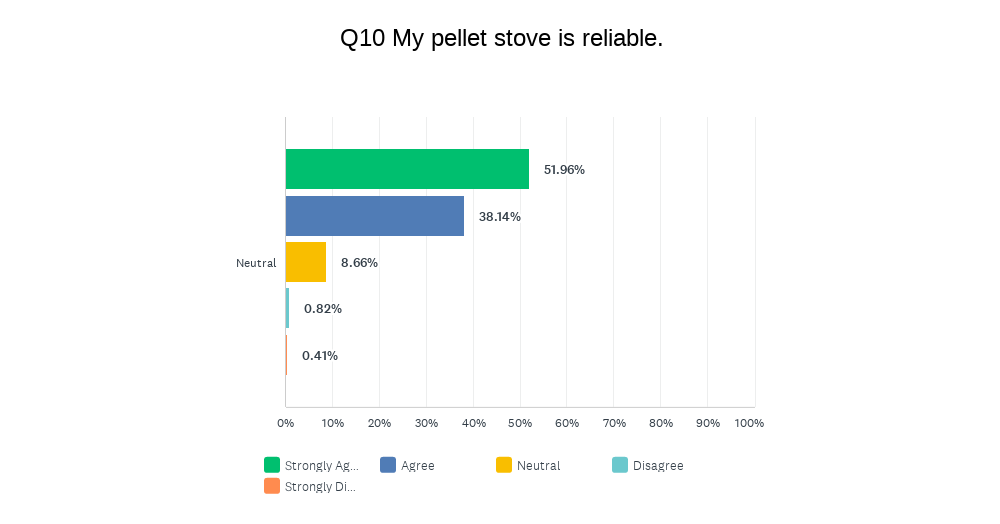
A survey taken by 486 people who use pellet stoves revealed some predictable and some unpredictable results. For instance, an overwhelming majority of pellet stove owners, 85%, said they would buy another pellet stove if theirs broke and 90% say their stove is reliable or very reliable, challenging a perception that pellet stoves are not very dependable. 


Pellet stoves are cleaner and more efficient than wood stoves and make up 25% of the stove market in New England, and 10% nationally, according to the US Energy Information Administration (EIA), Table CE7.1.  Until recently, likely around 5 years ago, American homes still made more renewable energy from wood and pellets than they did from residential solar photovoltaics, which have since surged past wood and pellet heat. 


The survey was undertaken between April and June of 2024 by the Alliance for Green Heat, an independent non-profit. AGH chose the Survey Monkey platform and circulated it through scores of social media pages, newsletters and neighborhood listservs. Thus, the survey is not rigorously scientific and likely over-represents pellet stove enthusiasts. Keeping that in mind, the data offers a glimpse into an important demographic of pellet stove users. By segmenting the data, we were also able to compare the views and values and pellet stove users based on income, region, motivation to buy a pellet stove and other characteristics. 


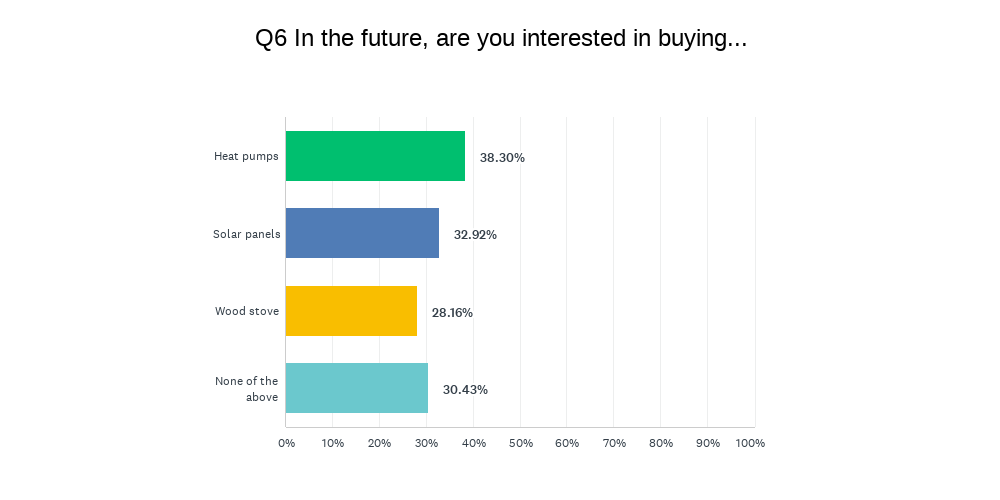
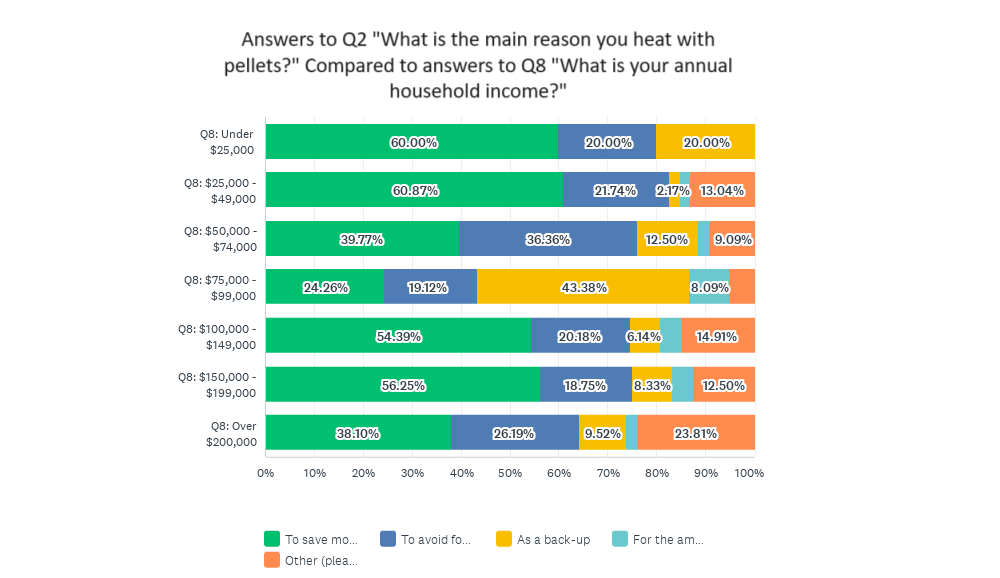
Of this group, 61% of the 486 respondents used their stoves for primary heat and in the future 38% were interested in buying heat pumps and 33% were interested in buying solar panels. Unlike households adopting solar panels, the primary reason homes adopt pellet stoves is for the substantial short term cost saving.  In the survey, all income groups except one listed “saving money” as the most common reason to heat with pellets.


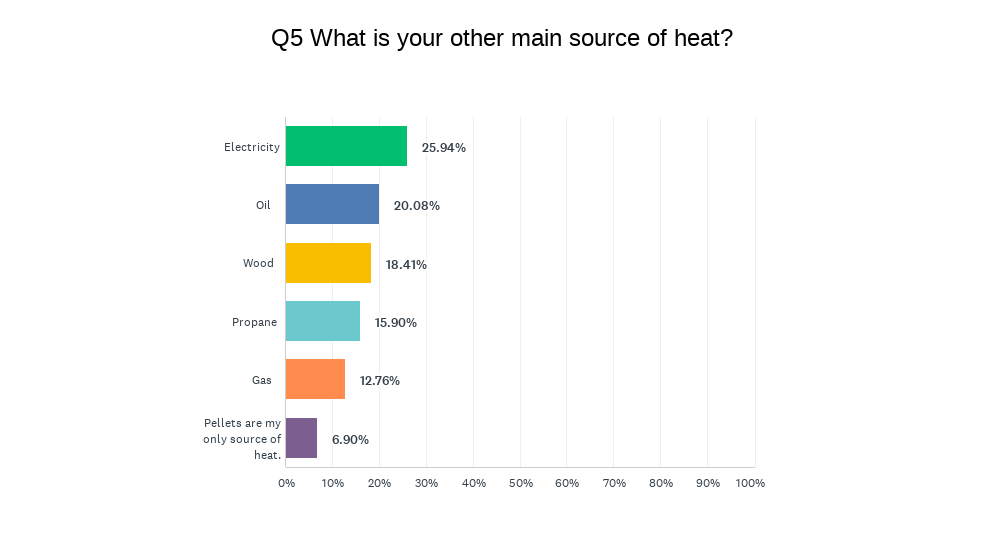
Twenty-six percent of households with pellet stoves displaced electric heat (both resistance and heat pumps) 20% displaced oil, and 18% displaced wood, 16% displaced propane and 13% displaced gas. This along with several other questions showed a high crossover with wood and pellet stoves, as many households that used to heat with wood have moved to pellet heat. In some cases, the reverse also happens with homes moving from pellets to wood fuel. 


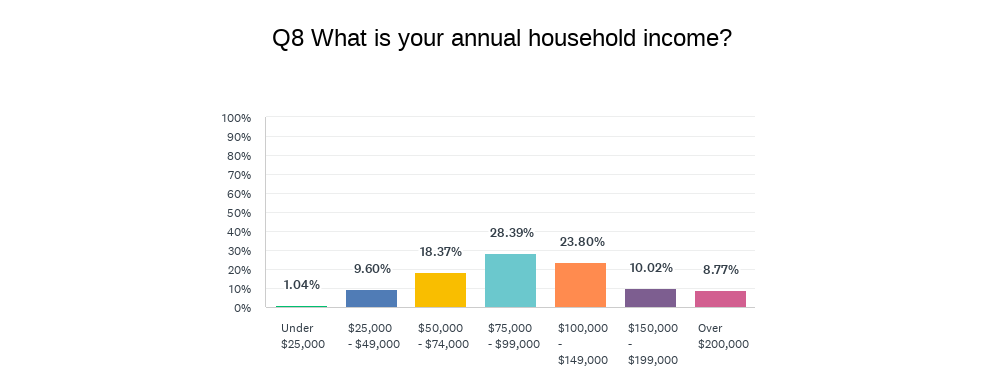
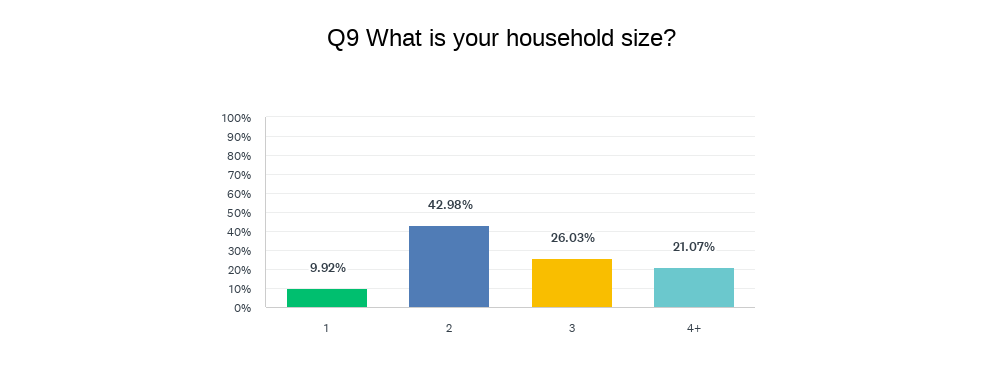
The median annual household income group was $75,000-$99,000, higher than than the national median ($74,580), and significantly lower than the median average income of homes with solar panels ($117,000 in 2022). The number of people per household was close to the national average with an average of 2.58. The national average is 2.51.


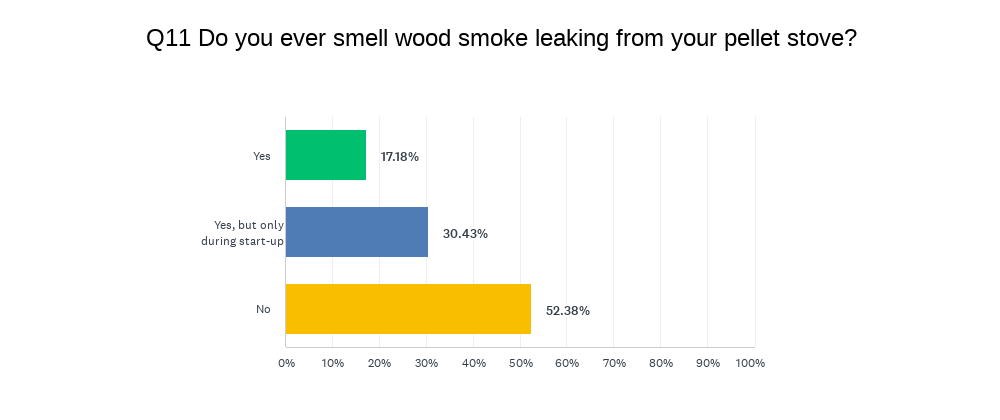
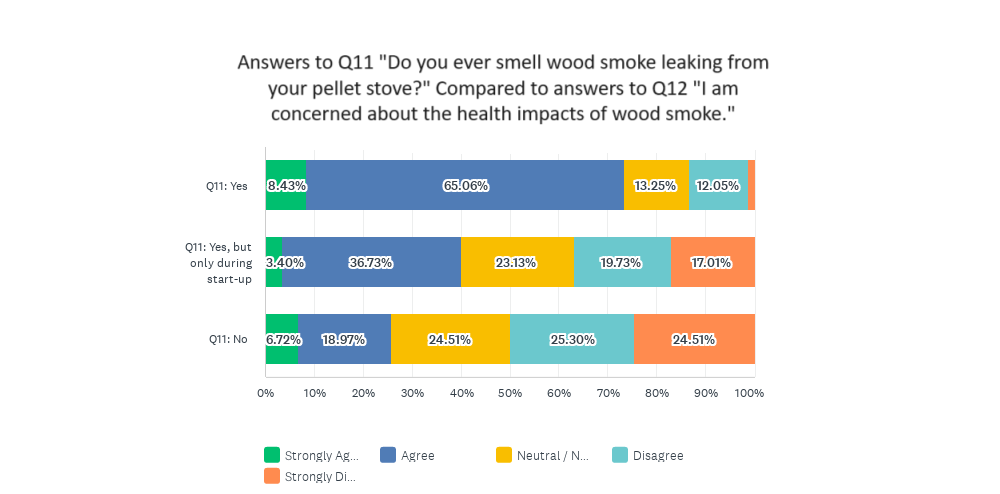
The survey also asked if pellet stove owners smelled smoke from their stoves and 17 % said they did, and 52% said they didn’t. In between those groups, 30% said they only smelled it during start-up which in most homes is no more than once a day. 


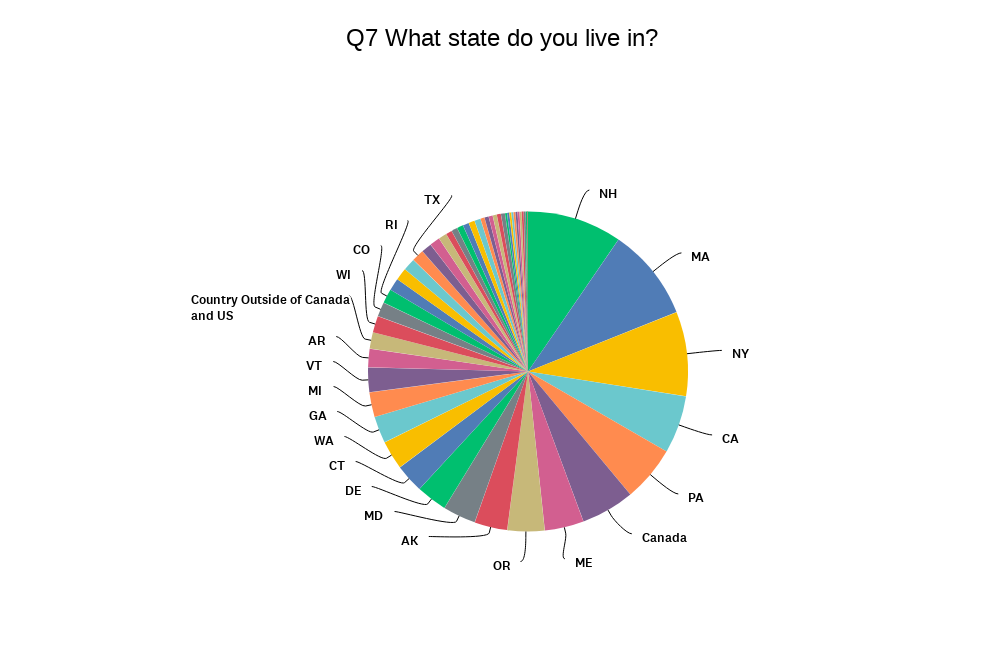
Survey respondents were from across the county, with respondents from every state except five, mostly in the deep south. The top 5 states were New Hampshire (10% of responses), Massachusetts (9%) and New York (9%), California (6%) and Pennsylvania (6%). Canada and countries outside of Canada and the US had 7% of responses. 


Scores of state and national studies show that small scale wood and pellet heat is enormously important to the transition away from fossil fuels both here and throughout Europe, in part because it does not strain the grid in the winter, and complements available renewable electricity.


Pellet heating has grown considerably in America, but public education lags, and there remains a lot of confusion about the export of pellets to make electricity versus the use of pellets for domestic heating.  The US Energy Information Administration publishes vital data about pellet production in America that can help clear up some of this confusion. 


Data from Each Question

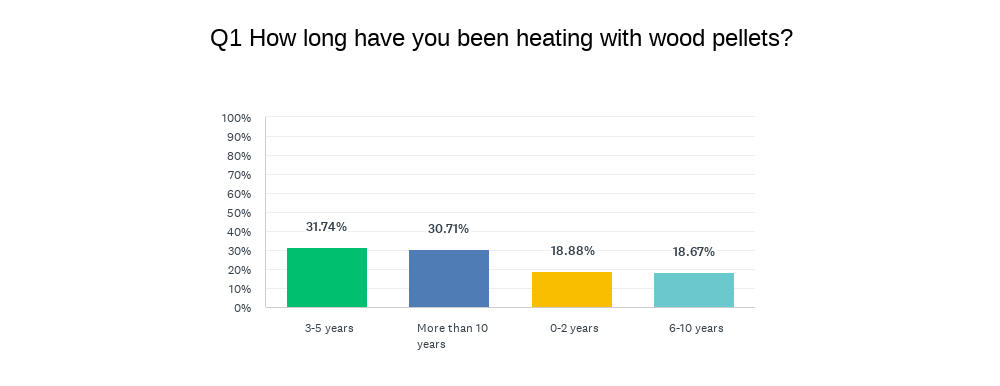
Q1. How long have you been heating with pellets? The responses show a range of households who are just starting to use a wood stove, to those who have used them for a long time. That indicates that there is continued interest by new people in starting to use pellet stoves.

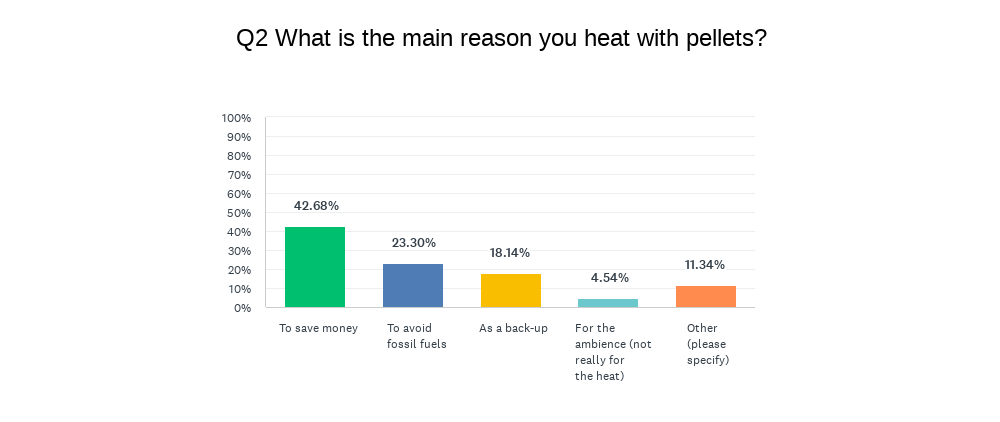
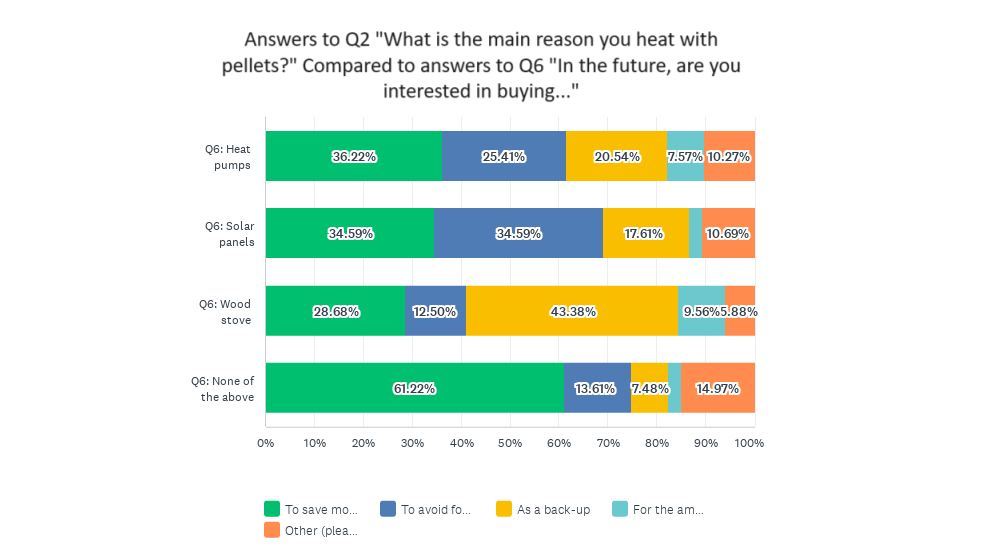
Q2. What is the main reason you heat with pellets? Respondents were only allowed to pick one answer. Predictably, “saving money” was the leading reason, with 43% choosing this as their main motivation. But the surprising aspect is that so many people chose avoidance of fossil fuel as their main motivation (23%). The 18% choosing “as a back-up” could either be a regular or periodica back-up to another heating system or an emergency back-up if their other heating system broke down. Or, it could be people who have battery back-ups or generators so they can use a pellet stove during a power outage.

The three most common “Other (please specify)” comments were related to the following categories:

  1. The ease of use and consistency of pellet heat over log wood heat with comments such as, “Switched from firewood. Easier to deal with,” “Wood-fired heat, but more controllable than a wood stove,” and “Too old for firewood.”

  2. It’s popularity in supplementing other heat or areas of home with comments like, “Heat compensation, my furnace doesn’t keep up with a big drafty house,” and “Supplement heat for my basement.”

  3. Those heating with pellets because they are associated with the industry (pellet stove dealers, engineers, etc.)


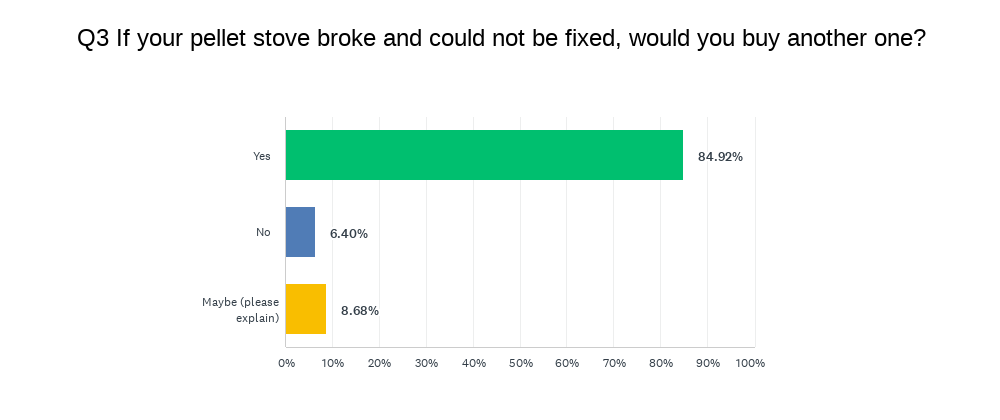
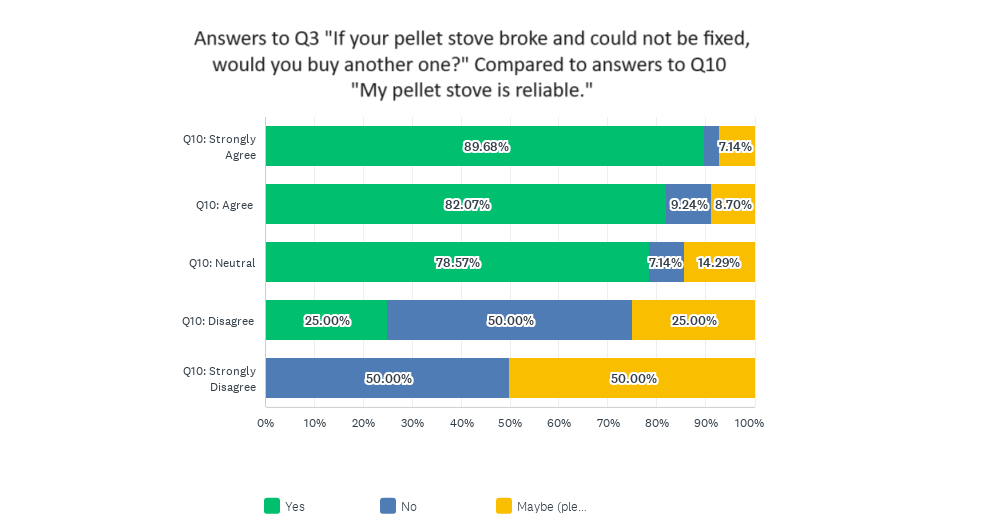
Q3. Would you buy another? This may be one of the most surprising results: 85% said they would buy another pellet stove if their current one could not be fixed, with another 9% choosing “Maybe.” This indicates a strong loyalty to the appliance. For those who selected “Maybe (please explain),” their answers were concerned with whether the price of pellets remained reasonable and if their health still allowed them to deal with the physicality of pellets. Another popular reason for explaining further was that they were confident they could fix their pellet stove if it ever stopped working: “I’d probably just fix it because they’re easy to repair.” 

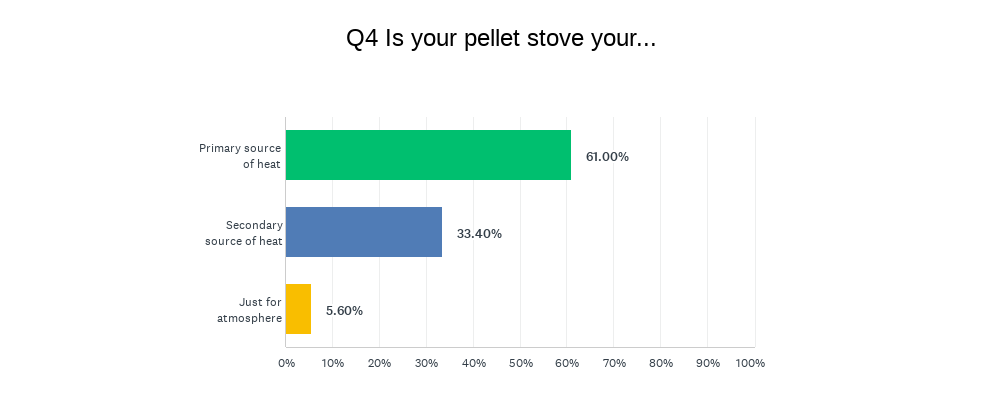
Q4. Primary or Secondary Heat? That 61%so many respondents use their pellet stove as a primary heater is somewhat surprising, since nationally, the number of people who use wood or pellet as a secondary heat source is higher than primary heat source. This may be because we tapped into a more enthusiastic demographic, or it may be an indication that pellet stove users use their stove for primary heating more than wood stove users. We also didn’t ask about house size, though we did ask about the number of people in the household, which averaged only 2.58. Thus, it may be that people who completed this survey have smaller homes, possibly close to the national median of 2,299 square feet for a single family home.

Q5. Other Main Source of Heat? Nothing surprising here. Electricity is the highest percentage with 26%, and many of those are likely homes with electric resistance heat or early model heat pumps which are not nearly as efficient as modern ones. It may come as a bit of a surprise to some that 18% of pellet stove users have cord wood as their other main source of heat. Cord wood is the third most common “other main source of heat” after electricity and oil, another indication that we may have reached a more hardcore, dedicated biomass heat demographic.

Q6. Interest in Heat Pumps or Solar Panels. Respondents could choose multiple answers on this one. On average, a respondent chose 1.3 options. We found it somewhat surprising to see such high interest in heat pumps and solar panels.

Q7.State of residence. No surprises here. The fact that we had such a good demographic diversity shows that our data doesn’t just represent one part of the country. 

Q8. Household income. According to the US Census, the median household income was $74,580 and the average was $74,755 in 2022. Both fall right below the median income bracket of the respondents of our survey ($75,000 - $99,000). This shows a lower household income for this group compared to homes that have solar panels, or drive electric cars.


Q9.Household size. The average household size is 2.58, slightly larger than the national average of 2.51.

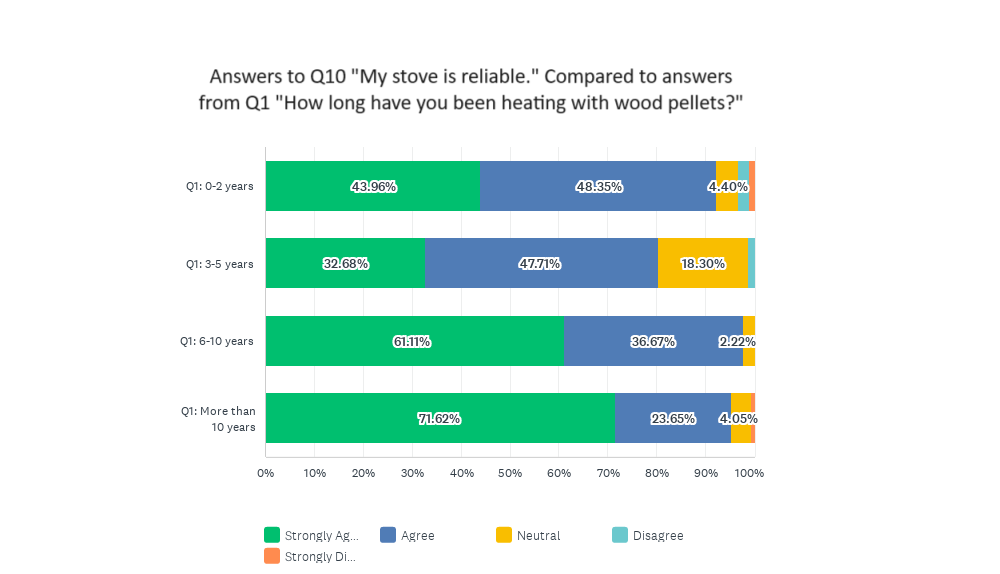
Q10. Is your stove reliable? The number of households who strongly agreed or agreed that their pellet stove is reliable is remarkably high (90.1%). 

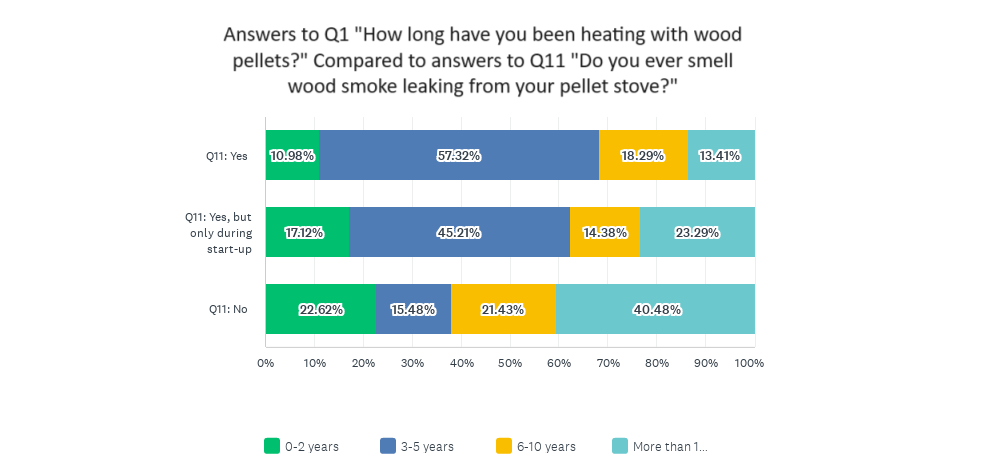
Q11. Do you smell wood smoke? While a majority did not smell any smoke in their house, 30% smelled some on start-up. And the fact that 17% of this group say they smell it more regularly is significant enough to warrant further study into this problem. AGH has done some at-home testing and found start-up smoke to produce about the same amount of PM as making breakfasts or dinners that involve frying, using a griddle or making well-done toast. While this was not an in-depth study, AGH believes that the very small amount of smoke during start up could be partially caused by stoves not being sufficiently cleaned, or it may be a design flaw in some stoves that are not completely airtight and can leak.

Q12. Concern about health impacts of wood smoke. This question was not worked as well as it could have been, because it could be interpreted two ways: first, are you concerned about the health effects of wood smoke generally, or are you concerned about the health effect of wood smoke from your own pellet stove. Thus, someone could be extremely concerned about the health implications but answered that they weren’t concerned because they didn’t smell it in their own home. 


All of these tables can also be viewed on the Survey Monkey platform.


Overlaying Responses from Two Different Questions


Survey Monkey allows you to take the individual answers of a question and see how those people answered another question, because all answers are attached to an IP address. Thus, we were able to see how different demographics answered different questions.


Income and main reason to heat with pellets


On Q2 overlaid with Q8, reasons for heating with pellets vs. income, saving money was the top rationale for all income categories exempt the middle, median income bracket. Lower income brackets favored saving money to some extent, and no one in the lowest bracket used their stove for ambience. As for being motivated to reduce fossil fuels, there is no clear pattern based on this sample of 486 people. 


Main reason to heat with pellets and interest in buying other appliances


Comparing Q2 and Q6 unsurprisingly shows that people who heat with pellets who are more motivated to reduce fossil are the most likely to be interested in buying solar panels. And people who are more motivated to save money least interested in solar or heat pumps.


Reliability vs. interest in buying another pellet stove 


Unsurprisingly, overall those who agreed or strongly agreed that their pellet stove was reliable were most likely to want to buy another one if it broke down. Those who strongly agreed that their pellet stove was reliable were more than twice as likely to want to buy another. 


Reliability and length of ownership


In this comparison, those who had their stove for longer than 10 years reported higher levels of satisfaction with reliability. And it was the group who owned stoves for 3 - 5 years who reported lower levels of satisfaction with reliability, possibly indicating that this is the period that repairs may be the highest.


Smelling smoke and length of ownership


This indicates that the group who smells smoke the most is 3 - 5 year ownership and that the longer you own a stove the less smoke you report smelling. 


Overlap between smelling wood smoke and being concerned about it 


When comparing the answers of concern to those having reported that they were smelling smoke, a majority of those smelling smoke were also concerned about the impacts of wood smoke. Those who did not smell wood smoke from their stove were least likely to consider it a health issue. (Again, the ambiguous wording of Q12 makes this comparison less useful.)


Issues and Limitations of the Survey Data


AGH intentionally created a short and simple survey to increase respondent activity but this also naturally made it more susceptible to bot activity. In addition, we offered two $75 gift cards which likely increased bot activity even more. Survey Monkey also did not have an option to include a CAPTCHA at the end of the survey, which would have been a simple tool that could have stopped some bot activity. 


Where IP addresses were repeated, and where the states also differed, the data was excluded from the analysis. Out of the original 626 responses, 140 of these were excluded on that basis. Bot activity appeared to be especially prevalent from batches of respondents identifying as being from Guam that also consistently submitted the same answer, with only one variation, for each submission. The exclusion of these responses did not significantly alter the results of any of the answers. 


Monday, September 25, 2017

Six tips to buy the right pellet stove

Retailers say BTU output can be most confusing issue

Glenn Robinson is one
of many retailers struggling
to help consumers avoid
relying on manufacturer
claims about BTU output.
Updated on Jan, 7, 2021 - Glenn Robinson has been selling and installing pellet, wood and coal stoves in Pennsylvania for 11 years, and one of the biggest problems he faces is sizing the stove.  “I became tired of false information from manufacturers about how many BTUs they claimed their stoves put out” he said in a recent interview.  “Customers see these exaggerated BTU numbers from a small stove and think it will heat their home, but it won’t.  The result is that the stove is undersized and there is premature wear and tear.  One model from a big name brand would only last for 3 – 4 months before needing repair or even full replacement,” he said.

Glenn is not alone in identifying exaggerated BTU listings as one of the biggest problems consumers face in buying a stove.  Scott Williamson, a Massachusetts pellet installation and repair technician says that he sees stoves “all the time that are being run on high 24/7 and pellet stoves just aren’t designed to do that.”  Both installers say that under sizing of pellet stoves is one of the biggest problems, and urge customers to consider larger (higher BTU output) stoves if they live in average size homes in the northern half of the country and plan to use the stove a lot.

Buying a pellet stove can be a confusing process for consumers (but as of 2021 high efficiency pellet stoves and installation costs are eligible for a 26% federal tax credit!)  Retailers are likely to push the brands they sell and manufacturer websites don’t tell the whole story.  Objective, third party reviews are rare and often outdated.  Consumer Reports did a pretty good review in 2009 but used very limited criteria and didn’t test for durability.  The Alliance for Green Heat (AGH) also undertook third party testing in 2015 and issued a detailed online report on some issues including BTU output, maintenance and efficiency. (Like Consumer Reports, AGH conducted completely independent testing by purchasing all the units and doing all of our own testing.)

This blog identifies and discusses six rules for consumers to keep in mind when buying a pellet stove, with a focus on sizing.  This is not an exhaustive list but it’s a good place to start: 1. Don’t undersize, 2. Beware of cheaper stoves, 3. Look for range of heat output, 4. Understand maintenance requirements of the stove, 5. Look for cleaner stoves and 6. Beware of stoves with no efficiency on the EPA list
AGH tested six popular pellet stoves.
Almost all performed well during
intensive 30 day testing, but did not
live up to some manufacturer claims.

Pellet stoves can be a very effective and affordable way to provide primary or secondary heat for your home without the smoke that wood stoves often create in the hands of the typical user. Wood stoves require lots of work on the fuel side of the equation, but pellet stoves involve more work on the appliance side of the equation. 

The Alliance for Green Heat also monitors advertising of pellet stoves and has found over the years that the great majority of companies vastly overrate the amount of heat their stoves put out.  The EPA list of certified wood and pellet stoves is not perfect but it remains the best source of BTU output for consumers. 

Most EPA-certified pellet stoves are listed as producing a maximum of 25,000 – 40,000 Btu and minimum of 7,000 – 13,000 Btu. The average pellet stove on the EPA list, according to data provided by third party test labs, put out a maximum of approximately 31,800 Btu and a minimum of approximately 10,050 Btu. 

The stove with the highest maximum Btu on the EPA list is the Harman P68 at 53,500 Btu (advertised at 71,200 Btu input).  When a stove manufacturer lists Btu input, it refers to amount of Btus in the fuel, if you were to get 100% of those Btus into the room.  But the average pellet stove is around 73% efficiency, which means you will get 73% of the fuel’s potential heat into the room.  (This is similar to the AFUE – the annual fuel utilization efficiency – that is used on gas and oil boilers and furnaces.)

The stove with the lowest maximum Btu is the Thelin Gnome pellet stove that puts out up to 9,000 Btus.  However the company advertises three times that - 27,000 Btus - without any explanation.  Manufacturers usually exaggerate Btu, thinking that it will make their stoves more attractive, but in the case of the Thelin Gnome, there are people looking for stoves to heat very small places and the exaggerated Btu output may make them think even the Gnome is too big.

Here are six critical things for consumers to keep in mind when purchasing a pellet stove:

1.       1. Don’t undersize. If the stove is going to be your primary heat source you will likely need a medium or large pellet stove, even if a smaller unit advertises high BTU output.  Ignore BTU numbers on manufacturers websites and literature and check the EPA list.  The maximum output for pellet stoves is in the 30,000 – 50,000 range, enough to heat all or most of a small or medium house in most climates. “Don’t plan to run the stove all the time at its highest setting,” warns Scott Williamson “or you will be calling someone like me to fix it quicker than you think.”  When we tested six popular pellet stove models, we calculated an output of no more than 21,000 BTUs, far below what the EPA listed and even farther below what manufacturers claimed.

It is possible to oversize the stove and that can be a problem, but is not nearly as common as under sizing.  For example, the Harman P68 is notorious for being installed in small areas like mobile homes but they gunk up when they aren't allowed to get up to temperature for a bit before they shutdown,” says Scott Williamson.

2.      2. Beware of cheaper stoves. There are some good budget wood stoves on the market, but with pellet stoves, you are more likely to get what you pay for than with wood stoves.  “If you want a reliable stove that puts out a lot of heat, we urge customers to ignore pellet stoves under $2,500,” says Glenn Robinson.  Scott Williamson generally agrees but has seen some basic stoves like the Pel Pro in particular holds up very well.

3.      3. Check for range of heat output.  Most stoves can put out about 3.5 times more heat at their highest setting, compared to their lowest.  Some stoves have a tiny range, putting out only 1.5 times more heat at their highest setting.  If you live in a more moderate climate, in the early fall and late spring, you may want just a little heat, and still have the capacity for much greater heat output on the coldest days and nights of winter.  All other things being equal in a stove, you may want a stove with a larger range of heat output and you can check the range of all stoves on the EPA list of certified stoves. In our tests, we found that the Enviro M55 insert ran continuously for an impressive 49 hours on its lowest setting with a tested hopper size of 60 pounds and it ran for 22 hours on its higher setting.  However, with a 37-pound hopper, the Englander 25 PDVC only rain for 15 hours on its lower setting and 13 hours on its highest setting, indicating a very low turn down ratio.


4.       4. Understand maintenance requirements. If you don’t clean your stove regularly and have it professionally serviced once a year, don’t expect high BTU output.  Most consumers get subpar performance from stoves and have to repair them more often because they are not maintaining their stoves according to the owner’s manual.  Pellet stoves are not like wood stoves: they have lots of moving parts and need cleaning of the burn pot and inside the stove on weekly, and depending on the stove, a daily basis.  Pellet stoves that are not cleaned regularly can lose 10% or more of their efficiency – and their heat output, and lead to costlier repairs. Understand the daily, weekly and annual maintenance requirements from the start and don’t put them off.  When we tested six popular pellet stoves, we found that the three more expensive ones (Harman, Quadra-Fire and Enviro) could go for a week or more without cleaning the burn pot.  However, the Englander, Ravelli and Piazzetta needed daily burn pot cleanings.

5.       5. Look for cleaner pellet stoves and ones that are 2020 certified.  Pellet stoves are far cleaner than wood stoves, even if they both have the same particulate matter in grams per hour.  Particulate matter is the tiny stuff that smoke is made out of and pellet stoves should not have any visible smoke after the 3-minute start up.   The average pellet stove used to put out about 2 grams of particulate per hour.  But since the new EPA regulations took effect in 2015, pellet stoves have become even cleaner and more efficient.  As of April 2020, more than half of the 2020 certified pellets stoves emit 1 gram or less per hour. This makes pellet stoves more suitable in more densely populated suburban and even urban areas.  Choosing a cleaner pellet stove means a cleaner flue pipe and cleaner air around your and your neighbors’ homes. You can now easily search for the cleanest pellet stoves on the EPA's new searchable database.

6.       6. Beware of efficiency numbers on manufacturer and retailers websites.  As with BTUs, manufacturers routinely exaggerate the efficiency of their stoves on their websites, so if efficiency and saving money is important to you, check the EPA list of stoves for efficiency ratings.  Until May 2020, many companies still hadn't even reported their efficiency to the EPA, but thanks to new regulations, all companies have to test for and disclose their efficiency.  Pellet stoves range from 58 to 87% efficiency, so do your homework and check the EPA list.  As of Jan. 1, 2021, consumers can get a 26% tax credit when buying and installing pellet stoves that are 75% efficient or higher. Click here for more details.

Do not rely on Manufacturers Certificates that claim their stoves are eligible for a federal tax credit without first checking the efficiency on the EPA's searchable database of certified heaters.  Even large companies that make good quality stoves like Jotul and QuadraFire have claimed that stoves as low as 66% efficiency are eligible for the tax credit.  The credit is supposed to be for stoves over 75% efficiency.  

The EPA used to allow companies to calculate efficiency based on a default of 78% efficiency, even though most pellet stoves are below that, explains Ben Myren, who runs one of the stove test labs approved by the EPA. The result is a 5-10% exaggeration of some stoves on the EPA site, something that the EPA has not publicly acknowledged. (Some incentive and change out programs - Maryland, Massachusetts and New York - require that the stove have an efficiency listed on the EPA list to get the full rebate.)

Appreciating these six factors are likely to help you make a better decision, but we also encourage consumers to rely on feedback from friends, neighbors and others who own pellet stoves. One site that can be helpful for research is hearth.com.  

A final note of caution is to take advertised hopper size with a grain of salt.  Most manufacturers also exaggerate hopper size.  Of the six models we tested, Harman and Ravelli exaggerated their hopper size by 15 – 18%, while Enviro didn’t exaggerate at all.  Choosing a stove with an advertised hopper size of 50 – 60 pounds can be a good idea, as it means the hopper will likely hold 45 – 55 pounds and you can empty an entire 40 pound bag in it when its low.