Showing posts with label change-out program. Show all posts

Tuesday, June 4, 2024

Wood stoves essential in transition to heat pumps, say tribal experts

Shaina Oliver is from the Northern
Navajo Nation and represented Mom's
Clean Air Force at the Conference. 
In a series of meetings at the annual National Tribal Forum on Air Quality , experts voiced a consistent message: as we install heat pumps in tribal homes, we should also keep wood stoves.

Nowhere are wood stoves as common as on many tribal reservations, who have long relied on both wood and coal for residential heating. Some homes are still being outfitted with coal stoves that can also burn wood, whereas wood stoves cannot safely burn coal.


There is a historic amount of money available to tribes and other underserved communities that can be used for residential home energy upgrades, and this funding was possibly the most common theme of the air quality conference, held on the land of the Eastern Band of Cherokee Indians near the Great Smoky Mountains National Park.

AGH was part of a panel workshop along with EPA’s Burn Wise, the Tribal Healthy Homes Network, Red Feather Development Group, and the Nez Perce Air Quality Program. Among the core topics were how change-out funds can best be used, how to reduce indoor wood smoke, improving firewood bank programs, switching from wood to electric heat pumps, etc. Some change out programs have been conducted, but the number of dangerously installed old stoves remains enormous. AGH now has funding for tribal firewood banks, which includes assistance in seasoning wood, and steps toward getting stoves inspected and repaired.

From left: John Ackerly, Joe Seidenberg,
Darian Dyer, Larry Brockman and
Danielle Johnson.
AGH's funding for firewood banks is helping tribal communities in the four corners area to transition away from coal heat. According to Shaina Oliver, an indigenous people's rights advocate and field organizer for Mom's Clean Air Force, a treaty forced on the Navajo Nation included a deal to mine coal on Navajo land, and tribal members were given free coal for heating, cooking - or selling. But when the mine closed, thousands of households struggled to heat their homes, even though coal can still be scavenged in some places. "We may not be able to control what we breath outdoors, but we can control the indoor air quality," said Shaina Oliver, which is why the National Tribal Air Association has pushed for replacements of wood stoves to newer ones that reduce indoor smoke.

The key problem with the conversion to heat pumps is mainly that they are expensive, and it could take decades for even a majority of tribal homes to have them. “Wood heating is vital for maintaining healthy homes in the Navajo and Hopi Nations and it is deeply ingrained in their cultures, representing healing, remembrance, and togetherness,” according to Joe Seidenberg, Executive Director of Red Feather Development Group that has been involved in many change-outs on the Hopi and Navajo reservations, and has one of the best wood heat education sites in the country.


An abnormally high percent of 
wood stoves on reservations are
dangerously installed.

“While the wave of electrification and heat pump technology will bring significant benefits to these communities, wood heating will never be completely replaced,” Mr. Seidenberg said. “The Colorado Plateau, rich in forested landscapes, provides ample wood resources, and using this wood helps preserve healthy ecosystems by preventing catastrophic wildfires through active thinning operations,” he continued.

The number of people who identify as Native Americans in the US, jumped from around 5 million in 2010 to more than 9 million in 2020, with about 78% living outside of reservations. The highest percentage of Native Americans in the U.S. are in Alaska, Oklahoma, New Mexico, South Dakota, Montana, and North Dakota.

Compared to other races or ethnic populations, American Indian and Alaskan Native populations (AI/AN) have the highest poverty rates (24.1%)—almost twice the national rate (12.8%). Poverty, combined with living in rural areas, is one of the biggest determinants of whether wood or coal will be your primary source of heat.

For many of the large western tribes, particularly in the southwest, outdoor ambient wood smoke issues were far less of a problem than indoor wood smoke issues. As a result, there appears to be a trend away from wood stove change outs, toward a far more cost-effective solution: indoor air purifiers. There is also the expectation that heat pumps will reduce the amount of time that wood stoves are used.
AGH's Pam Porter with the
Cherokee firewood bank
staff. 

Many speakers voiced concern about the ongoing cost of heat pumps for homes that had been relying on wood, which is often cheaper. But for the many tribal homes that have electric baseboard heating, or propane heat, heat pumps can lower monthly bills significantly, sometimes to a fraction of the cost.

There are a number of funding opportunities open to tribes and non-profits that could be used for wood stove changeouts, for larger firewood bank projects, and to deploy heat pumps. EPA’s Burn Wise team at the conference urged tribes to explore this funding, including the EPA’s The Environmental Justice Thriving Communities Grantmaking Program. Applicants typically apply in stages, starting with $150,000, and then going to $250,000 and finally $350,000. AGH could also partner with one of more firewood banks to apply for this funding.

Friday, March 17, 2023

Wood smoke in low-income communities is an environmental justice challenge for the EPA


The Alliance for Green Heat, along with eight firewood banks across the nation that support the comment, submitted a response to the EPA's Request for Information on the Environmental and Climate Justice Block Grant Program (ECJ Program). This was a great opportunity to practice viewing wood heating through an environmental justice lens. Below is the submitted comment.


"Re: Environmental and Climate Justice Block Grant Program - Request for Information (Docket No. EPA-HQ-OEJECR-2023-0023)

Summary 

The Environmental and Climate Justice Block Grant (ECJ) program presents an opportunity to address marginalized communities who primarily heat with wood and experience excessive wood smoke that is a health hazard. The EPA has neglected wood heating technology and wood heating regulations, contributing to thousands of communities living with excessive indoor and outdoor wood smoke.  

Wood heating communities include many tribes and also rural areas in the colder parts of the United States that have always relied on wood heat. The technology has stagnated, in part due to lack of attention by the EPA and DOE, who appear to regard wood stoves as an antiquated appliance relied on by poor households, and not worthy of development.  A recent report from the EPA’s Office of Inspector General found that the EPA wood stove certification program is broken, leaving consumers vulnerable to stoves that may have higher emissions than they should (EPA OIG, 2023).  For decades, under administrations of both parties, the EPA’s wood heater certification program has been underfunded and understaffed, jeopardizing those communities that rely most on wood heat, which include many of the poorest rural populations.   

The OIG report recognized the environmental justice issue in poor communities that primarily heat with wood, but it used data that obscures the extent of the problem. The EPA looked at all households, including urban ones, rather than focusing on income levels of rural homes that use wood. A very flawed study commissioned by the EPA in 2010 found that “the average risk from residential wood smoke is lower for people living on Tribal Lands than for the general population,” (Analysis of Exposure to Residential Wood Combustion Emissions for Different Socio-Economic Groups, 2010). Thus, the final 2015 NSPS, the updated wood stove regulations, found that there were no “disproportionately high and adverse human health or environmental effects on any population, including any minority, low-income or indigenous population,” (EPA, 2015).

As our country electrifies and looks to the heat pump to decarbonize heating, wood stoves will likely remain popular for some time or even increase in popularity. In rural areas, power outages are becoming more, not less common, and people are wary of relying solely on electric heat. In addition, for millions of households wood is a free fuel and despite the efficiency of a heat pump, wood will always be cheaper than electricity. There still does not appear to be the political will at the EPA to address the needs of LMI communities that rely on wood to heat their homes.  

We urge the EPA to consider funding programs that:

  1. Change out old wood stoves for heat pumps or newer wood stoves, depending on the needs of LMI households.

  2. Support Firewood Banks that help LMI households get seasoned wood, energy audits, repairs for dangerous wood stoves and ultimately trade up to cleaner heaters.

  3. Explore the development of affordable, computerized wood stoves that drastically reduce PM and give households the chance to heat with a renewable without excessive air pollution.

  4. Provide training to do health and safety inspections of wood stoves during energy audits. Currently, energy audits programs for LMI households are not equitable in inspecting wood stoves, as they do for fossil fuel heaters which are typically found in wealthier homes.  Wood heaters should not be treated as a second-class appliance. 

By funding such projects, the ECJ program will help achieve Justice40 Initiative objectives by investing in cleaner, renewable heating in rural, firewood dependent LMI communities.  

Comment addressing item (2) types of actions related to President Biden’s Justice40 Initiative

We recommend that the Environmental and Climate Justice Block Grant program consider how best to support the fuel poverty and resilience of wood heating populations due to their rural geographic location and socioeconomic status. 


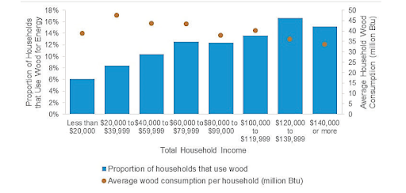
Lower-income households rely on wood heating more than higher-income households (Figure 1). The reasons for this range from accessibility to affordability. In our work, we hear stories of burning kitchen cabinets as a last resort for heating a home. Stories of elder community members making the choice of whether they should pay for heat, pay for their prescriptions, or pay for groceries is not uncommon. 


Figure 1. Data from 2015 OIG analysis of U.S. Energy Information Administration data. 

The average household income of homes using wood as a primary heat source is $76,490, the second lowest of any heating category (above homes that lack a primary heat source and just below homes that use electric heating) (Figure 2). 


No. of HomesAverage Household Income
Utility Gas58,643,017$102,942
Propane5,961,261$89,662
Electricity48,468,896$77,460
Fuel Oil5,426,218$102,019
Coal111,521$80,480
Wood2,022,868$76,490
Solar255,514$141,873
Other575,782$85,732
None1,337,827$74,136

Figure 2. ACS 1-Year Estimates-Public Use Microdata Sample. Average of US household income in past 12 months.


Energy production and distribution have created archetypal cases of environmental injustice—

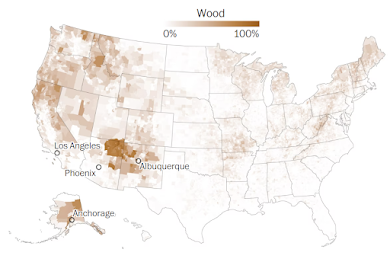
mountaintop removal for coal mining in Appalachia, nuclear waste siting on Navajo reservations in the West, oil refineries in southern Louisiana. Another example is the incredibly high percentage of homes that still heat with wood in poor rural areas that have not yet become part of the fossil fuel age. Areas where the majority population identifies as Native American, particularly in the Southwest, are likely to either heat primarily with wood or find it as the second most popular heating fuel in the area. This further makes the case that regulating and supporting wood stove households is an environmental justice issue. For example, in Apache County, Arizona, nearly 54% of homes are heated with wood (U.S. Census Bureau, 2021) with 71% of people identifying as Native American (U.S. Census Bureau, 2020). In McKinley County, New Mexico, a similar story. Around 44% of homes heat with wood (U.S Census Bureau, 2021) and 78% of people identify as Native American (U.S. Census Bureau, 2020). In San Juan County, Utah, about 38% of homes are heated with wood (U.S. Census Bureau, 2021) as 50% of the population identify as Native American (U.S. Census Bureau, 2020). These are not the only examples that represent the important role wood heating plays in Native American populations. Acknowledging that wood is used for primary heating by only 1.4% of homes nationally, this is a staggering rate of wood burners for a certain population and one that should not be overlooked when discussing funding to rectify environmental injustice (U.S. Census Bureau, 2021). The map below illustrates the concentration of wood fuel users by highlighting the often rural geography of their location as well as the prevalence of wood fuel on Southwest reservations. 

Muyskens et al. 2023. “U.S. home heating is fractured in surprising ways: Look up your neighborhood.” Washington Post. https://www.washingtonpost.com/climate-environment/interactive/2023/home-electrification-heat-pumps-gas-furnace/?itid=hp_desktop-dont-miss_p005_f002.  


Considering that there is legitimate concern over the capacity of our energy grid to handle increasingly harsh climate change-driven natural disasters (Climate Reality Project, 2022), wood stoves may help in some areas during the transition to electricity. Making sure wood stoves are safe to use in LMI households should be paramount. Maintaining realistic expectations for the performance of our energy grid, given that U.S. households experienced more electric disruptions in 2021 than the previous high level of disruptions in 2020 (U.S. Energy Information Administration, 2021), would ensure more energy resilient communities. In this way, wood stoves could play an empowering role for households that fear electric disruptions as well as the increasing costs (U.S. Energy Information Administration, 2023), and environmental concerns of natural gas (Jordan, 2022). 


Proper wood stove inspections, referrals for possible wood stove change-outs, and heat pump installation consultations when wood heat does not best serve a household anymore are needed. Multiple firewood banks that we have worked with have expressed interest in offering these services if they could secure funding to train volunteers to properly inspect and then facilitate the next steps to address the household’s needs. Firewood banks have an intimate view and partnership with fuel-poor households and are in a unique position to facilitate a more energy-equitable outcome. Because socioeconomic status and geography play such an intricate role in identifying environmental injustices, a mechanism to support firewood banks to provide these services would be of great help.


Providing households who struggle to keep their families warm with an emergency fuel source is one thing but ensuring that these families are using this fuel source in a safe wood stove appliance is another. We suggest that the ECJ grant funds programs address the reduction of indoor and outdoor air pollution, the prevention of house fires, and the repair or removal of wood stoves."


Signed By

Alliance for Green Heat 

Takoma Park, MD


Koho4Hopi 

Second Mesa, AZ


Pikunivi Wood Haulers

Second Mesa, AZ


Oglala Lakota Cultural & Economic 

Revitalization Initiative (OLCERI) 

Pine Ridge, SD


Kootznoowoo, Inc.

 on behalf of the village of Angoon, AK

Cullowhee UMC Project F.I.R.E.

Cullowhee, NC


Petersham Community Wood Bank

Petersham, MA


Rural Organizing and Resilience

Marshall, NC


St. Michael & All Angels Episcopal Church Wood Bank

Eureka, MT


Friday, November 20, 2020

Alaska releases deficiency details on wood and pellet stove test reports

Bryce Ward, Mayor of Fairbanks
North Star Borough.
Alaska posted summary review sheets of nearly every certified wood and pellet stove, exposing issues in a certification system that has been running for decades with little oversight. Of the 131 wood stove models, 130 had major problems in their testing report based on the Alaska classification system.

ADEC is pursuing EPA approval of s smoke reduction plan similar to one in Montana. They said, “Missoula City-County Montana regulations allows installation permits only for pellet stoves emitting no more than 1.0 gm/hr.  Alaska embarked on the certification test review and the establishment of a 1-hr filter pull standard as an alternative to a pellet only program for the nonattainment area as DEC feels this approach meets the communities desire for more device options and is at least equal to the Missoula requirement."  Click here for the full email.)

Alaska also sought and received approval from the EPA for an IDC cordwood stove test method to be "broadly applicable" which means any manufacturer can choose to use it in a stove's certification test. It also sets the stage for Alaska to potentially require that test for stoves sold in Fairbanks.

Alaska is undertaking this unprecedented review in an effort to find the stoves that they can be assured are the cleanest and meet all the requirements in EPA regulations under the Clean Air Act. AGH first covered this in a October 22 blog. In addition to checking that stoves meet the extremely detailed level of documentation based on emission testing, Alaska has imposed even stricter emission requirements, which do not apply anywhere other than Fairbanks. The primary stricter standard is that stoves cannot emit more than 6 grams an hour of particulates during the first hour of a multi hour test. Ultimately, when averaging the PM of the entire test, stoves must emit no more than 2 grams an hour to meet the Fairbanks standard, even though the federal standard allows up to 2.5 grams of PM if a stove is tested with cordwood.

Part of ADECs summary sheet showing
 the preliminary and initial final
determination and the reasons.
The initiative is being undertaken by the Alaska Department of Environmental Conservation (ADEC). It only impacts which stoves and boilers can be installed in a relatively small area around the city of Fairbanks that currently fails federal air quality limits. That is a very small market for the wood stove industry but the initiative may end up having far reaching implications for the EPA, the stove industry and how stoves are tested in the future.


One reason why so many stove models are flagged with multiple deficiencies is simply because ADEC officials missed data in the test reports or the manufacturer of the model has not yet provided it. Of the 130 stoves with major problems, many will likely meet Alaska’s review in the coming months. Manufacturers who have requested an extension from the State have until April 1 to work with Alaska to provide details, and only after that can the model not be sold in the Fairbanks non-attainment area. In the meantime, the review appears to shpow that only one wood stove model – MF Fire’s Nova tested by ClearStak lab – could be on the market. The data sheets on all stove models can be found here and will be updated at least monthly.

A Step 1 Jotul stove being tested by
Dirigo labs, taken over by PFS-Teco.
The data on pellet stoves is far better in some respects. Rarely do pellet stoves emit more than 6 grams during the first hour of a test like many wood stoves do. Of the 97 certified pellet stoves, only 3, or about 3%, are disqualified for this reason, compared to 31% of wood stoves. However, like wood stoves, the vast majority of pellet stove test reports had missing data. Only 7 had minor issues. As with wood stoves, over the ensuing months, scores more will likely be approved after missing information is found or provided by the manufacturer. Eleven of the test reports could not be found by ADEC. Sometimes links to these reports are hard to find, sometimes the link is broken, and sometimes the report doesn’t appear to be posted.

ADEC has not yet determined which missing items on test lab reports disqualify a stove. Some of the issues ADEC is flagging have to do more with paperwork requirements than the potential cleanliness of the stove. They are engaging in a series of meetings with EPA personnel from both enforcement (OECA) and air quality (OAQPS) offices to determine what is actually required by the NSPS, what isn’t required, and what should be considered significant. One long time technician at an EPA approved lab said that “based upon ADEC’s interpretation of the language in parts of the Federal Register, they have come up with several new requirements” which never existed before.

A 2019 pie chart made by AGH
showing an approximate percent
of stoves tested by each lab based 
on one data set.

For manufacturers, a key distinction is also data that was collected and exists, but was never calculated or reported properly, compared to data that was mistakenly not collected and could only be obtained by retesting the unit. It’s unclear if any of the test reports are so deficient that the EPA would ever considering revoking a certificate.

The scrutiny of certification paperwork by labs by Alaska also comes on the heels of years of effort by the stove industry to prevent stricter emission standards and the possibility of stricter audits. States have become increasingly frustrated that the EPA is not enforcing their regulations governing wood stoves and boilers. While enforcement was explicitly curtailed under the Trump administration, under Obama and previous administrations, enforcement has been regarded as lax or sporadic. In particular, the EPA has never initiated an audit of a wood stove or boiler to determine if it can achieve the emission levels that it got on its initial certification test. There is also no documentation of the EPA denying certification of a stove or boiler based on inadequate lab reports. In addition, there are only a handful of documented cases when a stove or boiler has failed emission tests in a lab even though industry cites very high rates of variability in emissions during testing.

Some of these issues emerged in 2019 when the EPA released hundreds of documents that NESCAUM had requested in a Freedom of Information Act request. But very little has ever been written about the many complex and opaque issues in test labs other than a blog AGH posted in August 2019: Records reveal successes and challenges in laboratory wood heater testing. That article explored issues of conflicts of interest, compliance with testing regulations and suspension of certification tests, all of which are receiving are receiving more scrutiny by ADEC officials and their partner agencies.


An ASTM 3053 test at Omni lab in
May 2020 on a GHP Group stove. GHP
is a company that has not 
requested that ADEC review its stoves.

ADEC’s initiative is also intertwined with concerns about the ASTM E3053 cordwood method and lab tests that showed the method was lax and may have helped some stoves to achieve certification to the EPA’s stricter 2020 standards with few or no modifications to their design. A meeting between EPA and state officials and industry representatives in January of 2020 explored these concerns and ADEC presented their strategy at that time.

ADECs efforts to improve air quality in the Fairbanks non-attainment area go back at least 10 years, starting with traditional stove and boiler change-out programs and a variety of restrictions. But the tenacity of excessive wood smoke in America’s coldest city has frustrated residents and officials alike, leading to this latest effort to understand which stoves are actually cleaner than others. Fairbanks is also spearheading solutions for the other most obvious culprit: unseasoned wood. As of October 1, 2021, only seasoned firewood can be sold in the non-attainment area.

Registration for firewood retailers is
compulsory in Fairbanks and voluntary
in the rest of the state.

It is still too early to tell how much this latest initiative will lead to cleaner air in Fairbanks. There is little doubt that it will bring a new level of scrutiny and integrity to test reports submitted to the EPA, and help the EPA and state agencies better understand how to craft a federal reference method for testing stoves with cordwood.

Postscript: In March 2021, NESCAUM released a report that was largely based off of the reviews of certification reports done jointly by ADEC and NESCAUM.  The scathing report concluded that the EPA process of certifying stoves is "dysfunctional" and recommended a series of aggressive measures.  AGH's initial response that report can be found here.

Monday, September 25, 2017

Six tips to buy the right pellet stove

Retailers say BTU output can be most confusing issue

Glenn Robinson is one
of many retailers struggling
to help consumers avoid
relying on manufacturer
claims about BTU output.
Updated on Jan, 7, 2021 - Glenn Robinson has been selling and installing pellet, wood and coal stoves in Pennsylvania for 11 years, and one of the biggest problems he faces is sizing the stove.  “I became tired of false information from manufacturers about how many BTUs they claimed their stoves put out” he said in a recent interview.  “Customers see these exaggerated BTU numbers from a small stove and think it will heat their home, but it won’t.  The result is that the stove is undersized and there is premature wear and tear.  One model from a big name brand would only last for 3 – 4 months before needing repair or even full replacement,” he said.

Glenn is not alone in identifying exaggerated BTU listings as one of the biggest problems consumers face in buying a stove.  Scott Williamson, a Massachusetts pellet installation and repair technician says that he sees stoves “all the time that are being run on high 24/7 and pellet stoves just aren’t designed to do that.”  Both installers say that under sizing of pellet stoves is one of the biggest problems, and urge customers to consider larger (higher BTU output) stoves if they live in average size homes in the northern half of the country and plan to use the stove a lot.

Buying a pellet stove can be a confusing process for consumers (but as of 2021 high efficiency pellet stoves and installation costs are eligible for a 26% federal tax credit!)  Retailers are likely to push the brands they sell and manufacturer websites don’t tell the whole story.  Objective, third party reviews are rare and often outdated.  Consumer Reports did a pretty good review in 2009 but used very limited criteria and didn’t test for durability.  The Alliance for Green Heat (AGH) also undertook third party testing in 2015 and issued a detailed online report on some issues including BTU output, maintenance and efficiency. (Like Consumer Reports, AGH conducted completely independent testing by purchasing all the units and doing all of our own testing.)

This blog identifies and discusses six rules for consumers to keep in mind when buying a pellet stove, with a focus on sizing.  This is not an exhaustive list but it’s a good place to start: 1. Don’t undersize, 2. Beware of cheaper stoves, 3. Look for range of heat output, 4. Understand maintenance requirements of the stove, 5. Look for cleaner stoves and 6. Beware of stoves with no efficiency on the EPA list
AGH tested six popular pellet stoves.
Almost all performed well during
intensive 30 day testing, but did not
live up to some manufacturer claims.

Pellet stoves can be a very effective and affordable way to provide primary or secondary heat for your home without the smoke that wood stoves often create in the hands of the typical user. Wood stoves require lots of work on the fuel side of the equation, but pellet stoves involve more work on the appliance side of the equation. 

The Alliance for Green Heat also monitors advertising of pellet stoves and has found over the years that the great majority of companies vastly overrate the amount of heat their stoves put out.  The EPA list of certified wood and pellet stoves is not perfect but it remains the best source of BTU output for consumers. 

Most EPA-certified pellet stoves are listed as producing a maximum of 25,000 – 40,000 Btu and minimum of 7,000 – 13,000 Btu. The average pellet stove on the EPA list, according to data provided by third party test labs, put out a maximum of approximately 31,800 Btu and a minimum of approximately 10,050 Btu. 

The stove with the highest maximum Btu on the EPA list is the Harman P68 at 53,500 Btu (advertised at 71,200 Btu input).  When a stove manufacturer lists Btu input, it refers to amount of Btus in the fuel, if you were to get 100% of those Btus into the room.  But the average pellet stove is around 73% efficiency, which means you will get 73% of the fuel’s potential heat into the room.  (This is similar to the AFUE – the annual fuel utilization efficiency – that is used on gas and oil boilers and furnaces.)

The stove with the lowest maximum Btu is the Thelin Gnome pellet stove that puts out up to 9,000 Btus.  However the company advertises three times that - 27,000 Btus - without any explanation.  Manufacturers usually exaggerate Btu, thinking that it will make their stoves more attractive, but in the case of the Thelin Gnome, there are people looking for stoves to heat very small places and the exaggerated Btu output may make them think even the Gnome is too big.

Here are six critical things for consumers to keep in mind when purchasing a pellet stove:

1.       1. Don’t undersize. If the stove is going to be your primary heat source you will likely need a medium or large pellet stove, even if a smaller unit advertises high BTU output.  Ignore BTU numbers on manufacturers websites and literature and check the EPA list.  The maximum output for pellet stoves is in the 30,000 – 50,000 range, enough to heat all or most of a small or medium house in most climates. “Don’t plan to run the stove all the time at its highest setting,” warns Scott Williamson “or you will be calling someone like me to fix it quicker than you think.”  When we tested six popular pellet stove models, we calculated an output of no more than 21,000 BTUs, far below what the EPA listed and even farther below what manufacturers claimed.

It is possible to oversize the stove and that can be a problem, but is not nearly as common as under sizing.  For example, the Harman P68 is notorious for being installed in small areas like mobile homes but they gunk up when they aren't allowed to get up to temperature for a bit before they shutdown,” says Scott Williamson.

2.      2. Beware of cheaper stoves. There are some good budget wood stoves on the market, but with pellet stoves, you are more likely to get what you pay for than with wood stoves.  “If you want a reliable stove that puts out a lot of heat, we urge customers to ignore pellet stoves under $2,500,” says Glenn Robinson.  Scott Williamson generally agrees but has seen some basic stoves like the Pel Pro in particular holds up very well.

3.      3. Check for range of heat output.  Most stoves can put out about 3.5 times more heat at their highest setting, compared to their lowest.  Some stoves have a tiny range, putting out only 1.5 times more heat at their highest setting.  If you live in a more moderate climate, in the early fall and late spring, you may want just a little heat, and still have the capacity for much greater heat output on the coldest days and nights of winter.  All other things being equal in a stove, you may want a stove with a larger range of heat output and you can check the range of all stoves on the EPA list of certified stoves. In our tests, we found that the Enviro M55 insert ran continuously for an impressive 49 hours on its lowest setting with a tested hopper size of 60 pounds and it ran for 22 hours on its higher setting.  However, with a 37-pound hopper, the Englander 25 PDVC only rain for 15 hours on its lower setting and 13 hours on its highest setting, indicating a very low turn down ratio.


4.       4. Understand maintenance requirements. If you don’t clean your stove regularly and have it professionally serviced once a year, don’t expect high BTU output.  Most consumers get subpar performance from stoves and have to repair them more often because they are not maintaining their stoves according to the owner’s manual.  Pellet stoves are not like wood stoves: they have lots of moving parts and need cleaning of the burn pot and inside the stove on weekly, and depending on the stove, a daily basis.  Pellet stoves that are not cleaned regularly can lose 10% or more of their efficiency – and their heat output, and lead to costlier repairs. Understand the daily, weekly and annual maintenance requirements from the start and don’t put them off.  When we tested six popular pellet stoves, we found that the three more expensive ones (Harman, Quadra-Fire and Enviro) could go for a week or more without cleaning the burn pot.  However, the Englander, Ravelli and Piazzetta needed daily burn pot cleanings.

5.       5. Look for cleaner pellet stoves and ones that are 2020 certified.  Pellet stoves are far cleaner than wood stoves, even if they both have the same particulate matter in grams per hour.  Particulate matter is the tiny stuff that smoke is made out of and pellet stoves should not have any visible smoke after the 3-minute start up.   The average pellet stove used to put out about 2 grams of particulate per hour.  But since the new EPA regulations took effect in 2015, pellet stoves have become even cleaner and more efficient.  As of April 2020, more than half of the 2020 certified pellets stoves emit 1 gram or less per hour. This makes pellet stoves more suitable in more densely populated suburban and even urban areas.  Choosing a cleaner pellet stove means a cleaner flue pipe and cleaner air around your and your neighbors’ homes. You can now easily search for the cleanest pellet stoves on the EPA's new searchable database.

6.       6. Beware of efficiency numbers on manufacturer and retailers websites.  As with BTUs, manufacturers routinely exaggerate the efficiency of their stoves on their websites, so if efficiency and saving money is important to you, check the EPA list of stoves for efficiency ratings.  Until May 2020, many companies still hadn't even reported their efficiency to the EPA, but thanks to new regulations, all companies have to test for and disclose their efficiency.  Pellet stoves range from 58 to 87% efficiency, so do your homework and check the EPA list.  As of Jan. 1, 2021, consumers can get a 26% tax credit when buying and installing pellet stoves that are 75% efficient or higher. Click here for more details.

Do not rely on Manufacturers Certificates that claim their stoves are eligible for a federal tax credit without first checking the efficiency on the EPA's searchable database of certified heaters.  Even large companies that make good quality stoves like Jotul and QuadraFire have claimed that stoves as low as 66% efficiency are eligible for the tax credit.  The credit is supposed to be for stoves over 75% efficiency.  

The EPA used to allow companies to calculate efficiency based on a default of 78% efficiency, even though most pellet stoves are below that, explains Ben Myren, who runs one of the stove test labs approved by the EPA. The result is a 5-10% exaggeration of some stoves on the EPA site, something that the EPA has not publicly acknowledged. (Some incentive and change out programs - Maryland, Massachusetts and New York - require that the stove have an efficiency listed on the EPA list to get the full rebate.)

Appreciating these six factors are likely to help you make a better decision, but we also encourage consumers to rely on feedback from friends, neighbors and others who own pellet stoves. One site that can be helpful for research is hearth.com.  

A final note of caution is to take advertised hopper size with a grain of salt.  Most manufacturers also exaggerate hopper size.  Of the six models we tested, Harman and Ravelli exaggerated their hopper size by 15 – 18%, while Enviro didn’t exaggerate at all.  Choosing a stove with an advertised hopper size of 50 – 60 pounds can be a good idea, as it means the hopper will likely hold 45 – 55 pounds and you can empty an entire 40 pound bag in it when its low.