Showing posts with label certified pellet stoves. Show all posts

Tuesday, November 26, 2024

IRS proposes using EPA database to verify 75% efficiency for tax credit

Industry is split three ways on question of eligibility.

July 2025 update: Congress revoked the wood heater tax credit as of Dec. 31 2025, ending what was meant to be a 10 year extension under President Biden. Expenses are eligible for stove purchases and installation of stoves prior to Dec, 31. 

Nov. 2024 - The IRS issued a proposed rule on October 25 to give guidance on how manufacturers can interpret“75% efficiency.” They are proposing to adopt the EPA database as the means of determining efficiency, which has been long expected by many in industry. 

The proposed rule is long-awaited by many who grew frustrated over the years that the IRS could not do what many felt was obvious: recognize the EPA efficiency listing. AGH was a prominent advocate for a uniform way to list efficiency as a way of protecting consumers, making a level playing field for manufacturers and instilling more faith in the industry. AGH often publicized exaggerated and misleading efficiency claims over the years.

Comments to this IRS notice are due by December 24, 2024 and a hearing is scheduled for January 21, 2025. The IRS notice can be found here.

Congress stipulated that biomass heaters at 75% efficiency, using the higher heating value, were eligible for a 30% tax credit, up to $2,000. However, Congress revoked that as of Dec. 31, 2025.

Most manufacturers were already using the efficiency numbers on the EPA database as the arbiter of which stoves or boilers were 75% efficient or higher. The EPA number is an average of the efficiencies on all the certification tests. But a few manufacturers chose to say their stoves qualified for the tax credit if any of the certification tests were 75% or higher.

The third faction, made up of masonry stove manufacturers, urged the IRS not to issue any further guidance, so that they could claim masonry stoves at 75% or higher could qualify even though they are not listed on the EPA database because they are not required to be EPA certified.

According to the Congressional Research Service, approximately 48,300 taxpayers claimed the biomass tax credit in 2023, making it the least likely tax credit that taxpayers claimed other than for home energy audits. There is no public data on how many biomass stoves and boilers were sold in recent years, but experts say that an average of 200,000 is plausible. EPA has the data but it is not organized or compiled.

Currently 67% of the 101 certified pellet stoves are 75% or higher, based on the EPA database figures and 45% of wood stoves are. However, 92% of cat and hybrid stoves are 75% or higher and only 15% of the 106 non-cat stoves on the market are 75% or higher.

The legacy of using efficiency to qualify for this tax credit, that started in 2008, raises many questions. Arguably, cleanliness is more important than efficiency when using wood, a renewable fuel that a substantial percent of Americans cut or collect on their own instead of purchasing it. The result is that stove manufacturers now focus more on efficiency, while sacrificing R&D to achieve incremental reductions of particulate matter. Congress controls the efficiency number, while EPA sets emissions levels, and a lower efficiency threshold could allow the EPA more leeway to set stricter emissions standards.

Most manufacturers did not submit comments on the proposed regulations. All comments can be found here. Among stove manufacturers, some manufacturers who make lower efficiency stoves (e.g. US Stoves) argued for the stricter definition of efficiency, while those making higher efficiency stoves (Hearth & Home Technologies) argued for a more lenient definition.

The comments by stakeholders outside the wood and pellet heating community provide an interesting snapshot into views on incentives for wood and pellet stoves and boilers. For instance, the American Lung Association does not support biomass stoves or boilers should be qualified energy property regardless of efficiency rating. The California Air Resources Board (CARB) and the Attorney Generals of MA, CO, DE, IL, ME, MD, MI, NJ, NY OR, RI and DC believe a full carbon lifecycle analysis should be done to better calculate an efficiency rating.

However, based on their comment and the sources in the footnotes, it appears that they are confusing biomass to electricity, rather than focusing on biomass heat. While this is a common mistake in the media, it is notable that whoever drafted this comment for these states also made it. Nevertheless, these states do not oppose the tax credit but argue that a stricter one could be better. No commentator suggested that only pellet heaters, that are consistently cleaner and more efficient, should receive the tax credit. A carbon life cycle analysis however, would most likely favor cordwood over pellets.

Support using EPA database

Alliance for Green Heat: The most reliable method to protect consumers, ensure that tax credits are
going to compliant models and create a level playing field for manufacturers is for Treasury/IRS to specify that eligibility is limited to units listed in the EPA Certified Wood Stove Database that have an overall weighted average efficiency of 75% or more using the higher heating value of the fuel. (AGH’s full comment can be found here.)

BPA, ACEEE, ASE: The most reliable method to protect consumers and to ensure that tax credits are going to compliant models is for Treasury/IRS to specify that eligibility is limited to units listed in the EPA Certified Wood Stove Database as having an overall efficiency of 75% or more using the higher heating value of fuel.

Blaze King: Our company has always viewed the overall efficiency to be the metric intended by the IRS as the qualifier for the 75% high heating value.

Travis: In the interest of efficiency and the preservation of resources, the IRS should rely on EPA’s database to confirm whether biomass stoves meet the 75 percent rating requirement.

US Stove Company: Therefore, for a biomass stove or boiler regulated by the EPA to qualify for the 25C credit, only the average “overall efficiency” is reported in the EPA Certification report should be recognized. In addition, this same efficiency number will be posted on the EPA Wood Heater Database, therefore easily verifiable. This will eliminate any question or “gaming” of the tax credit.

Support using any single test run

Hearth & Home Technologies: In our view, the Treasury Department and the IRS should issue guidance stating that biomass stoves meet the definition of "qualified energy property'' provided they have a "a thermal efficiency rating of at least 75 percent (measured by the higher heating value of the fuel as reflected in a single certified test run)." Providing this guidance will resolve the current uncertainty about how to meet the HHV requirement. By establishing the single test criteria, a greater number of biomass stoves could qualify for the tax credit, thereby giving consumers more affordable choices to replace noncertified heaters while burning an efficient renewable energy source.

Stove Builder International: Manufacturers should be able to qualify a property …provided this efficiency number is 75% or greater and can be found in the property’s test report. An efficiency number of 75% or greater should be obtained when the property is used at a combustion setting typically used by consumers. For instance, in the case of a wood stove, the products are typically used by consumers at the low setting. That is, consumers use their stoves in slow-combustion mode to get an “overnight burn”. The stove can be used at a higher setting, but this setting is normally recommended upon start-up only. The basis of their argument is that manufacturers will “make up any number they want.” This could not be farther from the truth. We don’t know where this paranoia comes from.

If the efficiency criteria do not offer enough flexibility and most non-catalytic wood stoves cannot qualify for the 25C tax credit, we feel that the IRS misses its objective of helping the middle class to switch to cleaner, more efficient biomass appliances.

Support current language without further guidance

Masonry Heater Association: the IRS not to issue guidance that conflates the regulations of different types of biomass heaters, potentially imposing the requirements of one category of biomass heater onto another category, for tax credit eligibility. For example, woodstoves must be on the EPA's certified list, EPA Wood Stove Database, to be legally installed; however, this is not a legal requirement of all categories of biomass heaters, e.g. masonry heaters. Masonry heaters are a category of biomass heating appliance that the EPA has chosen to defer regulating.

Tulikivi: we feel that guidance is not needed as the original text is clear enough and allows masonry heaters that meet the efficiency requirement to qualify for the tax credit despite not being on the EPA list of certified appliances


Support strict enforcement based on efficiency tiers

Comments Of The Attorneys General Of Massachusetts, Colorado, Delaware, Illinois, Maine, Maryland, Michigan, New Jersey, New York, Oregon, Rhode Island, And The District Of Columbia; The California Air Resources Board; And The Ramsey County, Minnesota, Attorney: With respect to Section 25C’s biomass provisions, we urge Treasury and the IRS to strictly enforce energy efficiency tiers to verify qualification for biomass stoves and boilers. Per British thermal unit (BTU), wood has about the same carbon content as coal, and, according to EPA, wood contains about 75% more CO2 per BTU than natural gas. As a result, wood that is harvested and burned for energy immediately increases greenhouse gas emissions—even where it is displacing fossil fuels. Biomass combustion also emits other harmful air pollutants, like particulate matter, which is connected to a multitude of adverse health consequences including premature death, cardiovascular effects, asthma, bronchitis, pneumonia, chronic obstructive pulmonary disease. To avoid inadvertently increasing greenhouse gas and other harmful pollutant emissions through biomass incentives, Treasury and the IRS should comprehensively evaluate lifecycle greenhouse gas emissions in calculating the efficiency rating of eligible biomass. If, however, Treasury and the IRS elect to rely on EPA wood stove certifications to demonstrate efficiency ratings, they should not allow certification based on test methods 125 and 127 (relying on ASTM 3053), which allow too much variability and manufacturer and laboratory manipulation.


Do not support including biomass heaters in the 25C tax credit

American Lung Association: The ALA recognizes that pollution from the combustion of wood and other biomass sources poses a significant threat to human health and supports measures to transition away from using these products for heat production. As such, we do not believe biomass stoves or boilers should be considered as part of a qualified energy property regardless of efficiency rating.


Other comments

Governor’s Office of NJ: Biomass stoves and boilers are a concern. It’s likely we would have difficulty supporting incentives for biomass but there may be cases that make sense.

Rewiring America: Treasury should structure the updated Form 5695 such that each product category (heat pumps for space heating/cooling, heat pump water heaters, biomass stoves, and biomass boilers) has its own line and can be tracked accordingly. This is crucial to track how many claims are filed for heat pumps and heat pump water heaters; otherwise, it would be impossible to distinguish between claims filed for heat pumps and biomass products.

Friday, June 28, 2024

Survey: Pellet stove owners love their stoves – and are also interested in heat pumps and solar panels

 Pellet stove adoption is growing and reached 25% of market compared to wood stoves in New England 

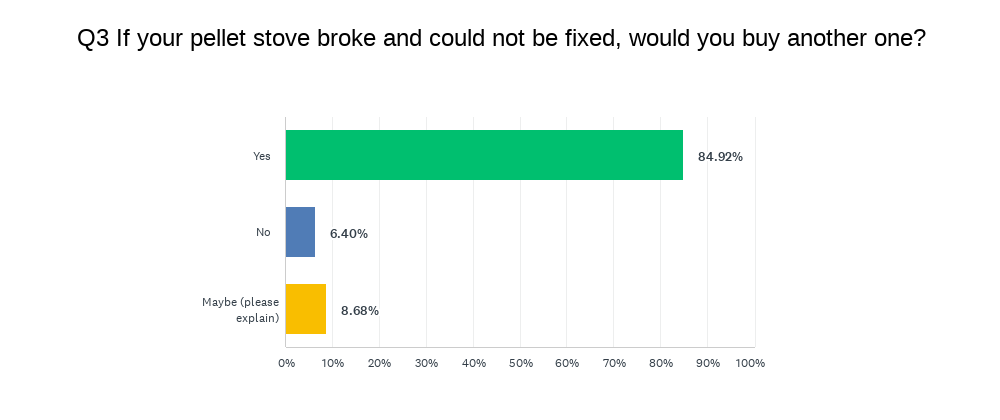
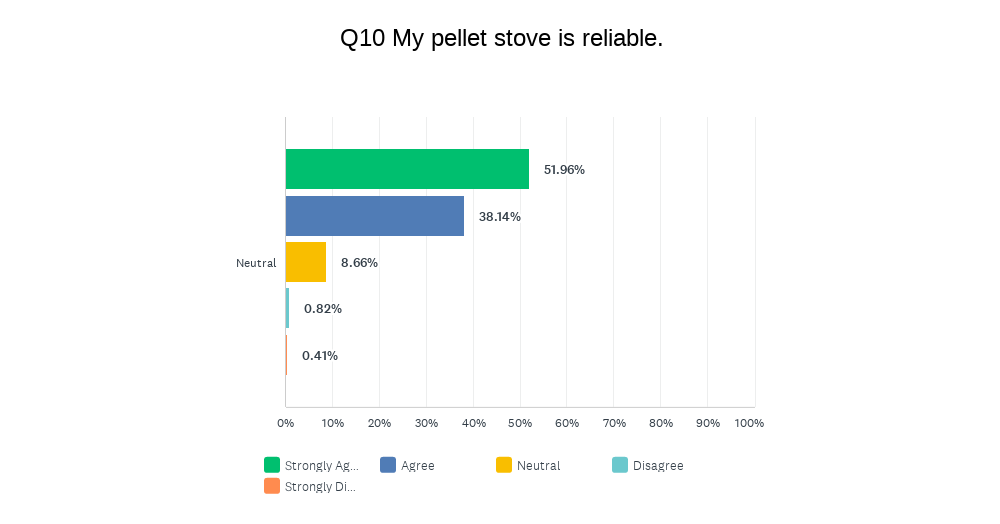
A survey taken by 486 people who use pellet stoves revealed some predictable and some unpredictable results. For instance, an overwhelming majority of pellet stove owners, 85%, said they would buy another pellet stove if theirs broke and 90% say their stove is reliable or very reliable, challenging a perception that pellet stoves are not very dependable. 


Pellet stoves are cleaner and more efficient than wood stoves and make up 25% of the stove market in New England, and 10% nationally, according to the US Energy Information Administration (EIA), Table CE7.1.  Until recently, likely around 5 years ago, American homes still made more renewable energy from wood and pellets than they did from residential solar photovoltaics, which have since surged past wood and pellet heat. 


The survey was undertaken between April and June of 2024 by the Alliance for Green Heat, an independent non-profit. AGH chose the Survey Monkey platform and circulated it through scores of social media pages, newsletters and neighborhood listservs. Thus, the survey is not rigorously scientific and likely over-represents pellet stove enthusiasts. Keeping that in mind, the data offers a glimpse into an important demographic of pellet stove users. By segmenting the data, we were also able to compare the views and values and pellet stove users based on income, region, motivation to buy a pellet stove and other characteristics. 


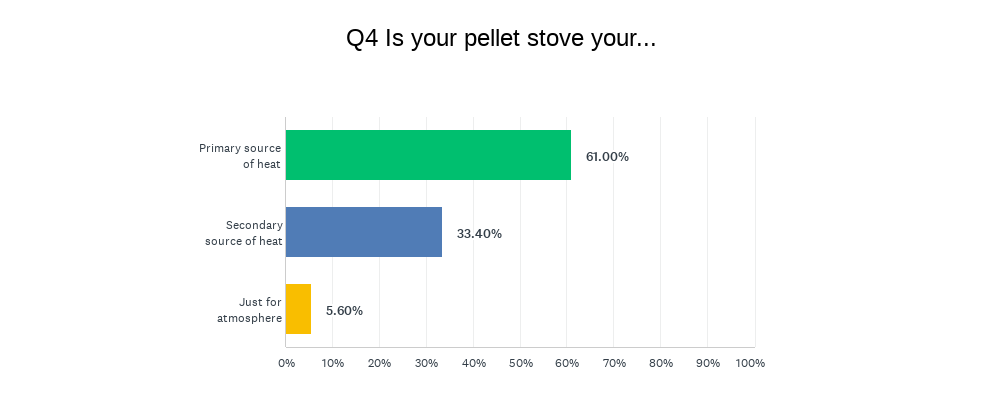
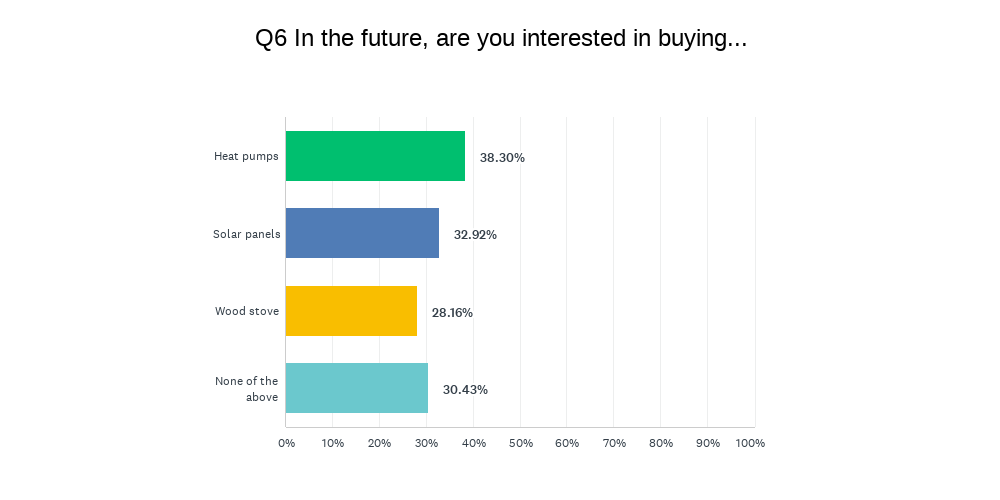
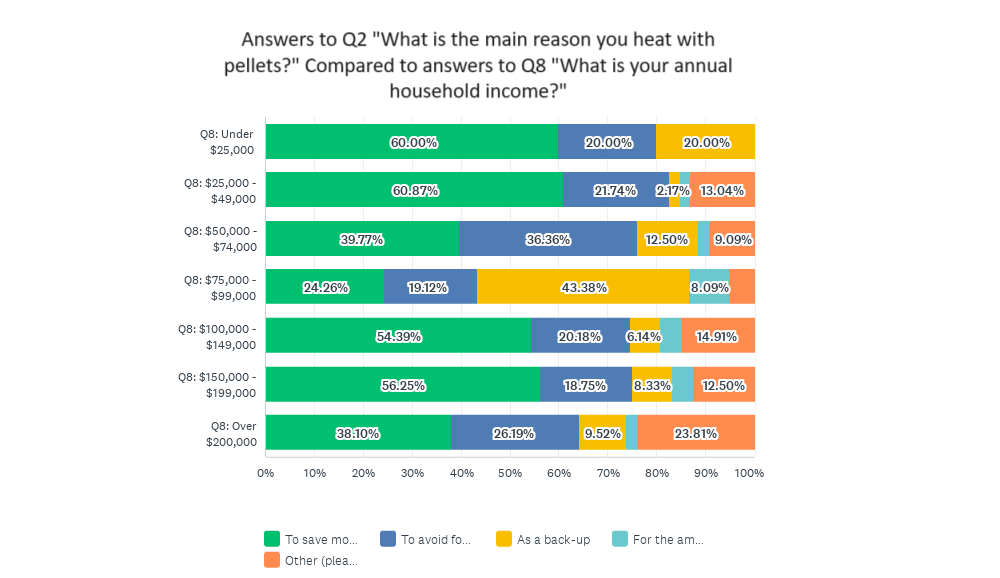
Of this group, 61% of the 486 respondents used their stoves for primary heat and in the future 38% were interested in buying heat pumps and 33% were interested in buying solar panels. Unlike households adopting solar panels, the primary reason homes adopt pellet stoves is for the substantial short term cost saving.  In the survey, all income groups except one listed “saving money” as the most common reason to heat with pellets.


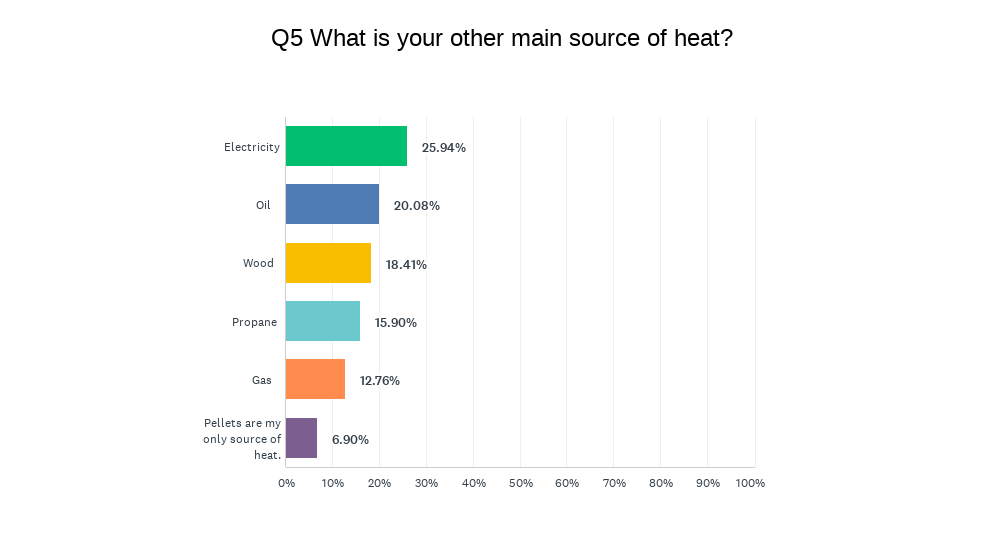
Twenty-six percent of households with pellet stoves displaced electric heat (both resistance and heat pumps) 20% displaced oil, and 18% displaced wood, 16% displaced propane and 13% displaced gas. This along with several other questions showed a high crossover with wood and pellet stoves, as many households that used to heat with wood have moved to pellet heat. In some cases, the reverse also happens with homes moving from pellets to wood fuel. 


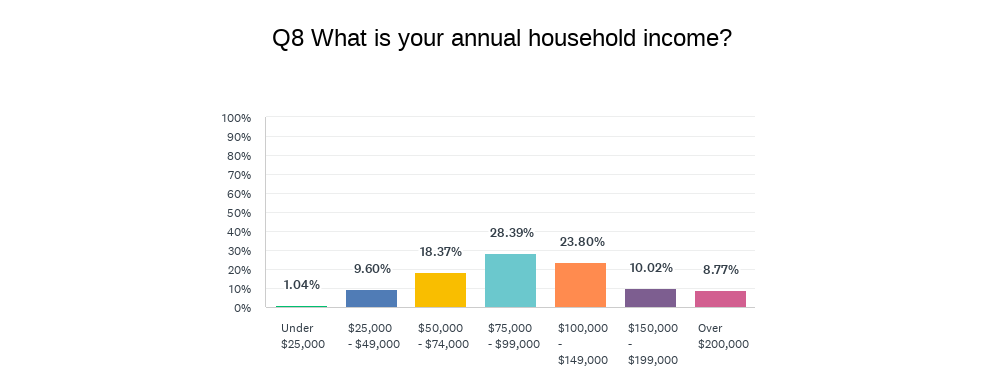
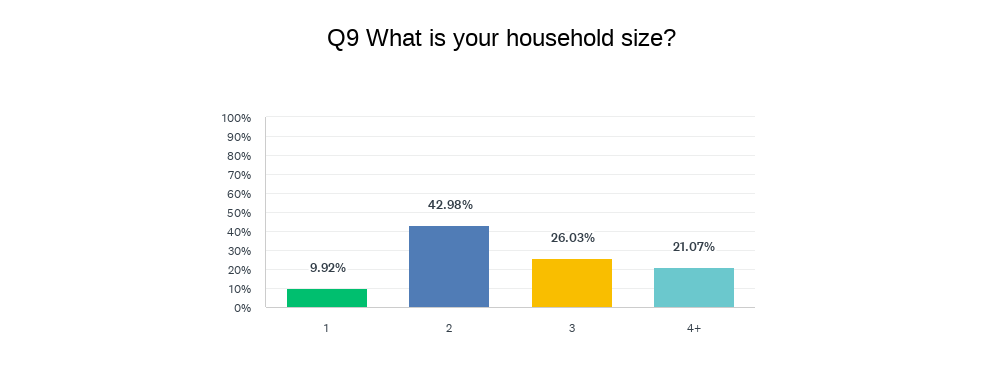
The median annual household income group was $75,000-$99,000, higher than than the national median ($74,580), and significantly lower than the median average income of homes with solar panels ($117,000 in 2022). The number of people per household was close to the national average with an average of 2.58. The national average is 2.51.


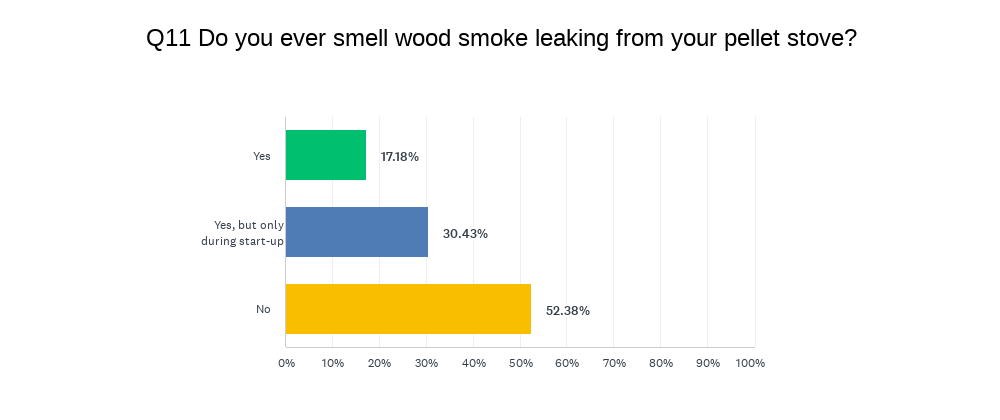
The survey also asked if pellet stove owners smelled smoke from their stoves and 17 % said they did, and 52% said they didn’t. In between those groups, 30% said they only smelled it during start-up which in most homes is no more than once a day. 


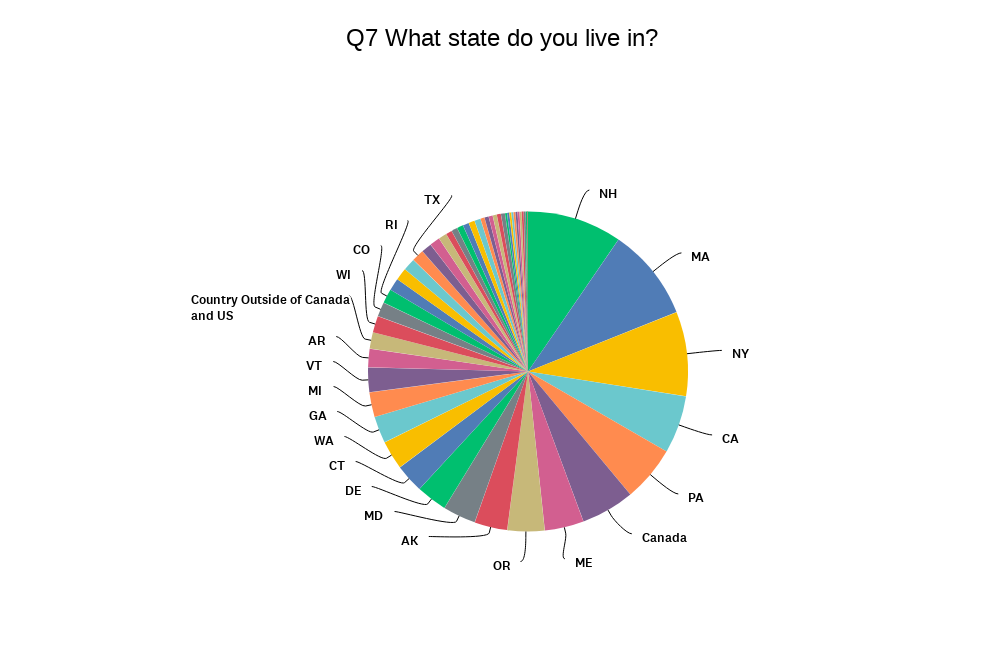
Survey respondents were from across the county, with respondents from every state except five, mostly in the deep south. The top 5 states were New Hampshire (10% of responses), Massachusetts (9%) and New York (9%), California (6%) and Pennsylvania (6%). Canada and countries outside of Canada and the US had 7% of responses. 


Scores of state and national studies show that small scale wood and pellet heat is enormously important to the transition away from fossil fuels both here and throughout Europe, in part because it does not strain the grid in the winter, and complements available renewable electricity.


Pellet heating has grown considerably in America, but public education lags, and there remains a lot of confusion about the export of pellets to make electricity versus the use of pellets for domestic heating.  The US Energy Information Administration publishes vital data about pellet production in America that can help clear up some of this confusion. 


Data from Each Question

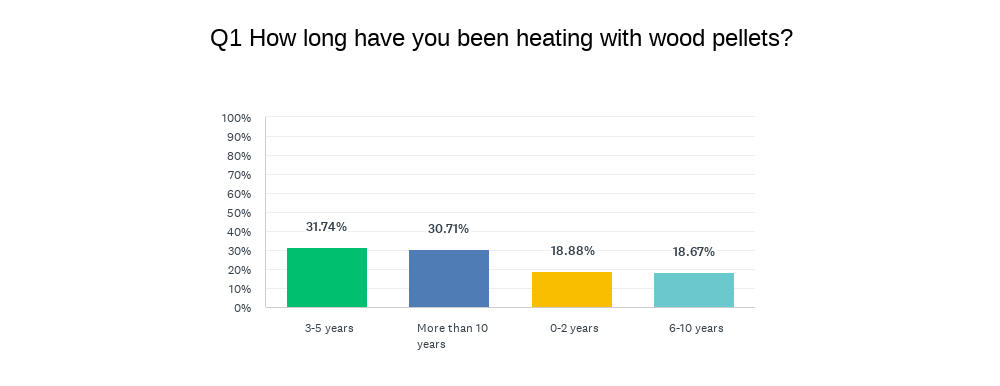
Q1. How long have you been heating with pellets? The responses show a range of households who are just starting to use a wood stove, to those who have used them for a long time. That indicates that there is continued interest by new people in starting to use pellet stoves.

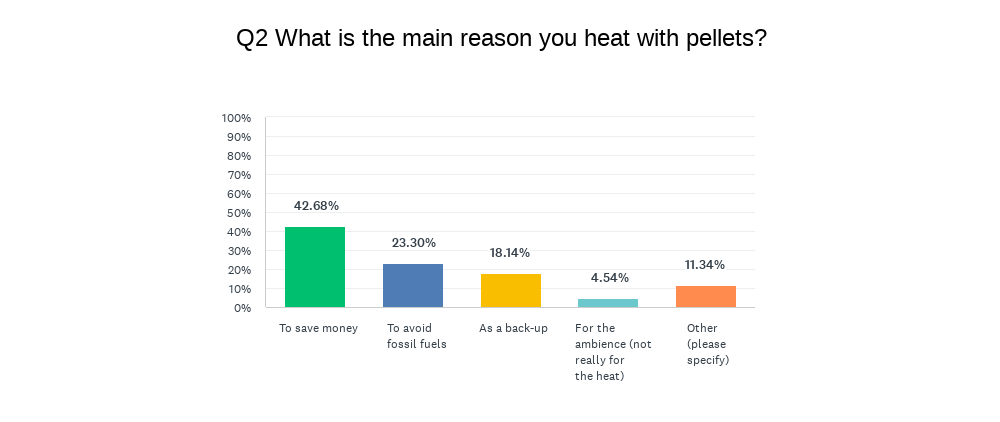
Q2. What is the main reason you heat with pellets? Respondents were only allowed to pick one answer. Predictably, “saving money” was the leading reason, with 43% choosing this as their main motivation. But the surprising aspect is that so many people chose avoidance of fossil fuel as their main motivation (23%). The 18% choosing “as a back-up” could either be a regular or periodica back-up to another heating system or an emergency back-up if their other heating system broke down. Or, it could be people who have battery back-ups or generators so they can use a pellet stove during a power outage.

The three most common “Other (please specify)” comments were related to the following categories:

  1. The ease of use and consistency of pellet heat over log wood heat with comments such as, “Switched from firewood. Easier to deal with,” “Wood-fired heat, but more controllable than a wood stove,” and “Too old for firewood.”

  2. It’s popularity in supplementing other heat or areas of home with comments like, “Heat compensation, my furnace doesn’t keep up with a big drafty house,” and “Supplement heat for my basement.”

  3. Those heating with pellets because they are associated with the industry (pellet stove dealers, engineers, etc.)


Q3. Would you buy another? This may be one of the most surprising results: 85% said they would buy another pellet stove if their current one could not be fixed, with another 9% choosing “Maybe.” This indicates a strong loyalty to the appliance. For those who selected “Maybe (please explain),” their answers were concerned with whether the price of pellets remained reasonable and if their health still allowed them to deal with the physicality of pellets. Another popular reason for explaining further was that they were confident they could fix their pellet stove if it ever stopped working: “I’d probably just fix it because they’re easy to repair.” 

Q4. Primary or Secondary Heat? That 61%so many respondents use their pellet stove as a primary heater is somewhat surprising, since nationally, the number of people who use wood or pellet as a secondary heat source is higher than primary heat source. This may be because we tapped into a more enthusiastic demographic, or it may be an indication that pellet stove users use their stove for primary heating more than wood stove users. We also didn’t ask about house size, though we did ask about the number of people in the household, which averaged only 2.58. Thus, it may be that people who completed this survey have smaller homes, possibly close to the national median of 2,299 square feet for a single family home.

Q5. Other Main Source of Heat? Nothing surprising here. Electricity is the highest percentage with 26%, and many of those are likely homes with electric resistance heat or early model heat pumps which are not nearly as efficient as modern ones. It may come as a bit of a surprise to some that 18% of pellet stove users have cord wood as their other main source of heat. Cord wood is the third most common “other main source of heat” after electricity and oil, another indication that we may have reached a more hardcore, dedicated biomass heat demographic.

Q6. Interest in Heat Pumps or Solar Panels. Respondents could choose multiple answers on this one. On average, a respondent chose 1.3 options. We found it somewhat surprising to see such high interest in heat pumps and solar panels.

Q7.State of residence. No surprises here. The fact that we had such a good demographic diversity shows that our data doesn’t just represent one part of the country. 

Q8. Household income. According to the US Census, the median household income was $74,580 and the average was $74,755 in 2022. Both fall right below the median income bracket of the respondents of our survey ($75,000 - $99,000). This shows a lower household income for this group compared to homes that have solar panels, or drive electric cars.


Q9.Household size. The average household size is 2.58, slightly larger than the national average of 2.51.

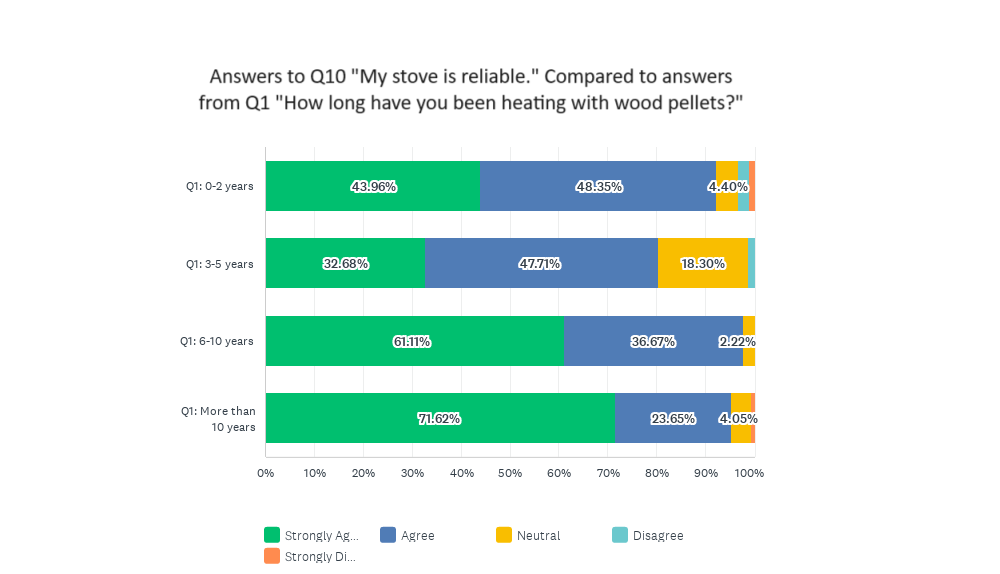
Q10. Is your stove reliable? The number of households who strongly agreed or agreed that their pellet stove is reliable is remarkably high (90.1%). 

Q11. Do you smell wood smoke? While a majority did not smell any smoke in their house, 30% smelled some on start-up. And the fact that 17% of this group say they smell it more regularly is significant enough to warrant further study into this problem. AGH has done some at-home testing and found start-up smoke to produce about the same amount of PM as making breakfasts or dinners that involve frying, using a griddle or making well-done toast. While this was not an in-depth study, AGH believes that the very small amount of smoke during start up could be partially caused by stoves not being sufficiently cleaned, or it may be a design flaw in some stoves that are not completely airtight and can leak.

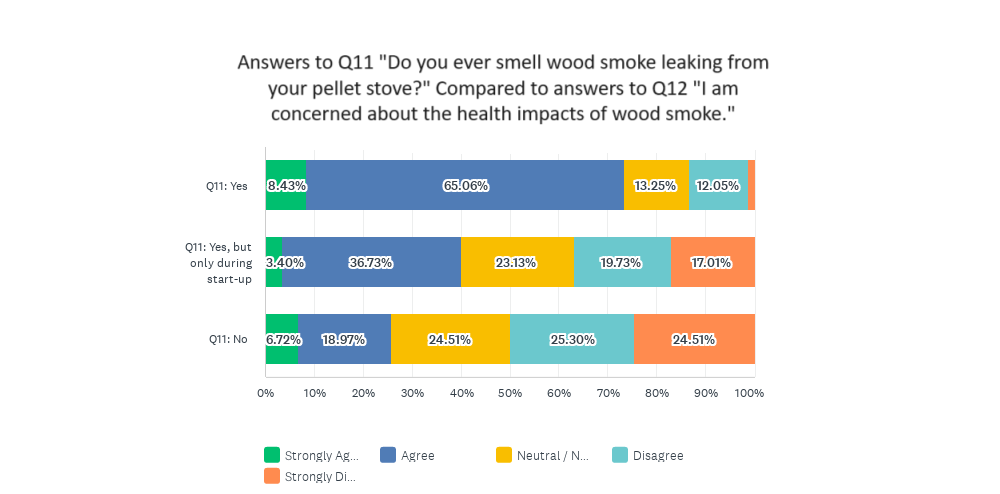
Q12. Concern about health impacts of wood smoke. This question was not worked as well as it could have been, because it could be interpreted two ways: first, are you concerned about the health effects of wood smoke generally, or are you concerned about the health effect of wood smoke from your own pellet stove. Thus, someone could be extremely concerned about the health implications but answered that they weren’t concerned because they didn’t smell it in their own home. 


All of these tables can also be viewed on the Survey Monkey platform.


Overlaying Responses from Two Different Questions


Survey Monkey allows you to take the individual answers of a question and see how those people answered another question, because all answers are attached to an IP address. Thus, we were able to see how different demographics answered different questions.


Income and main reason to heat with pellets


On Q2 overlaid with Q8, reasons for heating with pellets vs. income, saving money was the top rationale for all income categories exempt the middle, median income bracket. Lower income brackets favored saving money to some extent, and no one in the lowest bracket used their stove for ambience. As for being motivated to reduce fossil fuels, there is no clear pattern based on this sample of 486 people. 


Main reason to heat with pellets and interest in buying other appliances


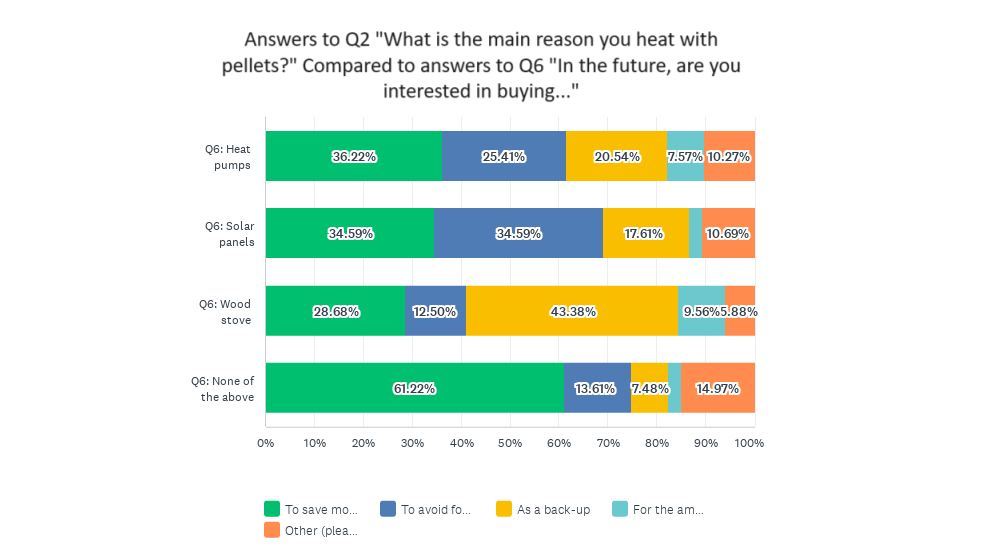
Comparing Q2 and Q6 unsurprisingly shows that people who heat with pellets who are more motivated to reduce fossil are the most likely to be interested in buying solar panels. And people who are more motivated to save money least interested in solar or heat pumps.


Reliability vs. interest in buying another pellet stove 


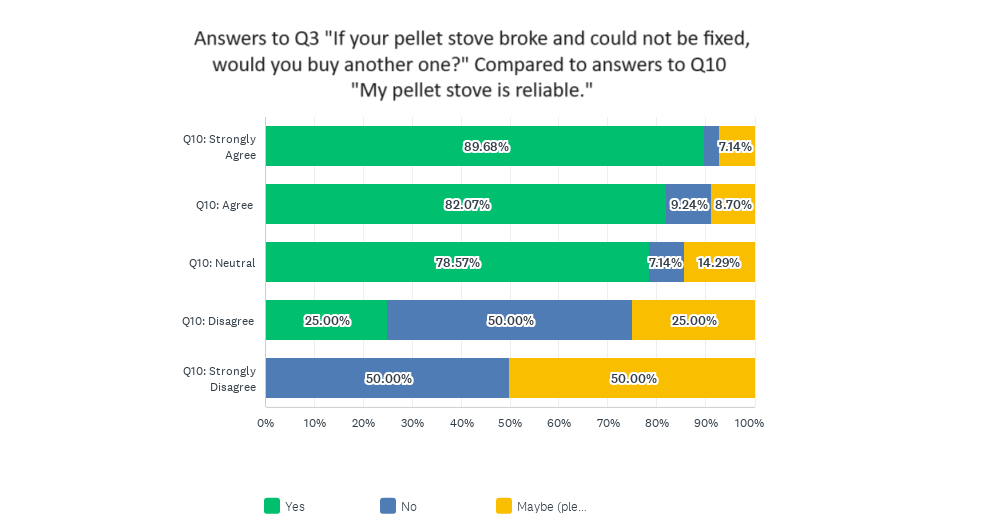
Unsurprisingly, overall those who agreed or strongly agreed that their pellet stove was reliable were most likely to want to buy another one if it broke down. Those who strongly agreed that their pellet stove was reliable were more than twice as likely to want to buy another. 


Reliability and length of ownership


In this comparison, those who had their stove for longer than 10 years reported higher levels of satisfaction with reliability. And it was the group who owned stoves for 3 - 5 years who reported lower levels of satisfaction with reliability, possibly indicating that this is the period that repairs may be the highest.


Smelling smoke and length of ownership


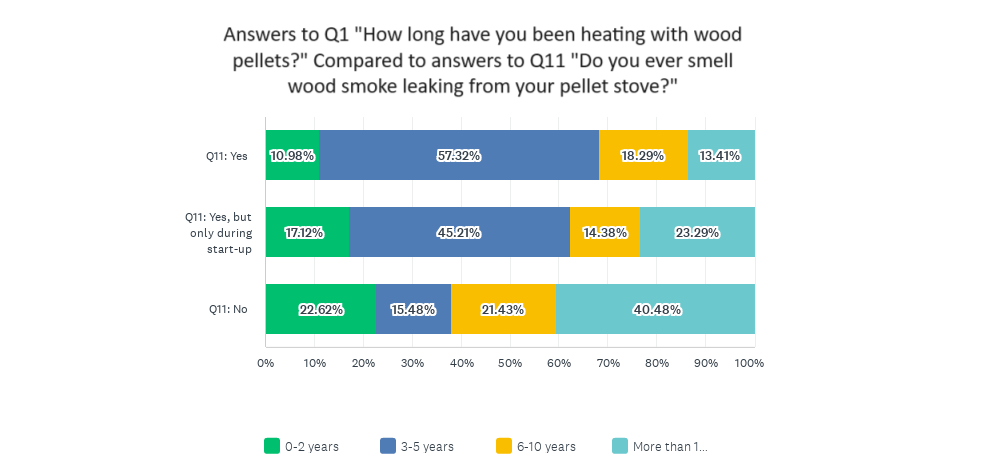
This indicates that the group who smells smoke the most is 3 - 5 year ownership and that the longer you own a stove the less smoke you report smelling. 


Overlap between smelling wood smoke and being concerned about it 


When comparing the answers of concern to those having reported that they were smelling smoke, a majority of those smelling smoke were also concerned about the impacts of wood smoke. Those who did not smell wood smoke from their stove were least likely to consider it a health issue. (Again, the ambiguous wording of Q12 makes this comparison less useful.)


Issues and Limitations of the Survey Data


AGH intentionally created a short and simple survey to increase respondent activity but this also naturally made it more susceptible to bot activity. In addition, we offered two $75 gift cards which likely increased bot activity even more. Survey Monkey also did not have an option to include a CAPTCHA at the end of the survey, which would have been a simple tool that could have stopped some bot activity. 


Where IP addresses were repeated, and where the states also differed, the data was excluded from the analysis. Out of the original 626 responses, 140 of these were excluded on that basis. Bot activity appeared to be especially prevalent from batches of respondents identifying as being from Guam that also consistently submitted the same answer, with only one variation, for each submission. The exclusion of these responses did not significantly alter the results of any of the answers. 


Tuesday, January 3, 2023

Recommendations for California's wood stove replacement program

In the fall of 2022, the California Air Resources Board (CARB) published their draft guidelines for their annual wood smoke reduction program. The State legislature committed $5 million for the program that offers financial incentives for homeowners to replace older, high-polluting wood burning devices with newer, cleaner burning units.  The Alliance for Green Heat submitted the following comments, urging California to 1. focus first on households in more densely populated areas where the public health ramifications are the highest, 2. to consider the benefits of hybrid stoves over catalytic stoves and to expand the number of eligible non-cat stoves, 3. to make sure California fully integrates wood stoves into its energy audit and weatherization programs, which would lead to more voluntary stove removals and repairs, 4. and to study and better understand the actual carbon footprint of firewood based on estimates of how people source their wood.

Dec. 8, 2022 

Hon. Steven Cliff, 

Executive Officer

Channel Fletcher, 

Deputy Executive Officer, Environmental Justice

California Air Resources Board

1001 I St,

Sacramento, CA 95814


Dear Mr. Cliff and Ms. Fletcher,

Thank you for the opportunity to provide comments on your draft Program Guidelines to reduce wood smoke. Funds to replace older stoves with cleaner sources heat are funds well-spent, especially since many old stoves provide primary heat to homes of marginalized, lower-income households.  


1.      Focus on households in densely populated areas

Our biggest recommendation is to focus your resources on households in areas that are more densely populated and/or experience frequent weather inversions, where the public health ramifications of older wood stoves are the highest.  Stoves in very rural homes with few or no neighbors will have very few public health impacts. This is an area that more change-out programs should explore.  Hopefully, homes in these sensitive areas would opt for heat pumps or pellet stoves. For homes in densely populated areas, we would also encourage you to see if the home has a woodshed or a way to store their fuel.  


2.     Replacement devices

We fully support CARB’s decision to replace older wood stoves with low-carbon alternatives such as heat pumps and pellet stoves.  We would be wary to include electric resistance stove heaters because this may burden lower income homes with higher electric bills than they can afford, assuming electric rates rise in the future.  We are glad that CARB does not include gas stoves as that would have a counterproductive carbon impact and hinder electrification goals.

We do not have a high level of confidence in catalytic stoves as they often are not maintained or used properly as the years go by, especially in lower income homes who may not be able to pay to replace the catalyst when needed.  Hybrid stoves are a far better option, and we would urge CARB to focus on hybrid stoves because they still provide valuable PM reduction technology even if the cat is not engaged.  It is important to understand how stoves are likely to work in the real world, once they leave the lab, and cat stoves are a class of stoves that can work even worse than non-cats if they are not maintained or used properly, particularly after the home or stove is sold and the device is being operated by a new owner.  Some owners of older cat stove do not even know they have a cat stove.

We are extremely concerned that CARB is only making four models of non-cats eligible for change-outs. The four non-cats selected by CARB may operate better than some with greater testing flaws, but there is no proof that many non-cat stoves are just as good as the four you identify.  The process undertaken by the Alaska and NESCAUM was valuable in many ways, but it does not easily lend itself to being used to qualify stoves for change-out programs.  If CARB wants to identify non-cat stoves that would burn more cleanly, allowing more single burn rate stoves to qualify may be the best way.  However, most households do not want single-burn rate stoves, particularly if the stove is their primary heat source.  

A major dilemma for your program is that you are trying to serve many marginalized, lower income households and balance their legitimate energy needs with the impact their smoke will have on neighbors.  By choosing only 4 non-cats, you are sidelining the heating needs of these households in favor of a very questionable process to identify only 4 models, some of which are not likely to be available near these homes.


We support the effort undertaken by Alaska and NESCAUM but decisions like this, to select four stoves, takes their data beyond its usefulness. We think there is disconnect between limiting to 4 non-cats and serving low-income households.  Though we understand the desire to put Alaska’s work to use, it will likely be ineffectual in reducing PM in this change-out program. 


3.     Inspection, repair and safety

One of the best ways to start to identify, repair and/or remove old stoves is to ensure that local energy audits and weatherization programs have integrated wood stoves into their work.  Most energy auditors still do not have the training or the software to do undertake stove inspections, even though DOE and state regulations claim to require that all heaters are inspected.  If they did, they would find many self-installed stoves that are dangerous, higher polluting and in need of replacement or removal.  LIHEAP funding and low-income weatherization programs will cover these costs where the stove is the primary heat source.  If the stove is a secondary heater, these programs could cover repairs.  Few states have demanded that the US Department of Energy develop standards for inspecting wood stoves, like there are for boilers and furnaces, and the DOE is still hesitant to take this on, even though it would have a major impact for lower-income households across the country.  We urge CARB to review how wood stoves are inspected during energy audits and weatherization programs in California and see whether they are being repaired, replaced or removed.


4.     GHG reductions 

We are pleased that CARB is no longer using carbon to justify switching from a wood stove to a gas stove.  In its 2016-2017 Woodsmoke Reduction Program Guidelines, CARB stated, ”Switching from an uncertified wood stove to a natural gas or electric heating device reduces GHG emissions.”  We find this statement to be without scientific basis.  We understand that the GHG calculations are not central to how CARB runs this change-out program, but we want to open a conversation about it.  


In the current Program Guidelines, CARB seems to assert that 100% of carbon released from wood and pellets should be attributed to this form of heating.  The Guidelines say that “biogenic CO2 is included in the calculation of GHG benefits for these devices.”  We agree that some biogenic carbon should be included, as some carbon can be attributed to all energy sources.


To make scientific estimates of carbon released from firewood that would not have been released anyway, there is a lot of data that can be considered.  For CARB to start to gain a basic understanding of the carbon cycles from firewood, you could also ask on your change-out application, “where do you get your wood?”.  A researcher can also get data from a sampling of California firewood dealers and households who use firewood. 


By not engaging in basic research, CARB is putting the burden on low-income households who heat with wood and is inferring their carbon impact of their heating is far higher than it is. This flies in the face of current thinking about energy justice that seeks to remediate social, economic, and health burdens on those disproportionately harmed by the energy system. 


Estimating carbon from gas, oil and electricity involves a complex set of assumptions and calculations and there is no reason that similar effort could be made to assess the carbon cycle from firewood.


In California, as in the rest of the country, it is likely that a substantial number of homes who heat with wood acquire their firewood in a very responsible way by using dead and downed wood, as lower-income households do around the rest of the country.  A lot of firewood used for home heating could otherwise end up in the landfill where it would produce worse GHG emissions.  


The Minnesota Residential Wood Combustion Survey Results, (May 2019) done by the Minnesota Department of Natural Resources is one of the most definitive studies on firewood procurement and use.  The report says, “Most of the wood cut (84%) by residential households comes from dead or downed trees, land clearing, and logging residues (Table 15). Approximately 9.3% comes from live standing trees in the forest.”  This is a crucial statistic for understanding carbon impacts of firewood.  If 84% of wood cut by households comes from dead of downed trees, it means that carbon was already in the process of being released unlike when a live tree is cut.  


Household income generally correlates to how firewood is procured and how much firewood is used.  The lower the income of a household, the more wood they use and the more likely they gather their own wood, assuming wood is being used for heating, and not for recreation.  More urban and higher income families are more likely to purchase wood. The chart below is based on EIA data.

The Minnesota Residential Wood Combustion Survey Results, found that 60% of firewood is cut by households and 40% is purchased.


Table 15, below, provides further detail of where firewood comes from in Minnesota, and these trends are likely to exist in other states. 

Table 17 shows a breakdown of firewood from both household and loggers.  Even where firewood is provided by commercial loggers, most of it is still from trees that are dead, down or from the residues of a commercial harvest, which usually is for sawlogs (lumber).

In conclusion, we believe that whether firewood comes from a “locally or nationally approved” forestry plan is not as relevant as existing data about where firewood comes, how sustainable it is and how to understand carbon implications. From a carbon perspective, we believe a rigorous look at the carbon footprint across the value chain of gas production and usage will always be higher than the footprint of firewood, across its value chain. The Achilles heel of firewood is the excessive PM that comes from most wood stoves, and it is that PM which fully justifies change out programs like this one.

As we initially stated, we fully support this program and see it is improving over the years, and we hope that our comments help improve it in future years.  Thank you for undertaking the program and accepting comments from the public. 

Sincerely, 


John Ackerly

President

Further reading: State Parks give downed trees to public for firewood (March 2023)


Tuesday, June 23, 2015

Technology Design Challenge to Promote Top Performing Pellet Stoves

A yearlong project to test and assess pellet stoves is entering its first phase this summer.  This first phase focuses on the most popular pellet stoves in North America and aims to help consumers identify the most efficient stoves and how best to operate them.

(The Pellet Stove Design Challenge is now accepting applications for innovative pellet stoves and individual participants at the April 2016 Workshop.)

The initiative is being led by the Alliance for Green Heat with a wide group of partner organizations and stove experts.  Pellet stoves are increasingly popular in North America and Europe, are far cleaner than wood stoves and have enormous potential to replace fossil heating fuel. 

2013 Design Challenge
in Wash. DC
The second phase of the project will feature an international stove technology competition to spotlight innovative and high performing pellet stoves and prototypes.  The project will culminate in an international gathering at Brookhaven National Lab in New York, where pellet stoves will be tested and the top performers will receive awards.  The focus will not just be on low emissions and high efficiency in a test lab setting, but also in the hands of consumers.  The application to submit pellet stoves and stove prototypes for the competition will be available later this summer.  The competition and workshop is scheduled for the week of April 4, 2016.


Ben Myren, Tom Butcher and others
in a lab at Brookhaven at the 2014
Wood Stove Design Challenge
This pellet stove challenge marks the third Stove Design Challenge, and the second to take place at Brookhaven. Previous challenges, including the inaugural Wood Stove Design Challenge on the National Mall in 2013, focused on promoting technological innovations that would help ensure wood stoves burn cleaner in the hands of consumers.  All the Stove Design Challenges involve stakeholder engagement in testing and assessing stoves, the opportunity to see and understand how testing works, and workshops and roundtables that bring together industry, regulators, air quality groups, non-profits and the media.

Phase one: Testing of Popular Pellet Stoves

There are approximately one million pellet stoves in North America.  Unlike the wood stove market, which has many manufacturers, most pellet stoves are made by just a handful of companies.  The Alliance will independently test some of the most popular models made in North America and Europe for emissions and efficiency.  The first round of tests will follow EPA lab testing protocols, while the second round will approximate how some consumers might use the stoves to better understand the range in efficiency when stoves are burned clean as well as dirty.  We will also test the stoves for noise level and ease of cleaning and repair. We may also test heat output and efficiency differences using high and low quality pellets.

Prior to both rounds of testing, the Alliance will explain what test methods and procedures are to be   used and seek input from industry and other stakeholders.  Testing will begin in an EPA accredited test lab and then move to Brookhaven National Lab.  The project expects to produce some data about the variability and reproducibility of emissions and efficiency in pellet stove testing. 

Planning meeting for the 2013 Design
Challenge. Pictured (left to right) Ray
Albrecht, Rod Tinnemore, Mark Knaebe,
John Ackerly, Melissa Bollman, David
Agrell, Norbert Senf, Ellen Burkhard  &
Tom Butcher. Photo: by Norbert Senf

To get better baseline data on some popular stoves, the Alliance for Green Heat submitted a Freedom of Information Act (FOIA) request to the EPA asking for emission and efficiency data for each of the four tested burn rates.  The Alliance also asked for moisture and ash content of the pellets used in the certification tests.  The EPA provided some of the data but issued a partial denial for efficiency values, pending a process to see whether the stove manufacturers will challenge the release of that information.

Funding for the ongoing Wood Stove Design Challenge initiative has been provided by the New York State Energy and Research Development Authority (NYSERDA), Osprey Foundation, the US Forest Service and the Alliance for Green Heat.


More information about this yearlong project will be posted on our website, blog, Facebook page and monthly newsletter.