Showing posts with label census. Show all posts

Friday, June 28, 2024

Survey: Pellet stove owners love their stoves – and are also interested in heat pumps and solar panels

 Pellet stove adoption is growing and reached 25% of market compared to wood stoves in New England 

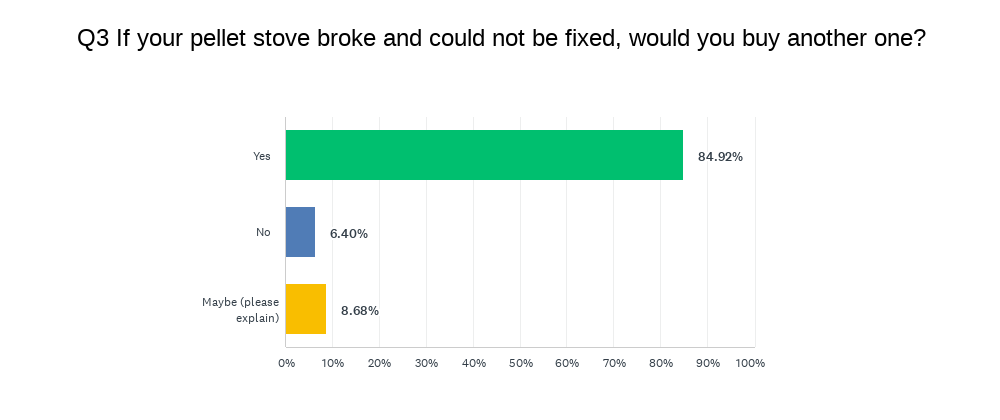
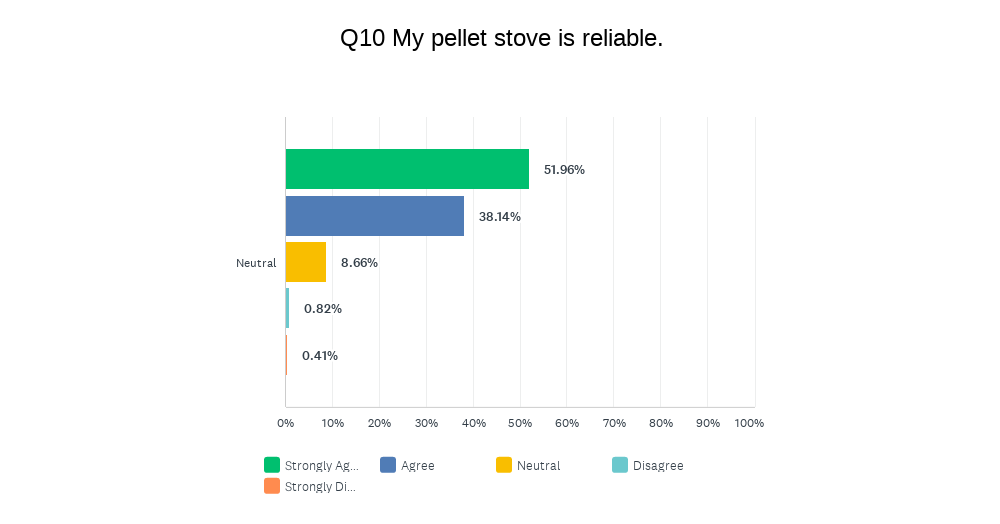
A survey taken by 486 people who use pellet stoves revealed some predictable and some unpredictable results. For instance, an overwhelming majority of pellet stove owners, 85%, said they would buy another pellet stove if theirs broke and 90% say their stove is reliable or very reliable, challenging a perception that pellet stoves are not very dependable. 


Pellet stoves are cleaner and more efficient than wood stoves and make up 25% of the stove market in New England, and 10% nationally, according to the US Energy Information Administration (EIA), Table CE7.1.  Until recently, likely around 5 years ago, American homes still made more renewable energy from wood and pellets than they did from residential solar photovoltaics, which have since surged past wood and pellet heat. 


The survey was undertaken between April and June of 2024 by the Alliance for Green Heat, an independent non-profit. AGH chose the Survey Monkey platform and circulated it through scores of social media pages, newsletters and neighborhood listservs. Thus, the survey is not rigorously scientific and likely over-represents pellet stove enthusiasts. Keeping that in mind, the data offers a glimpse into an important demographic of pellet stove users. By segmenting the data, we were also able to compare the views and values and pellet stove users based on income, region, motivation to buy a pellet stove and other characteristics. 


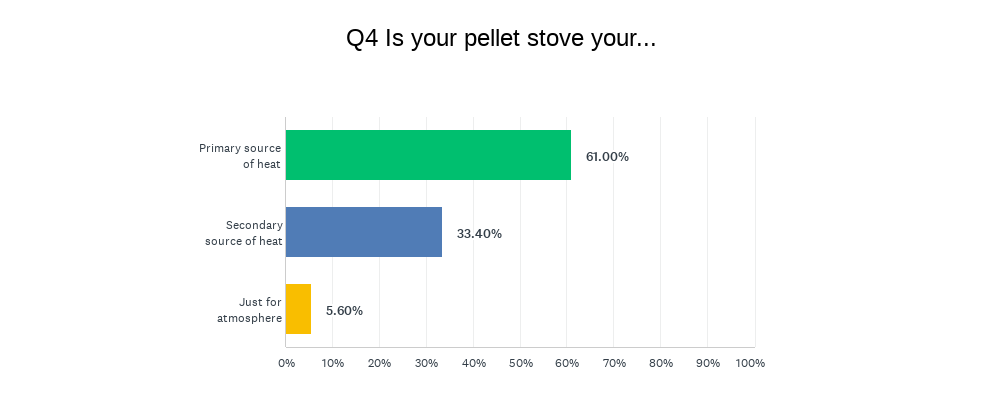
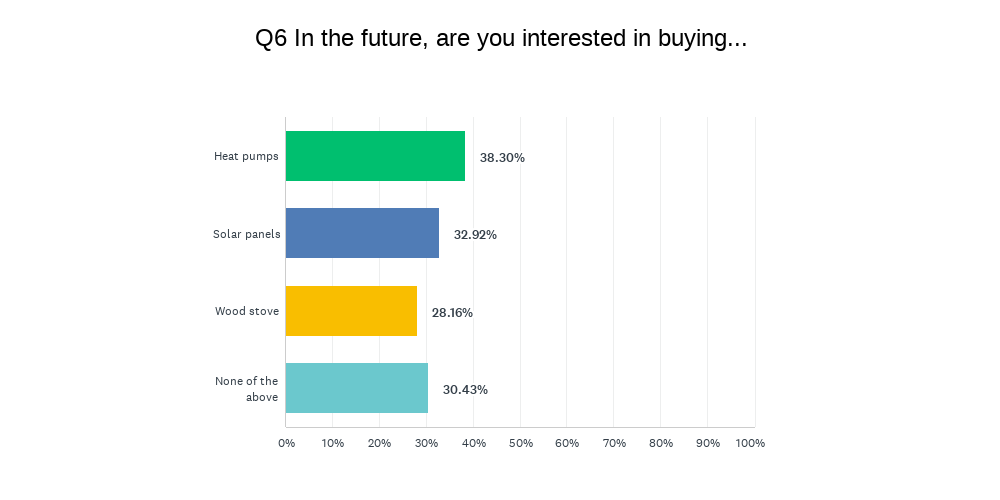
Of this group, 61% of the 486 respondents used their stoves for primary heat and in the future 38% were interested in buying heat pumps and 33% were interested in buying solar panels. Unlike households adopting solar panels, the primary reason homes adopt pellet stoves is for the substantial short term cost saving.  In the survey, all income groups except one listed “saving money” as the most common reason to heat with pellets.


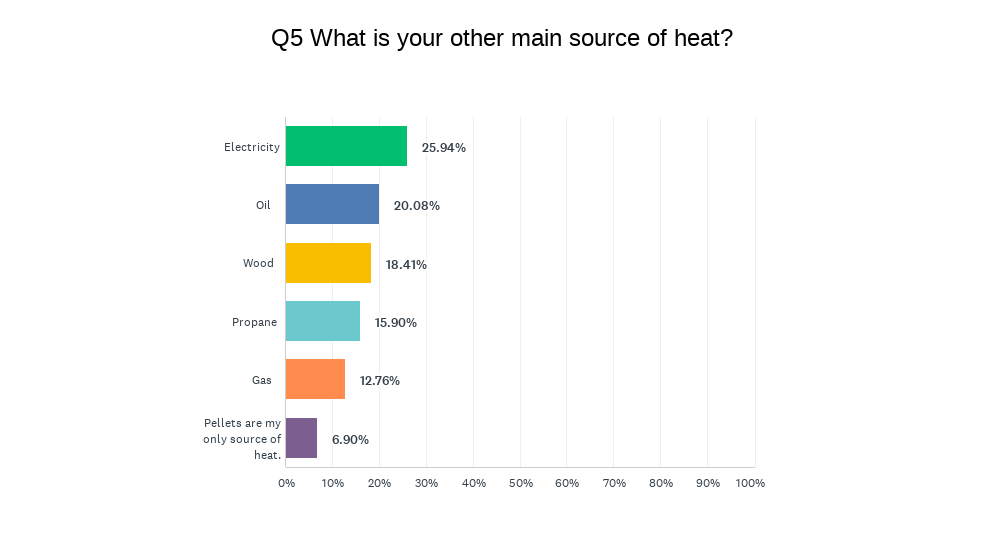
Twenty-six percent of households with pellet stoves displaced electric heat (both resistance and heat pumps) 20% displaced oil, and 18% displaced wood, 16% displaced propane and 13% displaced gas. This along with several other questions showed a high crossover with wood and pellet stoves, as many households that used to heat with wood have moved to pellet heat. In some cases, the reverse also happens with homes moving from pellets to wood fuel. 


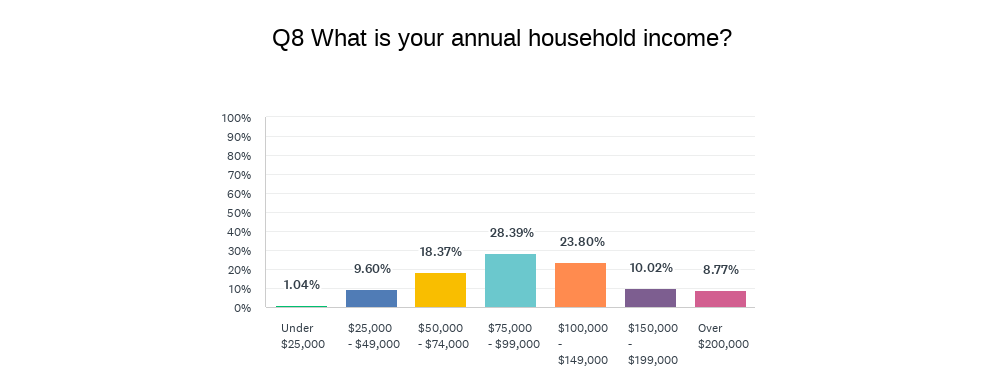
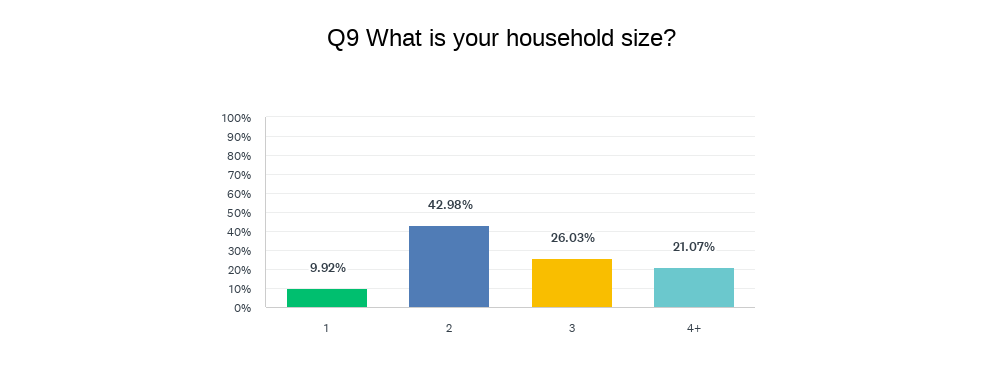
The median annual household income group was $75,000-$99,000, higher than than the national median ($74,580), and significantly lower than the median average income of homes with solar panels ($117,000 in 2022). The number of people per household was close to the national average with an average of 2.58. The national average is 2.51.


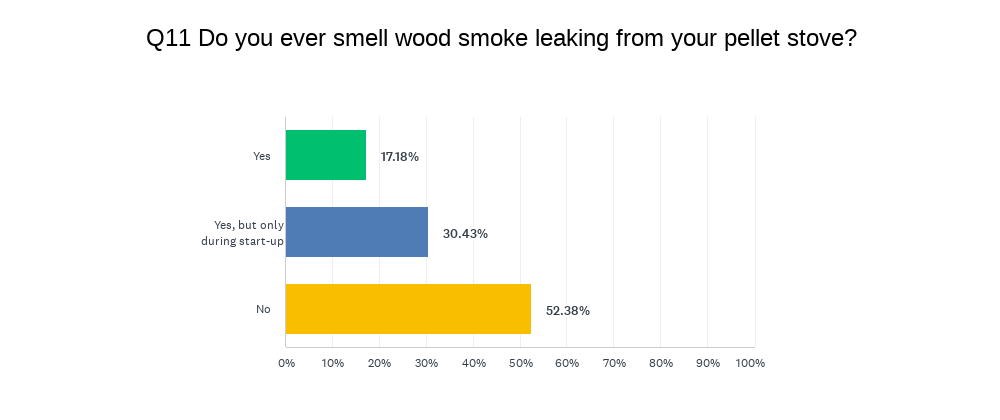
The survey also asked if pellet stove owners smelled smoke from their stoves and 17 % said they did, and 52% said they didn’t. In between those groups, 30% said they only smelled it during start-up which in most homes is no more than once a day. 


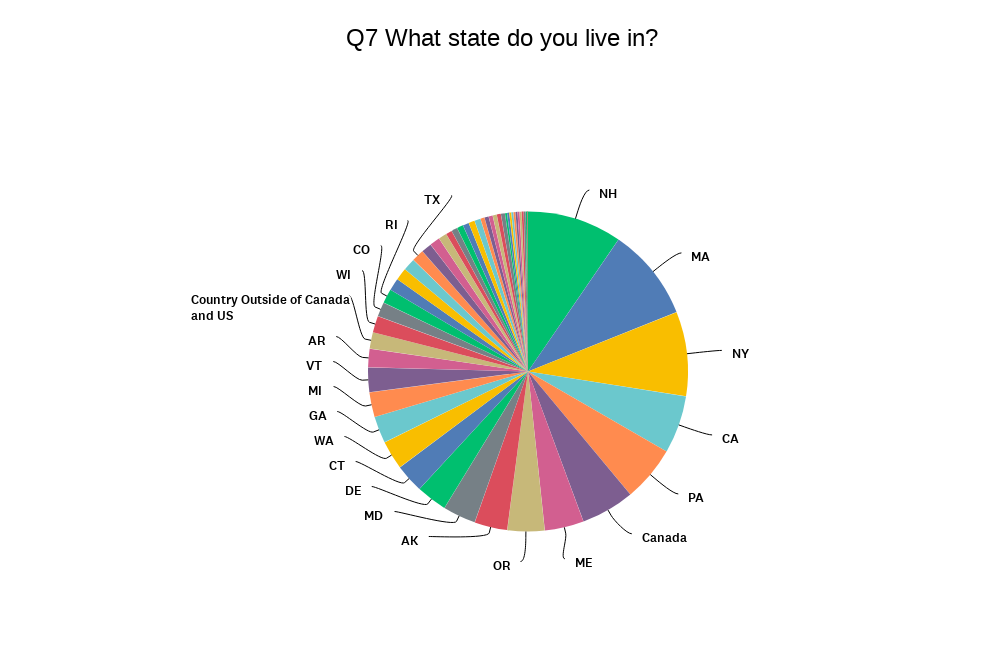
Survey respondents were from across the county, with respondents from every state except five, mostly in the deep south. The top 5 states were New Hampshire (10% of responses), Massachusetts (9%) and New York (9%), California (6%) and Pennsylvania (6%). Canada and countries outside of Canada and the US had 7% of responses. 


Scores of state and national studies show that small scale wood and pellet heat is enormously important to the transition away from fossil fuels both here and throughout Europe, in part because it does not strain the grid in the winter, and complements available renewable electricity.


Pellet heating has grown considerably in America, but public education lags, and there remains a lot of confusion about the export of pellets to make electricity versus the use of pellets for domestic heating.  The US Energy Information Administration publishes vital data about pellet production in America that can help clear up some of this confusion. 


Data from Each Question
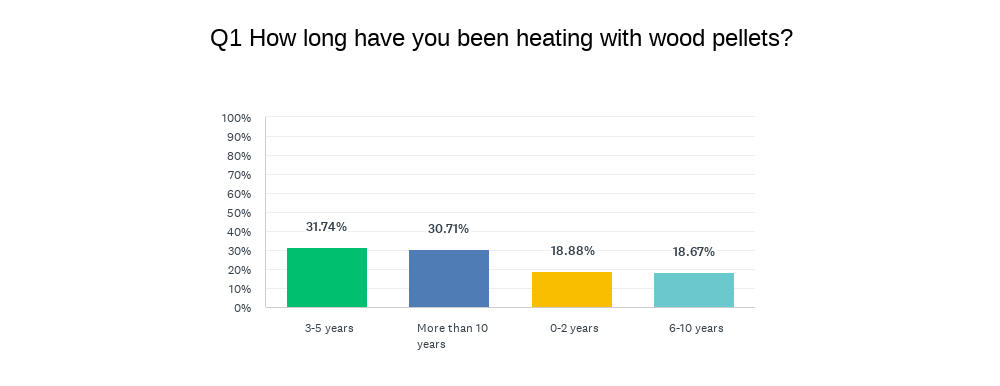
Q1. How long have you been heating with pellets? The responses show a range of households who are just starting to use a wood stove, to those who have used them for a long time. That indicates that there is continued interest by new people in starting to use pellet stoves.

Q2. What is the main reason you heat with pellets? Respondents were only allowed to pick one answer. Predictably, “saving money” was the leading reason, with 43% choosing this as their main motivation. But the surprising aspect is that so many people chose avoidance of fossil fuel as their main motivation (23%). The 18% choosing “as a back-up” could either be a regular or periodica back-up to another heating system or an emergency back-up if their other heating system broke down. Or, it could be people who have battery back-ups or generators so they can use a pellet stove during a power outage.
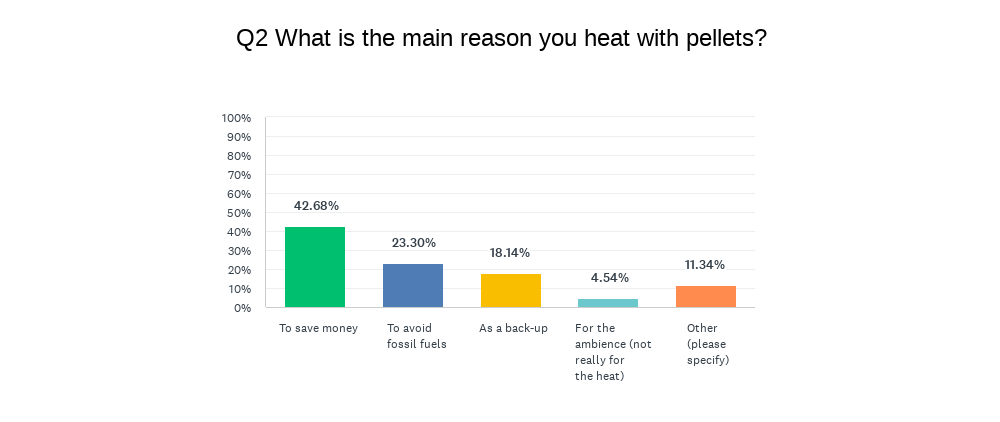
The three most common “Other (please specify)” comments were related to the following categories:

  1. The ease of use and consistency of pellet heat over log wood heat with comments such as, “Switched from firewood. Easier to deal with,” “Wood-fired heat, but more controllable than a wood stove,” and “Too old for firewood.”

  2. It’s popularity in supplementing other heat or areas of home with comments like, “Heat compensation, my furnace doesn’t keep up with a big drafty house,” and “Supplement heat for my basement.”

  3. Those heating with pellets because they are associated with the industry (pellet stove dealers, engineers, etc.)


Q3. Would you buy another? This may be one of the most surprising results: 85% said they would buy another pellet stove if their current one could not be fixed, with another 9% choosing “Maybe.” This indicates a strong loyalty to the appliance. For those who selected “Maybe (please explain),” their answers were concerned with whether the price of pellets remained reasonable and if their health still allowed them to deal with the physicality of pellets. Another popular reason for explaining further was that they were confident they could fix their pellet stove if it ever stopped working: “I’d probably just fix it because they’re easy to repair.” 
Q4. Primary or Secondary Heat? That 61%so many respondents use their pellet stove as a primary heater is somewhat surprising, since nationally, the number of people who use wood or pellet as a secondary heat source is higher than primary heat source. This may be because we tapped into a more enthusiastic demographic, or it may be an indication that pellet stove users use their stove for primary heating more than wood stove users. We also didn’t ask about house size, though we did ask about the number of people in the household, which averaged only 2.58. Thus, it may be that people who completed this survey have smaller homes, possibly close to the national median of 2,299 square feet for a single family home.
Q5. Other Main Source of Heat? Nothing surprising here. Electricity is the highest percentage with 26%, and many of those are likely homes with electric resistance heat or early model heat pumps which are not nearly as efficient as modern ones. It may come as a bit of a surprise to some that 18% of pellet stove users have cord wood as their other main source of heat. Cord wood is the third most common “other main source of heat” after electricity and oil, another indication that we may have reached a more hardcore, dedicated biomass heat demographic.
Q6. Interest in Heat Pumps or Solar Panels. Respondents could choose multiple answers on this one. On average, a respondent chose 1.3 options. We found it somewhat surprising to see such high interest in heat pumps and solar panels.
Q7.State of residence. No surprises here. The fact that we had such a good demographic diversity shows that our data doesn’t just represent one part of the country. 
Q8. Household income. According to the US Census, the median household income was $74,580 and the average was $74,755 in 2022. Both fall right below the median income bracket of the respondents of our survey ($75,000 - $99,000). This shows a lower household income for this group compared to homes that have solar panels, or drive electric cars.

Q9.Household size. The average household size is 2.58, slightly larger than the national average of 2.51.
Q10. Is your stove reliable? The number of households who strongly agreed or agreed that their pellet stove is reliable is remarkably high (90.1%). 
Q11. Do you smell wood smoke? While a majority did not smell any smoke in their house, 30% smelled some on start-up. And the fact that 17% of this group say they smell it more regularly is significant enough to warrant further study into this problem. AGH has done some at-home testing and found start-up smoke to produce about the same amount of PM as making breakfasts or dinners that involve frying, using a griddle or making well-done toast. While this was not an in-depth study, AGH believes that the very small amount of smoke during start up could be partially caused by stoves not being sufficiently cleaned, or it may be a design flaw in some stoves that are not completely airtight and can leak.
Q12. Concern about health impacts of wood smoke. This question was not worked as well as it could have been, because it could be interpreted two ways: first, are you concerned about the health effects of wood smoke generally, or are you concerned about the health effect of wood smoke from your own pellet stove. Thus, someone could be extremely concerned about the health implications but answered that they weren’t concerned because they didn’t smell it in their own home. 


All of these tables can also be viewed on the Survey Monkey platform.


Overlaying Responses from Two Different Questions


Survey Monkey allows you to take the individual answers of a question and see how those people answered another question, because all answers are attached to an IP address. Thus, we were able to see how different demographics answered different questions.


Income and main reason to heat with pellets
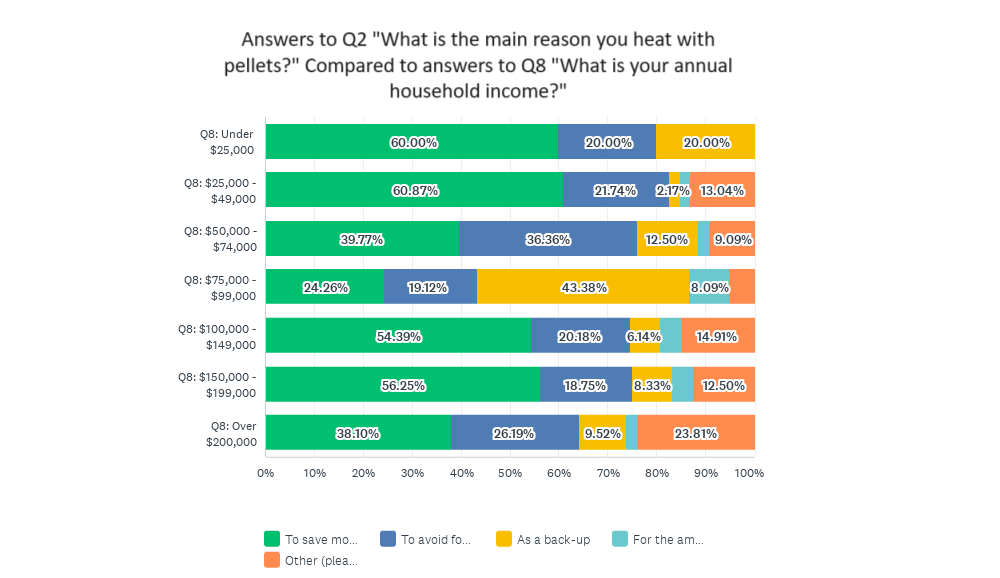

On Q2 overlaid with Q8, reasons for heating with pellets vs. income, saving money was the top rationale for all income categories exempt the middle, median income bracket. Lower income brackets favored saving money to some extent, and no one in the lowest bracket used their stove for ambience. As for being motivated to reduce fossil fuels, there is no clear pattern based on this sample of 486 people. 


Main reason to heat with pellets and interest in buying other appliances
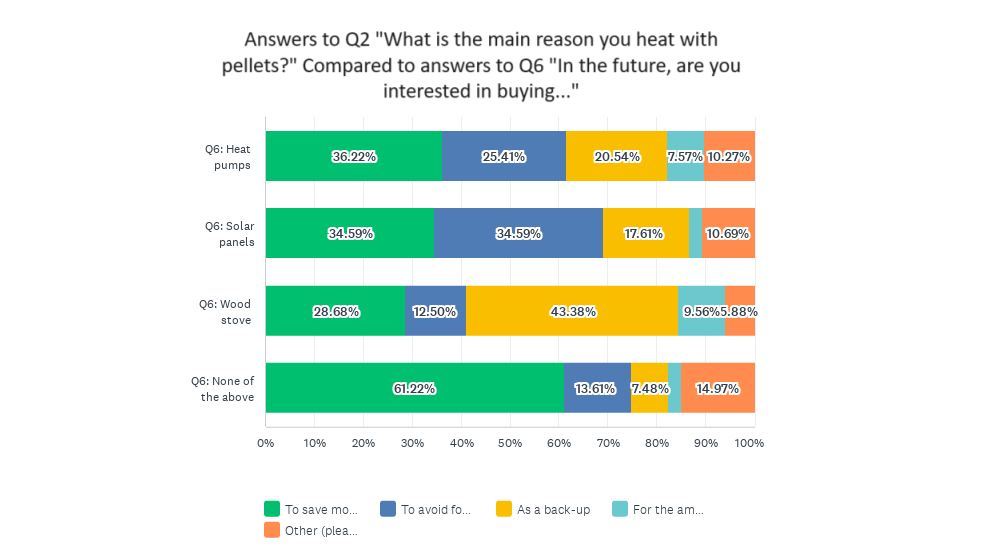


Comparing Q2 and Q6 unsurprisingly shows that people who heat with pellets who are more motivated to reduce fossil are the most likely to be interested in buying solar panels. And people who are more motivated to save money least interested in solar or heat pumps.


Reliability vs. interest in buying another pellet stove 
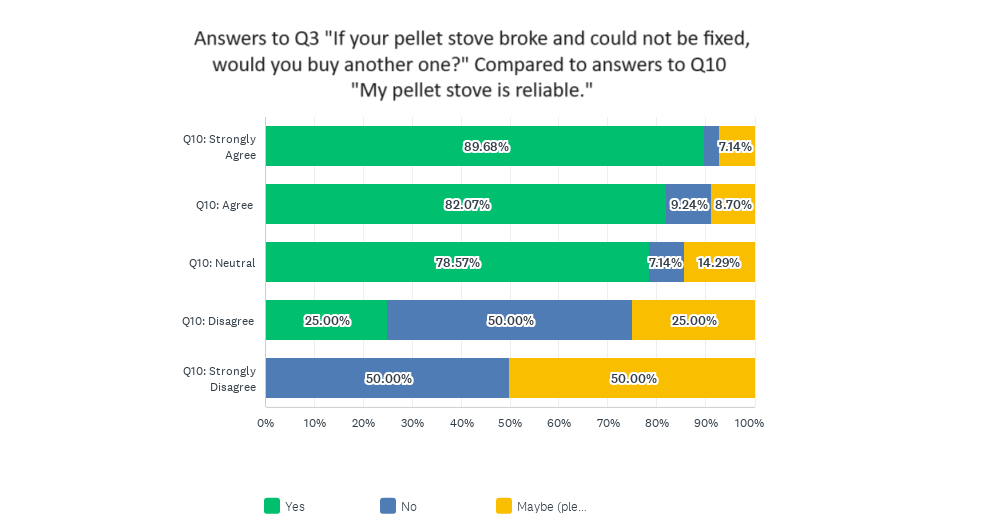


Unsurprisingly, overall those who agreed or strongly agreed that their pellet stove was reliable were most likely to want to buy another one if it broke down. Those who strongly agreed that their pellet stove was reliable were more than twice as likely to want to buy another. 


Reliability and length of ownership
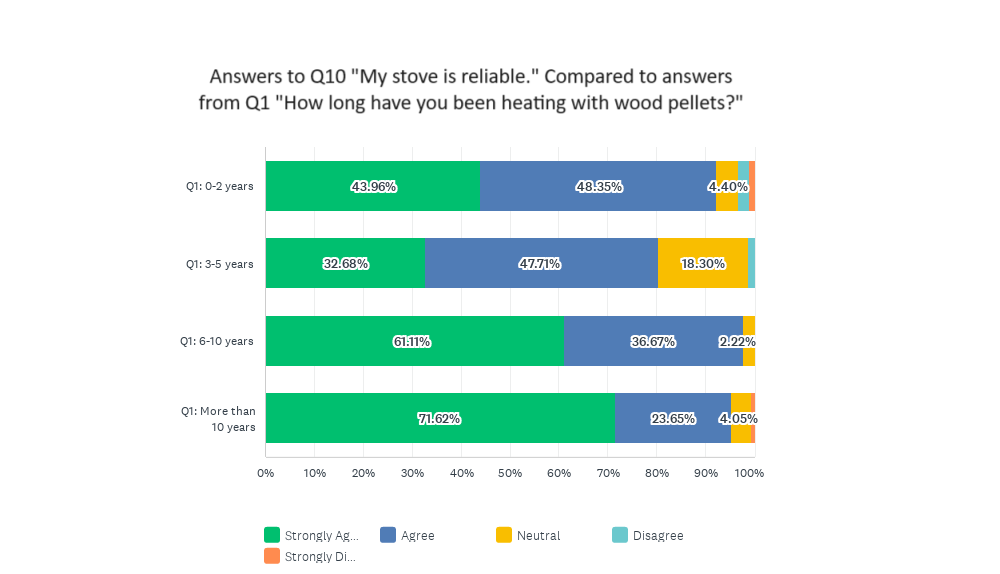

In this comparison, those who had their stove for longer than 10 years reported higher levels of satisfaction with reliability. And it was the group who owned stoves for 3 - 5 years who reported lower levels of satisfaction with reliability, possibly indicating that this is the period that repairs may be the highest.


Smelling smoke and length of ownership
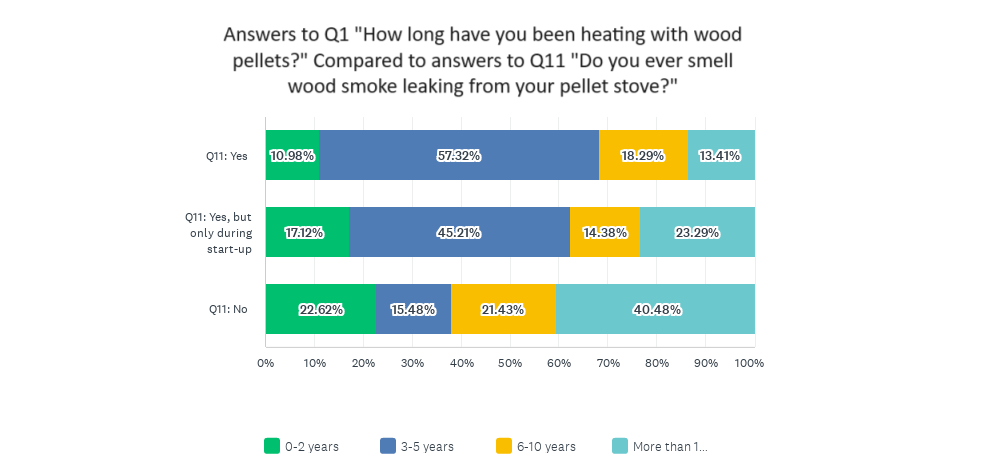

This indicates that the group who smells smoke the most is 3 - 5 year ownership and that the longer you own a stove the less smoke you report smelling. 


Overlap between smelling wood smoke and being concerned about it 
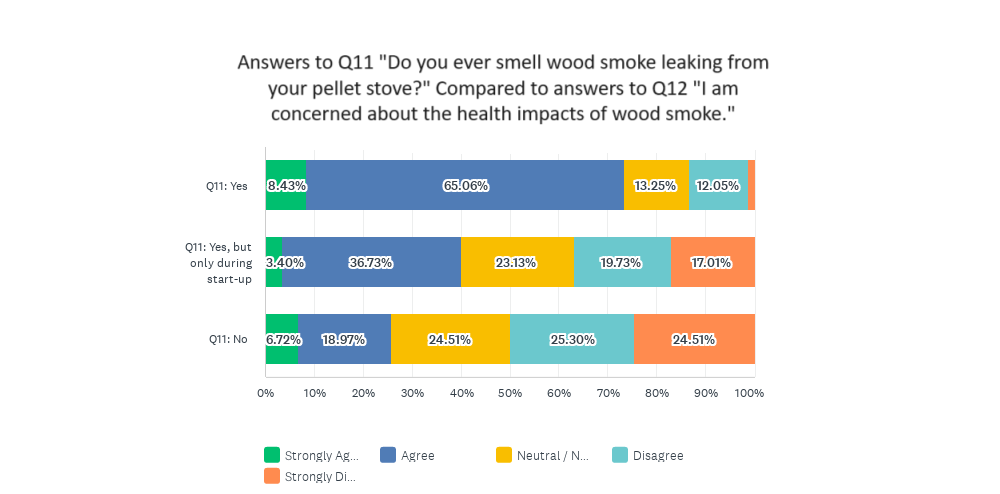

When comparing the answers of concern to those having reported that they were smelling smoke, a majority of those smelling smoke were also concerned about the impacts of wood smoke. Those who did not smell wood smoke from their stove were least likely to consider it a health issue. (Again, the ambiguous wording of Q12 makes this comparison less useful.)


Issues and Limitations of the Survey Data


AGH intentionally created a short and simple survey to increase respondent activity but this also naturally made it more susceptible to bot activity. In addition, we offered two $75 gift cards which likely increased bot activity even more. Survey Monkey also did not have an option to include a CAPTCHA at the end of the survey, which would have been a simple tool that could have stopped some bot activity. 


Where IP addresses were repeated, and where the states also differed, the data was excluded from the analysis. Out of the original 626 responses, 140 of these were excluded on that basis. Bot activity appeared to be especially prevalent from batches of respondents identifying as being from Guam that also consistently submitted the same answer, with only one variation, for each submission. The exclusion of these responses did not significantly alter the results of any of the answers. 


Thursday, May 9, 2024

Pellet stove owners needed for survey on pellet heating

 The Alliance for Green Heat has designed  a new survey to gain insight into how and why people use pellet stoves,  and what they like and don’t like about them.  Compared to the more traditional cord wood stoves, less is known about pellet stove users. Many studies and government agencies do not even distinguish between the two when discussing wood heat.  

If you used a pellet stove for home heating in the past year, please take the  Pellet Stove Survey.


The US Census does not distinguish between wood stoves and pellet stoves, but the US Energy Information Agency (EIA) began publishing basic information on the number of households using pellet stoves in 2009.  According to the EIA, one million Americans use pellet stoves.  Unlike the US Census, the EIA does not ask whether households use an appliance for primary or secondary heat, so it is unknown if pellet stove owners use their stove for primary heat more than wood stove users.  


This  survey was designed to be short to encourage maximum participation, and cover key issues.  Respondents may participate anonymously. Respondents who leave an email address, are eligible for a $75 gift card and/or have the results sent to them when the survey closes.  


Please take the  Pellet Stove Survey if you use one.

Monday, April 8, 2024

Alliance for Green Heat and USDA Forest Service partner to expand national network of firewood banks using local, renewable energy to assist low income households

AGH, April 8, 2024 - Alliance for Green Heat is making over $1 million available to expand and connect the nation’s network of firewood banks thanks to a grant from the USDA Forest Service made possible by President Biden’s Bipartisan Infrastructure Law. Firewood banks, similar in approach to food banks, provide a local, renewable and cost-effective heating source to households in need. 

Firewood banks can start applying for funds on May 1. Banks that have already received funding can apply for renewable grants on September 1. 

The program is intended to help firewood banks expand, be sustainable, deliver seasoned wood and improve safety practices. 

The Census Bureau estimates 1.9 million U.S. households use wood or pellets as a primary heat source. In rural areas, about 25% of homes use wood as a secondary heat source. In tribal communities, wood is often the primary heat source for the majority of households.  The top wood heating states, in order, are Vermont, Maine, Montana, New Mexico, Idaho, New Hampshire, Oregon and West Virginia. 

Forest Service Chief
Randy Moore

“Firewood provides a local, renewable source of heat for so many families across our country, especially in tribal communities,” said Forest Service Chief Randy Moore. “Thanks to the Bipartisan Infrastructure Law and our partners at Alliance for Green Heat, we are able to support the network of firewood banks that are providing lifesaving aid by ensuring more families can access the firewood they need.” 

Funding mostly goes to purchase tools, chain saws, splitters and protective safety equipment. Most firewood banks receive free logs from towns, tree trimmers, loggers and other donors but some have to purchase logs. They largely rely on volunteers to cut, split, season, and deliver firewood to local households who have run out of firewood and cannot afford to buy more.

Most communities in the United States have excess wood which is thrown away. An important source of firewood comes from efforts to remove material from forests that could potentially fuel a destructive wildfire, like dead or dying trees. 

In its first two years, the grant program funded 80 firewood banks in 24 states. 31% are operated by, or primarily serve, tribes, 19% by faith-based organizations and 47% by non-profits, towns, or community groups, and 3% by businesses.  During the first two year of the program, firewood banks produced more than 20,000 cords of wood to about 20,000 homes. On average, each firewood bank produces more than 200 cords per year, with many western tribal firewood banks leading the way producing 500 to several thousand cords. Nationally, the Alliance for Green Heat has identified more than 150 firewood banks and scores more are likely active. 

Volunteers prepare wood for thousands 
of homes in nearly every US state.
“Firewood is ‘the people’s fuel’, used by rural households who can’t afford fossil fuel, or are trying to be less dependent on it,” said John Ackerly, president of the Alliance for Green Heat.  “It is and always has been an affordable way to reduce fossil fuels and back up heat pumps but the challenge is using it without producing too much smoke.” 

As of May 1, existing wood banks who served households last winter and start-up firewood banks can apply for funding.  Firewood banks seeking a second, renewal grant can apply starting in September. For more information about firewood banks and to apply for funding, visit firewoodbanks.org.

About the Alliance for Green Heat

The Alliance for Green Heat promotes modern wood and pellet heating systems as a low-carbon, sustainable and affordable energy solution. The Alliance works to advance cleaner and more efficient residential heating technology, particularly for low and middle-income families. Founded in Maryland in 2009, the Alliance is an independent non-profit organization and is tax-exempt under section 501c3 of the tax code.


Friday, March 17, 2023

Wood smoke in low-income communities is an environmental justice challenge for the EPA


The Alliance for Green Heat, along with eight firewood banks across the nation that support the comment, submitted a response to the EPA's Request for Information on the Environmental and Climate Justice Block Grant Program (ECJ Program). This was a great opportunity to practice viewing wood heating through an environmental justice lens. Below is the submitted comment.


"Re: Environmental and Climate Justice Block Grant Program - Request for Information (Docket No. EPA-HQ-OEJECR-2023-0023)

Summary 

The Environmental and Climate Justice Block Grant (ECJ) program presents an opportunity to address marginalized communities who primarily heat with wood and experience excessive wood smoke that is a health hazard. The EPA has neglected wood heating technology and wood heating regulations, contributing to thousands of communities living with excessive indoor and outdoor wood smoke.  

Wood heating communities include many tribes and also rural areas in the colder parts of the United States that have always relied on wood heat. The technology has stagnated, in part due to lack of attention by the EPA and DOE, who appear to regard wood stoves as an antiquated appliance relied on by poor households, and not worthy of development.  A recent report from the EPA’s Office of Inspector General found that the EPA wood stove certification program is broken, leaving consumers vulnerable to stoves that may have higher emissions than they should (EPA OIG, 2023).  For decades, under administrations of both parties, the EPA’s wood heater certification program has been underfunded and understaffed, jeopardizing those communities that rely most on wood heat, which include many of the poorest rural populations.   

The OIG report recognized the environmental justice issue in poor communities that primarily heat with wood, but it used data that obscures the extent of the problem. The EPA looked at all households, including urban ones, rather than focusing on income levels of rural homes that use wood. A very flawed study commissioned by the EPA in 2010 found that “the average risk from residential wood smoke is lower for people living on Tribal Lands than for the general population,” (Analysis of Exposure to Residential Wood Combustion Emissions for Different Socio-Economic Groups, 2010). Thus, the final 2015 NSPS, the updated wood stove regulations, found that there were no “disproportionately high and adverse human health or environmental effects on any population, including any minority, low-income or indigenous population,” (EPA, 2015).

As our country electrifies and looks to the heat pump to decarbonize heating, wood stoves will likely remain popular for some time or even increase in popularity. In rural areas, power outages are becoming more, not less common, and people are wary of relying solely on electric heat. In addition, for millions of households wood is a free fuel and despite the efficiency of a heat pump, wood will always be cheaper than electricity. There still does not appear to be the political will at the EPA to address the needs of LMI communities that rely on wood to heat their homes.  

We urge the EPA to consider funding programs that:

  1. Change out old wood stoves for heat pumps or newer wood stoves, depending on the needs of LMI households.

  2. Support Firewood Banks that help LMI households get seasoned wood, energy audits, repairs for dangerous wood stoves and ultimately trade up to cleaner heaters.

  3. Explore the development of affordable, computerized wood stoves that drastically reduce PM and give households the chance to heat with a renewable without excessive air pollution.

  4. Provide training to do health and safety inspections of wood stoves during energy audits. Currently, energy audits programs for LMI households are not equitable in inspecting wood stoves, as they do for fossil fuel heaters which are typically found in wealthier homes.  Wood heaters should not be treated as a second-class appliance. 

By funding such projects, the ECJ program will help achieve Justice40 Initiative objectives by investing in cleaner, renewable heating in rural, firewood dependent LMI communities.  

Comment addressing item (2) types of actions related to President Biden’s Justice40 Initiative

We recommend that the Environmental and Climate Justice Block Grant program consider how best to support the fuel poverty and resilience of wood heating populations due to their rural geographic location and socioeconomic status. 


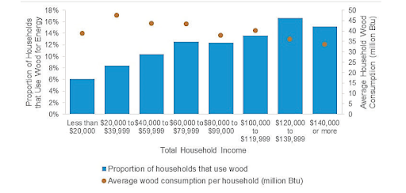
Lower-income households rely on wood heating more than higher-income households (Figure 1). The reasons for this range from accessibility to affordability. In our work, we hear stories of burning kitchen cabinets as a last resort for heating a home. Stories of elder community members making the choice of whether they should pay for heat, pay for their prescriptions, or pay for groceries is not uncommon. 


Figure 1. Data from 2015 OIG analysis of U.S. Energy Information Administration data. 

The average household income of homes using wood as a primary heat source is $76,490, the second lowest of any heating category (above homes that lack a primary heat source and just below homes that use electric heating) (Figure 2). 


No. of HomesAverage Household Income
Utility Gas58,643,017$102,942
Propane5,961,261$89,662
Electricity48,468,896$77,460
Fuel Oil5,426,218$102,019
Coal111,521$80,480
Wood2,022,868$76,490
Solar255,514$141,873
Other575,782$85,732
None1,337,827$74,136

Figure 2. ACS 1-Year Estimates-Public Use Microdata Sample. Average of US household income in past 12 months.


Energy production and distribution have created archetypal cases of environmental injustice—

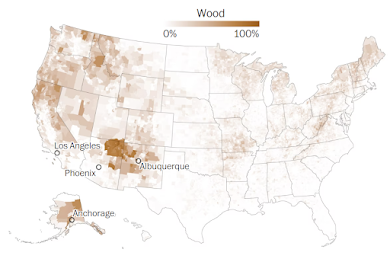
mountaintop removal for coal mining in Appalachia, nuclear waste siting on Navajo reservations in the West, oil refineries in southern Louisiana. Another example is the incredibly high percentage of homes that still heat with wood in poor rural areas that have not yet become part of the fossil fuel age. Areas where the majority population identifies as Native American, particularly in the Southwest, are likely to either heat primarily with wood or find it as the second most popular heating fuel in the area. This further makes the case that regulating and supporting wood stove households is an environmental justice issue. For example, in Apache County, Arizona, nearly 54% of homes are heated with wood (U.S. Census Bureau, 2021) with 71% of people identifying as Native American (U.S. Census Bureau, 2020). In McKinley County, New Mexico, a similar story. Around 44% of homes heat with wood (U.S Census Bureau, 2021) and 78% of people identify as Native American (U.S. Census Bureau, 2020). In San Juan County, Utah, about 38% of homes are heated with wood (U.S. Census Bureau, 2021) as 50% of the population identify as Native American (U.S. Census Bureau, 2020). These are not the only examples that represent the important role wood heating plays in Native American populations. Acknowledging that wood is used for primary heating by only 1.4% of homes nationally, this is a staggering rate of wood burners for a certain population and one that should not be overlooked when discussing funding to rectify environmental injustice (U.S. Census Bureau, 2021). The map below illustrates the concentration of wood fuel users by highlighting the often rural geography of their location as well as the prevalence of wood fuel on Southwest reservations. 

Muyskens et al. 2023. “U.S. home heating is fractured in surprising ways: Look up your neighborhood.” Washington Post. https://www.washingtonpost.com/climate-environment/interactive/2023/home-electrification-heat-pumps-gas-furnace/?itid=hp_desktop-dont-miss_p005_f002.  


Considering that there is legitimate concern over the capacity of our energy grid to handle increasingly harsh climate change-driven natural disasters (Climate Reality Project, 2022), wood stoves may help in some areas during the transition to electricity. Making sure wood stoves are safe to use in LMI households should be paramount. Maintaining realistic expectations for the performance of our energy grid, given that U.S. households experienced more electric disruptions in 2021 than the previous high level of disruptions in 2020 (U.S. Energy Information Administration, 2021), would ensure more energy resilient communities. In this way, wood stoves could play an empowering role for households that fear electric disruptions as well as the increasing costs (U.S. Energy Information Administration, 2023), and environmental concerns of natural gas (Jordan, 2022). 


Proper wood stove inspections, referrals for possible wood stove change-outs, and heat pump installation consultations when wood heat does not best serve a household anymore are needed. Multiple firewood banks that we have worked with have expressed interest in offering these services if they could secure funding to train volunteers to properly inspect and then facilitate the next steps to address the household’s needs. Firewood banks have an intimate view and partnership with fuel-poor households and are in a unique position to facilitate a more energy-equitable outcome. Because socioeconomic status and geography play such an intricate role in identifying environmental injustices, a mechanism to support firewood banks to provide these services would be of great help.


Providing households who struggle to keep their families warm with an emergency fuel source is one thing but ensuring that these families are using this fuel source in a safe wood stove appliance is another. We suggest that the ECJ grant funds programs address the reduction of indoor and outdoor air pollution, the prevention of house fires, and the repair or removal of wood stoves."


Signed By

Alliance for Green Heat 

Takoma Park, MD


Koho4Hopi 

Second Mesa, AZ


Pikunivi Wood Haulers

Second Mesa, AZ


Oglala Lakota Cultural & Economic 

Revitalization Initiative (OLCERI) 

Pine Ridge, SD


Kootznoowoo, Inc.

 on behalf of the village of Angoon, AK

Cullowhee UMC Project F.I.R.E.

Cullowhee, NC


Petersham Community Wood Bank

Petersham, MA


Rural Organizing and Resilience

Marshall, NC


St. Michael & All Angels Episcopal Church Wood Bank

Eureka, MT