Updated July 11 - The newest type of stove on the market is the automated or ‘smart’ stove that use sensors and computer chips to adjust airflow, instead of relying on the operator. Automated stoves enable the operator to "load and leave," allowing the stove to maximize efficiency and emissions reductions on its own. These stoves are likely to be the next major step towards cleaner residential wood heating because it is well-known that poor operation by the consumer is one of the main reasons for excessive smoke, and often it is the main reason.
Automation does not just seek to address poor operation by the consumer. It also can assess variable draft conditions caused by different chimney configuration, the altitude of the home, and the moisture content of the wood. In addition, automated stoves are often interactive, helping to educate operators through visual prompts or detailed apps on smart phones.
In Europe, automated stoves have been advancing far more quickly and are recognized as by the regulatory community as an important solution. In the U.S., the EPA and other agencies are focusing on an equally important process - improving test methods for manually operated stoves – with little attention to automation. Improved test methods still leave manually operated stove vulnerable to wildly variable real-world emissions.
Outside of regulatory circles, automated stove technologies have been promoted in the U.S. by the Wood Stove Design Challenge, a series of technology competitions, and by funding from the US Department of Energy in association with national labs. A 2023 study from Brookhaven National Lab described the technology as “a minimal set of measurement sensors and a heuristic control strategy to actively modulate incoming air to enhance stove combustion performance, thereby eliminating user-error as a factor for emissions production.” More recently, researchers at Oregon State University and Aprovecho Research Center are focusing on automated technologies that show PM reductions up to 95% compared to older models
The first such stove on the US market, MF Fire’s Catalyst, launched in 2016, is now off the market. The second, Charnwood, a British manufacturer entered the US market in 2020 with their Skye E2700. The company say, “This stove uses Charnwood I-Blu combustion intelligence that continuously monitors the state of the fire and optimizes efficiency while reducing emissions through real-time adjustments. Air is introduced in just the right amounts, in the right places, at exactly the right time to ensure a cleaner, highly efficient burn.”
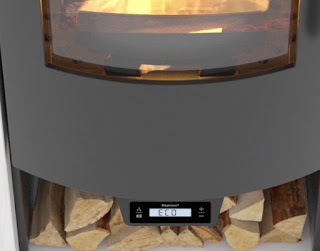
The Canadian manufacturer SBI won an award at the 4th Wood Stove Design Challenge for their progress toward an automated stove and they received a grant from the DOE to develop it. A final version of it is expected to be EPA certified and on the North American market later in 2025.
Automated stoves on the European market
In Europe there has been far more R&D and diversity of automated stove technology. Notably, in Europe, manufacturers highlight the environmental benefits of automation to the public and to the regulatory community. Models include:
Hase, Lima IQ (Germany)
Hwam SmartControl (Denmark)
Nordica, Larissa (France)
Rika, Rikatronic4 (Austria)
Scan Zensoric Technology, (Denmark)
Xeoos Twinfire Blue (Germany)
Wodtke, Stage F (Germany)
Full vs. partial automation. There are many ways to automate a wood stove and one of the main variables is whether the stove still has air levers that the operator can control. If the stove has controls for the operator, it is virtually impossible to tell if the automation can override the operator, or vice versa. Many consumers, particularly in North America, want to at least have the sense that they can control air flow, which is key to heat output. Otherwise, control of heat output can be with the amount and frequency of wood that is loaded into the stove. Also, there is always the question of whether and how well an automated stove works during a power outage. Most, if not all, can work, but will do so sub-optimally. Bi-metal springs that have been used for decades in stoves produce a very modest amount of automation to stoves, and they can be used in conjunction with electronic automation strategies.
Other features. Some stoves have a LED light that will come on when its time to reload the stove. Some are connected via wi-fi apps and can produce a sound to prompt the consumer when to reload. The Austrian company Rika has a feature where you load firestarter in the tray, add wood, and then you can program the stove to start remotely, as pellet stoves can.

Aftermarket solutions. Several companies have built devices that can monitor and/or control the airflow of existing stoves or be integrated into new stoves. Maxitrol is a leading supplier and makes the battery powered “E-Flame air control system” that drives an actuator to control primary and secondary air flow. It was designed in part to help companies meet future European EcoDesign Directives. The Danish stove manufacturer Aduro has had it’s Smart Response on the market for several years. The app-connected thermometer provides feedback to the consumer on their smart phone about whether their stove is burning well, and how to improve its use. Baltimore-based MF Fire is working on something similar. These technologies do not automate stove functions but monitor conditions and prompt the user to give the stove more air, add wood, clean their chimney, etc. Regulations and incentives to automate: In the United States, there is little regulatory pressure or incentives for manufacturers to automate. The new Integrated Duty Cycle (IDC) test protocols are designed so that manually operated stoves can pass without features that will reduce the routine and significant difference between lab and real-world emissions. It is imperative that the National Residential Heating Task Force test the automated stoves on the market in the U.S. and give them the profile that other stove types are getting. Currently, the test regimen may show the benefits of catalytic and hybrid stoves in the lab, without sufficient data or attention to how well cat stoves are used and maintained over their 10 – 20 year lifetime. Automated stoves may also have maintenance issues over their 10 – 20 year lifespan, and it’s important to start assessing which automation strategies are more robust. Test protocols are perhaps the best way to encourage manufacturers to innovate. Protocols can make it harder for manually operated stoves to pass by requiring air adjustments that are likely to produce more smoke, unless sensors in the stove can adjust airflow themselves. Making certification marginally tougher for non-cats to pass, leading to a growing percent of catalyst and hybrid stoves, is not an ideal solution compared to growing the number of automated stoves on the market.
At the state level, change-out and other incentive programs can start to recognize automated stoves and give them higher incentives. Massachusetts is the only state that sought to provide incentives to automated stoves in a change out program in 2017 but it came too early and automated models were delayed coming on the marketplace. States and air agencies can start to make consumers aware of this new type of wood stove, along with catalytic, non-catalytic, hybrid and pellet stoves.
The lack of attention and support for the development of automated stove technology in the United States is connected to similar lack of support for cleaner pellet heating appliances. Despite the ability of pellet stoves to emit very low levels of PM, the EPA allows them to emit the same level of PM as wood stoves, even though they have a different type of fuel, which should lead to stricter emission standards. In Europe, the EcoDesign Directive of 2022 requires pellet stoves to emit only half of what wood stoves are.
The lack of “eco” or “green” labels for wood stoves in the U.S. has left manufacturers with little incentive to produce cleaner or automated stoves. In Europe, some eco labels require pellet stoves, for example, to produce a quarter of the PM of wood stoves, and half of regular pellet stoves. Manufacturers selling on the US market have mainly focused on achieving 75% efficiency, in order to qualify for the tax credit under IRS Section 25C. Congress revoked that section, effective Dec. 31, 2025 and its unclear if it will be a permanent revocation or just for several years. The credit has often lapsed since 2005, when it first began. In Europe incentives have steered away from residential log heaters and focused on the best pellet stoves and boilers, which is a possible path forward in the U.S.
In Europe, some manufacturers feel that is not if, but when, they will have to start producing automated stoves. There is more urgency in Europe because of more widespread use of wood stoves in cities like London, and densely populated areas of Denmark, Netherlands, France, Germany and other countries. The German Blue Angel label and more local regulatory efforts, such as in Berlin, have also led to far more innovation and R&D on automation. As in the U.S., lobbying by industry is slowing efforts at national and local levels to pass stricter measures that could lead to quicker adoption of automated stoves and more reliance on pellet stoves.In early 2025, the European Commission released draft language of a new directive to take effect in 2027, including language that automation in stoves would be required. This led to strong industry push-back, and work on the new directive has been delayed. The European Committee of Manufacturers of Domestic Heating and Cooking Appliances stated:
“The requirement of for automatic combustion control systems, additional testing, second conformity contradicts Ecodesign principles: it increases costs, energy consumption and maintenance need, limits technological neutrality and makes appliances more expensive.”
“Any Ecodesign regulation should not favour specific technologies. It should be technology-neutral and allow manufacturers to choose how to meet the regulation's requirements…. Although not explicitly required, a stove without a built-in catalytic converter and electrostatic precipitator is unlikely to meet the emission requirements. All seven known Blue Angel stoves have these features.”

This industry response to the draft of the next European Directive has many valid points which will also be part of the landscape in North America. Regulators on both continents should shift their focus away from manually operated stoves and address these concerns and others as they move toward next-generation solid fuel heating solutions. One European study found automation reduced PM by 66% compared to one test method.
More resources on automated stoves
Eurocities, “Cities call for stronger EU rules on new wood-burning heaters to tackle deadly air pollution,” June 2025
AGH Webinar, “Harnessing Electronics for Cleaner, Smarter Wood Heating,” June 2025
14th U. S. National Combustion Meeting, “Forced-draft Airflow Control Tuned to Reduce PM Emissions in a Cordwood Room Heater Under Variable Operating Conditions,” 2025
Chemical Engineering Reactions. “Reducing Emissions from Current Clean-Burn Wood Stove Technology by Automating the Combustion Air Supply and Improving the End-User Interaction -Two Important Primary Measures,” 2023
IEA Bioenergy, “Design of Low Emission Wood Stoves,” 2022
Tarm Biomass, “Automated Wood Stoves: Technology Policies and Barriers,” 2017
Technical University of Denmark, “Guidelines for automated controls for wood stoves,” 2017
AGH Blog, “Automated stoves entering the marketplace,” 2014
AGH Blog, “Nine reasons manufacturers don’t use sensors in wood stoves,” 2013


