Showing posts with label Catalyst. Show all posts

Tuesday, January 3, 2023

Recommendations for California's wood stove replacement program

In the fall of 2022, the California Air Resources Board (CARB) published their draft guidelines for their annual wood smoke reduction program. The State legislature committed $5 million for the program that offers financial incentives for homeowners to replace older, high-polluting wood burning devices with newer, cleaner burning units.  The Alliance for Green Heat submitted the following comments, urging California to 1. focus first on households in more densely populated areas where the public health ramifications are the highest, 2. to consider the benefits of hybrid stoves over catalytic stoves and to expand the number of eligible non-cat stoves, 3. to make sure California fully integrates wood stoves into its energy audit and weatherization programs, which would lead to more voluntary stove removals and repairs, 4. and to study and better understand the actual carbon footprint of firewood based on estimates of how people source their wood.

Dec. 8, 2022 

Hon. Steven Cliff, 

Executive Officer

Channel Fletcher, 

Deputy Executive Officer, Environmental Justice

California Air Resources Board

1001 I St,

Sacramento, CA 95814


Dear Mr. Cliff and Ms. Fletcher,

Thank you for the opportunity to provide comments on your draft Program Guidelines to reduce wood smoke. Funds to replace older stoves with cleaner sources heat are funds well-spent, especially since many old stoves provide primary heat to homes of marginalized, lower-income households.  


1.      Focus on households in densely populated areas

Our biggest recommendation is to focus your resources on households in areas that are more densely populated and/or experience frequent weather inversions, where the public health ramifications of older wood stoves are the highest.  Stoves in very rural homes with few or no neighbors will have very few public health impacts. This is an area that more change-out programs should explore.  Hopefully, homes in these sensitive areas would opt for heat pumps or pellet stoves. For homes in densely populated areas, we would also encourage you to see if the home has a woodshed or a way to store their fuel.  


2.     Replacement devices

We fully support CARB’s decision to replace older wood stoves with low-carbon alternatives such as heat pumps and pellet stoves.  We would be wary to include electric resistance stove heaters because this may burden lower income homes with higher electric bills than they can afford, assuming electric rates rise in the future.  We are glad that CARB does not include gas stoves as that would have a counterproductive carbon impact and hinder electrification goals.

We do not have a high level of confidence in catalytic stoves as they often are not maintained or used properly as the years go by, especially in lower income homes who may not be able to pay to replace the catalyst when needed.  Hybrid stoves are a far better option, and we would urge CARB to focus on hybrid stoves because they still provide valuable PM reduction technology even if the cat is not engaged.  It is important to understand how stoves are likely to work in the real world, once they leave the lab, and cat stoves are a class of stoves that can work even worse than non-cats if they are not maintained or used properly, particularly after the home or stove is sold and the device is being operated by a new owner.  Some owners of older cat stove do not even know they have a cat stove.

We are extremely concerned that CARB is only making four models of non-cats eligible for change-outs. The four non-cats selected by CARB may operate better than some with greater testing flaws, but there is no proof that many non-cat stoves are just as good as the four you identify.  The process undertaken by the Alaska and NESCAUM was valuable in many ways, but it does not easily lend itself to being used to qualify stoves for change-out programs.  If CARB wants to identify non-cat stoves that would burn more cleanly, allowing more single burn rate stoves to qualify may be the best way.  However, most households do not want single-burn rate stoves, particularly if the stove is their primary heat source.  

A major dilemma for your program is that you are trying to serve many marginalized, lower income households and balance their legitimate energy needs with the impact their smoke will have on neighbors.  By choosing only 4 non-cats, you are sidelining the heating needs of these households in favor of a very questionable process to identify only 4 models, some of which are not likely to be available near these homes.


We support the effort undertaken by Alaska and NESCAUM but decisions like this, to select four stoves, takes their data beyond its usefulness. We think there is disconnect between limiting to 4 non-cats and serving low-income households.  Though we understand the desire to put Alaska’s work to use, it will likely be ineffectual in reducing PM in this change-out program. 


3.     Inspection, repair and safety

One of the best ways to start to identify, repair and/or remove old stoves is to ensure that local energy audits and weatherization programs have integrated wood stoves into their work.  Most energy auditors still do not have the training or the software to do undertake stove inspections, even though DOE and state regulations claim to require that all heaters are inspected.  If they did, they would find many self-installed stoves that are dangerous, higher polluting and in need of replacement or removal.  LIHEAP funding and low-income weatherization programs will cover these costs where the stove is the primary heat source.  If the stove is a secondary heater, these programs could cover repairs.  Few states have demanded that the US Department of Energy develop standards for inspecting wood stoves, like there are for boilers and furnaces, and the DOE is still hesitant to take this on, even though it would have a major impact for lower-income households across the country.  We urge CARB to review how wood stoves are inspected during energy audits and weatherization programs in California and see whether they are being repaired, replaced or removed.


4.     GHG reductions 

We are pleased that CARB is no longer using carbon to justify switching from a wood stove to a gas stove.  In its 2016-2017 Woodsmoke Reduction Program Guidelines, CARB stated, ”Switching from an uncertified wood stove to a natural gas or electric heating device reduces GHG emissions.”  We find this statement to be without scientific basis.  We understand that the GHG calculations are not central to how CARB runs this change-out program, but we want to open a conversation about it.  


In the current Program Guidelines, CARB seems to assert that 100% of carbon released from wood and pellets should be attributed to this form of heating.  The Guidelines say that “biogenic CO2 is included in the calculation of GHG benefits for these devices.”  We agree that some biogenic carbon should be included, as some carbon can be attributed to all energy sources.


To make scientific estimates of carbon released from firewood that would not have been released anyway, there is a lot of data that can be considered.  For CARB to start to gain a basic understanding of the carbon cycles from firewood, you could also ask on your change-out application, “where do you get your wood?”.  A researcher can also get data from a sampling of California firewood dealers and households who use firewood. 


By not engaging in basic research, CARB is putting the burden on low-income households who heat with wood and is inferring their carbon impact of their heating is far higher than it is. This flies in the face of current thinking about energy justice that seeks to remediate social, economic, and health burdens on those disproportionately harmed by the energy system. 


Estimating carbon from gas, oil and electricity involves a complex set of assumptions and calculations and there is no reason that similar effort could be made to assess the carbon cycle from firewood.


In California, as in the rest of the country, it is likely that a substantial number of homes who heat with wood acquire their firewood in a very responsible way by using dead and downed wood, as lower-income households do around the rest of the country.  A lot of firewood used for home heating could otherwise end up in the landfill where it would produce worse GHG emissions.  


The Minnesota Residential Wood Combustion Survey Results, (May 2019) done by the Minnesota Department of Natural Resources is one of the most definitive studies on firewood procurement and use.  The report says, “Most of the wood cut (84%) by residential households comes from dead or downed trees, land clearing, and logging residues (Table 15). Approximately 9.3% comes from live standing trees in the forest.”  This is a crucial statistic for understanding carbon impacts of firewood.  If 84% of wood cut by households comes from dead of downed trees, it means that carbon was already in the process of being released unlike when a live tree is cut.  


Household income generally correlates to how firewood is procured and how much firewood is used.  The lower the income of a household, the more wood they use and the more likely they gather their own wood, assuming wood is being used for heating, and not for recreation.  More urban and higher income families are more likely to purchase wood. The chart below is based on EIA data.

The Minnesota Residential Wood Combustion Survey Results, found that 60% of firewood is cut by households and 40% is purchased.


Table 15, below, provides further detail of where firewood comes from in Minnesota, and these trends are likely to exist in other states. 

Table 17 shows a breakdown of firewood from both household and loggers.  Even where firewood is provided by commercial loggers, most of it is still from trees that are dead, down or from the residues of a commercial harvest, which usually is for sawlogs (lumber).

In conclusion, we believe that whether firewood comes from a “locally or nationally approved” forestry plan is not as relevant as existing data about where firewood comes, how sustainable it is and how to understand carbon implications. From a carbon perspective, we believe a rigorous look at the carbon footprint across the value chain of gas production and usage will always be higher than the footprint of firewood, across its value chain. The Achilles heel of firewood is the excessive PM that comes from most wood stoves, and it is that PM which fully justifies change out programs like this one.

As we initially stated, we fully support this program and see it is improving over the years, and we hope that our comments help improve it in future years.  Thank you for undertaking the program and accepting comments from the public. 

Sincerely, 


John Ackerly

President

Further reading: State Parks give downed trees to public for firewood (March 2023)


Wednesday, July 18, 2018

Meet the teams: A young company automates the wood stove and challenges the established stove industry

This post is the ninth in a series introducing the 12 teams participating in the 2018 Wood Stove Design Challenge in November.

By John Ackerly and Shoshana Rybeck, Alliance for Green Heat 


Ryan Fisher
In 2013, a group of students from the University of Maryland with absolutely no experience in stove building, entered a stove into the first Wood Stove Design Challenge. They had built one of the first automated stoves in America and it worked surprisingly well though it clearly was a prototype that needed a lot of work. Some seasoned stove experts scoffed at their efforts, but they persisted and despite the odds, released the stove onto the market 2017.

The team is back for the 2018 competition with a new stove which is simpler and sleeker. Along they way, they morphed from a University team to a company, MF Fire, based in Baltimore and backed by some venture capital.

“We’ve learned a lot,” says Ryan Fisher, the 28 year-old COO of the company, who never imagined he would end up in a career working with wood stoves. They still have a lot of skeptics but they are starting to earn a niche in the industry as they continue trying to disrupt it. The company is based on the premise that “wood stoves haven’t changed much in decades but there is no reason a wood stove should be polluting, inefficient or difficult to use.” They use sensors that can find the combustion “sweet spot” that any stove can hit, but few stoves or operators can stay in the sweet spot for very long.

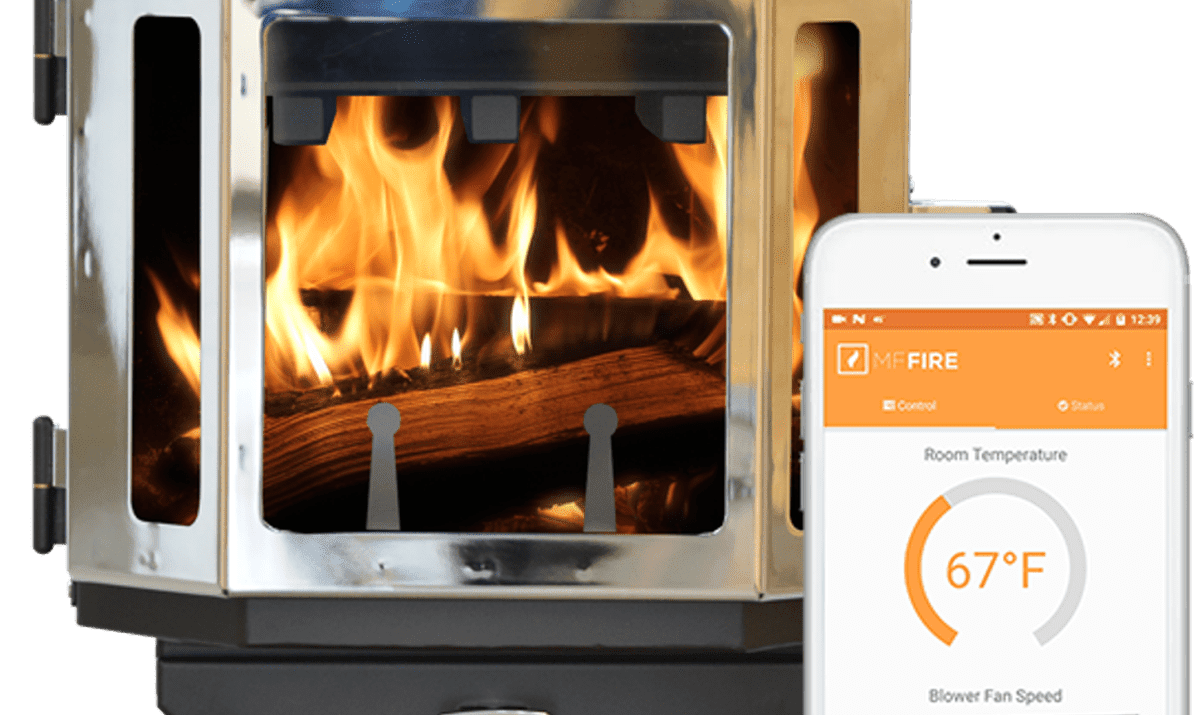
MF Fire developed an app where a user can control temperature and monitor the status of the fire inside the stove. Throughout, it’s collecting data to learn more about the environmental conditions as well as when the user likes to burn. Ryan told us that they “locate thermocouple within the stove in combustion areas. Based on the current and past readings of the stove as well as user inputs, the smart controller is able to make automatic adjustments to the combustion.”

MF Fires stoves can be 
controlled via aphone app

The company is now able to sell it for $4,000, trying to tap into environmentally conscious consumers who appreciate high tech appliances. The basic version of the stove, the Nova, that they are entering into the 2018 competition sells for only $2,490 but will have optional automated features that will bring the price over $3,000. The stove has a catalyst that is manually engaged and went through certification testing and met the 2020 standards as a single burn rate stove. Their model uses Schott Robox glass, a spondor of the 2018 Wood Stove Design Challenge. The company is now waiting for the EPA to formally approve the test and post the certification results.

Using technology to maximize efficiency - and safety
The new NOVA stove 

In addition to thermocouples that relay temperature data to the smart controller, the Catalyst and the automated version of the Nova have an induction fan integrated in the stack that can modulate air flow through the stove. Induction fans are perhaps one of the biggest ways to automate the operation of the wood stove in an industry relying on natural draft chimneys. Ryan says that “one of the biggest benefits of the fan is that it gets through the dirtiest part of the burn very quickly from a cold start. You can close the door right after lighting, and the sensors and fans will ensure the stove gets plenty of air. Unlike most other wood stoves, there is no need for leaving the door or ash pan ajar on Catalyst during startup.”

The thermocouple sensors, fan and smart controller also greatly enhance safety. They can prevent over-firing, which can be dangerous to the stove and lead to chimney fires, and they can prevent the conditions that lead to creosote build up in the first place. And, the MF Fire Smart App has wood stove safety features, including a built-in alarm that will alert an owner that a stove door has been left ajar, enabling the door to be secured quickly and safely.

MF Fire: A technology development company, not just a stove manufacturer

Ryan Fisher and the original Catalyst
MF Fire has been working on developing the smart controls for the stove, that will allow the user to better track their stove’s behavior, control its burn, and operate it safely.

MF Fire is a technology development company first and foremost, working to introduce modern smart controls to an age old form of heat production. Ryan believes that approaching this challenge from a technological development standpoint gives them a unique outlook that they are excited to share in November. Some stove manufacturers are churning out stoves designed 20 years ago and are mainly manufacturing companies, and have minimal in-house R&D capability. They may be skilled at creating well built stoves but they are part of a status quo in the industry that is not keeping up with the rapid technology changes that encompass modern appliances in the HVAC and all other sectors.

That technical acumen within MF Fire led their very first stoves to meet the stricter 2020 EPA emission limits and they hoped that their company would have an edge in the market as of 2020. Now that the EPA has signaled a willingness to consider delaying the stricter standards until 2023, MF Fire may not have the edge that they were hoping for. They still believe that there is a more environmentally conscious, possibly younger demographic who want to get off of fossil fuels with an advanced, modern wood stove. The 2018 Stove Challenge provides a platform to prove their new stove and introduce it to a wider audience.

Contact the team

Ryan Fisher, COO
ryan@mffire.com

Paul LaPorte, CEO
Paul@mffire.com


Thursday, October 23, 2014

Automated Wood Stoves Entering the Marketplace

Updated: Nov. 2020: There are at least a half dozen stoves on the market that are fully automated or have some automated features that are gaining traction.  Many of these features help the stove burn cleaner and are aiming at a demographic looking for easier operation.

We define a fully automated wood stove as one where the consumer can "load and leave" and not have to worry about adjusting the air flow to get an optimum burn.  On all traditional wood stoves, the consumer must adjust one or sometimes two levers that control the air.  Often consumers don't do this well, resulting in poor combustion that fails to maximize efficiency or minimize smoke.  Thus, even a brand new wood stove that performed very well in the test lab can perform very poorly in the hands of an inexperienced or inattentive operator.

There is only one fully automated stoves on the US market and several more that will be released in 2021.   MF Fire, a Baltimore-based company makes the fully automated Catalyst.  It uses electronic sensors to monitor combustion and adjust air flow as needed.  SBI has an automated stove in the final R&D stage and Buck stove is participating in an automated stove project, both of which are funded by the bioenergy office of the Department of Energy.

MF Fire, a small Maryland
company is trying to disrupt
traditional stove technology.
The automation in the Catalyst is a great option for consumers who want to minimize smoke from their stoves and enjoy the ease of automation.  You can more easily leave for the day or go to sleep at night knowing that your stove won't be smoldering away, which is one of the leading causes of excessive pollution from both old and new wood stoves.

The real promise of automation is not to get a hot stove to hit an ultra-low particulate matter number in a test lab, but to improve real-world results by seamlessly optimizing performance throughout the burn cycle, reducing start-up emissions, and even reducing emissions from unseasoned wood.  EPA certification testing does not test for real-world performance, and incentive programs do not yet recognize the positive attributes of automated or semi-automated stoves, so stove companies have not had much incentive to invest a lot of time, effort, and money in developing them.

In Europe, fully automated stoves have been on the market for some time and are beginning to gain wider recognition from consumers and air agencies.  Two companies have advanced automatic stoves that unfortunately are not available on the US market: The Danish company Hwam, who developed the Autopilot IHS, and Austria's Rika, who developed the Rikatronic.  In the United Kingdom, solid burning heating devices are classified by whether they are automatic or manual. To achieve a rating to be used in more polluted areas, manually operated stoves must submit lab tests showing 5 burns for each output level because “manually controlled appliances show much higher variation between tests.”  Automatic appliances only have to be tested 3 times at each output level.  The chart below shows a wide variety of technology that exists in both stoves and boilers in Europe, but only exists in boilers in the U.S. 


In 2013, 2014 and 2018, the Alliance for Green Heat partnered with Brookhaven National Lab to assess and test automated stoves and prototypes at stove design competitions.  Their designers aspire to be part of a real trend towards cleaner, more automated residential wood heating.  But can they do it at an affordable price point?  And, are consumers ready for them?  Here, we look at stoves with partially automated features that are already on the market.

Partial automation solutions

A bi-metal coil acts as a heat-
sensitive thermostat which can partially
control the opening and closing of the damper.
1. The bi-metal coil. One of the oldest forms of automation of steel wood stoves is the bi-metal coil which has been used on scores of stove models and is now mostly just used by a few catalytic stove makers, principally Blaze King and Vermont Castings.  A bi-metal coil is simply a thermostat run by a metal coil that can close a damper down when it's really hot, and open it up when it's cooler. The stove’s air inlet can still be operated manually, but the bimetal coil will adjust the air inlet further. They tend to not work nearly as well on non-cat stoves, because the temperatures in a non-cat firebox can be more unpredictable, and if the coil shuts down the air, or opens it too much, the stove would operate poorly, which adds far too much uncertainty in passing the EPA emissions certification test. A new, more sophisticated version of this technology is the VcV valve developed by a Australian company and Ben Myren.

The rotating trigger mechanism in the
Smartstove Collection by Englander
reduces air flow once the stove is hot.
2. Better start-up: Several companies have features that help start-up: the Quadrafire "Automatic Combustion Control" and the Travis "Green Start."  They all use different automated approaches to starting the fire quicker and with fewer emissions.  After the start-up period, the stove operates like any other.

Quadrafire's Explorer 2 Start-Up air
control helps give the stove more
air in the first 25 minutes.
Another recent arrival on the market is Quadrafire’s Explorer II, which provides a similar automated start-up.  The website says “Automatic Combustion Control-provides the fire with air when it is most needed-leading to longer burns.”  A marketing video says the operation is so easy that all you have to do is “load the wood, light the fire and walk away.” According to the installation manual, ACC is basically a timer which the operator must manually initiate with a control mechanism.  Essentially, it opens the front air channel which allows air to enter for 25 minutes before closing.  Once the front air channel is closed, manual controls are used to deliver preheated air to the top of the firebox to burn the rest of the unburned gases in the remaining three combustion zones.

The slider on the Cape Cod
adjusts the rate of burns.
Travis industries Hybrid-Fire technology™ developed an automated “Greenstart” which shoots 1,400 degree air into the firebox for 15 minutes to start your fire, or when you reload.  The Greenstart can significantly reduce start-up emissions, and emissions during reloading on a low temperature bed of coals, by jumpstarting the start-up process and heating the wood up faster than it would with newspaper.  After the first 15 minutes, the stove has no automated features, but some of the Travis stoves that use catalysts are among the cleanest in the industry.  The Travis Cape Cod stove won second prize in the Wood Stove Decathlon.

3. Remote operation. A remote control device does not necessarily provide any automation to the air flow.  It can just allow you to do it manually from the couch.  However, some like the Nestor Martin’s Efel has a partial “automatic mode” that can keep the room at a desired temperature.  In timer mode, it can adjust the room temperature at a pre-set time. The stoves uses a simple ambient air thermostat in a remote control device that you can operate from the couch or anywhere nearby.  If you don’t use it in automatic mode, the remote control allows the user to adjust the intensity of the fire just as you would with a manual air control. One of the key things that distinguishes this Efel from truly automated stoves is that there are no sensors in the stove that can prevent the stove from smoldering or override an adjustment by the operator that would make the fire smolder.

HWAM's Autopilot technology uses
sensors, along with a bi-metal spring to
regulate combustion temperatures.
Fully automated stove on the European market

1. The final two stoves are more fully automated stoves and are on the market in Europe, but not in the US.  Danish company HWAM has integrated a new patented system: Autopilot.  Along with the Austrian Rikatronic, described below, the Hwam is one of the most advanced and fully automated stoves in Europe. HWAM 3630 IHS features a control system that electronically measures combustion conditions through the use of a lambda oxygen sensor and a thermocouple.  An onboard computer then allocates combustion air through three separate valves to help the consumer achieve the same results at home that are obtained in test labs under ideal conditions.  According to the Danish Technological institute, HWAM stoves with this system are 17% more efficient and produce 40% more heat.

Rikatronic has a microprocessor-controlled
motor and a flame temperature sensor
which drives the RLS air distribution system.
The light tells you the optimal time to reload.
By pressing the button, the stove knows
 it has fresh wood to handle. 
2. There are numerous versions of the Rikatronic wood heater system. The Fox II stove features manual and automatic control settings.  In manual mode the air distribution can be controlled in each combustion phase-even in the event of a power outage.  Automation in Rikatronic technology works with a microprocessor-controlled motor and flame temperature sensor which operates the RLS air distribution system.  Airflow in each of the 5 combustion zones is effectively adjusted for efficient burn.  A red light indicates the optimal time to reload the stove.  You can set the room temperature you want and once the required room temperature is reached, you can activate the eco mode by pressing the Rikatronic³ button.  This causes the air supply to be optimally controlled to maintain the fire for as long as possible, without smoldering, and to leave behind as little ash as possible.  Power consumption is 2 – 4 watts.