Showing posts with label SBI. Show all posts

Tuesday, November 26, 2024

IRS proposes using EPA database to verify 75% efficiency for tax credit

Industry is split three ways on question of eligibility.

July 2025 update: Congress revoked the wood heater tax credit as of Dec. 31 2025, ending what was meant to be a 10 year extension under President Biden. Expenses are eligible for stove purchases and installation of stoves prior to Dec, 31. 

Nov. 2024 - The IRS issued a proposed rule on October 25 to give guidance on how manufacturers can interpret“75% efficiency.” They are proposing to adopt the EPA database as the means of determining efficiency, which has been long expected by many in industry. 

The proposed rule is long-awaited by many who grew frustrated over the years that the IRS could not do what many felt was obvious: recognize the EPA efficiency listing. AGH was a prominent advocate for a uniform way to list efficiency as a way of protecting consumers, making a level playing field for manufacturers and instilling more faith in the industry. AGH often publicized exaggerated and misleading efficiency claims over the years.

Comments to this IRS notice are due by December 24, 2024 and a hearing is scheduled for January 21, 2025. The IRS notice can be found here.

Congress stipulated that biomass heaters at 75% efficiency, using the higher heating value, were eligible for a 30% tax credit, up to $2,000. However, Congress revoked that as of Dec. 31, 2025.

Most manufacturers were already using the efficiency numbers on the EPA database as the arbiter of which stoves or boilers were 75% efficient or higher. The EPA number is an average of the efficiencies on all the certification tests. But a few manufacturers chose to say their stoves qualified for the tax credit if any of the certification tests were 75% or higher.

The third faction, made up of masonry stove manufacturers, urged the IRS not to issue any further guidance, so that they could claim masonry stoves at 75% or higher could qualify even though they are not listed on the EPA database because they are not required to be EPA certified.

According to the Congressional Research Service, approximately 48,300 taxpayers claimed the biomass tax credit in 2023, making it the least likely tax credit that taxpayers claimed other than for home energy audits. There is no public data on how many biomass stoves and boilers were sold in recent years, but experts say that an average of 200,000 is plausible. EPA has the data but it is not organized or compiled.

Currently 67% of the 101 certified pellet stoves are 75% or higher, based on the EPA database figures and 45% of wood stoves are. However, 92% of cat and hybrid stoves are 75% or higher and only 15% of the 106 non-cat stoves on the market are 75% or higher.

The legacy of using efficiency to qualify for this tax credit, that started in 2008, raises many questions. Arguably, cleanliness is more important than efficiency when using wood, a renewable fuel that a substantial percent of Americans cut or collect on their own instead of purchasing it. The result is that stove manufacturers now focus more on efficiency, while sacrificing R&D to achieve incremental reductions of particulate matter. Congress controls the efficiency number, while EPA sets emissions levels, and a lower efficiency threshold could allow the EPA more leeway to set stricter emissions standards.

Most manufacturers did not submit comments on the proposed regulations. All comments can be found here. Among stove manufacturers, some manufacturers who make lower efficiency stoves (e.g. US Stoves) argued for the stricter definition of efficiency, while those making higher efficiency stoves (Hearth & Home Technologies) argued for a more lenient definition.

The comments by stakeholders outside the wood and pellet heating community provide an interesting snapshot into views on incentives for wood and pellet stoves and boilers. For instance, the American Lung Association does not support biomass stoves or boilers should be qualified energy property regardless of efficiency rating. The California Air Resources Board (CARB) and the Attorney Generals of MA, CO, DE, IL, ME, MD, MI, NJ, NY OR, RI and DC believe a full carbon lifecycle analysis should be done to better calculate an efficiency rating.

However, based on their comment and the sources in the footnotes, it appears that they are confusing biomass to electricity, rather than focusing on biomass heat. While this is a common mistake in the media, it is notable that whoever drafted this comment for these states also made it. Nevertheless, these states do not oppose the tax credit but argue that a stricter one could be better. No commentator suggested that only pellet heaters, that are consistently cleaner and more efficient, should receive the tax credit. A carbon life cycle analysis however, would most likely favor cordwood over pellets.

Support using EPA database

Alliance for Green Heat: The most reliable method to protect consumers, ensure that tax credits are
going to compliant models and create a level playing field for manufacturers is for Treasury/IRS to specify that eligibility is limited to units listed in the EPA Certified Wood Stove Database that have an overall weighted average efficiency of 75% or more using the higher heating value of the fuel. (AGH’s full comment can be found here.)

BPA, ACEEE, ASE: The most reliable method to protect consumers and to ensure that tax credits are going to compliant models is for Treasury/IRS to specify that eligibility is limited to units listed in the EPA Certified Wood Stove Database as having an overall efficiency of 75% or more using the higher heating value of fuel.

Blaze King: Our company has always viewed the overall efficiency to be the metric intended by the IRS as the qualifier for the 75% high heating value.

Travis: In the interest of efficiency and the preservation of resources, the IRS should rely on EPA’s database to confirm whether biomass stoves meet the 75 percent rating requirement.

US Stove Company: Therefore, for a biomass stove or boiler regulated by the EPA to qualify for the 25C credit, only the average “overall efficiency” is reported in the EPA Certification report should be recognized. In addition, this same efficiency number will be posted on the EPA Wood Heater Database, therefore easily verifiable. This will eliminate any question or “gaming” of the tax credit.

Support using any single test run

Hearth & Home Technologies: In our view, the Treasury Department and the IRS should issue guidance stating that biomass stoves meet the definition of "qualified energy property'' provided they have a "a thermal efficiency rating of at least 75 percent (measured by the higher heating value of the fuel as reflected in a single certified test run)." Providing this guidance will resolve the current uncertainty about how to meet the HHV requirement. By establishing the single test criteria, a greater number of biomass stoves could qualify for the tax credit, thereby giving consumers more affordable choices to replace noncertified heaters while burning an efficient renewable energy source.

Stove Builder International: Manufacturers should be able to qualify a property …provided this efficiency number is 75% or greater and can be found in the property’s test report. An efficiency number of 75% or greater should be obtained when the property is used at a combustion setting typically used by consumers. For instance, in the case of a wood stove, the products are typically used by consumers at the low setting. That is, consumers use their stoves in slow-combustion mode to get an “overnight burn”. The stove can be used at a higher setting, but this setting is normally recommended upon start-up only. The basis of their argument is that manufacturers will “make up any number they want.” This could not be farther from the truth. We don’t know where this paranoia comes from.

If the efficiency criteria do not offer enough flexibility and most non-catalytic wood stoves cannot qualify for the 25C tax credit, we feel that the IRS misses its objective of helping the middle class to switch to cleaner, more efficient biomass appliances.

Support current language without further guidance

Masonry Heater Association: the IRS not to issue guidance that conflates the regulations of different types of biomass heaters, potentially imposing the requirements of one category of biomass heater onto another category, for tax credit eligibility. For example, woodstoves must be on the EPA's certified list, EPA Wood Stove Database, to be legally installed; however, this is not a legal requirement of all categories of biomass heaters, e.g. masonry heaters. Masonry heaters are a category of biomass heating appliance that the EPA has chosen to defer regulating.

Tulikivi: we feel that guidance is not needed as the original text is clear enough and allows masonry heaters that meet the efficiency requirement to qualify for the tax credit despite not being on the EPA list of certified appliances


Support strict enforcement based on efficiency tiers

Comments Of The Attorneys General Of Massachusetts, Colorado, Delaware, Illinois, Maine, Maryland, Michigan, New Jersey, New York, Oregon, Rhode Island, And The District Of Columbia; The California Air Resources Board; And The Ramsey County, Minnesota, Attorney: With respect to Section 25C’s biomass provisions, we urge Treasury and the IRS to strictly enforce energy efficiency tiers to verify qualification for biomass stoves and boilers. Per British thermal unit (BTU), wood has about the same carbon content as coal, and, according to EPA, wood contains about 75% more CO2 per BTU than natural gas. As a result, wood that is harvested and burned for energy immediately increases greenhouse gas emissions—even where it is displacing fossil fuels. Biomass combustion also emits other harmful air pollutants, like particulate matter, which is connected to a multitude of adverse health consequences including premature death, cardiovascular effects, asthma, bronchitis, pneumonia, chronic obstructive pulmonary disease. To avoid inadvertently increasing greenhouse gas and other harmful pollutant emissions through biomass incentives, Treasury and the IRS should comprehensively evaluate lifecycle greenhouse gas emissions in calculating the efficiency rating of eligible biomass. If, however, Treasury and the IRS elect to rely on EPA wood stove certifications to demonstrate efficiency ratings, they should not allow certification based on test methods 125 and 127 (relying on ASTM 3053), which allow too much variability and manufacturer and laboratory manipulation.


Do not support including biomass heaters in the 25C tax credit

American Lung Association: The ALA recognizes that pollution from the combustion of wood and other biomass sources poses a significant threat to human health and supports measures to transition away from using these products for heat production. As such, we do not believe biomass stoves or boilers should be considered as part of a qualified energy property regardless of efficiency rating.


Other comments

Governor’s Office of NJ: Biomass stoves and boilers are a concern. It’s likely we would have difficulty supporting incentives for biomass but there may be cases that make sense.

Rewiring America: Treasury should structure the updated Form 5695 such that each product category (heat pumps for space heating/cooling, heat pump water heaters, biomass stoves, and biomass boilers) has its own line and can be tracked accordingly. This is crucial to track how many claims are filed for heat pumps and heat pump water heaters; otherwise, it would be impossible to distinguish between claims filed for heat pumps and biomass products.

Monday, September 20, 2021

A DOE program that invests in next generation wood stoves


Prof. Nordica MacCarty, right, from 
Oregon State University, just won
a third round DOE grant.

The DOE just completed its third round of funding for novel and innovative wood heater designs, selecting teams from Oregon State University and the University of Alabama.  To date, the program has now invested about $11 million in the wood and pellet heating sector.  The program seeks to modernize the most common renewable energy technology in American homes – the traditional wood stove – which is in 10% of all households.

Wood stoves are often not included in the vision for clean renewable energy but they have done more than any other technology to reduce fossil fuel use in American homes in recent decades thus far.  The far more modern cousin of the wood stove, the pellet stove, is already automated in many ways and consistently cleaner and more efficient than the wood stove.  The DOE program is investing in novel wood stove technologies to address excessive wood smoke in many communities, particularly in western states where stoves are popular and weather inversions trap smoke near the ground.

Professor Nordica MacCarty, who just won a $2.5 million grant, says her team will make stove “prototypes operationalized with closed-loop sensors and control algorithms. Plans are in place for market transformation with regulatory oversight and open-source knowledge sharing among partner manufacturers and the industry at large.”  The DOE requires that teams work with existing stove manufacturers or develop other plans to get their inventions on the market. 

Taylor Myers, Chief Technical Officer
at MF Fire, doing very early testing on
movement characteristics of fire.


A review of the seven projects funded so far show that the DOE is focusing on automated controls and sensing technologies that mimic the controls in other combustion technologies, from the automobile to power plants. There is little published data to date about the results of the DOE investment and stoves supported by the DOE are just getting to the market.

MF Fire, a Baltimore based start-up company, got 2 awards the first year.  One is a “smart monitoring and real-time guidance” device that can be added to any stove.  The other is a stove with “swirling combustion technology” designed to reduce PM and be a novel, visual focal point in the room, according to Ryan Fisher, the company’s COO.


SBI’s grant from DOE is being used to build an automated stove which has been delayed due to Covid. Louis-Pierre Côté, SBI’s Director of Product Development, told AGH that the stove is designed to “burn efficiently even though the user makes operating mistakes, and it should be easier to light the stove and should then reduce the number of misfires.”

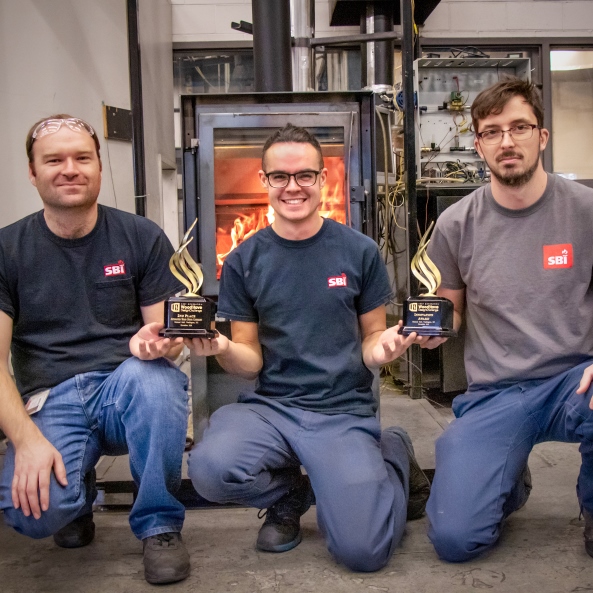
The SBI team that designed an early 
prototype of an automated stove that
won awards at the 4th Wood Stove 
Design Challenge in 2018.

The DOE program, part of larger grant cycle run by the Bioenergy Technology Office within the Office of Energy Efficiency and Renewable Energy (EERE) complements the efforts of the EPA to regulate the emissions of residential wood stoves.  The EPA has never invested in the R&D of cleaner stoves but its first set of regulations in 1988 resulted in a rapid and universal technology upgrade for all stoves.  Since then, many experts say technology has stalled. While stoves can perform well in the lab, they are all still manually operated so that in the hands of consumers, they can still perform poorly.


“There is a mismatch between the EPA’s regulations and the DOE programs because the EPA is still embroiled in the ongoing clash between industry and air quality agencies over how to test manually operated stoves,” said John Ackerly, President of the Alliance for Green Heat. The DOE is investing in the future - stoves with automated controls - but these stoves may be at a disadvantage using the EPA’s test protocols designed for manually controlled stoves.  Manufacturers have had little incentive to build automated stoves and must design their own alternative test protocols which need to be approved by the EPA.  


Each of the six projects are ambitious and highly innovative and they should start to hit the market in the next few years.  Until they pass EPA certification and are in the marketplace, its hard to prove that they are able to match their vision with a clean stove that consumers will want to buy.  Assuming the DOE maintains the program, over time it is likely to have a major impact on a technology sector that is not known for high-tech innovation.


MF Fire, Swirl Stove

SBI/ISB, Automated stove

Ohio State, Simulation drive automated stove

NTRE Tech, Fluid bed combuster

Oregon State, Forced air and automated controls

University of Alabama, Autonomous Stove 


The DOE is expected to announce its next round of wood heater grants early next year.

Monday, March 16, 2020

HPBA 2020 Expo showcases all new stoves to smaller audience

Jack Goldman, right, opens the 2020
Expo in New Orleans.
Updated, April 9, 2020: The hearth industry’s annual marketplace for manufacturers and retailers concluded on March 14th, a half a day early in New Orleans amidst a dwindling crowd and growing concern about the spread of Covid-19. This was the first hearth industry gathering since the late 1980s in which virtually all the stoves and boilers on the floor were newly redesigned and tested to meet stricter emission standards.  

Some manufacturers were clearly proud of what they felt were genuinely cleaner stoves while others were unconvinced or cynical of the new standard’s impact in the real world. 
Mark Shmorhun of the DOE's
Biotechnology office
attended the Expo to talk to
manufacturers about R&D
funding needs.

Due to Coronavirus concerns, Travis and Jotul, two large manufacturers, pulled out at the last minute, leading to a notably smaller Expo. U.S. Stove, having dropped their HPBA membership, decided not to attend this year, presumably because their inability to meet the 2020 emission standards on most of their appliances weakened their position in the hearth industry.  US Stove has 18 stove models that are 2020 compliant but no 2020 compliant furnaces yet, an area it had once domoniated.  US Stove responded to this blog, saying they are well positioned to move forward with a broad range of new and exciting products.

From the perspective of the Alliance for Green Heat, the 2020 Expo showcased several notable trends, some encouraging and others troubling.  

Vesta gives Best in Show award to an automated wood stove

Possibly the biggest highlight for AGH was seeing automated stoves take more of a foothold in the marketplace. Napoleon’s Eco Smart wood stove won Best in Show at the Vesta Awards, marking the first time that an automated stove won a Vesta Award.  The stove has an optical sensor that monitors particulate matter and can continually adjust air settings to produce a cleaner burn. According to Napoleon, the automation will only add $300 to the price and they expect the complete system with stove to retail for about $2,500. The stove also connects to the Napoleon cloud via the user's smart phone so they can monitor combustion conditions. The user can also allow the company to log data from the stove, providing a valuable record of how the stove runs. The stove is not yet EPA certified, but should be within months. 
The Charnwood Skye 2700, expected to
retail for about $3,300, several hundred
more than its non-automated cousin.

Charnwood, a British manufacturer, also was a finalist in the Vesta award, with their Skye E2700, also an automated stove that does much of what the Napoleon does, but with different technology.  Charnwood will be entering the US market for the first time later this year with this stove. Hugh Wells, head of the Britsh company told AGH, "We are very excited about this product because it does revolutionise how we burn wood by taking out user error." CFS-Teco did the certication testing in Portland and it achieved 78% efficiency, the highest of any non-cat. 

SBI should also have an automated stove on the market within a year, and MF Fire had their automated Catalyst on display at the Expo and have another one in development.  Maxitrol also exhibited a prototype of an automated stove and says that they are taking off in Germany.  Napoleon also won a second Vesta award for their novel "Heat & Cool Electric Fireplace," a mini-split heat pump housed in an electric fireplace.  

2020 stove trends

The 2020 NSPS has resulted in many more catalytic and hybrid stove models. AGH is particularly
Larry Brockman from the EPA's
voluntary Burn Wise program
talks the MF Fire staff about their
automated stove.
happy to see more hybrid models as they help reduce start-up smoke and provide back-up secondary combustion if the operator does not engage the catalyst. A more unnoticed trend is the rapid adoption of the ASTM E3503 cordwood test method. Data from the EPA list of stoves shows the average grams per hour for cordwood tested stoves is 1.6 grams – the exact same average for crib tested stoves. About 45% of all 2020 certified wood stoves were tested with the ASTM cordwood method, which reportedly has more flexibility in its parameters making it easier for manufacturers to pass the certification test. Nearly all of the smaller non-cat stoves were tested with cordwood. Quite a few very affordable stoves that sell primarily in big box and hardware stores are passing the 2020 standards, and some stoves barely had to undergo any redesign.  

A sophisticated, lower priced electronic precipitator
ESPs for wood stoves, considered
far-fetched just a few years ago, are
improving rapidly and popular in
Germany and Switzerland. 

Danish manufacturer Enervex brought a self-cleaning electronic precipitator, known as an ESP. They are commonly used by factories and restaurants, but now small and affordable enough for residential applications. ESPs are a type of scrubber that uses static electricity to remove particulate matter from exhaust fumes before the particulates exit the smokestack. Enervex’s innovation is to design a residential ESP that is self-cleaning, often a big problem, and to bring the price down. They expect theirs will sell for $1,200- $1,600 when it comes on the US market. There is a quickly growing market for them in Germany, now that they are recognized by the country's eco-label, Blue Swan, and some cities may require them. OekoSolve, a Swiss company, made the ESP being tested in Fairbanks.

HPBA recruits Appalachia Service Project to take 2015 stoves in May

To address the fate of potentially hundreds of wood stoves that are 2015 certified but not allowed to be sold after May 15, 2020, HPBA negotiated with the EPA to allow retailers to donate stoves to a non-profit who can them install them. HPBA is teaming up with the Christian ministry Appalachia Service Project, based in Tennessee, who repairs homes in Central Appalachia, making them warmer,
AGH President John Ackerly with
Adam Bean of the Appalachia
Service Project
safer, and drier. At the Expo, AGH met with Adam Bean,
Home Repair Coordinator for the group, 
who is quickly learning about wood stove installations and trying to estimate how many stoves his group has the capacity to install, which will partly depend on securing donated NFI installing and training.

Pellet stoves out of the limelight

Even though pellet stoves were relatively easy to redesign and test at 2 grams an hour or lower, the market for pellet stoves has not been particularly good and there were not many on the Expo floor. There were no pellet stove finalists in the Vesta Awards, which may indicate a pause in innovation in the North American market.

EPA announces final NSPS rule during Expo

On the first day of the conference, the EPA formally announced that they would not allow a retailer sell-through. The EPA had said on October 15, 2019 that entities should follow the compliance dates but some felt that there was still a chance for a sell-through. HPBA expressed its disappointment in a written statement while the Pellet Fuel Institute claimed a victory because the EPA removed minimum requirements from pellet fuel while retaining the prohibition that pellet fuel must not contain any of the prohibited fuels listed in the 2015 NSPS. There remains considerable debate about whether the 5-year timeline would have been enough if manufacturers had started redesigning and testing to the 2020 standards early in the process. Key excerpts of the EPA ruling provide detailed insight into why the EPA did not allow a sell-through. Some did start early and began offering 2020 compliant models to their retailers as soon as 2018, while most did not start releasing 2020 models until 2019 or even this year.  The issue was far more complicated because manufacturers had large inventories of 2015 stoves and some needed the cooperation of retailers to buy their 2015 inventory well into 2019. An HPBA mailer to retailers in 2019 said: “retailers and distributors should NOT immediately stop buying anything that doesn’t meet Step 2” in part because there wasn’t enough variety and in part because manufacturers still needed revenue from sales of their 2015 inventory.

EPA holds 3-day wood smoke workshop

One of the main reasons AGH attends the annual HPBA Expo is to participate in workshops
The wood smoke workshop brought
scores of experts from across the US
to share new knowledge, tactics and
success stories.
organized by the EPA on wood smoke reduction strategies. This year 
the workshop was coordinated and supported by EPA's Burn Wise, the Western States Air Resources Council (WESTAR), the Northeast States for Coordinated Air Use Management (NESCAUM) and National Tribal Air Association (NTAA) and was going to be the largest one ever, with nearly 100 federal, state, local and tribal participants registered.  But some states like Washington banned their employees from travel and many other participants cancelled, leaving a group of about 60. The workshop mainly consisted of a series of talks and powerpoints about change out programs, cord wood test methods, the impact of the NSPS, DOE funding opportunities for stove R&D, retrofits and ESPs, low cost consumer air quality sensors, indoor air quality issues, addressing wood smoke complaints, etc. Most of the powerpoints can be dowloaded here. AGH also hosted a gumbo and etouffee networking reception on Frenchman Street for all the participants. 


The 2021 HPBA Expo is scheduled for March 4-6 in Nashville, Tennessee.

Thursday, January 30, 2020

Blue Angel ecolabel requires wood stoves with automated air controls

Blue Angel, the German government equivalent of the US Energy Star label, approved a new eco-label for wood stoves that includes stoves with automated air control, “separating technologies” such as electrostatic precipitators and the ability to meet strict emission standards.

The Blue Angel label is also part of a trend that is exploring and adopting test procedures that more closely resembles how stoves are used in homes.  The label emerged in part from lessons learned by the BeReal initiative that involved extensive round-robin testing in multiple European countries. The Clean Heat initiative is promoting the label to help towns and cities to reduce air pollution.
Marius Wohler of BeReal presents
findings at Brookhaven National Lab
 in 2016

The label gives a boost to efforts by the Alliance for Green Heat which has worked with American state and federal agencies and American stove manufacturers to develop automated stove technology and bring them to the US market.

German Federal Environment Minister Svenja Schulze said in a press statement that "The Blue Angel standard for stoves for wood is a real step forward. The authorities can now take more effective action against particulate matter pollution, for example by only allowing the operation of stoves bearing the eco-label.”

Blue Angel says that cities and municipalities are introducing regional bans on conventional stoves (ban on the use of these stoves and ban on installing these devices in new housing developments) but there would be exceptions for those appliances holding the Blue Angel label. The city of Berlin has expressed interest in using the ecolabel.

Maria Krautzberger, President of the Federal Environment Agency said “With the Blue Angel requirements that have now been decided upon, we are showing that it is possible to go even further [to make wood stoves clean]. This boosts innovation in the industry, gives guidance to consumers and is good for our air".
SBI won an award for their automated
stove design and will be launching a series
of automated stoves in North America

The label is voluntary for manufacturers, as a number of other European eco-labels, but this one is stricter than others. Several European countries have developed eco-labels for wood stoves with varying degrees of success. The US Energy Star program has never covered wood stoves and US stove industry blocked an initiative by Washington State to explore a state-led label. The Alliance for Green Heat has been an advocate for ecolabels and urges stakeholders in the US to revisit the idea.

It is not yet known how many stoves will qualify for the label over the coming months and years, and how well they will work in the field. Automated stoves gained some visibility in the United States through the Wood Stove Design Challenge and subsequently the Department of Energy provided $3 million in funding for automated stove R&D in 2019 and are now offering an additional $5 million in 2020.

Electrostatic precipitators (ESPs) have long been used in commercial wood burning applications, and their use in residential applications has grown rapidly in Europe. In the US, an initiative in Alaska is using ESPs, and is hoping a review by the EPA will determine that change out funding can be used on a wider scale to install ESPs on wood stoves.  As prices come down under $2,000 the cost of adding an ESP may result in far more PM reductions than replacing an old stove.
This ESP made by Swiss
company Oekosolve was
also showcased by AGH
in Wash. DC in 2018.

Excerpts of the details of the Blue Angel label are reproduced below. The full criteria can be found here.

Excerpts

The environmental label may be awarded to stoves that use the fuel … in an efficient manner and have significantly lower pollutant emissions. In addition to the statutory regulations for the type testing process [lab testing of a sample stove] for the stoves, the special requirements stipulated by the Blue Angel mean that stoves have to comply with significantly lower particulate and CO limit values and this must also be verified during the ignition [start-up] phase that involves a particularly high level of emissions. In the case of organic gaseous carbon (OGC) and nitrogen oxides (NOx), emissions of these substances must already be below the limits defined in the EU Ecodesign requirements that will be generally applicable from January 2022.

When purchasing a new innovative stove, the environmental label will thus act as a decision- making aid for the reduction of air pollutants. It is a voluntary label that is designed to motivate manufacturers to develop efficient and low- emission heating appliances. The label will allow manufacturers to highlight the environmental benefits offered by their heating appliance in a simple way.

Therefore, the following benefits for the environment and health are stated in the explanatory box:

3.1 Emission requirements

Stoves, where relevant in combination with an integrated or downstream particle separator, must comply with the maximum limits stated in Table 1, Column 3 for the particle content, carbon monoxide (CO), organic gaseous carbon (OGC) and nitrogen oxides (NOx).

The particle count concentration must be determined (see Appendix C for the measurement method). In addition, the limit for the particle count concentration stated in Table 1, Column 3 must also be observed from 01/01/2022.

The requirements can be complied with in two ways:

1. a) Testing the overall system

The requirements will have been fulfilled if the mean values from the individual measurements described in Appendix B that were carried out on the tested stove, including all of the intended fixtures and attachments, do not exceed the relevant limits specified in Table 1, Column 3.

Spare parts are those parts which, typically, may develop a fault within the scope of the ordinary use of a product. Whereas those parts which normally exceed the life of the product are not to be considered as spare parts.

2. b) In combination with an efficient particle separator

§ The requirements will have been fulfilled if the mean values from the individual measurements described in Appendix B that were carried out on the stove do not exceed the relevant limits specified in Table 1, Column 4 and the stove is sold and installed together with a particle separator. For particle separators, a minimum separating efficiency of 75% of the particle mass and (from 01/01/2022) 90% of the particle count must be verified. The limit value in Table 1, Column 3 must be complied with reliably when taking into account the separating efficiency.

§ If a particle separator for which this minimum separating efficiency has been verified is already integrated into a chimney, the manufacturer can also sell the stove without the separator. The fact that the stove must be installed together with the associated particle separator that is integrated into the chimney must be indicated during the sale of the product and also in the installation instructions. The particle separator integrated into the chimney must already have been named and tested when submitting the application for the stove.

The measurement of the flue gas temperature, the flue gas sampling process and the measurement of the static pressure for the stove must be completed in a measurement circuit according to DIN EN 16510-1:2018-01 (D), Section A.2.3 as well as Diagrams 13 and 14 of this standard.

The measurement uncertainty stated in the test method is neither added nor subtracted.

3.11 Future revision of the environmental label

Furthermore, the revision will examine whether the applicant can offer a 5-year guarantee for the secondary reduction technology if it is sold in combination with the stove. 
To determine the particle count emissions from stoves, it has only been possible up to now to evaluate individual test results using the methods described in Appendix C. Round robin tests that could be used as the basis for defining a limit for the particle count emissions from the stove have not been available. 

Nevertheless, the measurement of the particle count in accordance with the new methods is being introduced as an obligatory requirement. Due to the unavailability of round robin tests, it is necessary to allow a transition period for the introduction of the particle count limit. Compliance with the particle count limit will be obligatory for the award of the Blue Angel from 01/01/2022. 

3.4 Air regulation

To ensure that the user has as little influence over the emissions as possible, it is not permitted for the air supply to be manually adjustable during intended operation. This is usually achieved through the automatic regulation of the air supply.

3.5 Combustion monitor

A display must be provided for the user to indicate any deviation from the optimal operating state and to request that the user stokes the fire with wood.

3.8.1 Repairability and provision of spare parts

The stove must be designed so that it can be repaired by replacing individual parts that are no longer working. The applicant undertakes to guarantee the provision of spare parts for the repair of the appliances for at least 10 years following the termination of production.

The product documentation must include information about the repairability and the guaranteed supply of spare parts.

3.8.2 Recyclable design

In terms of the recyclable design of those appliances issued with the environmental label, the following is valid:

· The appliances must be designed in such a way that they can be dismantled and separated into recyclable materials by specialist companies using standard tools or that this process is simplified by intelligently designed connections.

· The appliances must be designed so that it is possible to separate metals into single materials and, where possible, recycle them separately.

3.10.3 Quick user guide

· In addition, another guide covering a maximum of two pages must be provided that includes the most important instructions for the fuel to be used (size of the pieces, max. water content, quantity) for the ignition process, controlling the air flow, stoking the fire and cleaning/maintenance in a clearly visible and easy to understand form. This quick user guide must be permanently legible and abrasion-resistant and must not suffer from discolouration during normal use.

· The instructions must include easy to understand illustrations

5. Use of the Environmental Label

The use of the Environmental Label by the applicant is governed by a contract on the use of the Environmental Label concluded with RAL gGmbH.

Contracts on the Use of the Environmental Label are concluded to fix the terms for the certification of products under Paragraph 2. Such contracts shall run until December 31, 2023. They shall be extended by periods of one year each, unless terminated in writing by March 31, 2023 or March 31 of the respective year of extension.

Related stories

Thursday, October 3, 2019

DOE awards $3 million for R&D to wood stove manufacturers

The MF Fire leadership team in 2018
- Taylor Myers, Paul LaPorte and
Ryan Fisher.
The U.S. Department of Energy (DOE) selected only two companies – MF Fire and ISB Marketing – to receive $3 million for research and development (R&D) through the DOE’s Office of Energy Efficiency and Renewable Energy. The DOE had $5 million for stove and boiler manufacturers but decided to only award $3 million this year.

The two manufacturers are working on next-generation controls and designs for wood stoves that have barely entered the marketplace. Both companies are focusing their efforts on how to make stoves cleaner in the hands of consumers – not just in the test lab – which has become widely recognized as the Achilles heel for the millions of Americans who heat with cord wood.

[Dec. 15, 2019 update - The DOE announced their intention to grant another $5 million for biomass heater R&D in 2020.]

MF Fire received two grants, one for a device that continuously monitors performance of key combustion indicators and delivers real-time user guidance, and the other for a “swirl stove” that induces and maintains swirling combustion and introduces a new balance of primary, secondary, and dilutive air. ISB Marketing, working with its sister company, Stove Builder International (SBI), is developing a Machine Learning algorithm for a self-regulating wood stove that would have a PM emissions rate below 1.2g/h and offer an overall efficiency of more than 75% (HHV).
The SBI team that produced the award
winning prototype of an affordable,
automated stove

DOE is expected to be able to offer R&D grant funding again in 2020 and may be able to stimulate R&D in more wood heater manufacturers. “We applaud Congressional appropriators and the DOE for funding this R&D that can help millions of Americans affordably heat their homes with next generation wood and pellet stoves,” said John Ackerly, President of the Alliance for Green Heat.
The $2 million for MF Fire is a large cash infusion for a young, small manufacturer with lots of innovative ideas and priority on R&D. “This will enable us to hire new people to ramp up our testing and apply techniques and technologies used by other industries," said Ryan Fisher, COO of Baltimore based MF Fire. “For example, eliminating PM by more thoroughly and aggressively mixing fuel and air has not been done by stove manufacturers. Square, rectangular corners create dead spots that inhibit combustion." Mr. Fisher said. Fisher and his original partner Taylor Myers got their start in designing stoves as graduate students preparing for the first Wood Stove Design Challenge in 2013. The rookies won multiple awards before the age of 25 and still haven’t turned 30. Some see them as the face of a new wave of stove designers.

ISB Marketing, with their SBI counterparts, are taking a similar tack but its potentially applicable on a range of stove models from a major manufacturer. ISB is working with Machine Learning algorithm that will learn how each specific user heats his/her stove. The stove will then adjust its combustion parameters to compensate for any “bad” human behavior that tends to increase particulate matter (PM) emissions and reduce efficiency. A home-designed real-time PM monitoring system will be developed to obtain a better understanding of the stove’s behavior.

Mark Shmorhun, the program
manager at DOE who managed
the grant process, at the 2018
Wood Stove Design Challenge

Marc-Antoine Cantin, President of SBI said in an interview that moving innovative and more risky stove projects through a corporation takes longer, as models that have conventional technology are often green-lighted first. “External R&D funding can help reduce risk,” Cantin said. Even with a million dollars from the DOE, a batch of 26 of the new stoves is not expected to be beta-tested until the winter of 2022-23. SBI won second place at the 2018 Wood Stove Design Challenge for designing a simple, affordable stove that allowed the operator to select high or low heat output and used a low-cost control board and thermocouple sensors to ensure that the stove burned cleanly.

The DOE does not disclose how many applications they received or from whom, but it is widely believed that the agency received few applications for the available $5 million pot of funding. John Crouch, Director of Public Affairs for HPBA, said in an interview, “The funding announcement came at a bad year because manufacturers were scrambling to certify their stoves to the stricter 2020 EPA standards. We hope there will be more applicants if the DOE offers the grants next year.”

The DOE also does not disclose who was on their panel of expert reviewers. According to some companies who applied, some didn’t make it through the process because they had not fully completed the application. Others made it through the first round, and then had to respond to specific questions from the reviewers. Ryan Fisher of MF Fire said he got multiple questions about whether his small company could execute two grants and they had a solid plan in place to manage that. SBI got many questions about their corporate structure. They are owned by US-based Empire Group, who also owns ISB Marketing. They plan to carry out R&D for the grant in the US. Other applicants who made it through the first round, didn't make it through the second round.

The one-page summaries of the 3 grants can be found here: MF Fire-Swirl Stove, MF Fire-Performance Monitoring, ISB Marketing-Automated Stove.

This recent entry of the DOE’s Bioenergy Technologies Department which focuses mainly on biofuels, fills a significant gap for the US government. The EPA provides baseline emission and testing standards and the USDA’s Forest Service provides support for larger commercial use of biomass for heating applications. This marks the first time that a US government agency has provided support for companies to push the boundaries of emission and efficiency controls for residential wood and pellet heaters. The United States has the toughest emission standards for residential heaters in the world, which has kept US companies at the forefront of an industry that can provide affordable, low carbon heating solutions in the switch from fossil fuels to renewables.

The original DOE funding opportunity was directed at stove R&D that included:
  • Novel and innovative residential wood heater designs to improve combustion chamber geometry, combustion air flow distribution, mixing of combustion air with gasification products, stove baffling designs, etc.
  • Improvements in automation of stoves to optimize combustion control.
  • Wood heater power generation via thermoelectric module integration
  • Improvements in catalyst technologies for emissions reduction

Thursday, May 2, 2019

Despite claims of "devastating" impact, wood stove industry positioned to meet new emission standards

With the Step 2 deadline for wood and pellet stoves just a year away, most stove manufacturers say they are ready or will be soon. Many retailers also say they are ready, while others prepare to deeply discount stoves that can't be sold after May 2020. Gone are the days when industry was trying to convince Congress and the Administration that EPA's new stove regulations would have a "devastating" impact. Such claims are common in Washington, as groups try to rally their base, but it can also lead to a diminished credibility for an industry association if the hyperbole goes too far.
From the start, it was clear that the boiler and furnace manufacturers needed relief far more than stove companies and retailers.  Heads of outdoor boiler companies and indoor wood boilers that cost less than the average wood stove were leaders of a campaign to get Congress to give all classes of heaters a three-year delay in meeting the new standards.  At the same time, the industry association Hearth, Patio & Barbecue Association (HPBA) was challenging many of these standards in court, meaning a three-year delay could be permanent for some classes of heaters, if courts agreed with HPBA.  But it was never clear that stoves needed any delay and industry effort would have stalled innovation and efficiency improvements and put tens of thousands of families at higher risk of more wood smoke exposure.  The fallback position was that industry needed a two-year sell year, allowing manufacturers to sell Step 1 product during the fall and spring of 2019/2020, and retailers to sell Step 1 product until May 2022.  

At first, it appeared that the EPA under the current Administration was open to providing a two year  sell-through for stoves, but they have only issued a Notice of Proposed Rulemaking (NPRM) for boilers and furnaces, not for stoves.  Theoretically, the EPA could still issue a Notice of Proposed Rulemaking for a sell through for stoves but at this point it may be too late to provide any meaningful relief.

Many states pushed back strongly against watering down the NSPS and no state filed comments backing the Trump Administration's proposals.  States also began preparing their own plans in the event the EPA does change NSPS timelines, which could create a patchwork of regulations and more antagonistic relationships with a renewable energy industry.


If some manufacturers were not taking the 2020 deadline sufficiently seriously from 2016 - 2018, they are all likely to be doing so now.  Instead of focusing on government relief, HPBA's outreach to industry stakeholders is taking an a more urgent tone that everyone needs to focus on heeding the May 2020 deadline. However, almost all manufacturers were already focused on May 2020 for their own financial health and to assure their retailers that they are a reliable future partner.  And, many manufacturers and virtually all retailers already are well-diversified with gas fireplaces and stoves which often outsell their wood and pellet appliances.

The list of stove manufacturers who are ready for 2020, almost are or “well-positioned” to be 2020 ready grows by the week. As of May 1, they include:  APR Industries, Blaze King, Even Temp, ExtraFlame, Foyers, Heat Tech, Hearthstone, Innovative Hearth Products, Jotul, Kuma, Laminoux, MF Fire, Napoleon, Pacific Energy, Rais, Regency, Roby, RSF Fireplaces, SBI, Stuv, Supreme, Thelin, Travis and Woodstock Soapstone.  Hearth & Home Technologies, by far the largest manufacturer, says a majority of its stoves will be 2020 certified this year.

The 2020 deadline will undoubtedly be tough for much of the industry, but it remains to be seen if it’s tougher than lean shipment years such as 2007 and 2012.  Overall, the threat to industry does not appear to be as serious as industry claimed even a year ago.  The 2020 deadline is also bringing about benefits. some foreseen and others not. Some retailers still have stocks of Step 1 stoves and there is likely to be some heavily discounted stoves in the final year leading up to the deadline.  Retailers are still ordering some Step 1 stoves, but in much smaller quantities.  Many retailers are only buying Step 2 stoves but may face still competition from fire sales of Step 1 stoves by competitors.  Sending Step 1 stoves to Canada could have been a good outlet, but the more populous Canadian provinces have either adopted the 2020 deadline or are in the process of doing so. Other foreign countries are still a good option.  Most big box stores have the buying power to protect themselves by requiring manufacturers to buy back unsold inventory, influence that specialty hearth retailers don't have. 


Over the last six months, HPBA has developed more clear and insistent messaging for retailers and is using social media more to get the message across.  A facebook post outlined 5 things retailers need to know to survive the NSPS. Included is also a fear that in the race to meet the 2 gram an hour standard, some manufacturers may be putting out stoves that haven't been sufficiently beta-tested and simply won't work well in the real world.  This could jeopardize retailers who unknowingly carry those stoves.  HBPA urged retailers to test the stoves themselves, before selling them to customers, a tall order for retailers over the summer season.  The message for consumers is that the next twelve months will be a buyers’ market with unprecedented sales and discounts of Step 1 products

For the most part, the hyperbole from industry that consumers would be priced out of new stoves and there would be very little variety of product on floors, is not materializing.  Some manufacturers that were well known for disparaging catalytic stoves are now embracing them, swelling the ranks of "hybrid" stoves that only mention the catalyst in the fine-print. Presumably, this new crop of hybrids learned the tough lessons of the 80s and 90s, and their catalyst are well protected from flame impingement.


The 2020 deadline is also providing industry a gradual transition to cordwood testing, as some manufacturers opt to test with it.  Some groups idealistically hoped for a far quicker transition to cordwood.  Stoves tested with cordwood can emit up to 2.5 grams an hour, although many of them are coming in under 2 grams.  Despite messaging in advertisements from HPBA that it "shares the same goals as regulators," the 2.5 gram an hour standard for cordwood is one of the many emission standards that HPBA is challenging in federal court.  The many delays to the lawsuit may make it tougher for HPBA if enough stove models come in under 2.5 grams an hour using the broadly applicable alternative ASTM cordwood test method.

Many stakeholders are already looking past the 2020 deadlines toward the next NSPS, which by law should be scheduled in 2023.  Whenever the 2015 NSPS is superseded, there is likely to be intense controversies over certification protocols for cordwood testing and a timeline for all stoves to be tested with cordwood.  Key northeastern states believe the consensus driven ASTM Method is deeply flawed and are working behind the scenes on new test methods.


Unlike the 1988 wood heater NSPS that decimated the ranks of small stove manufacturers, the 2015 NSPS does not appear to be forcing manufacturers out of business. The 1988 regulations drastically improved the functioning, safety, cleanliness and efficiency of stoves while also driving up prices of those that were not claimed to be exempt.  The question remains whether the 2015 NSPS will significantly improve the functionality of stoves as they become cleaner and more efficient in the lab. Pellet stoves may the winners as their lab numbers should hold up in homes of consumers, a significant benefit that is rarely acknowledged by most in industry.  We can all agree that there will be both intended and unintended consequences which will take years to unfold.  Stay tuned.

March 11, 2020 update: The EPA finalized amendments to the 2015 NSPS and did not provide a retailer sell-through.  They did remove pellet fuel minimum requirements but retained the list of prohibited fuels in the 2015 NSPS.