Showing posts with label NSPS. Show all posts

Monday, June 30, 2025

Demand for automation in wood stoves moves forward in Europe, but could be sidelined in the U.S.

Updated July 8, 2026 - The newest type of stove on the market is the automated or ‘smart’ stove that use sensors and computer chips to adjust airflow, instead of relying on the operator. Automated stoves enable the operator to "load and leave," allowing the stove to maximize efficiency and emissions reductions on its own. These stoves are likely to be the next major step towards cleaner residential wood heating because it is well-known that poor operation by the consumer is one of the main reasons for excessive smoke, and often it is the main reason. 

Automation does not just seek to address poor operation by the consumer.  It also can assess variable draft conditions caused by different chimney configuration, the altitude of the home, and the moisture content of the wood.  In addition, automated stoves are often interactive, helping to educate operators through visual prompts or detailed apps on smart phones. 


In Europe, automated stoves have been advancing far more quickly and are recognized as by the regulatory community as an important solution.  In the U.S., the EPA and other agencies are focusing on an equally important process - improving test methods for manually operated stoves – with little attention to automation. Improved test methods still leave manually operated stove vulnerable to wildly variable real-world emissions.  


Outside of regulatory circles, automated stove technologies have been promoted in the U.S. by the Wood Stove Design Challenge, a series of technology competitions, and by funding from the US Department of Energy in association with national labs.  A 2023 study from Brookhaven National Lab described the technology as “a minimal set of measurement sensors and a heuristic control strategy to actively modulate incoming air to enhance stove combustion performance, thereby eliminating user-error as a factor for emissions production.” More recently, researchers at Oregon State University and Aprovecho Research Center are focusing on automated technologies that show PM reductions up to 95% compared to older models


The first such stove on the US market, MF Fire’s Catalyst, launched in 2016, is now off the market. The second, Charnwood, a British manufacturer entered the US market in 2020 with their Skye E2700. The company say, “This stove uses Charnwood I-Blu combustion intelligence that continuously monitors the state of the fire and optimizes efficiency while reducing emissions through real-time adjustments. Air is introduced in just the right amounts, in the right places, at exactly the right time to ensure a cleaner, highly efficient burn.”
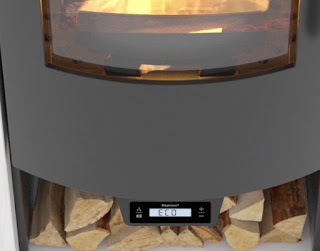
 

A number of companies are using passive, partial automation but its unclear how effective it it.  For example, Pacific Energy has added technology to three of their stove models. The Neo 1.6 LE2 and the larger NEO 2.5 LE2, both of which come in freestanding and insert models. Under their True North brand, the TN25 C, they use the same technology on a hybrid stove with a catalyst that is continuously engaged, and does not have a damper control. According to an email from Pacific Energy, they use an “algorithm controlling two sources of supplemental air, working in the background to seamlessly improve combustion.  This patent pending technology uses two probes to monitor the firebox and the flue temperatures. Based on the absolute, delta and the rate of change in temperatures, the combustion is being optimized at all times.”  The operator can still adjust the air damper, which may be then counteracted to some extent by the algorithm depending on combustion conditions. Pacific Energy markets these stoves as regular wood stoves without explaining the details of their automation to the consumer. 


The Canadian manufacturer SBI won an award at the 4th Wood Stove Design Challenge for their progress toward an automated stove and they received a grant from the DOE to develop it. A final version of it is expected to be EPA certified and on the North American market later in 2025. 
 
Automated stoves on the European market
In Europe there has been far more R&D and diversity of automated stove technology.  Notably, in Europe, manufacturers highlight the environmental benefits of automation to the public and to the regulatory community. There are now more than 10 models on the market such as: 


Hase, Lima IQ (Germany)

Hwam SmartControl (Denmark)

Nordica, Larissa (France)

Rika, Rikatronic4 (Austria)

Scan Zensoric Technology,  (Denmark)

Xeoos Twinfire Blue (Germany)

Wodtke, Stage F (Germany)

Full vs. partial automation.  There are many ways to automate a wood stove and one of the main variables is whether the stove still has air levers that the operator can control.  If the stove has controls for the operator, it is virtually impossible to tell if the automation can override the operator, or vice versa.  Many consumers, particularly in North America, want to at least have the sense that they can control air flow, which is key to heat output.  Otherwise, control of heat output can be with the amount and frequency of wood that is loaded into the stove. Also, there is always the question of whether and how well an automated stove works during a power outage.  Most, if not all, can work, but will do so sub-optimally. 

Bi-metal springs that have been used for decades in stoves produce a very modest amount of automation to stoves, and they can be used in conjunction with electronic automation strategies.  

Other features. Some stoves have a LED light that will come on when its time to reload the stove.  Some are connected via wi-fi apps and can produce a sound to prompt the consumer when to reload. The Austrian company Rika has a feature where you load firestarter in the tray, add wood, and then you can program the stove to start remotely, as pellet stoves can.


Aftermarket solutions. 
Several companies have built devices that can monitor and/or control the airflow of existing stoves or be integrated into new stoves.  Maxitrol is a leading supplier and makes the battery powered “E-Flame air control system” that drives an actuator to control primary and secondary air flow.  It was designed in part to help companies meet future European EcoDesign Directives.  The Danish stove manufacturer Aduro has had it’s Smart Response on the market for several years. The app-connected thermometer provides feedback to the consumer on their smart phone about whether their stove is burning well, and how to improve its use.  Baltimore-based MF Fire is working on something similar. These technologies do not automate stove functions but monitor conditions and prompt the user to give the stove more air, add wood, clean their chimney, etc. 

Regulations and incentives to automate: In the United States, there is little regulatory pressure or incentives for manufacturers to automate.  The new Integrated Duty Cycle (IDC) test protocols are designed so that all types of stoves can be tested and to our knowledge the test method was not designed so that automated features would help a stove pass, though it is possible that will be the case. It is imperative that the National Residential Heating Task Force test the automated stoves on the market in the U.S. and give them the profile that other stove types are getting.  Currently, the test regimen may show the benefits of catalytic and hybrid stoves in the lab, without sufficient data or attention to how well cat stoves are used and maintained over their 10 – 20 year lifetime.  Automated stoves may also have maintenance issues over their 10 – 20 year lifespan, and it’s important to start assessing which automation strategies are more robust.
Test protocols are perhaps the best way to encourage manufacturers to innovate.  Protocols can make it harder for manually operated stoves to pass by requiring air adjustments that are likely to produce more smoke, unless sensors in the stove can adjust airflow themselves.  Making certification marginally tougher for non-cats to pass, leading to a growing percent of catalyst and hybrid stoves, is not an ideal solution compared to growing the number of automated stoves on the market.

At the state level, change-out and other incentive programs can start to recognize automated stoves and give them higher incentives.  Massachusetts is the only state that sought to provide incentives to automated stoves in a change out program in 2017 but it came too early and automated models were delayed coming on the marketplace.  States and air agencies can start to make consumers aware of this new type of wood stove, along with catalytic, non-catalytic, hybrid and pellet stoves. 

The lack of attention and support for the development of automated stove technology in the United States is connected to similar lack of support for cleaner pellet heating appliances.  Despite the ability of pellet stoves to emit very low levels of PM, the EPA allows them to emit the same level of PM as wood stoves, even though they have a different type of fuel, which should lead to stricter emission standards. In Europe, the EcoDesign Directive of 2022 requires pellet stoves to emit only half of what wood stoves are.  

The lack of “eco” or “green” labels for wood stoves in the U.S. has left manufacturers with little incentive to produce cleaner or automated stoves.  In Europe, some eco labels require pellet stoves, for example, to produce a quarter of the PM of wood stoves, and half of regular pellet stoves.  Manufacturers selling on the US market have mainly focused on achieving 75% efficiency, in order to qualify for the tax credit under IRS Section 25C.  Congress revoked that section, effective Dec. 31, 2025 and its unclear if it will be a permanent revocation or just for several years.  The credit has often lapsed since 2005, when it first began.  In Europe incentives have steered away from residential log heaters and focused on the best pellet stoves and boilers, which is a possible path forward in the U.S.

In Europe, some manufacturers feel that is not if, but when, they will have to start producing automated stoves. There is more urgency in Europe because of more widespread use of wood stoves in cities like London, and densely populated areas of Denmark, Netherlands, France, Germany and other countries. The German Blue Angel label and more local regulatory efforts, such as in Berlin, have also led to far more innovation and R&D on automation.  As in the U.S., lobbying by industry is slowing efforts at national and local levels to pass stricter measures that could lead to quicker adoption of automated stoves and more reliance on pellet stoves.

In early 2025, the European Commission released draft language of a new directive to take effect in 2027, including language that automation in stoves would be required. This led to strong industry push-back, and work on the new directive has been delayed.  The European Committee of Manufacturers of Domestic Heating and Cooking Appliances stated:


“The requirement of for automatic combustion control systems, additional testing, second conformity contradicts Ecodesign principles: it increases costs, energy consumption and maintenance need, limits technological neutrality and makes appliances more expensive.”
 
“Any Ecodesign regulation should not favour specific technologies. It should be technology-neutral and allow manufacturers to choose how to meet the regulation's requirements…. Although not explicitly required, a stove without a built-in catalytic converter and electrostatic precipitator is unlikely to meet the emission requirements. All seven known Blue Angel stoves have these features.”


This industry response to the draft of the next European Directive has many valid points which will also be part of the landscape in North America.  Regulators on both continents should shift their focus away from manually operated stoves and address these concerns and others as they move toward next-generation solid fuel heating solutions. One European study found automation reduced PM by 66% compared to one test method.


More resources on automated stoves


Nordic Energy Research, Nordsyn EcoDesign, Task 2 Report, 2025

Eurocities, Cities call for stronger EU rules on new wood-burning heaters to tackle deadly air pollution,” June 2025

AGH Webinar, “Harnessing Electronics for Cleaner, Smarter Wood Heating,” June 2025

14th U. S. National Combustion Meeting, Forced-draft Airflow Control Tuned to Reduce PM Emissions in a Cordwood Room Heater Under Variable Operating Conditions,” 2025


Chemical Engineering Reactions. “Reducing Emissions from Current Clean-Burn Wood Stove Technology by Automating the Combustion Air Supply and Improving the End-User Interaction -Two Important Primary Measures,” 2023


IEA Bioenergy, “Design of Low Emission Wood Stoves,” 2022


Tarm Biomass, “Automated Wood Stoves: Technology Policies and Barriers,” 2017


Technical University of Denmark, “Guidelines for automated controls for wood stoves,” 2017


AGH Blog, “Automated stoves entering the marketplace,” 2014


AGH Blog, “Nine reasons manufacturers don’t use sensors in wood stoves,” 2013

Tuesday, December 31, 2024

President Carter, an early champion of modern wood stoves, installed them in the White House


President Carter next to a White House
fireplace.  We could not find any photo
of him with wood stoves.


A 1979 letter from Carter 
 
.


Carter praised new, secondary burn technology emerging in the 1970s, before EPA regulations


President Carter is well known for installing solar panels on the White House and for urging Americans to turn down the thermostat and wear a sweater. But he was also a very public advocate or wood stoves and had about six of them installed in the White House and at Camp David. 

President Carter took office on Jan. 27, 1977, four years after the oil embargo that led to the embrace of wood stoves by a wide swath of rural and suburban Americans.  Carter took a personal interest in the technology and by 1979, the absolute height of wood stove sales in the US, Carter wanted to “persuade any remaining skeptics that wood burning stoves can be efficient, clean, fume-free and money saving.,” according to an article from the New York Times. 

Ironically, President Carter was touting the old, uncertified stoves that were just beginning to adopt effective secondary burn technology. “Fume-free” may be a nod toward “airtight” stoves that could be completely deprived of air but were a big advance in terms of not leaking smoke into the room. 
 

Carter’s task of convincing Americans that wood stoves were not just your grandparent’s technology, is a refrain that stove advocates today have to keep using, because the details of wood stove technology are still a niche interest. And, little did Carter realize at the time that the pellet stove, a completely new wood burning technology was about to hit the market. 


Carter installed the first wood stove in his second-floor study in 1978, or possibly early 1979, and up to 5 more were installed in the White House and Camp David.  The man he appointed as his administrator of the EPA, Douglas Costle cared about clean air, but apparently no one yet realized how much the annual sales of wood stoves would add up in rural communities.  Costle later became the Dean of the Vermont Law School, from 1987 to 1991 and passed away in 2019.
After President Carter said he would install a stove, the White House had more than 50 offers from manufacturers. The White House staff carefully selected six, choosing makers from different parts of the country. The companies, however, were not allowed to say that one of their stoves was selected for fear they would commercialize the info for their own profit.
The stoves selected by the Administration "are airtight, with blowers, filters, draft controls and safety features, all costing between $200 and $600, and capable of being installed in fireplaces or left free‐standing," according to one account.

One of the stoves was contributed by Representative Norman E. D'Amours, a New Hampshire Democrat, who presented it to Rosalynn Carter on a trip she made to that state. Another was given by the Wood and Stove Fireplace Journal, a trade magazine (a precursor to Richard Wright's Hearth & Home.) We also know that Senator Patrick Leahy (D-VT) urged  to source the stoves from Vermont Castings and one article says they got six Vermont Casting stoves. 
 
Another was donated by the Buck Stove Cooperation from North Carolina.  Carol Buckner, founder of the company, claims to have had one of his famous Buck Stoves installed there in 1979.  Carter may have also used a Schrader Wood Stove according to White House records.  

A list of which models of stoves were installed, and what happened to them may be out there for a historical sleuth to uncover.  

An Abundant Life stove like
this on was donated to the
White House 
It was only a few years later, in 1986, that Oregon set the first stove emissions standards, effectively banning the sale of most popular ones.  The EPA set their first regulations in 1988, but still today is trying to disentangle its regulations from the dimensional lumber test method they adopted from Oregon.
 
The EPA had high hopes for their regulations. One of their staff wrote in 1990: “it is hoped that over the next 15 years the 800,000 new wood stoves sold each year will gradually replace most of the 12 million older, dirtier models now in use.”  But wood stove sales fell quicker than expected and by the late 1990s, had settled to about 250,000 units a year. 
 
Many may believe Carter made a colossal mistake by getting behind the wood stove frenzy during that time, but as President, he felt some personal responsibility for the suffering that Americans were going through, trying to affordably heat their homes.  Part of his message was to “demonstrate that wood is a readily available alternative to nonrenewable fossil fuels.”  To this day, the EPA has never really acknowledged the ongoing role that wood and pellet heaters play in reducing fossil fuel. 
 
It is likely that the hype of new stove technology coming from Vermont Castings influenced Carter. In 1979, Vermont Castings was on the Fortune 500 list of the fastest-growing private companies, as a technology start up that was turning heads on Wall Street. The nation had yet to learn that even as stove technology made strides, and many more were forthcoming, they could still be operated poorly, causing excessive smoke.  This remains the quintessential issue with wood stoves, rendering lower EPA emissions thresholds vulnerable to the same problem: the operator and the often-wet wood loaded by the operator.

President Carter said that the new stoves were “absolutely remarkable.  They burn not only the wood but the gases from the wood.  They are highly efficient, have automatic thermostats and 2 or 3 oak logs … will last for as long as 8 or 10 hours.” 
 
Eva Horton, the first pioneer of 
advanced wood stoves in the US.
This statement, in 1979, shows what many have forgotten: cleaner stove technology was emerging far before the EPA enacted its first set of regulations in 1988, but the majority of stoves being sold were mostly steel boxes with a chimney. Centuries of innovation in masonry and tile wood heaters in Europe had long been forgotten except for some advanced technology that Eva Horton, a woman from Maine, started to import from Norway in 1972, before the oil embargo. She came across a Jotul stove and realizing its potential in the United States, began importing them, providing a vital design reference for Duncan Syme and Murray Howell, who founded Vermont Castings in 1975.  Their first stove, the Defiant, set a standard that is still relevant today.  

 
On the West Coast, Bob Fisher, was also discovering important design elements in the early and mid-1970s, installing baffle plates and refractory brick, basic but vital elements to help smoke reburn before escaping out the chimney.  These were no doubt what President Carter was referring to when he marveled at the advanced designs. 
 
The wood stoves in the White House did not last long.  Carter’s successor, President Reagan, from southern California, may have removed them all, although one may have remained in Camp David for longer. There are 35 fireplaces in the White House and President Nixon is reported to have gone through 50 cords.  Carter only needed 10 cords and was able to provide some heating to the rooms they were in. 
 
Wood was used in the White House kitchen stoves in the early 1800s, but by the 1850s, some of all of the stoves were converted to coal, and later to gas, just like the fuel transition that happened in most homes.

White House kitchen coal stove, 1883
During the days of Franklin D. Roosevelt, the fireside chat in the Great Depression, symbolized a warm, folksy atmosphere. Still today, a fire in the White House figures frequently in the background of formal gatherings.  Fireplaces are the most antiquated, inefficient and polluting form of heating, which does not seem to be an issue for a succession of Administrations.  The fireplace after all, can be a symbol of wealth and status, as opposed to the more efficient, cleaner wood stove, a symbol of rural low- or middle-income homes.  The willingness to burn fuel, without getting hardly any heat, is still common across America, in part because so many people like smell of an open fire.

Crested Butte Wood Stove Fair in 1983, when 
there were long waiting lists to get stoves.
It’s hard to measure President Carter’s legacy in promoting improved stove technology and how it can help families reduce expensive fossil fuel. In retrospect, it was a missed opportunity for the government to invest in more lasting and well-funded programs at the EPA and DOE to better understand how to regulate and accelerate R&D.  Instead, as Washington looked to other renewables, it allowed unregulated outdoor wood boilers to take off and for uncertified wood stoves to stay on the market until 2015.  And the EPA never made concerted efforts to promote the pellet stove over the cord wood stove, despite its mission to promote lower emission technologies. 


Unlike in the US, Europe continued to focus on energy efficiency and renewables after the oil embargo of 1973.  If Carter had a second term, he may have been able to make a more enduring energy efficiency legacy.  


Carter's childhood home's wood
cook stove
Since President Carter left office, it's not clear if anyone asked him about his efforts to promote wood stoves.  We hope that future US Presidents appreciate the value of R&D in wood stoves because they have had and will continue to have a remarkable staying power in American homes.  And, just as President Carter wanted, they continue to be one of the most widespread technologies helping to get Americans off of fossil fuel. 

President Carter's tenure in the office coincided with a period of rapid stove growth following the rise in oil prices that followed the oil embargo.  The overall use of stoves is far greater than this graph shows, since the Census only tracks primary heat sources, and most households use wood or pellet stoves along with a furnace or boiler that is a primary heater, or they consider a "primary" heater. 

Thursday, April 22, 2021

AGH files report with Consumer Product Safety Commission on alleged fraud

The Alliance for Green Heat filed a report urging the Consumer Product Safety Commission (CPSC) to investigate whether a recall or some other action is warranted for a Log Wood Stove made by US Stove company.

A whistleblower provided information to the EPA Office of Enforcement alleging serious fraud and violations of EPA regulations, some of which could be dangerous to consumers.  AGH reported on those allegations last week, which include alleged fraudulent labelling of stoves and potential safety hazards from stoves allegedly flood-damaged but sold as new. 


AGH urges anyone who bought a Log Wood Stove in 2019 or 2020 (model 1269E) to check the permanent label on the back of the stove to determine if they bought a 2015 compliant stove or a 2020 compliant one.  If you bought a 2015 compliant unit after June 15, 2020, or the product was advertised as 2020 compliant when it was only 2015 compliant, AGH urges you to file a report with the Consumer Product Safety Commission and to contact Rafael Sanchez at the EPA Office of Enforcement at Sanchez.Rafael@epa.gov or (202) 564-7028.


If the report filed by AGH meets the minimum requirements for publication on SaferProducts.gov, CPSC will send it to the manufacturer within 5 business days.  Reports that meet the minimum requirements for publication should be posted on SaferProducts.gov 10 business days after CPSC sends them to the manufacturer.


The CPSC confirmed that on April 23, 2021, they sent Report No. 20210421-C5A48-2147364589 to the manufacturer of the product described in AGH's Report. AGH consented to have its contact information provided to the manufacturer, so they now can contact AGH directly about the contents of the report, if they wish to clear up any of the allegations.  To date, they have flatly denied all of the allegations.


After the whistleblower began to alert consumers about the alleged fraud and dangers, US Stove obtained a Temporary Restraining Order (TRO) against the whistleblower, requiring them to refrain from accessing, publishing, disclosing, or otherwise disseminating USSC’s confidential information to any third party. There is a court hearing on the 26th during which US Stove will likely have to show the whistleblower’s accusations are false for it to prevail.  Otherwise, the whistleblower can continue to warn consumers about the alleged fraudulent activities and safety issues.  Normally in whistleblower cases, a TRO would be issued against the employer, not the whistleblower. However, TROs also have been used to silence a critic if they are spreading false information that damages the company.  

If the whistleblower’s allegations are true, it could lead to serious fines by the EPA and trigger a recall of certain products.  There have been a number stove recalls in the past several decades, the largest of which was for another stove made by US Stove.  

Companies can cooperate with, or impede, investigations by the EPA and CPSC, and there are different implications in each case.  The CPSC made headline news recently when it took the highly unusual step of issuing an administrative subpoena to Peleton, a company that makes home workout products, after Peleton refused to issue a voluntarily recall a treadmill and clashed with the agency over the wording of a proposed safety notice. The Washington Post reported that the next day, the CPSC issued a public warning calling the treadmill dangerous and telling people with small children or pets to stop using it. 


The US 1269e model in question is only one of many US Stove models and its the only one to be approved, pending review by a rigorous state process that was conducted by the State of Alaska.  Alaska reviewed both the 2015 compliant version, the 1269e, as well as the 2020 compliant one, the US 1269.  The Alaska review says that for the 1269e there were two test reports for the same model, and one passed and one didn't. failed the emissions certification test and then retested and passed, a unique issue and potentially an illegal one.   The Alaska review would not be able to detect whether a unit is being manufactured prior to its certification or sold as 2020 compliant, when it was actually the 2015 compliant version, as the 1269E was alleged to have been.  The EPA has the authority to revoke the certification of the US 1269e, based on evidence in their possession, prior to determining whether there is cause to issue a fine.


The EPA Office of Enforcement handles a variety of enforcement actions, but larger cases with potentially higher penalties are turned over to the Environment and Natural Resources Division of the Department of Justice, as this case reportedly has been.  On April 26, US Stove is expected to ask for a longer-term injunction against the whistleblower for sharing confidential information, but this would not prevent the whistleblower from cooperating with the Department of Justice’s ongoing investigation or a potential investigation from the Consumer Product Safety Board. 

Tuesday, April 6, 2021

EPA announces extraordinary overhaul of wood stove certification program

Confidence in wood stove testing program shaken in wake of Alaska and NESCAUM exposé

Richard Wayland leads the nation’s
technical air quality management
programs


On Tuesday, April 5, the EPA published letters that they sent to wood stove testing labs, announcing they were embarking on a historic review of certification paperwork, similar to the examination that the state of Alaska is conducting.


The publication of the letters may have been prompted by a freedom of information request from a reporter, who got access to the letters hours before the EPA published them.


The overhaul could end up costing stove manufacturers large sums of money and the revocation of some models' certification.  This is sending reverberations throughout the manufacturing community of wood and pellet heating appliances, which has never faced such scrutiny and oversight since wood stoves were first required to be certified in 1988.


The EPA announcement is also derailing, at least temporarily, a move by members of Congress to refile legislation that would establish a national wood stove change out program heralded by industry as the best way to combat excessive wood smoke.  The EPA emphasized that local and state change out programs rely on EPA certification documents to help determine which stoves can achieve the best emission reductions. 


The immediate actions by the EPA include using a template similar to the one used by the state of Alaska to see if their review of deficiencies in paperwork matches the the state's review.  This indicates, as early reports confirm, that the EPA may not agree with some of the categories of deficiencies Alaska thought were significant.


The EPA is also announcing that starting immediately, they will be conducting far more intensive reviews of new certifications.  This is believed to also include the routine retesting waivers.  Under the current system, once a stove gets certified, it receives a 5-year certificate that can be renewed, without any additional testing, over and over.  While this benefits manufacturers who, prior to 2015, were still marketing stoves certified in the 1990s, it did not incentivize making even small improvements in the cleanliness or efficiency of the unit every 5 years.  


The letters to the EPA approved stove testing labs also put the labs under notice that they could lose their approved status if they do not improve their standard operating procedures. It is unclear why half of EPA approved labs and third-party certifiers appear to have expired approvals.  The newest third-party certifier, Guardian Fire Testing Laboratories, is based in New York, the state that has been providing most of the funding to NESCAUM through its energy department, NYSERDA.

List of EPA approved labs and 3rd
party certifiers who received letters


Although the letters the EPA sent to wood stove test labs dealt mostly with enforcement issues, they did not come from the EPA's Office of Enforcement, but rather from Richard Wayland, the Director of the Air Quality Assessment Division, which typically does not handle such measures.  Wayland’s Division is now under a new high profile political appointee, Joseph Goffman, who was one of Biden's top advisors during the presidential transition.  Under Goffman is Tomas Carbonell, the Deputy Assistant Administrator for Stationary Sources, another political appointee who worked on the 2015 wood heater NSPS during his tenure at the Environmental Defense Fund.  This may indicate a shifting and larger role for senior leadership at the Office of Air and Radiation, a potential sign that the Biden Administration is taking the NESCAUM report very seriously.


The EPA stopped short of implementing some of the recommendations in the NESCAUM report.  For instance, they have not yet indicated any interest in revoking an ASTM cordwood test method that NESCAUM and Alaska found to be flawed.  However, the agency did emphasize that the recently approved IDC cordwood test method could be used by any manufacturer and updated their approval of the method, possibly to correct an error found by veteran stove tester Ben Myren.  That error, which the Alliance for Green Heat highlighted in a recent blog, dealt with the amount of bark that must be left on logs during certification testing, and highlights the precarious role of the EPA in approving test methods where the underlying data has not been publicly released for experts to review.  It is unclear if EPA even had access to the IDC test method's underlying data which is owned by NYSERDA.  If the agency does have the data, it could make it available or it may have to disclose it through freedom of information requests.  


The EPA's announcement of this major overhaul comes just days after many top stove manufacturers and the main industry association, the Hearth, Patio & Barbecue Association,  filed comments vigorously opposing the results of the Alaska stove certification review. If the EPA does not approve Alaska's scheme of culling out stoves with too many deficiencies in their paperwork and which emit more than 6 grams an out during test runs, Alaska may be forced to only allow the new installation of pellet appliances in the Fairbanks area, that is fighting federal non-attainment status.


For many years, experts have known of the mounting complexities and loopholes in testing wood stoves. Then, by 2020, it became apparent that many stoves that were tested above 2 grams an hour were somehow able to test to below 2 grams an hour without being altered, calling into question whether the regulations led to a cleaner generation of wood stoves.  Pellet stoves and boilers however have genuinely become cleaner and more efficient from the tighter 2020 emission standards because of their automated functions and consistent fuel qualities. 


Related stories

EPA's cordwood test protocol moves forward (July 2021)

EPA and states vigorously defend stove audits (Sept. 2020)

Opinions of top stove industry insiders on controversial topics (Aug. 2017)

Study shows environmental advantages of pellet stoves and exaggerations by manufacturers (Oct. 2015)


Thursday, March 18, 2021

Initial response from AGH on the NESCAUM report

 A scathing report, "Assessment of EPA’s Residential Wood Heater Certification Program," raises many important points but overstates its case and fails to acknowledge the advances in stove technology in recent decades. The report never acknowledges that pellet stoves operate more consistently in homes as they did in the lab, compared to wood stoves, for example. Moreover, the policies and interests of the northeast states represented by the report's author, NESCAUM, are undermined by a report that never acknowledges the important role that modern, automated wood and pellet heating have to reduce fossil fuel use and help combat climate change. The Alliance for Green Heat (AGH) is preparing a response to the NESCAUM report.

The report alleges that the EPA certification process is "dysfunctional," and its tone and content easily digestible by the media.  The process needs significant improvements but we need to also recognize what works and what has been achieved. It rightly points out the deficiencies of the so called "independent" third-party reviewers, lack of sufficient enforcement by the EPA, and certification paperwork that often lacks required detail. AGH urges the EPA to take the report seriously, and calls on the Biden Administration to provide more resources to enforcement, the Burn Wise program, and the development of a federal cordwood test method that integrates IDC concepts.  Many of the problems cited by the report are the result of budget cuts in an agency tasked with scores of vital air quality programs.

AGH urges states and the media to take this report with a grain of salt.  This report provides an opportunity to further educate state and local experts but the report should not undermine the important steps states have taken to incentivize modern, automated wood and pellet heating.  The process to certify pellet stoves and boilers in particular is a functional one and can be even more so with improvements.  

The complexity of writing test methods that hold up over time is also evident in some of the missteps by the very authors of the report.  Test labs that used a flawed IDC test method developed by NESCAUM resulted in mysteriously low efficiency numbers.  The lab now has to explain to EPA why they should be allowed to adjust their efficiency numbers.  Our point is that regulators and experts all over the country - including the authors of this report - are going through an important learning curve to better understand how to improve test methods and the certification process.  We urge all stakeholders in this community to approach this highly complex process with humility - and urgency - so that lasting improvements can be made.


Friday, November 20, 2020

Alaska releases deficiency details on wood and pellet stove test reports

Bryce Ward, Mayor of Fairbanks
North Star Borough.
Alaska posted summary review sheets of nearly every certified wood and pellet stove, exposing issues in a certification system that has been running for decades with little oversight. Of the 131 wood stove models, 130 had major problems in their testing report based on the Alaska classification system.

ADEC is pursuing EPA approval of s smoke reduction plan similar to one in Montana. They said, “Missoula City-County Montana regulations allows installation permits only for pellet stoves emitting no more than 1.0 gm/hr.  Alaska embarked on the certification test review and the establishment of a 1-hr filter pull standard as an alternative to a pellet only program for the nonattainment area as DEC feels this approach meets the communities desire for more device options and is at least equal to the Missoula requirement."  Click here for the full email.)

Alaska also sought and received approval from the EPA for an IDC cordwood stove test method to be "broadly applicable" which means any manufacturer can choose to use it in a stove's certification test. It also sets the stage for Alaska to potentially require that test for stoves sold in Fairbanks.

Alaska is undertaking this unprecedented review in an effort to find the stoves that they can be assured are the cleanest and meet all the requirements in EPA regulations under the Clean Air Act. AGH first covered this in a October 22 blog. In addition to checking that stoves meet the extremely detailed level of documentation based on emission testing, Alaska has imposed even stricter emission requirements, which do not apply anywhere other than Fairbanks. The primary stricter standard is that stoves cannot emit more than 6 grams an hour of particulates during the first hour of a multi hour test. Ultimately, when averaging the PM of the entire test, stoves must emit no more than 2 grams an hour to meet the Fairbanks standard, even though the federal standard allows up to 2.5 grams of PM if a stove is tested with cordwood.

Part of ADECs summary sheet showing
 the preliminary and initial final
determination and the reasons.
The initiative is being undertaken by the Alaska Department of Environmental Conservation (ADEC). It only impacts which stoves and boilers can be installed in a relatively small area around the city of Fairbanks that currently fails federal air quality limits. That is a very small market for the wood stove industry but the initiative may end up having far reaching implications for the EPA, the stove industry and how stoves are tested in the future.


One reason why so many stove models are flagged with multiple deficiencies is simply because ADEC officials missed data in the test reports or the manufacturer of the model has not yet provided it. Of the 130 stoves with major problems, many will likely meet Alaska’s review in the coming months. Manufacturers who have requested an extension from the State have until April 1 to work with Alaska to provide details, and only after that can the model not be sold in the Fairbanks non-attainment area. In the meantime, the review appears to shpow that only one wood stove model – MF Fire’s Nova tested by ClearStak lab – could be on the market. The data sheets on all stove models can be found here and will be updated at least monthly.

A Step 1 Jotul stove being tested by
Dirigo labs, taken over by PFS-Teco.
The data on pellet stoves is far better in some respects. Rarely do pellet stoves emit more than 6 grams during the first hour of a test like many wood stoves do. Of the 97 certified pellet stoves, only 3, or about 3%, are disqualified for this reason, compared to 31% of wood stoves. However, like wood stoves, the vast majority of pellet stove test reports had missing data. Only 7 had minor issues. As with wood stoves, over the ensuing months, scores more will likely be approved after missing information is found or provided by the manufacturer. Eleven of the test reports could not be found by ADEC. Sometimes links to these reports are hard to find, sometimes the link is broken, and sometimes the report doesn’t appear to be posted.

ADEC has not yet determined which missing items on test lab reports disqualify a stove. Some of the issues ADEC is flagging have to do more with paperwork requirements than the potential cleanliness of the stove. They are engaging in a series of meetings with EPA personnel from both enforcement (OECA) and air quality (OAQPS) offices to determine what is actually required by the NSPS, what isn’t required, and what should be considered significant. One long time technician at an EPA approved lab said that “based upon ADEC’s interpretation of the language in parts of the Federal Register, they have come up with several new requirements” which never existed before.

A 2019 pie chart made by AGH
showing an approximate percent
of stoves tested by each lab based 
on one data set.

For manufacturers, a key distinction is also data that was collected and exists, but was never calculated or reported properly, compared to data that was mistakenly not collected and could only be obtained by retesting the unit. It’s unclear if any of the test reports are so deficient that the EPA would ever considering revoking a certificate.

The scrutiny of certification paperwork by labs by Alaska also comes on the heels of years of effort by the stove industry to prevent stricter emission standards and the possibility of stricter audits. States have become increasingly frustrated that the EPA is not enforcing their regulations governing wood stoves and boilers. While enforcement was explicitly curtailed under the Trump administration, under Obama and previous administrations, enforcement has been regarded as lax or sporadic. In particular, the EPA has never initiated an audit of a wood stove or boiler to determine if it can achieve the emission levels that it got on its initial certification test. There is also no documentation of the EPA denying certification of a stove or boiler based on inadequate lab reports. In addition, there are only a handful of documented cases when a stove or boiler has failed emission tests in a lab even though industry cites very high rates of variability in emissions during testing.

Some of these issues emerged in 2019 when the EPA released hundreds of documents that NESCAUM had requested in a Freedom of Information Act request. But very little has ever been written about the many complex and opaque issues in test labs other than a blog AGH posted in August 2019: Records reveal successes and challenges in laboratory wood heater testing. That article explored issues of conflicts of interest, compliance with testing regulations and suspension of certification tests, all of which are receiving are receiving more scrutiny by ADEC officials and their partner agencies.


An ASTM 3053 test at Omni lab in
May 2020 on a GHP Group stove. GHP
is a company that has not 
requested that ADEC review its stoves.

ADEC’s initiative is also intertwined with concerns about the ASTM E3053 cordwood method and lab tests that showed the method was lax and may have helped some stoves to achieve certification to the EPA’s stricter 2020 standards with few or no modifications to their design. A meeting between EPA and state officials and industry representatives in January of 2020 explored these concerns and ADEC presented their strategy at that time.

ADECs efforts to improve air quality in the Fairbanks non-attainment area go back at least 10 years, starting with traditional stove and boiler change-out programs and a variety of restrictions. But the tenacity of excessive wood smoke in America’s coldest city has frustrated residents and officials alike, leading to this latest effort to understand which stoves are actually cleaner than others. Fairbanks is also spearheading solutions for the other most obvious culprit: unseasoned wood. As of October 1, 2021, only seasoned firewood can be sold in the non-attainment area.

Registration for firewood retailers is
compulsory in Fairbanks and voluntary
in the rest of the state.

It is still too early to tell how much this latest initiative will lead to cleaner air in Fairbanks. There is little doubt that it will bring a new level of scrutiny and integrity to test reports submitted to the EPA, and help the EPA and state agencies better understand how to craft a federal reference method for testing stoves with cordwood.

Postscript: In March 2021, NESCAUM released a report that was largely based off of the reviews of certification reports done jointly by ADEC and NESCAUM.  The scathing report concluded that the EPA process of certifying stoves is "dysfunctional" and recommended a series of aggressive measures.  AGH's initial response that report can be found here.
