Showing posts with label EPA Burn Wise. Show all posts

Tuesday, June 4, 2024

Wood stoves essential in transition to heat pumps, say tribal experts

Shaina Oliver is from the Northern
Navajo Nation and represented Mom's
Clean Air Force at the Conference. 
In a series of meetings at the annual National Tribal Forum on Air Quality , experts voiced a consistent message: as we install heat pumps in tribal homes, we should also keep wood stoves.

Nowhere are wood stoves as common as on many tribal reservations, who have long relied on both wood and coal for residential heating. Some homes are still being outfitted with coal stoves that can also burn wood, whereas wood stoves cannot safely burn coal.


There is a historic amount of money available to tribes and other underserved communities that can be used for residential home energy upgrades, and this funding was possibly the most common theme of the air quality conference, held on the land of the Eastern Band of Cherokee Indians near the Great Smoky Mountains National Park.

AGH was part of a panel workshop along with EPA’s Burn Wise, the Tribal Healthy Homes Network, Red Feather Development Group, and the Nez Perce Air Quality Program. Among the core topics were how change-out funds can best be used, how to reduce indoor wood smoke, improving firewood bank programs, switching from wood to electric heat pumps, etc. Some change out programs have been conducted, but the number of dangerously installed old stoves remains enormous. AGH now has funding for tribal firewood banks, which includes assistance in seasoning wood, and steps toward getting stoves inspected and repaired.

From left: John Ackerly, Joe Seidenberg,
Darian Dyer, Larry Brockman and
Danielle Johnson.
AGH's funding for firewood banks is helping tribal communities in the four corners area to transition away from coal heat. According to Shaina Oliver, an indigenous people's rights advocate and field organizer for Mom's Clean Air Force, a treaty forced on the Navajo Nation included a deal to mine coal on Navajo land, and tribal members were given free coal for heating, cooking - or selling. But when the mine closed, thousands of households struggled to heat their homes, even though coal can still be scavenged in some places. "We may not be able to control what we breath outdoors, but we can control the indoor air quality," said Shaina Oliver, which is why the National Tribal Air Association has pushed for replacements of wood stoves to newer ones that reduce indoor smoke.

The key problem with the conversion to heat pumps is mainly that they are expensive, and it could take decades for even a majority of tribal homes to have them. “Wood heating is vital for maintaining healthy homes in the Navajo and Hopi Nations and it is deeply ingrained in their cultures, representing healing, remembrance, and togetherness,” according to Joe Seidenberg, Executive Director of Red Feather Development Group that has been involved in many change-outs on the Hopi and Navajo reservations, and has one of the best wood heat education sites in the country.


An abnormally high percent of 
wood stoves on reservations are
dangerously installed.

“While the wave of electrification and heat pump technology will bring significant benefits to these communities, wood heating will never be completely replaced,” Mr. Seidenberg said. “The Colorado Plateau, rich in forested landscapes, provides ample wood resources, and using this wood helps preserve healthy ecosystems by preventing catastrophic wildfires through active thinning operations,” he continued.

The number of people who identify as Native Americans in the US, jumped from around 5 million in 2010 to more than 9 million in 2020, with about 78% living outside of reservations. The highest percentage of Native Americans in the U.S. are in Alaska, Oklahoma, New Mexico, South Dakota, Montana, and North Dakota.

Compared to other races or ethnic populations, American Indian and Alaskan Native populations (AI/AN) have the highest poverty rates (24.1%)—almost twice the national rate (12.8%). Poverty, combined with living in rural areas, is one of the biggest determinants of whether wood or coal will be your primary source of heat.

For many of the large western tribes, particularly in the southwest, outdoor ambient wood smoke issues were far less of a problem than indoor wood smoke issues. As a result, there appears to be a trend away from wood stove change outs, toward a far more cost-effective solution: indoor air purifiers. There is also the expectation that heat pumps will reduce the amount of time that wood stoves are used.
AGH's Pam Porter with the
Cherokee firewood bank
staff. 

Many speakers voiced concern about the ongoing cost of heat pumps for homes that had been relying on wood, which is often cheaper. But for the many tribal homes that have electric baseboard heating, or propane heat, heat pumps can lower monthly bills significantly, sometimes to a fraction of the cost.

There are a number of funding opportunities open to tribes and non-profits that could be used for wood stove changeouts, for larger firewood bank projects, and to deploy heat pumps. EPA’s Burn Wise team at the conference urged tribes to explore this funding, including the EPA’s The Environmental Justice Thriving Communities Grantmaking Program. Applicants typically apply in stages, starting with $150,000, and then going to $250,000 and finally $350,000. AGH could also partner with one of more firewood banks to apply for this funding.

Friday, July 14, 2017

New York and Maryland add efficiency requirement to stove incentive program


Updated: August 2020

In July 2017, New York became the first state in the country to set a minimum efficiency requirement in an ongoing pellet stove incentive program.  The State will now only provide its $1,500 - $2,000 rebates to pellet stoves that are listed as 70% efficiency (HHV) or higher on the EPA’s list of certified stoves.

In September 2017, Maryland followed suit by offering larger incentives to stoves that have EPA listed efficiencies.  It used to provides a $500 - $700 rebates to stoves with listed efficiencies and only $250 - $350 for stoves whose manufacturers have not yet disclosed their efficiency.  As of February 1, 2020, it will only provide rebates to stoves that are listed at 70% efficiency or higher, matching the New York requirements.

Three other state programs have used efficiency values.  Oregon provided far higher rebates to stoves with higher efficiencies, but the program ended in 2018.  Massachusetts’ annual change-out program, now lapsed, gives an additional rebate if the stove is listed at 65% or higher on the EPA stove list.  A lapsed southern Vermont change out required stoves to be listed at least 70% and be 2 grams an hour or less.

The change in New York’s program, run by the New York State Energy and Research Development Agency (NYSERDA), will limit the number of currently eligible pellet stoves to about 30 models.  Both New York and Maryland also requires that pellet stoves emit no more than 2 grams an hour and that the home does not have access to natural gas.

Last year, NYSERDA gave rebates to help install about 500 pellet stoves and the Maryland program averages about 800 pellet stoves per year.  In both states, this is a significant boost to pellet stove sales.  One of the biggest differences between the two programs is that New York requires the trade-in of an old wood stove, unless you are a low income household, but the Maryland program does not.

Part of the motivation by states and programs to require that stoves have an efficiency listed on the EPA list of stoves is to counter the widespread misinformation provided by manufacturers to consumers.  The Alliance for Green Heat has consistently urged incentive and change out program managers to include efficiency and other best practices in program design. 

This can be particularly problematic with lower income families who may have tried to calculate savings when purchasing a pellet stove, and are relying on manufacturer claims to get one of the higher efficiency stoves.  Incentive and change out programs that give larger amounts to lower income households may be helping those families purchase pellet stoves that are under 60% efficient, saddling them with higher fuel costs for the lifetime of the appliance.

The New York program provides a rebate of $2,000 for lower income households compared to $1,500 for others, and now protects them from misleading information about efficiencies.  A large portion of the NYSERDA rebate recipients are low-income households.  Both New York and Massachusetts qualify lower income families if they earn less than 80% of median income.  The Massachusetts program was the first to use efficiency in a change out program, giving an additional $500 for stoves listed at 65% or higher on the EPA list of certified stoves.  Stoves made by manufacturers who do not disclose actual, tested efficiencies to the public are not eligible for the bonus in Massachusetts or for anything in New York.  Massachusetts also gives a higher rebate amount if you purchase an automated wood stove.

Many New York retailers welcome the change, as they are often caught between manufacturer efficiency claims and confused consumers.  Colin Miller of Mallarney's Garden Center in North Bangor NY says he supports the changes because they help his customers save money "with more efficient stoves and its good for the environment."

The Maryland program initially chose not to exclude any stoves on the basis on efficiency, but simply to "encourage" consumers to choose a stove with a known efficiency value, even if it is a low one. "However, it is likely that the overwhelming majority of consumers who take the rebate will now choose stoves with listed efficiencies," said John Ackerly, President of the Alliance for Green Heat, who had been urging Maryland to make the change. 

The main hearth industry association representing residential wood and pellet stoves, the Hearth, Patio & Barbecue Association, does not recommend only incentivizing cleaner and more efficient stoves, and urges program managers to "incentivize replacing old stoves with anything that is cleaner burning." HPBA provided this statement about the changes in the NYSERDA program: “Unfortunately, there are some very clean, and potentially very efficient, pellet stoves that were certified before efficiency data was required by the new NSPS, but NYSERDA's program requirements exclude them from consumers' options.”

For the New York program, of the approximately 30 pellet stoves that are 2 grams an hour or less and 70% efficiency or more, there are a wide range of more expensive brands carried by specialty hearth stores and very inexpensive ones carried by big box stores.  And more than a third emit no more than 1 gram an hour.  The most efficient pellet stoves on the EPA list, from the Italian Extraflame line, are 87% and 85% efficiency, but do not appear to be on the US market yet.

There are more than 500 models of wood and pellet stoves on the market and more than 150, or 25%, had  listed efficiencies in summer 2017.  Two years later, about 268 models, or about half of all stoves had listed efficiencies.  As of the August 2020, under the New EPA rules, all 232 EPA certified stoves have listed efficiencies.  In 2016 Alliance for Green Heat found that the average listed efficiency of a wood and pellet stove are the same - 73%.  The average pellet stove with a listed efficiency emits 1.2 grams an hour and the average wood stove emits 2.6 grams as of June 2016.  However, as of Aug. 2020, the median average is still 73%, but wood stoves only have 4 models, all catalytic, over 80% efficiency and pellet stoves have 16 models over 80% efficiency.

For consumer tips on how to choose a wood or pellet stove, this website offers advice on stove selection, installation, rebates in your state and how to know when a stove needs replacing.


Monday, June 26, 2017

The Alliance for Green Heat pursues retailers advertising uncertified wood furnaces

Six of the nine retailers AGH contacted stopped advertising uncertified furnaces within two weeks

Indoor furnaces are usually in the
basement, but can be in a garage.  Either
option often leads to better fuel storage
practices than outdoor boilers and
greatly reduces jacket losses.
On May 15, 2017, EPA regulations took effect that required all wood furnaces to include smoke reduction technologies and be certified by third party test labs. Some furnace manufacturers started educating their retailers early and stopped shipping uncertified furnaces during the winter. Others continued to ship units, and many retailers continued to advertise and sell uncertified furnaces after the law changed on May 15.

Indoor wood and coal furnaces—also called warm, hot air, or forced air furnaces—were very popular in the US through the early to mid-1900s, then gradually their lost market share as fossil liquid fuel furnaces gained traction in the late 1900s. Then, outdoor wood boilers gained favor, becoming a far worse threat to local air quality than indoor furnaces and boilers had been for decades.

The Alliance began contacting retailers advertising uncertified furnaces to find out whether they knew about the change in regulations and how responsive they would be to information about the change. “We believe that all manufacturers and retailers should play by the same rules, so that the ones who do follow the rules don’t get undercut by ones who do not,” said John Ackerly, President of the Alliance for Green Heat. “And, we found that many if not most retailers will stop advertising products that are not legal to sell if they are politely and professionally approached by an organization that is knowledgeable about the rules,” Ackerly said.

AGH Project Manager Melissa Bollman contacted nine retailers advertising uncertified furnaces. Of those, six stopped advertising those boilers within 2 weeks. Some of the furnaces were removed from the website entirely or are listed as unavailable, while other models that were previously advertised as capable of burning wood or coal have been rebranded as “coal only” to comply with EPA regulations.  Currently, if a stove or boiler is advertised as being able to burn wood, it must be tested and certified to burn wood.  (The EPA does not regulate coal heaters and some manufacturers have just added a grate and continue to sell the same unit as “coal only”.)

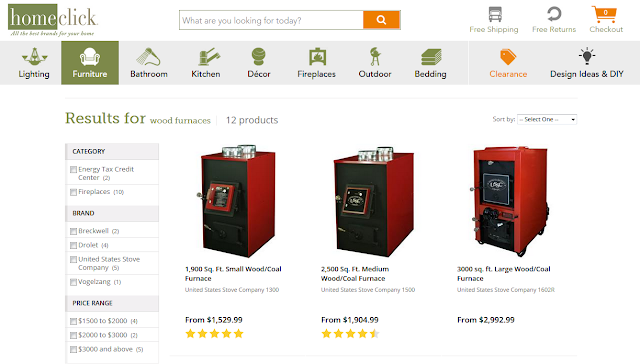
AGH efforts were not always effective, and a few retailers still appear to be advertising uncertified wood furnaces (see screenshots below). These include Sears’ online marketplace (orders fulfilled by the third party 123Stoves, Inc.), Homeclick, and HVAC direct. All screenshots were taken on June 22, 2017.

Houzz.com, Wayfair, and HVAC direct continue to sell uncertified wood furnaces or ones that are labeled wood/coal. The units they are selling are all made by US Stove Company, whose business model leaves it vulnerable to illegal sales of its units by multiple retailers.

AGH regularly monitors advertising by manufacturers and retailers in order to better educate consumers about misleading claims. We also publicize the names of manufacturers who provide better information and do not mislead consumers.

This continued advertising and sale of products that are no longer compliant highlights the danger that stranded inventory can pose for retailers when deadlines pass. If the 2020 emission rules are not delayed or changed, some wood stove retailers may get stuck with inventory that they are no longer allowed to sell, but are under pressure to unload to recoup their investment.

Without regulation, wood furnaces often sold for $1,000 - $2,000, less than many certified wood stoves. Even after the 2017 rules took effect, certified wood furnaces remain affordable with most selling for $2,100 to $3,200. Ten models are now certified, ranging from a more expensive European-designed pellet furnace at 89% efficiency to a very basic US Stove model 1330E that is 33% efficient.

However, the future of this class of wood heaters is far from secure, as EPA rules require wood furnaces to emit no more than 0.15 lbs/mmBtu as of 2020. Other than the European-designed pellet furnace, the other certified furnaces are not at all close to meeting that standard. Wood furnaces saw extremely little technological development until they were required to be certified between 2005 and 2017, and the sector is far behind the levels of controls that have been built into stoves and boilers.

Screenshots:


 https://hvacdirect.com/us-stove-1500-wood-coal-furnace.html 


 http://www.homeclick.com/vogelzang-vg1500-norseman-1500-sq-ft-wood-burning-add-on-furnace/p-878127.aspx

Tuesday, September 10, 2013

Consumer Reports Rates Chain Saws


Heavy-Duty Gas
Think it’s hard to decide between industry leaders Stihl and Husqvarna? Well, so does Consumer Reports magazine. But in the October 2013 issue, Stihl edged out Husqvarna on performance and price, garnering a “CR Best Buy”. The Stihl MS 180 C-BE (or the 181 C-BE) got CR’s top rating, and cost only $230.

These two top performers both weighed 11 pounds and had 16 inch chains. The Husqvarna 435 440E came in second at $270. Third and fourth place went to Echo, and a Poulan Pro came in 5th at $180.

Light-Duty Gas
Among the light duty saws, the Craftsman 34190 (made by Poulan Pro) came in top, at $150 and the Homelite UTI0589A second at $160. The light duty saws were no lighter in weight, and sometimes were heavier than the heavy-duty saws. Their chain length was also the same, either 16 or 18 inch.

Corded Electric
The top ranked corded electric saws performed as well as the light-duty gas saws. The best, the Worx WG303.1 cost only $100 and weighs 11 pounds. It sawed as quickly as some light duty models and spared you the hassle of refueling, pull starting and tune-ups.

Consumer Reports did not provide any information on repair history. For the complete CR story you may have to be a CR subscriber: http://www.consumerreports.org/cro/chain-saws.htm?loginMethod=auto

Now for advice from the Alliance for Green Heat: Even if your wood stove can take an 18 or even a 20 inch log, considering cutting lots into lengths of about 14 to 16 inches, especially if you're planning to burn it in the next few months (less than 6 months). Shorter, split pieces of wood will dry faster, and give you more usable BTUs from each log. And remember, you need to split the wood as soon as possible to really start the drying process. Un-split wood does not dry well and can double the time it takes to season the wood. The EPA's Burn Wise program's Best Burn Practices notes, "Wood burns best when the moisture content is less than 20 percent. You can purchase a wood moisture meter to test the moisture content of your wood before you burn it."

Thursday, March 28, 2013

Travis Takes Lead on Free Moisture Meters

Travis Industries has begun to include a free moisture meter with each purchase of one of its wood stoves. Travis teamed up with the EPA’s Burn Wise program, which is promoting voluntary efforts like this to help wood stove owners burn cleaner and more efficiently.

The Alliance for Green Heat applauds Travis' leadership on this and urges other manufacturers to start providing moisture meters with their new wood stoves. We'll do our best to publicize any manufacturer who joins this effort in our newsletters and on our website. For more information, you can also contact Larry Brockman at brockman.larry@epa.gov.

Here is how Travis is pitching it to their dealers:

"It's not a trade secret that you need properly dried and seasoned wood for any wood burning appliance to operate effectively. Your customers however may be in the dark about this small, yet crucial, detail.

Since we want Travis Industries wood appliances to live up to your customer's performance standards we're now supplying a FREE moisture meter with every wood model!

Also included is a "How to Use Your Moisture Meter" guide and handy educational sheet for the homeowner about the importance of wood moisture content.

It's our hope that cultivating a broader understanding of wood preparation will eliminate unnecessary tech and service calls about the appliance."

Click here for more independent, non-commercial consumer resources on choosing the right appliance and using it correctly.

Tuesday, October 20, 2009

Keene Sentinel Publishes AGH letter on Change out Program

Dear Editors,

Tuesday, Dec. 17, 2013 in Keene NH.
Keene is surrounded by hills,
trapping wintertime wood smoke.
The upcoming Keene woodstove changeout program could well become a national model for such programs. No other change out program in the US has had such a high rebate amount ($1,000) for all applicants.

But the long term benefits of the program will be undermined unless the City of Keene is able support it with some other measures. For example, anyone in Keene can go out and buy a new polluting wood stove that uses a loophole to avoid EPA emission standards, and install it tomorrow. What's the point of giving $1,000 rebates to take polluting stoves out of commission if you allow more polluting stoves to be installed? To remedy this, the Keene City Council needs to pass an ordinance requiring that any stove installed in Keene has to be EPA certified. This will also help prevent people from buying and installing old, second hand uncertified woodstoves in the City of Keene. Scores of old, polluting woodstoves are available in southern New Hampshire on Craigslist for as low as $75. Washington State and California already ban installing uncertified stoves but in most of the US anyone can buy a $200 stove made in China that can foul indoor air, as well as outdoor air.

Many of us in the woodburning community believe that to promote wood burning as a viable low carbon renewable energy, like wind and solar, we have to incentivize cleaner burning stoves, and phase out the most polluting ones. Woodstoves are an excellent and relatively inexpensive way to reduce your carbon footprint. A $1,000 - $2,000 woodstove can shave 3-4 tons of carbon from your carbon footprint every year, often the equivalent of what a $10,000 - $20,000 solar or geothermal system will shave off.

Sincerely,

John Ackerly,
Alliance for Green Heat