Showing posts with label warm air furnace. Show all posts

Monday, June 26, 2017

The Alliance for Green Heat pursues retailers advertising uncertified wood furnaces

Six of the nine retailers AGH contacted stopped advertising uncertified furnaces within two weeks

Indoor furnaces are usually in the
basement, but can be in a garage.  Either
option often leads to better fuel storage
practices than outdoor boilers and
greatly reduces jacket losses.
On May 15, 2017, EPA regulations took effect that required all wood furnaces to include smoke reduction technologies and be certified by third party test labs. Some furnace manufacturers started educating their retailers early and stopped shipping uncertified furnaces during the winter. Others continued to ship units, and many retailers continued to advertise and sell uncertified furnaces after the law changed on May 15.

Indoor wood and coal furnaces—also called warm, hot air, or forced air furnaces—were very popular in the US through the early to mid-1900s, then gradually their lost market share as fossil liquid fuel furnaces gained traction in the late 1900s. Then, outdoor wood boilers gained favor, becoming a far worse threat to local air quality than indoor furnaces and boilers had been for decades.

The Alliance began contacting retailers advertising uncertified furnaces to find out whether they knew about the change in regulations and how responsive they would be to information about the change. “We believe that all manufacturers and retailers should play by the same rules, so that the ones who do follow the rules don’t get undercut by ones who do not,” said John Ackerly, President of the Alliance for Green Heat. “And, we found that many if not most retailers will stop advertising products that are not legal to sell if they are politely and professionally approached by an organization that is knowledgeable about the rules,” Ackerly said.

AGH Project Manager Melissa Bollman contacted nine retailers advertising uncertified furnaces. Of those, six stopped advertising those boilers within 2 weeks. Some of the furnaces were removed from the website entirely or are listed as unavailable, while other models that were previously advertised as capable of burning wood or coal have been rebranded as “coal only” to comply with EPA regulations.  Currently, if a stove or boiler is advertised as being able to burn wood, it must be tested and certified to burn wood.  (The EPA does not regulate coal heaters and some manufacturers have just added a grate and continue to sell the same unit as “coal only”.)

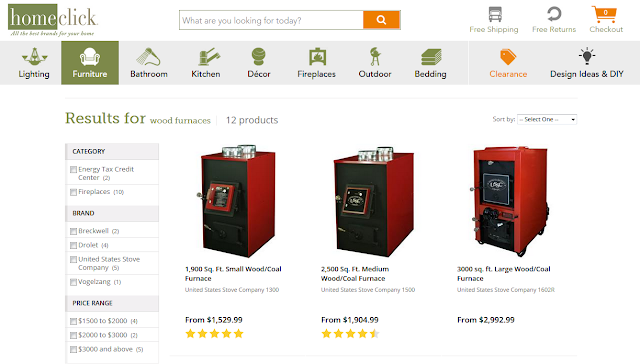
AGH efforts were not always effective, and a few retailers still appear to be advertising uncertified wood furnaces (see screenshots below). These include Sears’ online marketplace (orders fulfilled by the third party 123Stoves, Inc.), Homeclick, and HVAC direct. All screenshots were taken on June 22, 2017.

Houzz.com, Wayfair, and HVAC direct continue to sell uncertified wood furnaces or ones that are labeled wood/coal. The units they are selling are all made by US Stove Company, whose business model leaves it vulnerable to illegal sales of its units by multiple retailers.

AGH regularly monitors advertising by manufacturers and retailers in order to better educate consumers about misleading claims. We also publicize the names of manufacturers who provide better information and do not mislead consumers.

This continued advertising and sale of products that are no longer compliant highlights the danger that stranded inventory can pose for retailers when deadlines pass. If the 2020 emission rules are not delayed or changed, some wood stove retailers may get stuck with inventory that they are no longer allowed to sell, but are under pressure to unload to recoup their investment.

Without regulation, wood furnaces often sold for $1,000 - $2,000, less than many certified wood stoves. Even after the 2017 rules took effect, certified wood furnaces remain affordable with most selling for $2,100 to $3,200. Ten models are now certified, ranging from a more expensive European-designed pellet furnace at 89% efficiency to a very basic US Stove model 1330E that is 33% efficient.

However, the future of this class of wood heaters is far from secure, as EPA rules require wood furnaces to emit no more than 0.15 lbs/mmBtu as of 2020. Other than the European-designed pellet furnace, the other certified furnaces are not at all close to meeting that standard. Wood furnaces saw extremely little technological development until they were required to be certified between 2005 and 2017, and the sector is far behind the levels of controls that have been built into stoves and boilers.

Screenshots:


 https://hvacdirect.com/us-stove-1500-wood-coal-furnace.html 


 http://www.homeclick.com/vogelzang-vg1500-norseman-1500-sq-ft-wood-burning-add-on-furnace/p-878127.aspx

Monday, March 16, 2015

What Consumers Need to Know about New EPA Wood Stove Rules

Updated: May 2022
There have been many claims, counter-claims, predictions and fears about the new EPA regulations on wood and pellet heaters.  Here is a summary of the key points in the rule that will impact you, the consumer.

The rule became law on Friday, May 15, 2015 and various provisions go into effect on Jan. 1, 2016, May 15, 2016 and May 15, 2020.  On March 11, 2020 the EPA ruled that no major changes would be made to the rule and that there would not be any retailer "sell-through" period. Scroll to the bottom to see a timeline of implementation. This rule is an NSPS - a New Source Performance Standard  - established by the EPA with input from industry, states, consumers and other stakeholders.

Wood stoves: Most stove consumers will not notice any differences between stoves sold before 2015 and those sold now. As of 2016, stoves must not emit more than 4.5 grams an hour of particulates and after May 15, 2020, 2  or 2.5 grams an hour.  One of the biggest changes is that some of the really cheap, uncertified wood stoves went off the market after Jan. 1, 2016.  Similar, certified stoves that are EPA certified and put out less smoke are still available for $500 - $900.  Consumers will see more hybrid and catalytic models.

Pellet stoves: Consumers will also not notice differences in pellet stoves either but pellet stoves are getting gradually cleaner and more efficient.  As of Jan. 1, 2016 all pellet stoves have to be certified by the EPA.  Many models are also getting more efficient.  In 2020, pellet stoves also have to emit no more than 2 grams an hour. As of Nov.  2020, seventeen models are more than 80% efficient and more than half only emit 1 gram or less of particulate matter. Just because a stove is higher efficiency does not mean its more durable.

Prices: Prices are expected to rise modestly. As of November 2020, tariffs on steel were the biggest driving factor, not EPA regulations.  In 2018, we analyzed 77 popular models and found a 3-4% price rise since May 2015, but that may be due to a host of factors, and not necessarily impact of regulations. In the longer term some manufacturers say their stove prices may go up $75 - $400 by 2020.  

Retail “sell-through” period: Retailers had until Dec. 31, 2015 to sell existing stock, after the law went into effect on May 15, 2015.  There is not a similar sell-through provision in 2020 and all stoves that are not 2020 compliant need to be sold by May 15.  

Existing and second hand stoves: Existing stoves are not impacted by these rules, nor is the vibrant second hand market for wood stoves. States can regulate existing and uncertified stoves and two states - Washington and Oregon - do not allow anyone to sell or install an uncertified stove off the second hand market.  All states allow consumers to purchase and install second hand EPA certified stoves. (How to buy a second-hand EPA certified stove.)

Corn, coal and multi-fuel stoves: Corn and coal only stoves are not covered by EPA rules and can continue to be sold without any government emission regulation, so long as they don't advertise that they can also use wood or pellets. To advertise a multi-fuel stove that can use pellets and corn, the stove has to be certified for pellets and also tested with corn.  There is no threshold for emissions with corn, but the stove has to also be tested with corn and that data must be submitted to the EPA.  (More on corn stoves and coal stoves.)

Misleading advertising: Some manufacturers post unverified and exaggerated efficiency claims on their brochures and websites but this is gradually improving.  The new rules specify how stove efficiency is to be tested and reported to the EPA, and now all models have verified efficiencies on the list of EPA certified stoves. To date, neither the EPA nor state agencies have cracked down on exaggerated and misleading efficiency claims in advertisements.  As of 2021, consumers can rely on most certificates issued by manufactures about whether a stove model qualifies for the 26% federal tax credit.

Efficiency: There is no minimum efficiency standard, but the new rule requires efficiency testing and reporting.  Prior to 2015, manufacturers were allowed to keep their efficiencies confidential and most did not disclose them.  The average wood and pellet stove was about 70% efficient, but has been going up.  The median pellet stove efficiency is steadily climbing and is now about 74%, with some in the mid and high 80s.

New hangtags: The EPA has been issuing special, voluntary hang tags for those stoves and boilers that already meet the stricter Step 2 standards (2 grams and hour), disclose their actual efficiency and/or that have been designed and tested with cord wood. This will help consumers more easily identify the cleaner stoves and those that are designed to be used with cordwood - the same type of fuel that consumers use.  (Update: as of summer of 2017, a technical testing problem led to a temporary recall of these hang tags.) As of May 2020, only stoves tested and certified with cord wood will be allowed to use the hang-tag.


Carbon monoxide (CO): The new rules do not limit the amount of CO that can be emitted but require that it be tested and reported. There is a much wider range of CO than there is PM, with many pellet stoves under .05 grams per minute, and many non-catalytic wood stoves higher than 1.0 grams per minute, a 20-fold difference.

Stoves tested with cordwood: The rules set up an alternative, voluntary compliance option for Step 2 emission levels as of 2020 of 2.5 grams an hour for stoves tested with the ASTM cord wood
method.  There was a hope that these stoves would burn cleaner in hands of consumers, but that has not turned out to be the case. Generally, the cord wood test is a bit easier and manufacturers prefer to use it and tend to get cleaner PM numbers in the lab. No matter how the stove was tested in the lab, it is essential to use dry wood and give the stove enough air to get good performance and minimize health issues from wood smoke.

Pellet fuel: All new pellet stoves must be tested and warrantied to use with pellets that are certified by a third party entity - either the Pellet Fuels Institute (PFI), ENplus or CANplus. Consumers will likely see more and more pellets certified by one of those entities, which means they meet certain quality and consistency standards. As of 2020, 34 pellet plants make PFI certified pellets.  AGH urges consumers to purchase third party certified fuel, which in the U.S. means PFI certified.


Export stoves: US manufacturers can continue to make and sell their existing stoves that do not meet the new EPA standards in other countries.  Uncertified stoves with no emission controls or testing can be sold in most of the world.  US stove companies are also increasingly exporting to countries that have emission standards, like Japan, Korea, Australia and New Zealand. These stoves have to be labeled as an “export stove. May not be sold or operated within the United States.” 

Masonry Heaters: The EPA did not set emission standards for masonry heaters in this rule, but asked the Masonry Heater Association to further develop a testing standard so that they could be included in the next NSPS, which should be in 2023.

Fireplaces: The new rules do not apply to fireplaces, but there is a voluntary method for cleaner fireplaces to be tested and qualified by the EPA.  This rule does not refer to the voluntary program, which may mean there is little interest in including fireplaces in the next NSPS.

Owners manuals: All owners manuals should be updated as of May 15, 2015. Updated manuals will have more detail and must instruct operators how to get optimal performance from the stove or boiler.

Litigation: The largest stove and boiler industry association, the HPBA filed suit over the 2020 emission standards for boilers and the case was delayed many times.  Air quality groups are joining that suit to defend it from being weakened or delayed.  In August of 2021 the Federal Appeals Court ruled in favor of EPA, and dismissed industry's challenge.

Role of states: Several states have passed resolutions barring state agencies from enforcing this NSPS but the rule clearly states that it does “not impose any requirements on state and local governments.”   To date, Missouri, Michigan and Virginia have passed laws barring state enforcement, largely a symbolic gesture. A number of other states, including New Hamphsire and Vermont have formally taken delegation of NSPS provisions to achieve cleaner air in their states and protect consumers.


Boilers & Furnaces

Boilers: Like stoves, boilers must meet Step 1 emission limits by May 15.  Retailers could still sell older, uncertified and unqualified boilers through Dec. 31, 2015.  In 2020, they must meet stricter emission limits.  EPA regulations have led to far more efficient boilers, with many now topping 80% but the regulations have hit the boiler and furnace industry harder than the stove industry.  Only 29 of the more than 100 boiler and furnace models are now 2020 compliant.

Warm air furnaces: Furnaces that heat air, instead of water, got a reprieve from the EPA after intensive advocacy by industry and pressure from Congress.  Small ones have to meet Step 1 emission standards by May 15, 2016 and large ones not until May 15, 2017. Only 3 furnace models are now 2020 compliant.

Loophole for unregulated outdoor boilers: Manufacturers of unregulated outdoor wood boilers can continue to make and sell these units for "commercial" applications.  However, one outdoor boiler company has already indicated that as long as the customer assures the dealer that the unit will be used for commercial purposes, its up to the consumer to use it as they please.

Boiler and furnace prices: Unlike stoves, options for consumers will change more, since the boiler furnace industry had not been regulated and many low-cost, low-efficiency units were on the market.  Prices - and efficiencies- are likely to rise significantly but operating costs will be significantly lower.

Moisture meters: Conventional uncertified forced air furnaces and then certified ones must come with a free moisture meter.  (Some advocates had urged all stoves to come with moisture meters.)

Comments? If you think we have omitted important information in the NSPS for consumers, please let us know at  info@forgreenheat.org.