Showing posts with label forced air furnace. Show all posts

Friday, October 18, 2019

EPA urges manufacturers to stick to May 2020 compliance deadline; says its working towards a cordwood test method rulemaking


On October 15 the EPA provided an update on its wood heater website page urging “affected entities to continue efforts to certify compliance with the NSPS in light of the upcoming May 15, 2020, compliance date.” According to NSPS legal experts, the EPA sometimes issues such updates to provide more transparency when stakeholders need certainty due to an approaching deadline.  

[March 11, 2020 update: The EPA finalized amendments to the 2015 NSPS and did not provide a retailer sell-through.  They did remove pellet fuel minimum requirements but retained the list of prohibited fuels in the 2015 NSPS.]

The October 2019 update is widely interpreted to mean that there will be no sell-through for whole house heaters or any other significant changes in the regulations issued by the EPA in 2015. However, the details of any changes to the 2015 rules will come later this fall when the EPA issues the Final Rule.  

The news was welcomed by the Alliance for Green Heat and many stakeholders, including manufacturers and importers of wood heaters who have invested in R&D and retesting of their heaters that comply with May 2020 emission standards.   Nearly 200 models of wood and pellet heaters are certified to the 2020 standards and virtually all stove companies say they will be ready for May 2020.  Some include innovative designs that achieved emission levels that are six times cleaner than the maximum allowed in 2020.

The sectors of the wood heater industry that most needed a sell-through are the outdoor wood boiler and indoor forced-air furnace makers, both of whom are represented by the trade group Hearth, Patio and Barbecue Association (HPBA).  HPBA’s strategy of seeking relief from Congress and the Administration appear to have fallen through, leaving its litigation against the EPA as the most viable channel for relief.  But that relief will likely not occur before May 2020.

Test methods
 
A Canadian company who never
had an EPA certified heater
saw a new market open up
for their AirBilo Furnace.
Much of the EPA’s update addressed test methods, and the EPA noted that a newly approved broadly applicable alternative test method for furnaces “may facilitate the ability of manufacturers” of furnaces to comply by May 2020.  This is not the type of relief sought by HPBA, and it’s not yet known if many other furnaces will use this test method for certification.  However the EPA puts it in the context of providing some relief.  It was given to a Canadian company mostly known for maple syrup boilers, but who also makes a very affordable forced air furnace.

The EPA used this update to message that it is already moving on to the next proposed rulemaking, which will be on cordwood test methods.  The update said, “in the coming months, the agency is initiating a series of roundtable discussions with states and other stakeholders to inform the agency’s direction toward a cord wood-based compliance test method.”  In March 2016, the EPA laid out a process for developing improved cordwood test methods. By statute, the next NSPS should be in 2023 but the EPA could issue this rule making earlier.  AGH believes the next NSPS should not focus on reducing allowable PM without first modernizing test methods to ensure heaters are designed for real world use.

Part of the HPBA’s litigation focused on an agency decision to set a 2.5 gram an hour emission standard before setting a test method to meet that standard. Subsequently, an industry led ASTM committee developed the E3053 test method which has become a commonly used method along with the standard crib wood method that has been in use since the late 1980s.   The ASTM method is being widely used now but came under scrutiny by the EPA because of lax reporting by labs using the method.

NESCAUM is developing "Integrated
Dute Cycle" protocols based on the
way stoves are used by consumers.
Since the ASTM method became a “broadly acceptable” alternative test method, NESCAUM has dedicated substantial resources on a broad and ambitious effort to develop a range of new test methods for stoves, boilers and furnaces, as well as for pellet heaters.  The NESCAUM effort is partially funded by NYSERDA and the process and data is not fully public but ultimately it could provide the largest database of cordwood testing ever compiled to develop a North American test method.  Since test methods need to be data driven, this process may give these NESCAUM protocols an entry point and will challenge others to develop or make public data that can lead to a better protocol.

Thursday, March 21, 2019

Company makes 2020 certified warm air furnace for under $2,000 - and stirs controversy


Paul Van Der Eems, Dan Haynes,
and David Walters of HY-C accept
a Vesta Award for their furnace.
Updated on April 5, 2019 - Many said it could not be done.  A competitor called it “preposterous.” But HY-C, a Missouri company that makes a budget line of warm air wood-fired furnaces, is well on their way to being ready for June 2020, when stricter EPA regulations come into effect.  

Their first 2020 compliant model, their smallest unit, was certified at 0.106 lb/MMBtu Output, well under the .15 allowable. The suggested retail price is $1,899 which is only $100 more than the previous unit that was certified to the 2017 standards.  HY-C won a Vesta Award for the furnace at the industry’s annual expo in Dallas last week.

In 2014, HY-C went to the EPA and urged them to adopt a laddered approach, giving companies several years to get certified and several more to meet a stricter standard. “The EPA was responsive, giving us a total of 5 years,” David Walters, President of HY-C recalled in a phone interview.  David said that  when they bought the company in 2011, the NSPS process was well underway, and they knew they would have to change and clean up.  “It wasn’t easy, but we did it, and that is good for the environment, for consumers, and for us, the manufacturer,” David said.

The HY-C FC100E is the first
low-cost wood fired forced air
furnace to meet the strict EPA
2020 emission standards.
The EPA won’t list a certified unit on the list of certified appliances until the company posts their lab test report on their website.  Parts of those reports are highly technical but provide key information for consumers and others. The HY-C report said the unit achieved 50% delivered efficiency and a stack loss efficiency of 71%. It was certified using a modified test protocol that had been approved in advance by the EPA.  Intertek laboratories did the testing using about 36-pound loads of cord wood that had about 22% moisture content.  The five tests ran 3 to 6 hours.  Their target output was 13,000 – 37,000 BTUs but the certification test obtained 20,000 – 34,000, due in part to the modified test protocol. 

To date, the only other company to have a 2020 compliant forced air furnace is Lamppa Manufacturing, which hit .09 lbs/MMBtu several year ago and a stack loss efficiency of 79%, far above the HY-C.  The Lamppa unit, the Vapor-Fire 100 is currently priced at $5,695 and also obtained a test protocol variance from the EPA in the test protocol.  The Vapor Fire weights 670 pounds, which may indicate thicker and more durable materials compared to the HY-C unit at 435 pounds.  (Update: SBI has certified a third wood furnace, under the Caddy brand.)
The Lamppa Vapor Fire
100 is the only other 2020
compliant wood furnace,


Another big player in the forced air furnace space is US Stove, and it’s unclear when they will have a 2020 compliant unit.  Of their eight units certified to the 2017 standards, one came in at 33% efficiency and an average of 60% efficiency. US Stove is urging the EPA to repeal the Step 2 standards for forced air furnaces, arguing that agency picked a “compliance limit out of thin air with not [sic] real data to support it.”  In a filing with the EPA, they said that the EPA’s timeline of going from an uncertified appliance category to meeting .15 mmBTU “is preposterous and unrealistic.”  HY-C appears to have just proved otherwise.

However, the willingness of the EPA to approve alternative test methods can be controversial, and companies often claim a competitor got an unfair advantage with a particular variance.  The EPA is not supposed to approve variances that make the protocol easier to pass, but that may just what is happening in some instances.  Variances are a critical tool for the EPA to allow for innovative products to be fairly tested and they also create a precedent for others to receive similar variances.

The largest player in the Canadian forced air furnace market is Stove Builders International (SBI) and they do not directly compete in the budget market with US Stove or HY-C.  SBI is also working on certifying furnaces to the 2020 standards but “we are trying to achieve the desired performance without using the alternative test method that the EPA has granted to others,” said Marc-Antoine Cantin, of SBI.  “We want to put out a product that cycles combustion and doesn’t just cycle the blower, while the unit is kept burning at a single burn rate,” Cantin said.  

HY-C sells their furnaces through a variety of distributors and retailers, including many big box stores. They provide all of their own customer services and have tens of thousands of units in the field that provide them with intensive customer feedback.  They make all of their furnaces in St. Louis Missouri and have extremely little inventory of non-2020 inventory left and expect to start shipping 2020 compliant units in July.  “We worked hard with distributors, so the pipeline of older units is dry,” Walter told us.  As a result, they have abstained from the debate as to whether the wider industry needs a 2-year sell through for units that are not 2020 compliant.  Lamppa has been an outspoken defender of the original timelines, arguing that a 2-year sell through would be unfair. Click here for more on that debate.
The EPA exempt US Stove 
1357 Hotblast  "coal only" furnace 
also advertises "21 in. log 
capacity" at Home Depot (Home
Depot discontinued the unit
a week after the story appeared.)

Both US Stove and HY-C say that their customer base is very price sensitive and need a furnace under $2,000, if not close to $1,500.  Other industry experts have questioned how so many people came to expect a whole house furnace for less than the price of an average wood stove and assumed that price would have to climb substantially to meet 2020 emission standards.  At the core of the fight between industry, states and air quality agencies is whether the price of wood appliances and costs to manufacturers should drive EPA standards more than other factors.  While HY-C was able to meet both the timeline and the emission standards, it is still unclear how well it will be received by the general public.  US Stove also make “coal only” units that are exempt from EPA emissions and sell side-by-side in many stores with the regulated wood units. HY-C has a coal only unit but only sells a few each year direct to consumers and not through retailers.

According to one industry insider, Tractor Supply Company stores is the biggest seller of wood furnaces from their 1,700 US stores.  Floor staff at chain hardware stores like this have reportedly been trained to inform consumers that the “coal only” units can burn wood perfectly well.  Companies that make both wood and coal units benefit from this and can sustain market share, even as EPA standards tighten.

Certifying to 2020 standards appears to have led to shorter burn times and more finicky furnace and boilers for some units.  HY-C advertised up to 12-hour burn time and a maximum of 130,000 BTU output for the unit as certified to 2017 emission standards.  The EPA listed BTU output up to 45,000.  The 2020 version only had up to 6-hour burn times in the lab and a maximum of 34,000 BTU output.  Both the 2017 and the 2020 model accept 20-inch logs.  Can the 2020 version meet consumer expectations at virtually the same price? 

But for now, HY-C achieved what they set out to. “We planned to build a better mouse trap and we feel that we succeeded, with advice from industry experts and our consumers,” David Walter said.  “In America, we should not take for granted that we have clean air and water, thanks to Congress and decades of work by the EPA,” Walter continued.  If anyone thinks the EPA efforts are a waste of time, Walters says all you have to do is visit Shanghai or some other foreign cities. “It’s so polluted you can barely walk outside and see the other side of the street,” he said.

Monday, June 26, 2017

The Alliance for Green Heat pursues retailers advertising uncertified wood furnaces

Six of the nine retailers AGH contacted stopped advertising uncertified furnaces within two weeks

Indoor furnaces are usually in the
basement, but can be in a garage.  Either
option often leads to better fuel storage
practices than outdoor boilers and
greatly reduces jacket losses.
On May 15, 2017, EPA regulations took effect that required all wood furnaces to include smoke reduction technologies and be certified by third party test labs. Some furnace manufacturers started educating their retailers early and stopped shipping uncertified furnaces during the winter. Others continued to ship units, and many retailers continued to advertise and sell uncertified furnaces after the law changed on May 15.

Indoor wood and coal furnaces—also called warm, hot air, or forced air furnaces—were very popular in the US through the early to mid-1900s, then gradually their lost market share as fossil liquid fuel furnaces gained traction in the late 1900s. Then, outdoor wood boilers gained favor, becoming a far worse threat to local air quality than indoor furnaces and boilers had been for decades.

The Alliance began contacting retailers advertising uncertified furnaces to find out whether they knew about the change in regulations and how responsive they would be to information about the change. “We believe that all manufacturers and retailers should play by the same rules, so that the ones who do follow the rules don’t get undercut by ones who do not,” said John Ackerly, President of the Alliance for Green Heat. “And, we found that many if not most retailers will stop advertising products that are not legal to sell if they are politely and professionally approached by an organization that is knowledgeable about the rules,” Ackerly said.

AGH Project Manager Melissa Bollman contacted nine retailers advertising uncertified furnaces. Of those, six stopped advertising those boilers within 2 weeks. Some of the furnaces were removed from the website entirely or are listed as unavailable, while other models that were previously advertised as capable of burning wood or coal have been rebranded as “coal only” to comply with EPA regulations.  Currently, if a stove or boiler is advertised as being able to burn wood, it must be tested and certified to burn wood.  (The EPA does not regulate coal heaters and some manufacturers have just added a grate and continue to sell the same unit as “coal only”.)

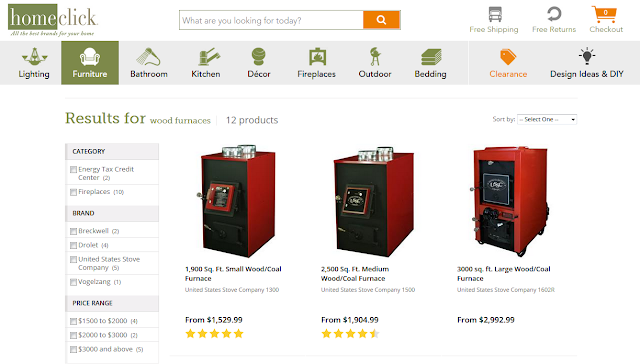
AGH efforts were not always effective, and a few retailers still appear to be advertising uncertified wood furnaces (see screenshots below). These include Sears’ online marketplace (orders fulfilled by the third party 123Stoves, Inc.), Homeclick, and HVAC direct. All screenshots were taken on June 22, 2017.

Houzz.com, Wayfair, and HVAC direct continue to sell uncertified wood furnaces or ones that are labeled wood/coal. The units they are selling are all made by US Stove Company, whose business model leaves it vulnerable to illegal sales of its units by multiple retailers.

AGH regularly monitors advertising by manufacturers and retailers in order to better educate consumers about misleading claims. We also publicize the names of manufacturers who provide better information and do not mislead consumers.

This continued advertising and sale of products that are no longer compliant highlights the danger that stranded inventory can pose for retailers when deadlines pass. If the 2020 emission rules are not delayed or changed, some wood stove retailers may get stuck with inventory that they are no longer allowed to sell, but are under pressure to unload to recoup their investment.

Without regulation, wood furnaces often sold for $1,000 - $2,000, less than many certified wood stoves. Even after the 2017 rules took effect, certified wood furnaces remain affordable with most selling for $2,100 to $3,200. Ten models are now certified, ranging from a more expensive European-designed pellet furnace at 89% efficiency to a very basic US Stove model 1330E that is 33% efficient.

However, the future of this class of wood heaters is far from secure, as EPA rules require wood furnaces to emit no more than 0.15 lbs/mmBtu as of 2020. Other than the European-designed pellet furnace, the other certified furnaces are not at all close to meeting that standard. Wood furnaces saw extremely little technological development until they were required to be certified between 2005 and 2017, and the sector is far behind the levels of controls that have been built into stoves and boilers.

Screenshots:


 https://hvacdirect.com/us-stove-1500-wood-coal-furnace.html 


 http://www.homeclick.com/vogelzang-vg1500-norseman-1500-sq-ft-wood-burning-add-on-furnace/p-878127.aspx

Monday, May 1, 2017

All wood and pellet furnaces must be certified by May 15, 2017

One of the loopholes in the new EPA regulations about to close
The cleanest and most efficient
forced air furnace is the Maine
Energy System Auto Pellet Air.
It delivers 89% efficiency.

One of the big loopholes in the new EPA wood and pellet heater regulations is closing this month.  Small forced air furnaces were required to meet new emission regulations in May 2016, but many very small furnaces declared themselves to be large furnaces, giving them until May 2017 to meet the new standards.  As of May 16, 2016, all forced air furnaces, large and small, must emit no more than 0.93 lbs per mmBTU of heat output regardless of whether they are wood or pellet units.

In April 2017, there were six certified forced air furnaces, four of which use wood and two of which use pellets.  The average emissions rate ranges between 0.06 to 0.84 lbs, with the average at 0.411 lbs, less than half the current standard.  However, as of 2020, this class of heaters must meet a far stricter standard of 0.15 lbs/mmBTU.  (This is the subject of litigation by the HPBA.)  Only one of the current six models, the Maine Energy System Auto Pellet Air,  emits less than 0.15 lbs, but it has to be retested using a different test method to comply with the 2020 standards.

Of the six on the market in April 2017, there is an efficiency range, from 48% to 89%.  Both ends of the spectrum are listed as pellet heaters.  At the top end is the Maine Energy System’s Auto Pellet Air, which was developed by OkoFEN, a leading pellet boiler company in Austria.  At the bottom end is US Stove’s 8500 multi-fuel furnace.  (US Stove also has a certified cordwood furnace that has lower emissions and higher efficiency than this pellet model.)  The average efficiency of the six
The US Stove 8500 pellet
furnace was the least efficient
certified furnace at 48%. Now, US Stove
has a 33% efficient log wood furnace. 
furnaces is 66%.

(June 2017 update: There are now 10 certified furnaces on the market, with an average of 60% efficiency and a huge range stretching from 33% to 89%.)


At the end of May 2017, it will be clear how which forced air furnaces did not get certified.  There are many more coal furnaces on the market today, compared with 3 or 4 years ago, as some companies have added grates and other slight modifications to outdoor wood boilers and furnaces in order to keep them on the market as coal units.  Coal heaters are still not covered by EPA emission regulations, so renaming a wood boiler or furnace a coal boiler or furnace is still a loophole used by some companies.