Showing posts with label DBFZ. Show all posts

Friday, August 17, 2018

Meet the teams: Wittus and German team bring the E-Stove to America

This is the final post in a series introducing the 12 teams participating in the 2018 Wood Stove Design Challenge in November.

By John Ackerly, Ken Adler, and Shoshana Rybeck, Alliance for Green Heat

Niels Wittus

Our final blog in this series is about a partnership between a US stove importer and a German thermoelectric stove manufacturer. Wittus-Fire by Design, lead by Niels Wittus in New York, is one of the premier retailers of higher end European stoves in America. He is working with a team of engineers at the German company, Thermoelect GmbH, to bring the “E-Stove” to the Design Challenge this November 9-14, 2018, and to the US market.

Niels and his wife, Alyce, started Wittus-Fire by Design in 1978 in the hopes of living out “the American Dream.”  The Danish couple Denmark found selling European stoves in the US to be the best way to combine their passion for their home and desire for an American life. Since the company’s creation, Niels and Alyce have internalized Hygge, the Danish term for “well-being” and the act of “enjoying life’s simple pleasures” in their work. From the beginning, their company was about much more than selling wood stoves, it was about supporting healthy environments and lifestyles. Niels truly believes that a wood stove is the “top Hygge product” that it is not only an “economical option” but also “the ultimate place where coziness, warmth and Hygge preside.”

Meet the technical guys

From left to right: Ingo
Hartmann, Frank Hoferecht, René Bindig
Horst Erichsen, Jonas Prell, Dr. Ingo Hartmann, René Bindig and Frank Hoferecht in Germany are responsible for all the technical elements of the E-Stove. Horst and Jonas together with their team designed and developed the basic elements of the E-Stove in the company Thermoelect GmbH. Ingo and René have worked together at the “German Biomass Research Center” (DBFZ Deutsches Biomasseforschungszentrum gemeinnützige GmbH), a government research institution, while Frank was previously working on developing combustion units for a start-up company, ETE EmTechEngineering GmbH. Frank, René and Ingo were brought together by a project in 2008 to design a very low emissions stove. Niels and his German counterparts had previously entered a stove in the Alliance’s 2013, 2014 and 2016 Design Challenges. Now, Ingo, René, and Frank are using their experiences to help Thermoelect GmbH create a very low emissions thermoelectric wood stove. Ingo and Frank have a world of experience in developing combustion units with low emissions. This will be their fourth time competing in the Wood Design Challenge and they are enthusiastic to see all of the US teams and products, as US wood stove technology and regulations are vastly different from those in Europe.

The E-Stove

Thermoelect’s E-stove is a very promising source of heat, electricity and hot water. They have achieved electricity yields of up to 250 watts in the past using a radiator, thermoelectric generator, and a battery to store the power. While their model can produce up to 250 watts, producing that much runs the possibility of producing too much heat for a single household room. So, Ingo says that their first step is to “produce 100 watts of power as a mean value over a day (24-hour period).” To generate greater power requires connecting the E-stove to a home’s hydronic heating system to distribute the heat to other rooms.

Team members holding thermoelectric
modules that make electricity.
The team credits much of their combustion efficiency as well as their subsequent emission reductions and heat and power generation to their novel down draft combustion unit with an integrated catalytic combustion system. Ingo says that catalytic emission control in wood combustion units has been “a point of focus in Germany for the past 10 to 15 years.” Ingo himself was brought to Thermoelect GmbH to research this type of emissions control and advance their stoves’ catalytic controls. However, what started as a project to create a stove with very low emissions became a project to create a highly efficient stove for producing electricity and heat. The team uses a radiator with the TEG, which is installed in the stove itself, and uses a pump to send the water throughout a home’s hydronic heating system. The stove runs with a large battery that is designed as backup power for the home, or potentially to augment a solar photovoltaic system.  
Thermoelect already has some units of the E-Stove running in German homes. Ingo says that the units that are in use have been working well, and that their main challenge is just ensuring the system does not produce too much heat when it produces high amount of power. The team is currently working on developing solutions to this problem in the lab. On the users’ end, the operator can control the heat for the water output system and has a permanent bypass at the catalytic combustion system, which is a mandatory feature for European stoves, so the user does not have to manually switch the bypass for the catalyst, including during cold start-up.
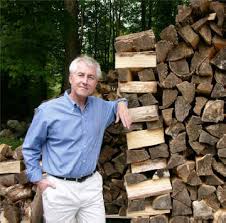
Niels Wittus with cordwood
From the beginning, all Team Wittus members have been working with wood stoves to create more efficient, clean, and affordable energy alternatives for consumers. The team believes that their recent progress advances “greener electricity” and address the needs of “people who do not have secure energy from the power plants.” For this reason, they work with wood logs, as pellets tend to be twice as expensive than cordwood in Germany, and many people have easy access to cordwood. Along with increasing affordability, the team is also always looking for new ways to give people even more reliable alternative energy. The E-Stove technology could be linked with solar power to give people living in boreal climates (e.g. Canada, the Northern US, and Scandinavia) power during times when solar power falls short.

Contact the team

Niels Wittus

Horst Erichsen

Dr. Ingo Hartmann

Frank Hoferecht

Tuesday, March 8, 2016

Press release: Alliance for Green Heat and NYSERDA Announce Seven Finalists in International Pellet Stove Competition


Two New York teams are among the finalists

Alliance for Green Heat and the New York State Energy Research and 
Development Authority (NYSERDA) today announced that seven pellet 
stoves have been chosen as finalists in the Pellet Stove Design 
Challenge. 

This international competition, administered by the Alliance for Green 
Heat, identifies innovative low emissions and high efficiency pellet 
stoves for the residential home heating market. The competition
supports Governor Andrew M. Cuomo's Renewable Heat NY initiative,
which is building a sustainable, high-efficiency, low-emissions wood
heating sector in New York.

The Pellet Stove Design Challenge supports the commitment of 
New York State, the Department of Energy's Brookhaven National
 Lab, the U.S. Forest Service and a number of other states, agencies
and institutions to understand and improve the technology,
engineering and smart deployment of pellet stoves to reduce reliance
on fossil heating fuels.

The stoves will be judged for particulate matter emissions, efficiency,
safety, innovation and market potential.  The winner of the
competition will be the team that best blends these qualities.  The
stoves present a wide range of design approaches, including gravity
feed, downdraft burners, a combination  cordwood/pellet stove, a
$300 stove and more traditional designs.

In April 2016, the teams will showcase their stoves at Brookhaven 
National Lab during the workshop and conference that are open 
to the public. The event includes several days of panel discussions
and informal roundtables on pellet stove technology, public health,
deployment, policy and innovation in pellet and cord wood stoves.

The technology competition will be followed by a multi-year 
initiative to exhibit the winning stoves and educate consumers and 
agencies that deal with wood smoke issues and the deployment of 
residential renewable energy systems. NYSERDA is providing 
support for this competition with additional support being provided 
 by the Osprey Foundation and U.S. Forest Service.

NYSERDA President and CEO John B. Rhodes said, "The Pellet 
Stove Design Challenge is an innovative way to advance new 
technologies that can potentially provide consumers with higher 
efficiency pellet stoves.  This competition aligns with Governor 
Cuomo's Renewable Heat NY initiative, which is building a 
sustainable, high-efficiency, low-emissions wood heating sector 
in New York."

Three stoves will be extensively tested and compete for a grand 
prize and four demonstration stoves will provide comparative, 
baseline data. The three competition stoves are:

1. A prototype that will burn cord wood or pellets and is controlled 
by sensor technology made by DBFZ, a German company, 
that markets in the U.S. through Wittus Fire by Design of
Pound Ridge, New York.
2.  A new stove coming to the commercial market later this year, 
made by Seraph Industries, a small Illinois company, known 
for robust heat exchangers and a track record of 
transparency and high efficiency multi-fuel stoves.
3.The Torrefire pellet stove, made by Seattle inventor 
Geoffrey Johnson, which is a prototype that employs radically 
different combustion and heat transfer strategies.

The four demonstration stoves are:

1. The Vibrastove, made by Noble Metals Recovery, a small 
Virginia company that is a downdraft, gravity feed stove, 
inspired by rocket stoves.
2. A modified Quadra-Fire pellet stove made by a student 
team from the State University of New York at Buffalo.
3. One of the cleanest commercial pellet stoves on the market 
today that is certified at less than .3 grams per hour.
4. Another very clean commercially available pellet stove,
 certified at less than .6 grams per hour.

The event is also bringing attention to the need for cleaner 
cord wood stoves. A student team from the State University 
of New York at Stony Brook and MF Fire, a company that 
grew from at University of Maryland team, will be showcasing 
automated, sensor controlled wood stoves.
The 2016 Pellet Stove Design Challenge is the third stove 
challenge that the Alliance for Green Heat will host.  The first 
was a cord wood stove competition held on the  National Mall 
in Washington DC in 2013 and the second was held at Brookhaven 
National Lab in 2014.  The Alliance for Green Heat, a non-profit 
education and advocacy organization manages the Challenge, 
which was inspired by the Department of Energy's Solar Decathlon.

"We strive to foster a community that shares ideas and data to push 
this technology forward and get pellet stoves the recognition they 
deserve as a mainstream renewable energy technology," said John 
Ackerly, President of the Alliance for Green Heat. "Like solar and 
wind, pellet stoves have huge potential in the United States to 
drastically reduce household use of fossil fuels if the technology can
raise efficiency and reduce emission levels," Ackerly added.

According to the Alliance for Green Heat, the average pellet stove in 
the U.S. is believed to be around 70 percent efficient but many of 
the most popular models are in the low 60s and the best ones are
around 80 percent efficient.  About one million homes are heated
with pellet stoves in the United States, with sales averaging about
75,000 per year.  An efficient pellet stove can pay itself back in
three-to-five years, depending on the heat source being replaced.
Currently, the federal government offers a $300 tax credit for new
pellet stoves.  Eight states including Idaho, Maryland, Maine,
Montana, Oregon and New York,  offer incentives of up to several
 thousand dollars for pellet stoves.

The  Advisory Committee that oversees the Challenge includes 
representatives from NYSERDA, Brookhaven National Lab, the 
 USDA Forest Service, the Washington State Department of Ecology, 
the Massachusetts Department of Energy Resources, Clarkson 
University and others.

About Reforming the Energy Vision 
Reforming the Energy Vision (REV) is New York Governor Andrew 
M. Cuomo's strategy to build a clean, resilient and affordable energy 
system for all New Yorkers. REV is transforming New York's energy 
policy with new state-wide initiatives and regulatory reforms. REV will 
grow the state's clean energy economy, support innovation, ensure 
grid resilience, mobilize private capital, create new jobs, and increase
choice and affordability for energy consumers. REV places clean, locally
produced power at the very core of New York's energy system. This 
protects the environment and supports the State's goal to reduce 
greenhouse gas emissions by 40% while generating 50% of its
electricity from renewable energy sources by 2030. Successful
initiatives already launched as part of REV include NY-Sun, NY Green
Bank, NY Prize, K-Solar, and a commitment to improve energy
affordability for low-income communities. To learn more about REV,
visit www.ny.gov/REV4NY and follow us @REV4NY.

About NYSERDA
NYSERDA, a public benefit corporation, offers objective information
and analysis, innovative programs, technical expertise, and support to
help New Yorkers increase energy efficiency, save money, use
renewable energy, and reduce reliance on fossil fuels. NYSERDA
professionals work to protect the environment and create clean
energy jobs. NYSERDA has been developing partnerships to advance
innovative energy solutions in New York State since 1975. To learn
more about NYSERDA's programs, visit nyserda.ny.gov or follow us
on TwitterFacebook, YouTube, or Instagram.


About the Alliance for Green Heat

The Alliance for Green Heat promotes modern wood and pellet 
heating systems as a low-carbon, sustainable and affordable energy 
solution. The Alliance works to advance cleaner and more efficient
 residential heating technology, particularly for low and middle-
income families. Founded in Maryland in 2009, the Alliance is an 
independent non-profit organization and is tax-exempt under section 
501c3 of the tax code.
