Showing posts with label thermocouple. Show all posts

Tuesday, July 7, 2026

The Sensor Surge: Why Equipment Engineers Are Adding Sensors Everywhere — and Why the Wood Stove May be Next


MF Fire is the US industry leader in
integrating sensors into wood stoves
Over the last decade equipment engineers have been rapidly adding sensors to cars, HVAC systems, laundry machines, refrigerators and other household appliances. That trend isn’t just about bells and whistles — it’s driven by lower sensor costs, smarter processing at the edge, connectivity, regulatory and efficiency pressures, and real customer value. Below is a concise look at the benefits, the sensor types being deployed, why prices are falling, where the trend is headed, and how this sensor wave will likely soon be more widespread in something old-school: the wood stove.

Sensors have slowly started to enter the wood stove technology space and are catching on in Europe much faster than North America.  In the US, the Baltimore-based MF Fire made an after-market device with funding from the Department of Energy that represents the most sophisticated use of sensors for wood stoves.  At least one big European stove brand, Jotul, with a major footprint in the U.S. are releasing stoves with automated combustion control only in the European market. 

In 2025, Ecodesign suggested that automated combustion control (ACC) should become mandatory on all new stoves, a suggestion that presumably comes from studying the Blauer Engel (Blauer Engel, 2020) certification. This sent a kind of a shockwave through the stove manufacturing industry, and resulted in industry pushback.  The Nordic Ecolabelling system, representing five countries, is considering requiring ACC in new stoves, or other technology innovation. 

According to a 2025 report from Nordic Energy Research, "In Europe, fully automated stoves have been on the market for some time—for example, RIKA (AU) since 2007 (RIKA Rikatronic, 2025) and HWAM (DK) since 2012 (HWAM, 2025)—and are beginning to gain wider recognition amongst consumers and distributors. The Rikatronic technology (now Rikatronic4 as the latest version) was introduced by RIKA of Austria in 2007; it integrates temperature sensors and electronics to control the air supply and advises when another wood log should be put on the fire through a light visible at the front of the fireplace. This seems to be the most advanced technology for a batch fed or manual wood log burner in terms of automating the reloading and ensuring optimum firebox temperatures for reducing emissions."

There are now more than 10 wood stoves with ACC on the market in Europe, with many in the range of US$2,500 - $4,000.  The best selling automated stove in the world may be the Connect 556 made by Contura a major Swedish stove manufacturer.  Once wood stove certification tests become stricter than they are today in the US and Europe, automation is likely to be the safest way to pass the tests.  Otherwise, the inherent variability in combustion in manually operated stoves will not leave any comfortable margin to passing emission tests.  Currently, stove certification labs on both continents have been able to develop the expertise to pass emission tests without hardly any record of stoves failing the test.

European retailers are also starting to advertise the benefits of automated stoves, socializing the technology benefits to consumers, retailers and the wider community concerned about the health impacts of residential wood smoke. But wood stoves still lag far behind other heating and combustion devices when it comes to embracing the adoption of more and more sensors.

It is important to distinguish full automation in wood stoves from partial automation. Full automation means that the stove has no lever for the operator to adjust air flow, unless the onboard computers can override and optimize the stove for emissions, before responding to the user adjustment for more or less heat. With partial automation, the stove still has a lever or handle to adjust airflow, and the stove has some technology to make minor adjustments in air flow.  The bi-metal coils in Blaze King stoves could be considered partial automation, along with the valves in Pacific Energy Neo stoves. Partial automation, often achieved with the need for electricity, appears to only offer minor benefits compared to fully automated stoves.


Without automation, there is
virtually no way to predict the
performance of a stove 
once it leaves the lab.

Air quality agencies in the U.S. – from the EPA, to NESCAUM to state and local agencies – have been focusing on the shortcomings of the certification process and on designing a better testing protocol.  But US institutions are far behind Europe in studying and promoting automation in stoves.

One of the most obvious benefits of ACC is to prevent overnight smoldering along with speeding up the start-up of the stove. But it may be the safety aspects – producing less creosote and safety sensors that offer peace of mind to homeowners (and insurance companies) that will drive innovation.

From 2013 – 2023, the Alliance for Green Heat ran a series of Design Challenges with the Brookhaven National Lab, and funding from NYSERDA, the Department of Energy and Osprey Foundation that sought to accelerate research and production of automation in wood stoves. Some of the contestants, such as MF Fire, have gone on to get that technology into the marketplace with the Fire MAPS Smart Fire Assistant

Why sensors are being added:
  • Improved safety: early detection of hazards (overheat, leaks, CO) reduces fire and poisoning risk.
  • Energy efficiency and emissions: feedback lets systems run only as hard as needed (modulating burners, variable fans).
  • Predictive maintenance: sensors spot component wear and anomalies before failure, lowering downtime and service costs.
  • Better user experience: remote monitoring, diagnostics, adaptive settings, and automated schedules.
  • Regulatory and reporting needs: emissions, indoor-air-quality (IAQ) monitoring, and energy reporting demand measurement.
  • Data-driven product improvement and new services (e.g., subscription performance monitoring).

The use and benefits of sensors are different for each
application based on the risks that application faces.


Common sensor types now used in consumer equipment
  • Temperature sensors (thermistors, RTDs, digital temp ICs) — ubiquitous in HVAC and appliances.
  • Pressure sensors — used for refrigerant systems, combustion chambers, and airflow measurement.
  • Humidity sensors — for IAQ, laundry cycles, and HVAC control.
  • Gas sensors (CO, CO2, O2, NOx) — safety and emissions control in furnaces and cookers.
  • Particulate sensors (optical/laser) — measuring PM2.5/PM10 for IAQ and emission controls.
  • Flow sensors (air and liquid) — ensure correct ventilation, fuel, and coolant flow.
  • Vibration and accelerometers — detect mechanical faults in compressors, pumps, motors.
  • Current and voltage sensors — monitor electrical health and detect stalled motors or short circuits.
  • Optical and camera sensors — visual inspections, flame detection, and product state recognition.
  • Position and angle sensors — actuators, dampers, and valve control.

The steady growth in the use of sensors is driven by
safety, consumer appeal and benefits to manufacturers. 
Why sensor prices are falling
  • MEMS and semiconductor scaling: MEMS fabrication and CMOS integration drive down unit cost and size.
  • High-volume consumer markets: smartphones, wearables, and automotive volumes subsidize production for other markets.
  • Integration: multifunction sensor packages combine temperature, pressure, humidity, and motion on a single die, lowering BOM cost.
  • Standardization and modularity: off-the-shelf sensor modules and cloud-friendly firmware speed integration and reduce engineering cost.
  • Wireless and low-power tech: cheaper connectivity (BLE, LoRaWAN, Thread) reduces installation complexity and cost of retrofits.
Is the trend likely to continue? Yes. Expected drivers:
  • Continued unit-cost declines and richer sensor fusion capabilities.
  • Edge computing and tiny ML: more intelligence on-device reduces data bandwidth and privacy concerns.
  • Stricter efficiency and emissions standards worldwide.
  • Growing consumer demand for smart, connected products and services.
  • OEMs monetizing data and offering remote service/subscription models.
Expect more sensors per device, tighter integration with controls, and better diagnostics.
HVAC sensors are dominated by temperature sensors, which 
in wood stoves are usually Type K thermocouples that 
typically cost a dollar or two.


Is this trend likely to come to wood stoves? Yes — and in multiple practical ways:

The increased use of sensors in stoves is likely for many reasons, not least of which is that they should make it easier to pass new certification tests in the US and Europe. Automation directly address the IDC’s challenge of consistent, repeatable combustion across varied loads and user behavior. That could make automation an attractive technical route to meet performance targets reliably. However, many manufacturer don't have experience with sensors and will likely want to optimize passive design, secondary combustion, or catalytic systems rather than add electronics.

The biggest hurdle in the short term is that government regulators in the US and European countries often do not have the expertise, resources or clout to overcome resistance by industry to changes leading to improved test methods and stricter emission limits. The US currently has an industry friendly, anti-regulatory administration, which could mean individual states get more involved.

Politics aside, the sensor boom is applicable in wood stoves in obvious ways:
  • Combustion efficiency: O2, CO, and temperature sensors can enable feedback-controlled air supplies to keep burn in the optimal stoichiometric window, increasing heat output and reducing fuel use.
  • Emissions reduction: particulate sensors (optical) and CO monitors can detect smoldering or incomplete combustion and trigger corrective measures (adjust draft or alert the user), reducing smoke and creosote formation.
  • Safety: CO sensors and high-temp cutoffs can warn of dangerous conditions or auto-shutdown linked to ventilation failure.
  • Draft and airflow control: pressure or differential-pressure sensors across the stove and flue help manage draft for steadier burns.
  • Predictive maintenance: temperature profiles, and smoke signatures can indicate gasket wear, or creosote build-up.
  • Remote monitoring and automation: smartphone alerts, remote adjustments to air dampers or blower speeds, and usage logging for fuel optimization.

    In the US, the Department of Energy is
    also supporting important automated 
    stove research at Nordica McCarthy's
    lab at Oregon State University

Practical considerations and challenges for wood stoves

Wood stoves present unique challenges because they use a solid fuel with very diverse characters, unlike electricity liquid fuels. In addition:

  • Harsh environment: soot, ash, high temperatures and corrosive gases require rugged sensors and protective housings.
  • Sensor placement: measuring combustion gases accurately often needs sampling ports or heated lines to the sensor; fouling is a risk.
  • Power and connectivity: many stoves are off-grid or in remote cabins; low-power sensors and local edge logic are important. The ability of the stove to work without electricity/sensors is important.
  • Cost vs. value: retrofit kits must be affordable and simple; OEM integration at manufacture yields better reliability.
  • Certification and safety/regulatory acceptance: devices that influence combustion or safety need testing and standards compliance.
  • User behavior: alerts are useful only if users understand and act on them; automation helps and users are learning from all the other sensor interactions in their daily lives.
Jotul says this stove "continually
monitors  temperature  and
automatically  adjusts  air supply  to
optimize combustion — giving cleaner,  more
efficient burning  and reduced emissions."
How this could be deployed
  • OEM integration: manufacturers build sensors and control loops into new stoves (best performance and reliability).
  • Retrofit modules: compact sensor packs (temp, CO, O2, particulate) with a local controller and optional wireless gateway for older stoves.
  • Service-focused models: subscription diagnostics for stoves used in rentals, remote cabins, or commercial premises – or in any stove where the user wants greater peace of mind.
  • Simple consumer features: auto-damper control, burn-stage alerts, and CO alarms tied to phone notifications.
Bottom line: Falling sensor costs, smarter edge processing and connectivity are driving a widespread sensor adoption in vehicles and home equipment — and that momentum should continue. Wood stoves are a natural candidate for the next wave of sensor-driven improvements: safer, cleaner, and more efficient burning is technically feasible today, but practical rollout requires rugged sensors, thoughtful placement, simple user interfaces, and standards-compliant designs.

Innovation in stove technology will also be driven by public health concerns. If wood stoves continue to be popular or become more so due to rising heating fuels - electricity, gas and oil - there will likely be more pressure on governments to do a better job at certifying new stoves. However, global warming is making winters warmer, reducing heating bills, which typically reduces the use of wood stoves, which in turn may ease pressure on air regulators.

Wednesday, July 18, 2018

Meet the teams: A young company automates the wood stove and challenges the established stove industry

This post is the ninth in a series introducing the 12 teams participating in the 2018 Wood Stove Design Challenge in November.

By John Ackerly and Shoshana Rybeck, Alliance for Green Heat 


Ryan Fisher
In 2013, a group of students from the University of Maryland with absolutely no experience in stove building, entered a stove into the first Wood Stove Design Challenge. They had built one of the first automated stoves in America and it worked surprisingly well though it clearly was a prototype that needed a lot of work. Some seasoned stove experts scoffed at their efforts, but they persisted and despite the odds, released the stove onto the market 2017.

The team is back for the 2018 competition with a new stove which is simpler and sleeker. Along they way, they morphed from a University team to a company, MF Fire, based in Baltimore and backed by some venture capital.

“We’ve learned a lot,” says Ryan Fisher, the 28 year-old COO of the company, who never imagined he would end up in a career working with wood stoves. They still have a lot of skeptics but they are starting to earn a niche in the industry as they continue trying to disrupt it. The company is based on the premise that “wood stoves haven’t changed much in decades but there is no reason a wood stove should be polluting, inefficient or difficult to use.” They use sensors that can find the combustion “sweet spot” that any stove can hit, but few stoves or operators can stay in the sweet spot for very long.

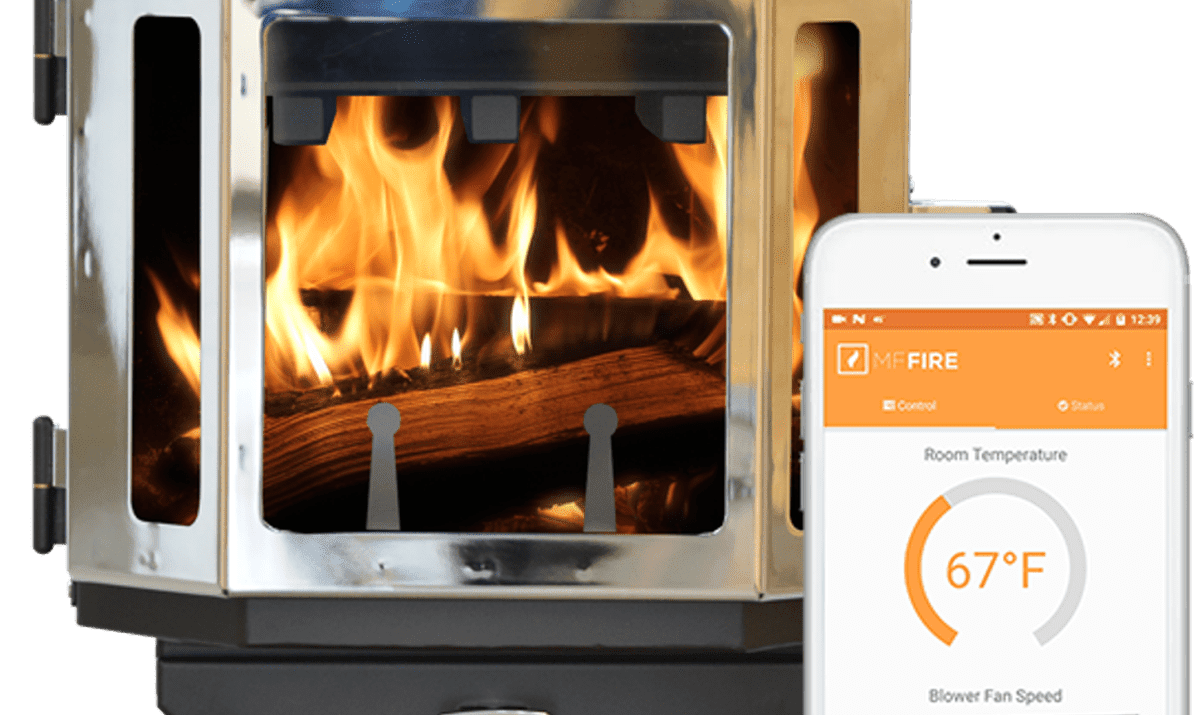
MF Fire developed an app where a user can control temperature and monitor the status of the fire inside the stove. Throughout, it’s collecting data to learn more about the environmental conditions as well as when the user likes to burn. Ryan told us that they “locate thermocouple within the stove in combustion areas. Based on the current and past readings of the stove as well as user inputs, the smart controller is able to make automatic adjustments to the combustion.”

MF Fires stoves can be 
controlled via aphone app

The company is now able to sell it for $4,000, trying to tap into environmentally conscious consumers who appreciate high tech appliances. The basic version of the stove, the Nova, that they are entering into the 2018 competition sells for only $2,490 but will have optional automated features that will bring the price over $3,000. The stove has a catalyst that is manually engaged and went through certification testing and met the 2020 standards as a single burn rate stove. Their model uses Schott Robox glass, a spondor of the 2018 Wood Stove Design Challenge. The company is now waiting for the EPA to formally approve the test and post the certification results.

Using technology to maximize efficiency - and safety
The new NOVA stove 

In addition to thermocouples that relay temperature data to the smart controller, the Catalyst and the automated version of the Nova have an induction fan integrated in the stack that can modulate air flow through the stove. Induction fans are perhaps one of the biggest ways to automate the operation of the wood stove in an industry relying on natural draft chimneys. Ryan says that “one of the biggest benefits of the fan is that it gets through the dirtiest part of the burn very quickly from a cold start. You can close the door right after lighting, and the sensors and fans will ensure the stove gets plenty of air. Unlike most other wood stoves, there is no need for leaving the door or ash pan ajar on Catalyst during startup.”

The thermocouple sensors, fan and smart controller also greatly enhance safety. They can prevent over-firing, which can be dangerous to the stove and lead to chimney fires, and they can prevent the conditions that lead to creosote build up in the first place. And, the MF Fire Smart App has wood stove safety features, including a built-in alarm that will alert an owner that a stove door has been left ajar, enabling the door to be secured quickly and safely.

MF Fire: A technology development company, not just a stove manufacturer

Ryan Fisher and the original Catalyst
MF Fire has been working on developing the smart controls for the stove, that will allow the user to better track their stove’s behavior, control its burn, and operate it safely.

MF Fire is a technology development company first and foremost, working to introduce modern smart controls to an age old form of heat production. Ryan believes that approaching this challenge from a technological development standpoint gives them a unique outlook that they are excited to share in November. Some stove manufacturers are churning out stoves designed 20 years ago and are mainly manufacturing companies, and have minimal in-house R&D capability. They may be skilled at creating well built stoves but they are part of a status quo in the industry that is not keeping up with the rapid technology changes that encompass modern appliances in the HVAC and all other sectors.

That technical acumen within MF Fire led their very first stoves to meet the stricter 2020 EPA emission limits and they hoped that their company would have an edge in the market as of 2020. Now that the EPA has signaled a willingness to consider delaying the stricter standards until 2023, MF Fire may not have the edge that they were hoping for. They still believe that there is a more environmentally conscious, possibly younger demographic who want to get off of fossil fuels with an advanced, modern wood stove. The 2018 Stove Challenge provides a platform to prove their new stove and introduce it to a wider audience.

Contact the team

Ryan Fisher, COO
ryan@mffire.com

Paul LaPorte, CEO
Paul@mffire.com


Monday, June 5, 2017

Hybrid Residential Solar and Thermoelectric Power Generation


by Ken Adler, Senior Technical Advisor at the Alliance for Green Heat

Some of you may be wondering about thermoelectric wood stoves and why we decided to include them in the 2018 Wood Stove DesignChallenge, which will be held in November 2018 on the Washington Mall.  Our goal of this competition is to support development and commercialization of a revolutionary thermoelectric wood stove that produces electricity equal to 50 percent or more of the winter time output of a residential solar photovoltaic system. By combining a thermoelectric wood stove and a residential solar PV system and home battery, like the TESLA Powerwall, we can support residential and grid-based distributive power goals, and incentivize greater investment in solar power. 

Specifically, thermoelectric wood stoves can help solve the problem of low winter time solar PV output in northern climates, where useful solar radiation is limited to 2 - 4 hours per day.

While a thermoelectric wood stove may sound revolutionary, the technology behind the stove has been used since the 1980s in oil and gas field operations, where methane gas provides a low-cost source of heat to power the thermoelectric generator. Wood stoves, like waste methane gas, can provide a free source of heat for the thermoelectric generator.
Alphabet Energy Thermoelectric Generator

Thermoelectric generators are like solar panels, however, instead of turning light into electricity they turn heat into electricity. To generate electricity, one side of a thermoelectric module is heated by the wood stove while the other side is cooled with either an air or water-cooled heat sink. For applications above 100-watts, water-cooled heat sinks are the most common approach because of their ability to extract greater amounts of heat from the thermoelectric module.

60-Watt Water Cooled Thermoelectric Generator

In northern climates like New England, Canada and northern Europe, low winter time solar radiation increases the cost and reduces the efficiency of solar PV systems, and the cost-effectiveness of battery storage systems like the Tesla Powerwall.  According to NREL, solar radiation in northern areas like Vermont peaks at 6.0kWh/m2 in June and declines to 1.7kWh/m2 in December. This means that an average 4,000-watt residential solar system will go from producing 571kWh in June to 191kWh in December--a 66% reduction is solar power output.  This project will demonstrate how a thermoelectric wood stove can cost-effectively supplement a solar PV system.

Building on our experience from 3 previous Design Challenges, we will work with wood stove manufacturers, universities and others to build and test 100 to 200-watt thermoelectric wood stoves that could effectively increase by 50% the winter time output of a 4,000-watt residential solar PV system.   

Thermoelectric generators are currently sold as accessories for wood stoves; however, these accessories are limited in size and efficiency. By integrating a thermoelectric generator into a wood stove we can achieve far greater power output, efficiency, and lower cost. For example, a wood stove with a 150 to 200-watt thermoelectric generator operating 20 hours per day could generate 93 to 124kWh of electricity per month, which compares favorably with the December solar PV output of 191kWh in Vermont.
Russian Thermoelectric Wood Stove 
(not certified for sale in the U.S.)

There are several reasons why now is the time to consider thermoelectric wood stoves. First, the price of the thermoelectric modules, which are a component of the TEG, has dropped substantially because they are now being mass produced in China.[1]  Second, the EPA’s recent wood stove NSPS regulation is helping to make new wood stoves cleaner and more efficient and, coupled with cordwood testing and automated features, a new generation of cleaner stoves could also generate electricity. Third, thermoelectric wood stoves can produce electricity up to 24 hours per day eliminating load management concerns common with solar and wind power. Lastly, the stoves are powered by local wood supplies, making their fuel low carbon and locally sourced.

The 2018 competition on the Mall will demonstrate the role thermoelectric wood stoves can play in promoting solar power, energy storage systems and biomass energy, while also reducing energy costs, supporting climate change goals, and increasing distributive power.   


[1] The cost of a thermoelectric module has fallen below $2 per watt (uninstalled), compared with $3.50 per watt for solar panels (installed).