|
| The MF Fire leadership team in 2018 - Taylor Myers, Paul LaPorte and Ryan Fisher. |
The U.S. Department of Energy (DOE) selected only two companies – MF Fire and ISB Marketing – to receive $3 million for research and development (R&D) through the DOE’s Office of Energy Efficiency and Renewable Energy. The DOE had $5 million for stove and boiler manufacturers but decided to only award $3 million this year.
The two manufacturers are working on next-generation controls and designs for wood stoves that have barely entered the marketplace. Both companies are focusing their efforts on how to make stoves cleaner in the hands of consumers – not just in the test lab – which has become widely recognized as the Achilles heel for the millions of Americans who heat with cord wood.
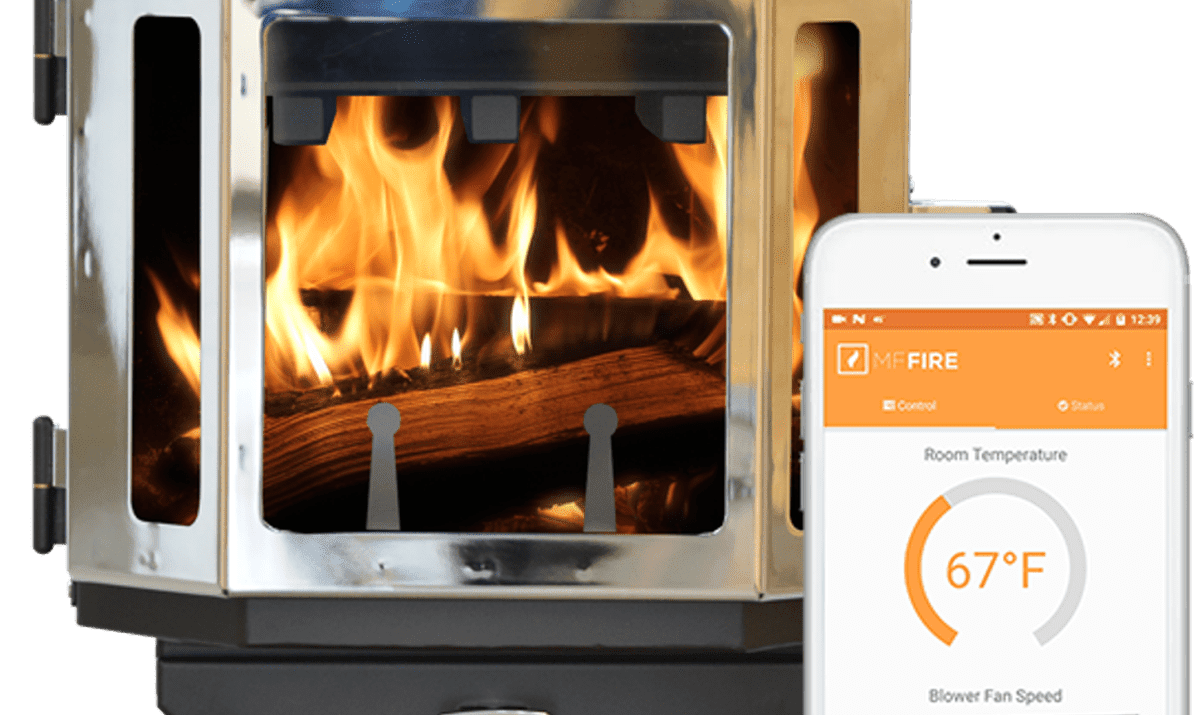
MF Fire received two grants, one for a device that continuously monitors performance of key combustion indicators and delivers real-time user guidance, and the other for a “swirl stove” that induces and maintains swirling combustion and introduces a new balance of primary, secondary, and dilutive air. ISB Marketing, working with its sister company, Stove Builder International (SBI), is developing a Machine Learning algorithm for a self-regulating wood stove that would have a PM emissions rate below 1.2g/h and offer an overall efficiency of more than 75% (HHV).
 |
| The SBI team that produced the award winning prototype of an affordable, automated stove |
DOE is expected to be able to offer R&D grant funding again in 2020 and may be able to stimulate R&D in more wood heater manufacturers. “We applaud Congressional appropriators and the DOE for funding this R&D that can help millions of Americans affordably heat their homes with next generation wood and pellet stoves,” said John Ackerly, President of the Alliance for Green Heat.
The $2 million for MF Fire is a large cash infusion for a young, small manufacturer with lots of innovative ideas and priority on R&D. “This will enable us to hire new people to ramp up our testing and apply techniques and technologies used by other industries," said Ryan Fisher, COO of Baltimore based MF Fire. “For example, eliminating PM by more thoroughly and aggressively mixing fuel and air has not been done by stove manufacturers. Square, rectangular corners create dead spots that inhibit combustion." Mr. Fisher said. Fisher and his original partner Taylor Myers got their start in designing stoves as graduate students preparing for the first Wood Stove Design Challenge in 2013. The rookies won multiple awards before the age of 25 and still haven’t turned 30. Some see them as the face of a new wave of stove designers.
ISB Marketing, with their SBI counterparts, are taking a similar tack but its potentially applicable on a range of stove models from a major manufacturer. ISB is working with Machine Learning algorithm that will learn how each specific user heats his/her stove. The stove will then adjust its combustion parameters to compensate for any “bad” human behavior that tends to increase particulate matter (PM) emissions and reduce efficiency. A home-designed real-time PM monitoring system will be developed to obtain a better understanding of the stove’s behavior.
 |
| Mark Shmorhun, the program manager at DOE who managed the grant process, at the 2018 Wood Stove Design Challenge |
Marc-Antoine Cantin, President of SBI said in an interview that moving innovative and more risky stove projects through a corporation takes longer, as models that have conventional technology are often green-lighted first. “External R&D funding can help reduce risk,” Cantin said. Even with a million dollars from the DOE, a batch of 26 of the new stoves is not expected to be beta-tested until the winter of 2022-23. SBI won second place at the 2018 Wood Stove Design Challenge for designing a simple, affordable stove that allowed the operator to select high or low heat output and used a low-cost control board and thermocouple sensors to ensure that the stove burned cleanly.
The DOE does not disclose how many applications they received or from whom, but it is widely believed that the agency received few applications for the available $5 million pot of funding. John Crouch, Director of Public Affairs for HPBA, said in an interview, “The funding announcement came at a bad year because manufacturers were scrambling to certify their stoves to the stricter 2020 EPA standards. We hope there will be more applicants if the DOE offers the grants next year.”
The DOE also does not disclose who was on their panel of expert reviewers. According to some companies who applied, some didn’t make it through the process because they had not fully completed the application. Others made it through the first round, and then had to respond to specific questions from the reviewers. Ryan Fisher of MF Fire said he got multiple questions about whether his small company could execute two grants and they had a solid plan in place to manage that. SBI got many questions about their corporate structure. They are owned by US-based Empire Group, who also owns ISB Marketing. They plan to carry out R&D for the grant in the US. Other applicants who made it through the first round, didn't make it through the second round.
The one-page summaries of the 3 grants can be found here: MF Fire-Swirl Stove, MF Fire-Performance Monitoring, ISB Marketing-Automated Stove.
This recent entry of the DOE’s Bioenergy Technologies Department which focuses mainly on biofuels, fills a significant gap for the US government. The EPA provides baseline emission and testing standards and the USDA’s Forest Service provides support for larger commercial use of biomass for heating applications. This marks the first time that a US government agency has provided support for companies to push the boundaries of emission and efficiency controls for residential wood and pellet heaters. The United States has the toughest emission standards for residential heaters in the world, which has kept US companies at the forefront of an industry that can provide affordable, low carbon heating solutions in the switch from fossil fuels to renewables.
The original DOE funding opportunity was directed at stove R&D that included:
- Novel and innovative residential wood heater designs to improve combustion chamber geometry, combustion air flow distribution, mixing of combustion air with gasification products, stove baffling designs, etc.
- Improvements in automation of stoves to optimize combustion control.
- Wood heater power generation via thermoelectric module integration
- Improvements in catalyst technologies for emissions reduction