Showing posts with label catalytic. Show all posts

Wednesday, July 18, 2018

Meet the teams: A young company automates the wood stove and challenges the established stove industry

This post is the ninth in a series introducing the 12 teams participating in the 2018 Wood Stove Design Challenge in November.

By John Ackerly and Shoshana Rybeck, Alliance for Green Heat 


Ryan Fisher
In 2013, a group of students from the University of Maryland with absolutely no experience in stove building, entered a stove into the first Wood Stove Design Challenge. They had built one of the first automated stoves in America and it worked surprisingly well though it clearly was a prototype that needed a lot of work. Some seasoned stove experts scoffed at their efforts, but they persisted and despite the odds, released the stove onto the market 2017.

The team is back for the 2018 competition with a new stove which is simpler and sleeker. Along they way, they morphed from a University team to a company, MF Fire, based in Baltimore and backed by some venture capital.

“We’ve learned a lot,” says Ryan Fisher, the 28 year-old COO of the company, who never imagined he would end up in a career working with wood stoves. They still have a lot of skeptics but they are starting to earn a niche in the industry as they continue trying to disrupt it. The company is based on the premise that “wood stoves haven’t changed much in decades but there is no reason a wood stove should be polluting, inefficient or difficult to use.” They use sensors that can find the combustion “sweet spot” that any stove can hit, but few stoves or operators can stay in the sweet spot for very long.

MF Fire developed an app where a user can control temperature and monitor the status of the fire inside the stove. Throughout, it’s collecting data to learn more about the environmental conditions as well as when the user likes to burn. Ryan told us that they “locate thermocouple within the stove in combustion areas. Based on the current and past readings of the stove as well as user inputs, the smart controller is able to make automatic adjustments to the combustion.”
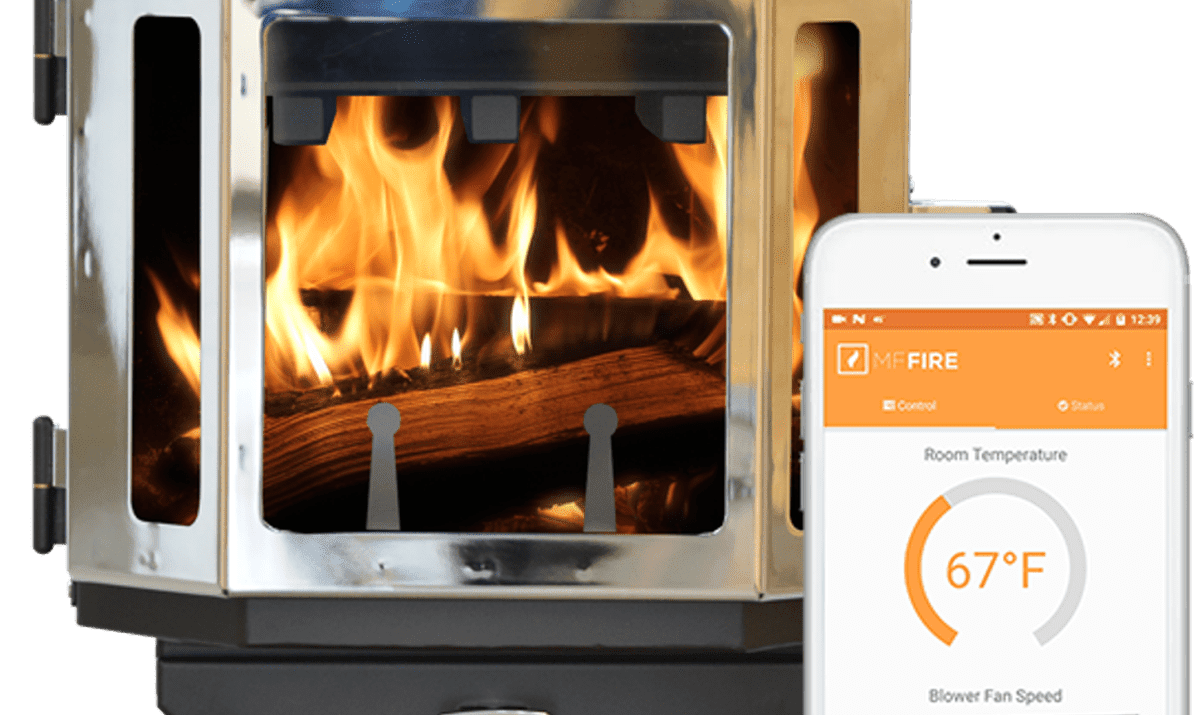
MF Fires stoves can be 
controlled via aphone app

The company is now able to sell it for $4,000, trying to tap into environmentally conscious consumers who appreciate high tech appliances. The basic version of the stove, the Nova, that they are entering into the 2018 competition sells for only $2,490 but will have optional automated features that will bring the price over $3,000. The stove has a catalyst that is manually engaged and went through certification testing and met the 2020 standards as a single burn rate stove. Their model uses Schott Robox glass, a spondor of the 2018 Wood Stove Design Challenge. The company is now waiting for the EPA to formally approve the test and post the certification results.

Using technology to maximize efficiency - and safety
The new NOVA stove 

In addition to thermocouples that relay temperature data to the smart controller, the Catalyst and the automated version of the Nova have an induction fan integrated in the stack that can modulate air flow through the stove. Induction fans are perhaps one of the biggest ways to automate the operation of the wood stove in an industry relying on natural draft chimneys. Ryan says that “one of the biggest benefits of the fan is that it gets through the dirtiest part of the burn very quickly from a cold start. You can close the door right after lighting, and the sensors and fans will ensure the stove gets plenty of air. Unlike most other wood stoves, there is no need for leaving the door or ash pan ajar on Catalyst during startup.”

The thermocouple sensors, fan and smart controller also greatly enhance safety. They can prevent over-firing, which can be dangerous to the stove and lead to chimney fires, and they can prevent the conditions that lead to creosote build up in the first place. And, the MF Fire Smart App has wood stove safety features, including a built-in alarm that will alert an owner that a stove door has been left ajar, enabling the door to be secured quickly and safely.

MF Fire: A technology development company, not just a stove manufacturer

Ryan Fisher and the original Catalyst
MF Fire has been working on developing the smart controls for the stove, that will allow the user to better track their stove’s behavior, control its burn, and operate it safely.

MF Fire is a technology development company first and foremost, working to introduce modern smart controls to an age old form of heat production. Ryan believes that approaching this challenge from a technological development standpoint gives them a unique outlook that they are excited to share in November. Some stove manufacturers are churning out stoves designed 20 years ago and are mainly manufacturing companies, and have minimal in-house R&D capability. They may be skilled at creating well built stoves but they are part of a status quo in the industry that is not keeping up with the rapid technology changes that encompass modern appliances in the HVAC and all other sectors.

That technical acumen within MF Fire led their very first stoves to meet the stricter 2020 EPA emission limits and they hoped that their company would have an edge in the market as of 2020. Now that the EPA has signaled a willingness to consider delaying the stricter standards until 2023, MF Fire may not have the edge that they were hoping for. They still believe that there is a more environmentally conscious, possibly younger demographic who want to get off of fossil fuels with an advanced, modern wood stove. The 2018 Stove Challenge provides a platform to prove their new stove and introduce it to a wider audience.

Contact the team

Ryan Fisher, COO
ryan@mffire.com

Paul LaPorte, CEO
Paul@mffire.com


Thursday, July 31, 2014

AGH Comments to the EPA on New Stove Data

The EPA is in the process of posting everyone's comments.  As of Monday, August 4, they have posted comments by Rick Kurkeet from Intertek Labs, Stuart Clark from Washington Department of Ecology and several anonymous ones.  They can be found here and ours are posted below.


Alliance for Green Heat
Comments on the
July 1, 2014 Notice of Data Availability
Regarding EPA’s Proposed Standards of Performance for New Residential Wood Heaters, New Residential Hydronic Heaters and Forced-Air Furnaces, and New Residential Masonry Heaters
Docket ID No. EPA-HQ-OAR-2009-0734

July 31, 2014

The Alliance for Green Heat (Alliance), appreciates the opportunity to comment on EPA’s July 1, 2014 Notice of Data Availability (NODA) regarding the agency’s proposed New Source Performance Standards (NSPS) for wood heating devices.[1]  The Alliance is an independent non-profit organization that works with environmental and forestry organizations, air quality experts, the wood and pellet stove industry, and others in the wood burning community to promote high-efficiency wood combustion as a low-carbon, sustainable, local and affordable heating solution.  The Clean Air Act requires EPA to review and revise, if appropriate, the NSPS at least every eight years.  As we explain in the original comments we submitted on the Proposed Rule, the Alliance strongly supports EPA’s decision to update the standards for wood stoves and to require a number of previously unregulated wood heating devices to reduce their emissions.  We also believe that the new standards, which reflect significant improvements in wood heating technology, are both appropriate and long overdue.  We offer the following additional comments in response to EPA’s July 1, 2014 NODA.

First and most importantly, it is imperative that, going forward, all stoves be required to complete a test at the lowest possible burn rate setting.  The data released in the NODA provided a vital insight that few people know: 80% of non-catalytic stoves cannot be successfully tested at the Category 1 burn rate (0.8 kg/h or less).  Under the current EPA test method, Method 28, these stoves have been allowed to test at the higher Category 2 burn rate, as long as they can successfully complete a test at 1.0 kg/h or less in Category 2.

The possibility of avoiding testing a stove at the lowest burn rate—which is when emissions of PM and other toxics are often the highest—has apparently created a loophole that has incentivized some manufacturers to design their stoves so that they fail to hold a flame for a sufficient amount of time in Category 1, so that they can be tested at the easier-to-meet 1.0 kg/h burn rate in Category 2. 

If EPA finalizes its proposal to certify stoves based on only the highest and lowest burn rates[2], this potential loophole could become even more important.  EPA should clarify in the final rule that all stoves certified under the new NSPS must be capable of being tested at their lowest burn rate, and that stoves that cannot successfully complete a test burn at their lowest rate will no longer be eligible for certification.

This will still allow stoves to be tested at 1 kg/h but assures that the consumer cannot operate the stove at a lower burn rate.  We are not opposed to allowing stoves to use a minimum burn rate of up to 1.15 for cordwood testing, but again, they must be successfully tested at their lowest burn rate.  Otherwise, the proposal to raise the minimum to 1.15 kg/h could just enlarge the loophole of stoves testing at higher burn rates than consumers could operate them.

Second, it has become abundantly clear in recent months that more and more manufacturers are using the K list to make minor changes in their stoves to ensure 5 more years of sales life before retesting.  While the K list provides an important function, it is now being used to significantly delay retesting of what could be a majority of EPA certified stoves.  One of the results of this is that manufacturers can avoid testing at their lowest burn rate and avoid releasing their efficiency data until 2019 for many or most or in some cases, all of their stoves. For this reason, we again urge the EPA to require that B415.1 efficiency numbers using HHV be submitted to the EPA within 6 months of promulgation. 

The data released in the NODA confirmed previous data sets, that the efficiency range of pellet stoves is far wider than wood stoves.  These certified pellet stoves ranged from 62 to 80% efficient with a standard deviation of 8.5, double the standard deviation of non-cats and four times the deviation of cat stoves.  Because of this wide variation of efficiencies, it is in the public interest to require efficiencies be released as soon as practicable.  Manufacturers already have efficiency data for most or all of their stoves so there would not be any significant burden to them.

In addition, we note that the data provided in the NODA appears to establish that an emission rate of 1.3 g/h is already being achieved by some sources in the source category using cord wood.  The Alliance continues to support EPA’s proposed approach of allowing stoves to be certified with either crib wood or cord wood during the first phase of the NSPS, and to require certification with cordwood thereafter.  In addition, the Alliance recommends that EPA continue to gather test data on cord wood emission rates for non-catalytic stoves over the next five years and consider revisiting the emission limits in the NSPS if additional data suggest that the NSPS should be adjusted for non-catalytic stoves. 

Finally, the Alliance has published a blog post that addresses a range of issues related to the data released in the NODA.  We have appended this post to these comments and request that EPA consider it along with our other comments as it finalizes the Proposed Rule.

                                                                                    Sincerely,
                                                                                    /s/ John Ackerly
                                                                                    Alliance for Green Heat


[1] Standards of Performance for New Residential Wood Heaters, New Residential Hydronic Heaters and Forced-Air Furnaces, and New Residential Masonry Heaters, Notice of Data Availability, 79 Fed. Reg. 37,259 (July 1, 2014) [hereinafter “NODA”].
[2] See Proposed Rule, 79 Fed. Reg. 6,329, 6,367 (Feb. 3, 2014).
