Showing posts with label WSDC. Show all posts

Thursday, October 3, 2019

DOE awards $3 million for R&D to wood stove manufacturers

The MF Fire leadership team in 2018
- Taylor Myers, Paul LaPorte and
Ryan Fisher.
The U.S. Department of Energy (DOE) selected only two companies – MF Fire and ISB Marketing – to receive $3 million for research and development (R&D) through the DOE’s Office of Energy Efficiency and Renewable Energy. The DOE had $5 million for stove and boiler manufacturers but decided to only award $3 million this year.

The two manufacturers are working on next-generation controls and designs for wood stoves that have barely entered the marketplace. Both companies are focusing their efforts on how to make stoves cleaner in the hands of consumers – not just in the test lab – which has become widely recognized as the Achilles heel for the millions of Americans who heat with cord wood.

[Dec. 15, 2019 update - The DOE announced their intention to grant another $5 million for biomass heater R&D in 2020.]

MF Fire received two grants, one for a device that continuously monitors performance of key combustion indicators and delivers real-time user guidance, and the other for a “swirl stove” that induces and maintains swirling combustion and introduces a new balance of primary, secondary, and dilutive air. ISB Marketing, working with its sister company, Stove Builder International (SBI), is developing a Machine Learning algorithm for a self-regulating wood stove that would have a PM emissions rate below 1.2g/h and offer an overall efficiency of more than 75% (HHV).
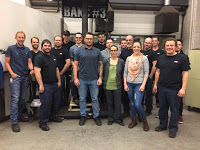
The SBI team that produced the award
winning prototype of an affordable,
automated stove

DOE is expected to be able to offer R&D grant funding again in 2020 and may be able to stimulate R&D in more wood heater manufacturers. “We applaud Congressional appropriators and the DOE for funding this R&D that can help millions of Americans affordably heat their homes with next generation wood and pellet stoves,” said John Ackerly, President of the Alliance for Green Heat.
The $2 million for MF Fire is a large cash infusion for a young, small manufacturer with lots of innovative ideas and priority on R&D. “This will enable us to hire new people to ramp up our testing and apply techniques and technologies used by other industries," said Ryan Fisher, COO of Baltimore based MF Fire. “For example, eliminating PM by more thoroughly and aggressively mixing fuel and air has not been done by stove manufacturers. Square, rectangular corners create dead spots that inhibit combustion." Mr. Fisher said. Fisher and his original partner Taylor Myers got their start in designing stoves as graduate students preparing for the first Wood Stove Design Challenge in 2013. The rookies won multiple awards before the age of 25 and still haven’t turned 30. Some see them as the face of a new wave of stove designers.

ISB Marketing, with their SBI counterparts, are taking a similar tack but its potentially applicable on a range of stove models from a major manufacturer. ISB is working with Machine Learning algorithm that will learn how each specific user heats his/her stove. The stove will then adjust its combustion parameters to compensate for any “bad” human behavior that tends to increase particulate matter (PM) emissions and reduce efficiency. A home-designed real-time PM monitoring system will be developed to obtain a better understanding of the stove’s behavior.

Mark Shmorhun, the program
manager at DOE who managed
the grant process, at the 2018
Wood Stove Design Challenge

Marc-Antoine Cantin, President of SBI said in an interview that moving innovative and more risky stove projects through a corporation takes longer, as models that have conventional technology are often green-lighted first. “External R&D funding can help reduce risk,” Cantin said. Even with a million dollars from the DOE, a batch of 26 of the new stoves is not expected to be beta-tested until the winter of 2022-23. SBI won second place at the 2018 Wood Stove Design Challenge for designing a simple, affordable stove that allowed the operator to select high or low heat output and used a low-cost control board and thermocouple sensors to ensure that the stove burned cleanly.

The DOE does not disclose how many applications they received or from whom, but it is widely believed that the agency received few applications for the available $5 million pot of funding. John Crouch, Director of Public Affairs for HPBA, said in an interview, “The funding announcement came at a bad year because manufacturers were scrambling to certify their stoves to the stricter 2020 EPA standards. We hope there will be more applicants if the DOE offers the grants next year.”

The DOE also does not disclose who was on their panel of expert reviewers. According to some companies who applied, some didn’t make it through the process because they had not fully completed the application. Others made it through the first round, and then had to respond to specific questions from the reviewers. Ryan Fisher of MF Fire said he got multiple questions about whether his small company could execute two grants and they had a solid plan in place to manage that. SBI got many questions about their corporate structure. They are owned by US-based Empire Group, who also owns ISB Marketing. They plan to carry out R&D for the grant in the US. Other applicants who made it through the first round, didn't make it through the second round.

The one-page summaries of the 3 grants can be found here: MF Fire-Swirl Stove, MF Fire-Performance Monitoring, ISB Marketing-Automated Stove.

This recent entry of the DOE’s Bioenergy Technologies Department which focuses mainly on biofuels, fills a significant gap for the US government. The EPA provides baseline emission and testing standards and the USDA’s Forest Service provides support for larger commercial use of biomass for heating applications. This marks the first time that a US government agency has provided support for companies to push the boundaries of emission and efficiency controls for residential wood and pellet heaters. The United States has the toughest emission standards for residential heaters in the world, which has kept US companies at the forefront of an industry that can provide affordable, low carbon heating solutions in the switch from fossil fuels to renewables.

The original DOE funding opportunity was directed at stove R&D that included:
  • Novel and innovative residential wood heater designs to improve combustion chamber geometry, combustion air flow distribution, mixing of combustion air with gasification products, stove baffling designs, etc.
  • Improvements in automation of stoves to optimize combustion control.
  • Wood heater power generation via thermoelectric module integration
  • Improvements in catalyst technologies for emissions reduction

Thursday, June 20, 2019

Danish stove industry looks to compete, grow in America

This award winning Aduro stove accepts
wood and/or pellets and can switch
between them automatically.
Companies must navigate and anticipate shifting regulations on multiple continents

The Danish stove industry is known for sleek, vertical, expensive stoves. There is a joke that they are made to look like high end furniture that happens to hold a fire. But amidst this new wave of modern design is an industry that embraces innovation, competes worldwide to heat homes and has many budget line models.  

Danish stove makers tend to be skeptical of catalysts, very comfortable testing with cordwood, committed to quality and adaptable to the preferences and requirements of different countries. Danish stove manufacturers also have their own EPA-approved test lab at the Danish Technological Institute, one of three European labs that are now approved for EPA certification testing.    

John Ackerly, AGH President
with Jes Sig Andersen and Anne-
Mette Frey of DTI. AGH photo
One of the most exciting new Danish stoves burns both wood and pellets. It can run off pellets, just like an ordinary pellet stove, but then you can load the firebox with cordwood, drastically reducing start-up emissions. When the wood fire dies down, it will automatically revert to pellets. The stove is made by Aduro, a major European manufacturer that has not yet entered the US market but will likely do so.

Danes do not appear as intimidated by sensors and smart control systems as their American counterparts. They may appear on the market quietly, with little fanfare, and possibly without the consumer even knowing what’s under the hood. Since they require very little power, they may just have a couple batteries and don’t have to be plugged into an outlet. The trick is to get those sensors past the 2020 emissions standards with or without using a single burn rate test.

Aarhus – the stove capitol of Europe

No city in Europe is surrounded by as many stove manufacturers as Aarhus, the second largest city in Denmark. It is located on the mainland, just a few hours north of the German border. Brands well-known to North Americans include Hwam, Rais, Morsø
Aarhus is on the Jutland Peninsula, the 
Danish mainland, an academic center 
and Denmark's the second largest city.

 and Scan, but the city is also home to others that are as big or much bigger, including Aduro, Heta and Termatech. All these brands are present in many if not all European countries.  

Aarhus is centrally located with wind turbines and biomass district heating plants dotting the surrounding countryside. The hundreds of small biomass district heating plants pipe hot water underground to virtually all homes in cities, towns and suburbs. The extensive network of district heating is one of the main reasons that Danish stoves tend to be small.  Most homes already have affordable and renewable heat. Rural homes that are not on the district heating grid usually have pellet boilers, made by one of the many Danish pellet boilers companies. Danes also have innovative boilers for farms that use hay bales, another novel technology that could have a market on America’s farms.

EPA’s 2020 emission standards and foreign stoves

Danes have always tested their stoves with cordwood (only Norwegians test with cribs). The ASTM cordwood standard that allows up to 2.5 grams an hour appears to be achievable, according to Danish manufacturers. EPA certification has always been considered the gold standard in Europe and is universally accepted as the hardest test a European stove can pass.  
Jes Sig Andersen of DTI lab in Aarhus,
 left, with a technician at the Rais lab. AGH photo

The 2020 standards make it even harder for manufacturers. Danish stoves “can’t be tweaked, they need to be redesigned,” says Jes Sig Andersen, a senior specialist at the stove test lab at the Danish Technological Institute (DTI). The entire system that delivers primary and secondary air has to be reengineered and optimized to ensure maximum combustion of particulates through primary oxidation, secondary pyrolysis and often tertiary combustion. Getting that just right is a challenge even for seasoned combustion engineers, who have spent their professional lives designing stoves for the laxer protocols required in Europe.  

At a seminar hosted by DTI on stove and boiler testing, AGH President John Ackerly presented a powerpoint (PDF) on the current state of EPA regulations, potential changes, and other cordwood test methods that are in development.

Danish attitudes toward wood heating
The Danish landscape is dotted with
small biomass district heating systems,
which often use chips or hay bales.

There is an ambivalence toward wood heating in Denmark that is similar in many respects to attitudes in the US and in many European countries. Wood heating is often viewed as too polluting, a result of too many old stoves and poorly operated new ones. Pellet stoves comprise an even smaller part of the market here but pellet boilers are far more commonplace. In the capital city of Copenhagen, the mayor, like the mayor of London, is cracking down on cordwood stoves and plans to ban their future installation in part of the city. One of the largest crackdowns in Europe is in the Po River valley in Northern Italy where regular inversions trap wintertime pollution.  

The Danish government has had national change out or scrapping programs that provide a US $300 grant to simply remove an old stove, or replace it with a newer certified stove (it does not have to carry the Nordic Swan eco-label).

Vertical, clean lines and small fireboxes
dominate the Danish domestic market.
Because Denmark has a culture that looks down on overnight burns, extremely few models produced here have large enough fireboxes to do that. Some local jurisdictions banned overnight burning as it is almost synonymous with smoldering. Danes tend to want smaller stoves anyway, not as a primary or even a secondary heater as much as for the ambience. Younger Danes are more likely to install a gas stove or just a heat pump for space heating.


Danish automated stoves
The Hwam smart controller allows
the user to load and leave, and uses
sensors to adjust the air.

Aarhus stove maker Hwam was one of the first to design a fully automated stove, with an Intelligent Heat System (IHS) which competed in the first Wood Stove Design Challenge in 2013 in Washington DC. That stove helped revolutionize the concept of what a wood stove can be, and how it can be assured of operating cleanly in the hands of consumers.  Other Danish manufacturers have also used sensors and controllers that will be coming out in future models. The Hwan IHS has held its own in the marketplace, but price conscious consumers still prefer more basic, cheaper stoves.

The Aduro hybrid that burns both pellets and cordwood uses automation by necessity, so that it knows when the operator has loaded cordwood and when the stove needs to switch back to pellets.  

Henrik Norgaard, CEO of Rais
explaining their upcoming automated
stove that gives consumers confidence
in clean during technology. AGH photo

Rais has an automated stove in development that pairs Maxitrol controls with smart phone connectivity to allow users to monitor and adjust it. Basic automation can also prevent overfiring on one extreme and extended smoldering on the other, a key safety features that may catch on in the marketplace. 

A German company, Thermoelect, is marketing their automated stove in Denmark, looking for buyers who desire heat, domestic hot water and reliable electricity from a very clean burning system. That stove won first place at the 2018 Wood Stove Design Challenge in Washington DC based on its efficiency, emissions, electric output and innovative design. 

A key question is whether local and national governments will support the advancement of automated stove technologies that help stoves operate better in the hands of consumers. Automation should be
Horst Erichson holds the trophy his
automated stove won at the 2018 Wood
Stove Design Challenge. Rene Bindig
from the German Biomass Research Centre
consulted on the firebox design. AGH photo
able to help stoves pass stricter emission standards such as the EPA’s 2020 standards. Otherwise, there may not be sufficient incentives for stove manufacturers to build stoves that do much more than operate well in the test lab.  

European Union 2022 Emission Directives result in weaker emission limits in northern Europe

A weakness of European wide emission standards for wood stoves is that they are the product of a
negotiation between countries with stricter standards, and countries that have no standards at all.  One of the key purposes of the Union is to harmonize standards so that goods can flow freely between all EU countries, which means that countries cannot maintain stricter standards than others. For countries like Denmark and Germany, this can result in having to weaken emission standards. The 2020 EU Eco-Design Regulation calls for a maximum of 40 mg/cubic meter for wood stoves and 20 for pellet stoves. Denmark already requires a max of 30 and most stoves are in the 10 – 20 range. Denmark may be able to negotiate keeping their stricter standards which would also result in keeping some stoves made in other countries out of their market. But the more powerful European stove industry associations may block a country’s attempt to keep stronger standards so that they can build stoves to the laxer standards. 


One reason that European stove testing protocols are laxer is that they typically only have to test at a nominal heat output rate. They do not have to test at their lowest air setting or heat output rate. They also allow fueling to be based on manufacturers’ instructions and do not require the stoves to be filled with nearly as large loads as EPA protocols. However, there are national variations and the Norwegian national protocols required testing at 4 burn rates and with crib wood.

beReal and IDC testing protocols
Round robin testing of the same stove in different labs and
settings shows emissions are often double or triple in the real
world compared to lab testing. 

Danish stoves for export to the US are much more likely to be tested with the ASTM cordwood method, which should make them somewhat cleaner in the hands of consumers. But using cordwood and including start-up emissions is just the beginning of innovation needed in test protocols. Stricter PM limits only result in cleaner stoves if there is a level of integrity in the test method that does not exist in Europe or North America. On both continents, industry has played a big role in writing the test methods and labs in both continents have a financial stake in making sure their clients pass the test.  

The need for more real-life test methods is just as obvious to Europeans as it has become for Americans. Even before NESCAUM began developing Integrating Duty Cycle test methods, European began beReal, a very similar process to understand the weaknesses of existing lab testing and move towards a method that would result in stoves being designed for consumers, not for test labs.
An early overview of the IDC protocol
under development by NESCAUM.  The
protocol had early input from HPBA but
 they have since dropped out of the process.

A ground-breaking 2018 report, “Advanced Test Methods for Firewood Stoves” by Christoph Schmidl and Gabriel Reichert, concluded that “Real-life oriented test concepts (e.g. beReal) are capable to reflect the real-life performance of the appliances better compared to existing EN standards. An implementation of a real-life oriented test protocol as a quality label or standard should be considered as an instrument to push technological development towards optimized real-life operation and to enable a better differentiation of good and poor products for the end customer.” 

Marius Wohler, manager of the beReal
initiative speaking at the 2016 Pellet
Stove Design Challenge at Brookhaven
Nartional Lab. AGH photo
The authors suggest that establishing a voluntary test method that could be used as the basis for an eco-label could justify the costs of developing the method and provide an incentive for stove manufacturers to test to it. Wood stove eco-labels, while common in Europe, are not supported by the wood stove industry in the US, which has never had any eco-label for stoves.

The adoption of more realistic and effective test methods based on the European beReal initiative or the American Integrated Duty Cycle approach will face headwinds. Regulators may not have the time, expertise or motivation to engage in a major test method shift, and industry may resist leaving charted waters that they know how to navigate for seas that may pose tougher challenges. But both continents have persistent stakeholders and face air quality and renewable energy targets that require technologies to operate cleaner in the field, not just the lab.

Compliance audit testing or "market surveillance"

Regulators on both continents also realizing the need for compliance audits, called “market surveillance” in European parlance. Without effective oversight of test lab results, a culture of artful, possibly legal, manipulation of test protocols can grow in labs.  Once the culture exists in one lab, other labs need to follow to keep their clients from going to labs who can help stoves pass more easily.  The Alliance for Green Heat wrote about this danger in 2015 in the wake of the Volkswagen testing scandal. That scandal involved a emission testing defeat device, but it also uncovered an old boys network that stayed quiet about a culture in labs that is driven more by client pressure and expectations than government-approved test protocols.

Under the U.S. Clean Air Act, the EPA has authority to conduct compliance audit testing of stoves
A page from a 2017 Belgian list
of stoves whose sale was banned
after audit testing was performed.

and revoke a certification if the particulate matter exceeds the original lab test by 50% or more.  That provision is under litigation by HPBA and other stakeholders agree that if the PM is below 1 gram per hour, 50% is too strict given the variability of solid fuel testing.  European countries have similar compliance laws, and Belgium has begun to conduct audit testing and cracking down on stoves that it believes may have exaggerated test numbers.  They issued a seven-page document, "List of devices tested in the laboratory" (pdf) that banned the sale of nine mostly Spanish Panadero stoves in Belgium based on discrepancies in PM or CO between the certification lab and the audit lab.  

Panadero is a family run, mass market value stove manufacturer that like many other companies
The Panadero website shows the eco-
labels that some of its stoves carry.
claims to have met the 2022 standards for all its stove in 2018.  In addition, some Panadero stoves carry the French Flamme Vert and British HETAS and other eco-labels.  They apparently do not qualify for the Nordic Swan or Blue Angel.  Most of the stoves found to have a large PM and/or CO variation in 2017 Belgian audit compliance tests appear to be out of production as of 2019. One that is still in production, the Luis, does not claim to meet any European eco-labels.

Can Danish stoves gain traction in the US market?

Vertical, stylish European stoves led by Danish companies have been slow to catch on in the US market. But the entry of Danish value stove makers could change that. They already make more horizontal style stoves with larger fireboxes for the British and other markets. Danes could have a real advantage with sensor-equipped stoves that have sensors that take some or all of the “idiot factor” away from the operator. If tests can better show the value of these stoves, then it will be up to federal, state and local jurisdictions to find ways to help pave the way for them to proliferate. The recent funding opportunity from the US DOE is clearly looking for R&D in automation, and that may be a tipping point for automated stoves. Danish companies are not eligible for that, but they are well-positioned to benefit from any trend in that direction. 

European stoves may also be a beneficiary if the trade war between the US and China escalates.  
Many Danish export stoves are
more horizontal and have larger fireboxes
for Eastern European and British markets
Tariffs on steel and parts such as fans could impact American manufacturers far more than European ones, which could benefit Italian pellet stove manufacturers, for example.  


Regardless of their share of the US market, Danish stoves represent an enduring aesthetic. They are also expanding into Eastern Europe, where some of them are manufactured, and where cleaner, more efficient stoves are needed far more than North America and Western Europe. It is difficult to know how regulations, innovation and energy demands will impact wood stoves, but Danish stove makers are likely to be on the forefront of those changes.


Wednesday, May 8, 2019

DOE offers funding for “state-of-the-art” residential wood and pellet heater R&D

Updated, May 2022 - The DOE has announced a fourth round of funding for manufacturers to design and produce innovative wood stoves.  The funding opportunity is likely to come in early summer of 2022.

Updated on April 9, 2021 - The US Department of Energy has announced its third round of funding for R&D towards more efficient residential wood and pellet heaters.  The funding level is $5 million, the same as it was for the first two years. 

The announcement is part of a larger bioenergy funding opportunityThe timeline for applying is short and requires a concept paper to be submitted by April 30 as a precondition of submitting the full application on June 21, 2021. Applicants will be notified of funding decisions in August and funds will be disbursed in September. To get started, interested applicants should register with the EERE Exchange

"The Alliance for Green Heat applauds the DOE bioenergy program for supporting innovation in the wood and pellet heater sector for a third year," said John Ackerly, President of the Alliance for Green Heat. "This funding will help kickstart a new wave of American innovation and ingenuity in wood heater design which is vital to keep wood and pellet heaters competitive with solar and other renewable technologies."

Jonathan Male, the former Director of
the Bioenergy Technology Office at
DOE,  speaking at the 2018 Wood
Stove Design Challenge


The first year, the DOE selected  two companies – MF Fire and ISB Marketing – to receive $3 million for research and development. Both companies are focusing their efforts on how to make stoves cleaner in the hands of consumers through automation – not just in the test lab – which has become widely recognized as the Achilles heel for the millions of Americans who heat with cord wood.

The DOE is trying to fund more than just tweaks and adjustments to traditionally-designed cat and non-cat stoves. Applications that can demonstrate genuine advancements toward state-of-the-art technology that ensure heaters burn well during start-up and reduce the opportunity for human error will have an edge.

Beyond merely preparing for traditional EPA testing, “applicants are encouraged to expand the testing regimen to evaluate performance over the full cycle of residential wood heater operating conditions (representative of how homeowners actually use their residential wood heaters with representative wood feedstocks).”

Areas of R&D interest

DOE listed specific areas of interest, though other innovations are not excluded.

  • Novel and innovative residential wood heater designs
  • Improvements in automation of stoves
  • Wood heater power generation via thermoelectric module integration,
  • Modeling and simulation tools, and
  • Improvements in catalyst technologies
The second area, improvements in automation of stoves, includes robust sensing technologies and remote control and real-time performance monitoring. Wood and pellet stoves, boilers, and furnaces could all integrate sensors that monitor and control combustion conditions better. The DOE was a core funder of the 2018 Wood Stove Design Challenge that focused on automation and gave them insight into the potential of this area.

Eligibility

DOE has relatively broad eligibility requirements. Individuals, for-profit companies, non-profits, universities, and state, local, and tribal governments can all apply. Foreign entities and companies can also apply as long as they have a US office. Federal agencies and DOE labs, such as Brookhaven National Lab, are not eligible to be prime recipients but could be a sub-recipient of a grant. All work must be performed on US soil.

Cost Share

Applicants must provide 20% of the total project costs. The 20% can include in-kind services or cash from non-federal sources. Cost share may be provided by the prime recipient, subrecipients, or third parties.

Questions

All questions about the FOA must be submitted to: EERE-ExchangeSupport@hq.doe.gov. DOE personnel are prohibited from communicating directly with applicants. All questions and answers related to this FOA will be posted on EERE Exchange: https://eere-exchange.energy.gov.

Tuesday, January 1, 2019

Thermoelectric Wood Stoves, Solar Power, and the 2018 Wood Stove Design Challenge

By Ken Adler, Program Director for Thermoelectrics


Could the marriage of residential solar photovoltaic and thermoelectric wood stoves soon be a reality? The results of our 2018 Wood Stove Design Challenge suggests that it just might be, and a productive marriage at that! The Challenge was held on the National Mall in Washington, D.C., in a large tent, from November 8-12.

The U.S. Department of Energy (DOE) Bioenergy Energy Technology Office (BETO) helped fund the Challenge. In its press release announcing the Challenge, BETO referenced the Alliance for Green Heat’s stretch goal that integrating thermoelectric wood stoves with solar PV systems could increase a home’s wintertime power by 50 percent in northern climates, and provide a renewable energy alternative to oil and natural gas heating systems. This year’s winning thermoelectric stoves generated enough power to demonstrate that we are well on our way to meeting this goal.  
Short winter days, clouds, and snow are the Achilles heel for solar power in northern climates. However, solar power is critical to reducing CO2 pollution and climate change. In Vermont, a home may get only 2-3 hours of effective sunlight in December versus 6-7 hours in July. Here’s where thermoelectric wood stoves come in: Residents typically operate their wood stoves during the morning and evenings, when solar PV power is at its lowest.

Winning Stoves Generate Excitement

The Alliance’s Organizing Committee invited five teams from industry and academia to participate in the thermoelectric stove competition of the 2018 Challenge.  An independent panel of judges evaluated each stove and selected the first and second prize winners.  
During the 3-hour test period, the judges scored the stoves based on power output, particulate matter and carbon monoxide emissions, safety, degree of automation, and efficiency. (We’ll review the stoves’ emissions results in a later blog post.) After 30 minutes to warm up, electric power output was measured every ten minutes over the remaining 2½ hours. Table 1 provides a summary of the results.

Table 1. Summary of Thermoelectric Power Results

Stove Name
Maximum Power (Watts)
Total Energy in 2.5 hours (Watt-Hours)
E-Stove
268
276
Wiseway
139
235
Kd3
85
118
Englander
32
47
ASAT
14
28


Figure 1. E-Stove
First prize went to E-Stove by Wittus and HE Energy. The stove generated a maximum of 268 watts, an average of 161 watts, and a total of 276 watt-hours over 2.5 hours[1]. The E-stove, manufactured in Germany, is designed to be installed in a living room. It works like a hydronic boiler and generates enough hot water to heat a medium size or large home. For the test, the hot water was pumped through two radiator systems, which discharged the heat into the tent. The power control system can be connected directly to a battery, like a TESLA Powerwall, or supply a 220-volt output (110 volt for U.S. market). HE Energy expects the stove to be commercially available in fall 2019.

Figure 2. Wiseway Stove
Second prize winner, Wiseway by Vulcan Energy and Hi-Z Technology, generated a maximum of 139 watts, an average of 123 watts, and a total of 235 watt-hours over 2.5 hours. The average power output of the Wiseway wasn’t substantially less than the E-Stove, even though the maximum wattage was almost 50 percent less. The Wiseway combustion temperature was kept even by a gravity fed pellet system that continuously fed pellets into the combustion chamber.  In contrast, power output from the E-Stove dropped from a high of 268 watts to a low of 38 watts as the logs burned down.

The Wiseway uses a water-cooled thermoelectric generator (TEG) to produce electricity. The hot water from the TEG was pumped into a hot water tank and through a radiator to discharge heat. The TEG has a power control center that includes a USB port, and a 12-volt and 110-volt output. Vulcan Energy designed the Wiseway to demonstrate the company’s capabilities to custom design thermoelectric generators for pellet stoves. It has no immediate plans to commercialize this stove.

Figure 3. Kd3 Stove and Power Control Center
The Kd3 by Unforgettable Fire generated a maximum of 85 watts, an average of 49 watts, and a total of 118 watt-hours over 2.5 hours. The Kd3 is a downdraft stove designed to generate electricity, and heat water like a hydronic boiler for radiators and domestic hot water. It uses two thermoelectric generators by FireVolt to generate electricity for lighting a home or charging a battery. It includes a power control center to manage power output from additional power sources like solar or wind generation. Due to limitations of our DC load meter, the judges and Kd3 team faced several challenges to accurately measure the power output of the FireVolt thermoelectric generators. We conducted a third unofficial power test, which demonstrated the Kd3 could generate 127 watts of power. Unforgettable Fire expects to have the Kd5 commercially available in 2019.

Figure 4. Englander Stove
A team of engineering students from George Washington University retrofitted a thermoelectric generator to work with a stove donated by England’s Stove Works. It generated a maximum of 32 watts, an average of 22 watts, and a total of 47 watt-hours over 2.5 hours. The team used a TegMart thermoelectric generator, which has a power control center with a dedicated power output for a water pump, USB port, and 12-volt output for charging a battery. The event provided an excellent opportunity to introduce GW engineering students to wood stoves and thermoelectric principles.

Figure 5. Downdraft Rocket
The Downdraft Rocket by ASAT uses a low-cost thermoelectric module to generate a maximum of 14 watts, an average of 12 watts, and a total of 28 watt-hours over 2.5 hours. ASAT was not attempting to design a thermoelectric stove that maximized electric power output. Instead, their stove was designed for use in the developing world to cook food and generate enough electricity to power LED lights and/or charge a cell phone. The combustion chamber, catalytic converter, and chimney have low emissions to protect the health of users. Its passive air-cooled system requires less maintenance then a water-cooled system.

Comparing Solar and Thermoelectric the Output

When compared with daily wintertime solar power output, the E-Stove demonstrated that a thermoelectric stove could potentially generate an energy output equal to 50 percent of a 5kW residential solar PV system. The graph below shows the large variation in daily power output of a 5kW solar PV system during January in Burlington, Vermont.[2] For 15 days in January, the solar PV system generates less than 4,000 watt-hours of energy per day, due to limited daylight, clouds, and snow. If the E-Stove was operated for 20 hours per day, it could generate 2,208 watt-hours of energy, which equals 52 percent of the solar energy produced during these 15 days. However, for the entire month, the E-Stove would increase total energy output by only 38 percent.[3] 
Maine Energy System demonstrating their
Okofen pellet boiler with a Stirling engine.

Pellet boilers with Sterling engines could also supplement solar power. Maine Energy Systems demonstrated two such units at the Challenge, though the units weren’t eligible for a prize. The larger system for commercial buildings can produce 50-60kW of heat and 4-5 kW of electrical power. The smaller system, which will not be available in the United States until 2019, produces 9-16 kW of heat and 0.6-1.0 kW of electrical power. This type of system could solve the Achilles heel problem faced by solar power during the wintertime. The commercial system, which operated every day at the Challenge, was surprisingly quiet. The Sterling Engines will be expensive until larger scale production can reduce their price. 

Hurdles to Overcome

While thermoelectric stoves and Sterling Engines look promising, none of the thermoelectric stoves have been commercialized, they will be very expensive until they’re mass produced, and their installation and maintenance require an expertise in wood heat, plumbing, and electricity. These are daunting challenges, but then so is climate change. The 2018 Wood Stove Design Challenge is over, but the future of thermoelectric wood stoves is just beginning.


[1] The power output of the E-Stove’s thermoelectric modules exceeded the 150-watt capacity of the Alliance’s DC load meter, so we used Team Wittus’ DC load meter.
[2] Based on DOE’s PVWatts Calculator.
[3] The Alliance for Green Heat and the Vermont Biomass Energy Resource Center has developed a proposal to provide a much more robust analysis of the potential role of thermoelectric stoves.
