Showing posts with label BETO. Show all posts

Monday, September 20, 2021

A DOE program that invests in next generation wood stoves


Prof. Nordica MacCarty, right, from 
Oregon State University, just won
a third round DOE grant.

The DOE just completed its third round of funding for novel and innovative wood heater designs, selecting teams from Oregon State University and the University of Alabama.  To date, the program has now invested about $11 million in the wood and pellet heating sector.  The program seeks to modernize the most common renewable energy technology in American homes – the traditional wood stove – which is in 10% of all households.

Wood stoves are often not included in the vision for clean renewable energy but they have done more than any other technology to reduce fossil fuel use in American homes in recent decades thus far.  The far more modern cousin of the wood stove, the pellet stove, is already automated in many ways and consistently cleaner and more efficient than the wood stove.  The DOE program is investing in novel wood stove technologies to address excessive wood smoke in many communities, particularly in western states where stoves are popular and weather inversions trap smoke near the ground.

Professor Nordica MacCarty, who just won a $2.5 million grant, says her team will make stove “prototypes operationalized with closed-loop sensors and control algorithms. Plans are in place for market transformation with regulatory oversight and open-source knowledge sharing among partner manufacturers and the industry at large.”  The DOE requires that teams work with existing stove manufacturers or develop other plans to get their inventions on the market. 

Taylor Myers, Chief Technical Officer
at MF Fire, doing very early testing on
movement characteristics of fire.


A review of the seven projects funded so far show that the DOE is focusing on automated controls and sensing technologies that mimic the controls in other combustion technologies, from the automobile to power plants. There is little published data to date about the results of the DOE investment and stoves supported by the DOE are just getting to the market.

MF Fire, a Baltimore based start-up company, got 2 awards the first year.  One is a “smart monitoring and real-time guidance” device that can be added to any stove.  The other is a stove with “swirling combustion technology” designed to reduce PM and be a novel, visual focal point in the room, according to Ryan Fisher, the company’s COO.


SBI’s grant from DOE is being used to build an automated stove which has been delayed due to Covid. Louis-Pierre Côté, SBI’s Director of Product Development, told AGH that the stove is designed to “burn efficiently even though the user makes operating mistakes, and it should be easier to light the stove and should then reduce the number of misfires.”

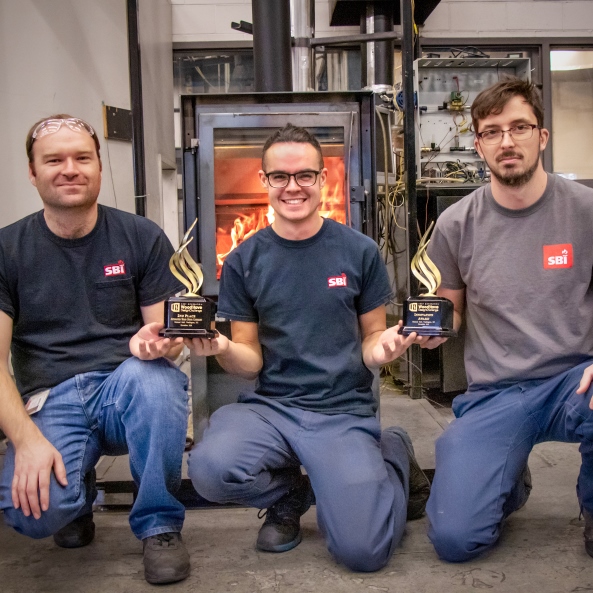
The SBI team that designed an early 
prototype of an automated stove that
won awards at the 4th Wood Stove 
Design Challenge in 2018.

The DOE program, part of larger grant cycle run by the Bioenergy Technology Office within the Office of Energy Efficiency and Renewable Energy (EERE) complements the efforts of the EPA to regulate the emissions of residential wood stoves.  The EPA has never invested in the R&D of cleaner stoves but its first set of regulations in 1988 resulted in a rapid and universal technology upgrade for all stoves.  Since then, many experts say technology has stalled. While stoves can perform well in the lab, they are all still manually operated so that in the hands of consumers, they can still perform poorly.


“There is a mismatch between the EPA’s regulations and the DOE programs because the EPA is still embroiled in the ongoing clash between industry and air quality agencies over how to test manually operated stoves,” said John Ackerly, President of the Alliance for Green Heat. The DOE is investing in the future - stoves with automated controls - but these stoves may be at a disadvantage using the EPA’s test protocols designed for manually controlled stoves.  Manufacturers have had little incentive to build automated stoves and must design their own alternative test protocols which need to be approved by the EPA.  


Each of the six projects are ambitious and highly innovative and they should start to hit the market in the next few years.  Until they pass EPA certification and are in the marketplace, its hard to prove that they are able to match their vision with a clean stove that consumers will want to buy.  Assuming the DOE maintains the program, over time it is likely to have a major impact on a technology sector that is not known for high-tech innovation.


MF Fire, Swirl Stove

SBI/ISB, Automated stove

Ohio State, Simulation drive automated stove

NTRE Tech, Fluid bed combuster

Oregon State, Forced air and automated controls

University of Alabama, Autonomous Stove 


The DOE is expected to announce its next round of wood heater grants early next year.

Wednesday, December 23, 2020

Expanded tax credits for modern, high efficiency wood and pellet heaters a big step in the right direction

Maine Senators Collins and King were
primary, bi-partisan champions of an
investment tax credit for wood heat.

Update for 2023 - The legislative victory that achieved the 26% tax credit in 2020, has now been upstaged by a law that will give a 30% tax credit as of Jan. 1, 2023.  The only downside to the 30% credit is that is has a $2,000 cap, which makes it of little value for homeowners who want to install very expensive whole house wood or pellet heating systems. Click here for our blog on the 2023 - 2032 wood heater tax credit.

2020 - 2022 - On December 28, 2020 President Trump signed into a law legislation passed by Congress which was the largest renewable energy spending bill in a decade and included incentives for solar, wind, advanced wood heat and a host of other technologies. This marks the first-time modern wood heating systems have been granted an Investment Tax Credit (ITC), rather than the far smaller tax credit wood heating technologies had been receiving.

The incentive provides a 26% tax credit for stoves and boilers that are 75% efficiency or higher. Consumers can easily identify efficiency levels by checking the EPA lists of certified wood and pellet heaters. The credit has no upper limit and lasts for three years, declining to 22% in 2023.

The effort to pass such an ambitious bill was led by the Biomass Thermal Energy Council, who started lobbying for it in 2009. In recent years, another significant push was led by Charlie Niebling, a consultant for Lignetics and former Chairman of BTEC. The Alliance for Green Heat contributed time and resources to both of these efforts, along with many other BTEC members.

As the founding Chairman
of BTEC, Charlie Niebling
was a chief architect of the 
bill and perhaps its most
ardent advocate.

Many Senators and members of Congress signed on to various iterations of the bill over the last decade, but it was Senator Collins and Senator Angus King who provided the final push, along with Chairman Richard Neal in the House of Representatives.

The legislative effort gained momentum as new EPA regulations required wood and pellet heaters to be cleaner and to disclose their efficiencies. “This is an important step forward but it is only one piece of a much larger puzzle to modernize the technology and the test protocols,” said John Ackerly, President of the Alliance for Green Heat.

Analysis

Wood and pellet heaters that at least 75% efficient are cleaner on average than those that have efficiencies below this threshold. Pellet stoves that test over 75% efficient emit five times less carbon monoxide (CO) than those with efficiencies under 75%. Wood stoves that test over 75% efficiency emit less than half of the CO of their less efficient counterparts.

The 75% efficiency threshold favors pellet technologies, as consistently dry fuel and automated combustion make it far easier to achieve consistently higher efficiencies. Sixty percent of all pellet stove models are over 75% efficient, compared to only 40% of wood stoves. Most catalytic and hybrid wood stove models are above 75% efficient, but only 12% of non-catalytic stoves will be eligible for the tax credit.

The seventy-five percent efficiency requirement was originally chosen about seven years ago, when fewer appliances could meet that level. With today’s technology, 75% efficiency is not a particularly high threshold, but it is much higher than how the 75% threshold was interpreted by industry to meet the previous $300 wood heating technology tax credit. That credit, under Section 25C of the tax code was also pegged to 75% efficiency but Congress did not consistently specify high heating value.

Using efficiency as the sole metric to identify wood and pellet heaters to receive public subsidies is a blunt and imperfect metric but satisfies legislators’ need for simplicity. Particulate matter (PM) emissions from cord wood stoves and boilers are a more important metric for public health. Efficiency is a more valuable tool for pellet appliances since their lab tested efficiencies are a reliable indicator for the efficiency homeowners' get. But wood and pellet appliance manufacturers sometimes purposely lower their efficiency to achieve other goals valued by consumers. Some pellet stove manufacturers use excess oxygen, leading to lower efficiency, to keep the viewing glass clean. Some wood stove manufacturers use excess oxygen to achieve cleaner, faster combustion and to prevent the operator from giving the unit too little air, which causes smoldering. The State of Alaska is currently exploring new metrics to identify cleaner wood heaters, including using the amount of PM created during the first hour of certification test burns.

Using efficiency as a metric does help deploy heaters that will save consumers money with a low-carbon renewable. Since the early 1900s, wood fuel has been the primary way that American households have avoided or reduced fossil heating fuel. An estimated half of American households who heat with wood gather all or most of it themselves, making it a highly sustainable fuel in a country with extensive forest cover.

This bill will help Americans afford to replace older wood heaters or buy higher efficiency ones and have them professionally installed because the tax credit covers the cost of installation. It will also help scores of small pellet mills across the country that mainly use sawdust produced by sawmills. Finally, the bill will also help manufacturers of more efficient wood and pellet appliances and encourage them to redesign heaters to be more efficient.

Benefits of a tax credit do not help everyone equally. Lower income families benefit far more from a rebate granted at time of purchase and many do not have the income level to benefit from a tax credit. And, the 75% efficiency threshold excludes the value wood stoves sold at hardware chains that are affordable to lower income households. Unlike wood stoves, many low cost pellet stoves are at least 75% efficient.

“The Alliance for Green Heat applauds this increased tax credit and calls on Congress needs to do more,” said Ackerly. “We need a dedicated federal fund to switch old, uncertified stove to cleaner heating technologies, similar to the federal program for diesel trucks. We also need increased funding for DOE and National Labs to focus on R&D to develop a new class of automated wood stoves and smart pellet appliances that integrate with solar and heat pumps and reduce electricity demand during winter electricity peak events,” Ackerly continued.

A separate bill included report language that directs the DOE to continue the $5 million grant program for R&D to modernize residential wood and pellet heaters. The Alliance for Green Heat worked with Senator Collins’ office to ensure this report language was included again.

The massive omnibus package included other provisions that could help advance cleaner and more efficient wood and pellet heating:
  • $1.7 billion reauthorization of the Weatherization Assistance Program to support low-income families by retrofitting homes with cost-saving clean energy technologies.
  • Robust funding for EPA “core” programs to protect clean air.
  • Reauthorization of the EPA Diesel Emissions Reduction Act (DERA) program, which is a model for a national wood stove change out program.
  • $200 million timber hauling businesses that experienced a loss of at least 10% of gross revenue between January 1, 2020 and December 1, 2020, compared to the gross revenue earned in the same period in 2019.

 Related stories

Guidance on the 26% tax credit for 2022 and changes for 2023 (Oct. 2022)

AGH urges IRS guidance to recognize efficiencies in the EPA Database (Feb. 2021)

Monday, November 16, 2020

Alliance for Green Heat calls on President-elect Biden to support and help transform wood and pellet heating

Press release
Contact: John Ackerly
202-365-4765

Nov. 16, 2020 - The Alliance for Green Heat congratulates President-elect Joe Biden and Kamala Harris on their 2020 presidential victory and welcome their commitment to scale up renewable energy and energy efficiency.

This change of administration offers the United States a historic opportunity to reduce fossil fuels through a range of renewable heating solutions and energy efficiency measures. We have already begun to decarbonize our electric grid, and now it’s time to also focus on our heating sector which can reduce heating costs for families across the country, buoy economic recovery and create good-paying jobs.

The Alliance for Green Heat’s supports all renewable heating options as well as strategic pairing of heat pumps, geothermal, solar thermal and solar PV with wood and pellet heat technologies (our specialty). The role of decentralized renewable thermal technologies, including wood, solar thermal and geothermal is essential along with the electrification of heat as our electric grids slowly become more renewable. The electrification of transportation is creating massive demands for new generation and distribution. This combined with very high peak demands in the cold, short daylength northern tier of the country calls for strategic deployment and use of non-electric heating technologies. Rural areas need special attention given the cost of new infrastructure.

Executive Branch


The Biden Administration, through executive action, can immediately begin to drive markets toward beneficial forms of advanced wood heating. It is essential that Biden’s administration analyzes small-scale wood heating as having unequivocal carbon benefits. This includes:
  • Ensuring there is an in-depth, science-based analysis to account for carbon content of wood used for residential and small-scale institutional heating that is separate and distinct from the analysis used for larger scale biomass to electric pathways.
  • Use the power of procurement, as outlined by the Climate 21 initiative, to “bolster markets for climate friendly products such as … heating systems that use wood pellets” in federal buildings, starting with more rural buildings in colder climates.
  • Directing the GSA to require rural federal buildings to consider heating with wood, chips or pellets where it is economically feasible.
  • Prioritize an interagency working group on bioenergy to focus on small scale thermal wood.
  • Include environmental justice considerations in bioenergy projects and expanding employment opportunities for Native Americans and low-income populations in rural areas.

Agencies

EPA: 

We urge the EPA, under new leadership to give more priority to one of the most popular and commonplace renewable energy solutions in the country. To this end, we encourage the EPA to

  • Invest in the expeditious development and adoption of test protocols that resemble how homeowners use wood heaters (we use the term “wood heater” to include wood and pellet stoves, boilers and furnaces).
  • Prepare the groundwork for a national wood stove exchange program to replace old wood heaters with cleaner alternatives.
  • Put resources into the offices that certify wood heaters so that the process is expedited and includes a full review of all testing requirements
  • Ensure the EPA’s Science Advisory Board (SAB) evaluates the carbon benefits of residential and small-scale institutional wood and pellet heating based on studies of how that wood is gathered and obtained by households and small institutions.
DOE:
  • Issue a Statement on Scientific Integrity that reaffirms DOE’s commitment to renewable energy pathways that can be deployed in the short term, including wood heating.
  • Expand the focus of the Bioenergy Technologies Office beyond liquid fuels to include biothermal and provide additional grants for automated, next generation wood heating technology.
  • Develop strategies that utilize wood heating as an integrated approach to mitigate grid-load growth risks caused by rapid electrification in the country’s northern tier.
USDA:
  • Prioritize the utilization of wood thinnings removed from high-hazard forests to be used for local heating of homes and institutions in those areas.
  • Ensure Rural Development Housing programs allow for and encourage the installation of modern, automated wood heating.
  • Increase funding to the Community Wood Energy program.
Congress:

We urge the Biden administration to work together with a closely divided Congress to:
  • Incorporate the BTU Act into any renewable energy or tax legislation to ensure that the most carbon beneficial pathway for low-grade, bi products of sustainably harvested wood is included.
  • Expand tax credits for energy efficient appliances including the cleanest and most efficient wood and pellet heaters,
  • Expand funding for the DOE to continue the R&D program to modernize residential wood and pellet heating technology
  • Establish a national program to retire older wood heaters in exchange for heat pumps, pellet heaters, and in some cases, new wood heaters.
  • Ensure that weatherizing programs inspect wood and pellet stoves just as they do with gas and oil furnaces for both safety and efficiency and provide avenues for repair or replacement, if needed.

The Alliance for Green Heat promotes wood and pellet heat as a low-carbon, sustainable and affordable residential energy solution. The Alliance works to advance cleaner and more efficient wood heating appliances, particularly for low and middle-income families.  The Alliance runs the semi-annual Wood Stove Design Challenge to encourage innovation and automation in wood stoves. Founded in 2009, the Alliance is a 510c3 non-profit organization based in Maryland.  

Friday, September 18, 2020

AGH urges DOE's bioenergy office to expand focus of funding

The Bioenergy Technologies Office of the U.S. Department of Energy recently asked for input on promoting the development and testing of low-emission, high-efficiency wood heaters. The deadline to reply is 5:00 PM on Monday, September 21, 2020 and the Alliance for Green Heat (AGH) continues to urge stakeholders to provide feedback to the DOE.
Diagram of stove field testing unit.

We also urge stakeholders to reinforce points made by AGH in your submission to the DOE. Please feel free to copy any of the points we make below, put them in your own words and/or develop them further. If you feel any of our points are off-base and should be changed or expanded, please email John Ackerly at jackerly@forgreenheat.org. For more background, click here.


Dear DOE,

Thank you for requesting input through this Request for Information (RFI). We are especially thankful that BETO has embraced this relatively small effort to distribute $5 million to support developing and testing new wood heaters. We are also mindful that the effort required to run a $5 million grant program may be similar to the effort required to run a $50 million program.

The wood heating manufacturing community has not had this kind of support from a government agency in the past several decades. However, it came at a time when the manufacturing community was in the final stage of testing to meet the stricter 2020 EPA emission standards. Much of the community does not have experience applying for federal grants, which can be challenging for smaller firms.

R&D labs could apply to test stoves after certification to help assess effectiveness of designs on emission performance.

We are encouraged that some of the questions posed in this RFI may indicate BETO is open to expanding the focus of future grant cycles. Questions on the performance of stoves already installed in homes and field testing are important as they embrace the life cycle of heaters. Congressional language has urged BETO to “support development and testing of new domestic manufactured low-emission, high efficiency residential wood heaters.” Testing of new heaters can also occur once they are installed in the field. Testing can include various iterations of round robin testing before or after certification. And, the development of new heaters can include the development of component parts, software applications, and other essential stages in the development process, not just the final act of assembling a finished stove for certification.In short, we fully support BETO to follow the Congressional language and not add additional restrictions or preconceptions about the traditional stove certification process.

We think that the barriers to developing and testing new stoves are not the only barriers stove manufacturers face. Thus, we are unsure if the list of technical questions you ask will solicit robust feedback on many key issues pertaining to the development of heaters. The engineering expertise and solutions to these questions can be built up. Many academics, non-profits and jurisdictions are eager to engage in more field testing of new stoves, and to do additional types of testing before deployment. 


Norbert Senf, AGH's board chair, introducing the SBI team at the 4th Stove Design Challenge. SBI later won one of the DOE grants with their US partner.

We understand from discussions with industry that few of the larger mainstream stove manufacturers have applied for grants in the last two grant cycles. Yet, there are urgent funding needs in the broader wood heating sector to help the development and testing of genuinely cleaner and more efficient wood heaters.

Renewable energy technology development often happens quickly when there is significant government subsidies and expanding consumer demand. The DOE’s programs supporting solar PV, paired with Congressional support for significant tax breaks, is a good example.

BETO’s program can help on the technical side of this equation by promoting the development and testing of heaters that meet the requirements of modern renewable energy incentive programs. These programs often need to better understand field performance characteristics of the technology in question.

Round robin testing at US stove labs are badly needed to assess testing variability.

Unlike some European counties, U.S. federal and state agencies have barely ventured into the realm of aggressively promoting the cleanest heaters, which first requires the development and testing of classes of heaters that are appropriate for greater deployment. State policy frameworks are beginning to shift from decarbonizing electricity solely to also include decarbonizing heat, and it is likely that the federal government will do so as well in coming years. BETO can play a vital role in preparing for this by focusing on technical issues related to heater development and testing.

We are providing answers to those questions where we have the most expertise and where we think BETO can be most influential.

Technological Barriers

1. What are the critical technical hurdles for improving performance of stoves for new installations (e.g. combustion chamber design, combustion air management, controls, mixing, sensors, etc.)?

A. We applaud BETO’s focus on supporting efforts to develop automated heater controls, as these are one of the most effective ways to improve performance over the lifetime of the heater.

2. What are the critical technical hurdles for improving performance of stoves already installed in homes (e.g. combustion chamber design, combustion air management, controls, mixing, sensors, etc.)?

A. Some technical solutions, such as adding an ESP, exist; however, these quickly can become more expensive than a stove replacement. The most cost-effective changes relate to the fuel used, and significant change in this area may require new local and state firewood regulation. For BETO’s mandate to support not just the development of heaters but also testing, there is much work to be done on testing new heaters that have just been installed in homes to better understand how performance can be improved.

3. What practical and new techniques are used to significantly reduce transient emissions (startup, shutdown, load changes)?


A. Automation of stoves is one of the most promising ways to improve transient emissions. Changes in test methods are also vital, and test methods depend on developing data about transient emissions and making that data transparent to the public.

4. What practical and new techniques are used to measure transient emissions that could be implemented in laboratory or field testing?

A. There is an increasing variety of technologies to measure not just transient emissions, but all emissions, both in the lab and in the field. The problem is that there is little funding or mandates for them.

5. How can new exhaust emission control technologies be developed and practically deployed?


6. How could integrated hybrid systems, in which biomass heaters are combined with other technologies such as heat pumps, solar, and high efficiency gas and liquid-fired appliances, be a route to reduced emissions? What are the technology barriers to this approach?

A. Many of these systems exist as prototypes or are on the market, especially in Europe. There are few technology barriers to this approach. When policies mandate increasing residential renewable heating, hybrid systems will emerge to make use of the strengths of different technologies and the seasonal costs and availability of electricity, solar, biomass and stored energy. BETO could play an important role by focusing future FOAs on hybrid systems and making R&D funding available for the integration of wood heaters with heat pumps. Funding could be routed through heat pump companies, wood heater companies or even software companies to achieve this. Integrating solar thermal with biomass thermal also holds tremendous potential.

Annual emission testing using handheld devices like the Testo 380 is vital to understand impacts of wear and tear on emissions.

7. How could field measurement methods be improved to ensure that biomass-appliances do not create local air quality issues in long-term use?

A. Testing new heaters in real world settings is vital before and after the certification process. Manufacturers need equipment to enhance their beta testing in homes during the winter(s) before they finalize and certify products. Academics and non-profits can use existing or newly developed equipment to test emissions of newly certified heaters once they are installed in homes. In terms of ambient air quality, a variety of sensors, including the Purple Air sensor network, exist or could be developed to help understand impacts of stove groupings. States that have enforcement capacity and use opacity criteria in the field, such as Washington State, have experience with identifying and understanding why certain stoves may be particularly problematic. Sensors or sensor networks could also calculate the benefits of deploying the cleanest heaters, instead of perpetually trying to monitor, enforce and manage emissions of traditional certified wood stoves that can burn unseasoned wood at low air settings at any time.

8. What stove features commonly encourage end-users to purchase new or replace a wood heater? Or, what stove features are commonly attractive to the end-user?

A. Price is a top consideration. Clean glass is another. Aesthetics are always a driving factor. The actual or perceived ease of use can be very important. Heating capacity, log size and burn time are key for many consumers. There are also different considerations for wood versus pellet stove customers, and for those looking for a primary versus a periodic or secondary heater. Fuel management is also a big issue, with some operators switching to pellets to avoid the enormous work of wood stoves, and others giving up pellet stoves because they can’t lift 40-pound bags. For pellet stoves, durability, reliability and access to professional service should be higher priorities than they are currently. BETO could play a very productive role in developing durable pellet stoves that use interchangeable, easily sourced replacement parts, for example.9. What advantages or disadvantages would continuous field performance data provide for advancing stove designs?

A. This sort of data is extremely valuable, and funding programs to collect it would help develop and test new wood heaters. This data is also helpful in developing new test protocols, which in turn would lead to changes in stove design. Depending on the metrics produced and how they are communicated, data could help consumers operate stoves better. It could also help stove R&D departments, especially if the data came from the stove manufacturer's own stoves. If this data is only available in summary form via a regulatory agency, it would have diminished applications. There is tremendous potential and a wide range of opportunities to gather certain types of field performance for different stakeholders: users, neighbors, retailers, manufacturers, air quality agencies, academics, etc. Continuous field performance data is currently collected by solar PV installers, internet providers and auto makers, for example, for a wide variety of purposes. One of the most obvious is to help with remote trouble shooting, which in turn leads to the R&D of software and hardware that avoids those issues.

Tools and Capabilities

1. How are trial-and-error test methods used to improved stove performance and advance stove design (i.e. development by implementation of incremental change and testing)?

2. Is access to performance testing facilities a barrier to development?

A. Most mid-sized and larger manufacturers have their own in-house labs for testing. Increasingly, the definition of a testing facility or testing lab is broadening, as more affordable and handheld equipment comes on the market, enabling anyone to enhance their in-house testing capacity. The third-party labs used for certification have the capacity to handle testing but the time and cost involved is a barrier. If the time and cost involved were less, companies may engage in more R&D and update their stove designs more often. Currently, when a stove model gets certified, it can remain unchanged on the market for 10 or 20 years, or until required by the EPA to test again to meet a new NSPS.

3. What in-house test methods are relied upon to validate and facilitate wood heater development?

4. How much could rapid performance measurement methods shorten R&D test cycles?

5. What specific test methods would be of interest to your enterprise?

A. A variety of test methods and practices are of great interest to AGH, starting with cord wood testing using test methods involving multiple labs, or being used on new stoves after installation in the field.

Stove testing is often considered as exciting as watching paint dry. Here, AGH researcher Gabriel McConnel assists in DOE's Brookhaven lab in advance of a Stove Design Challenge.

6. How are modeling and simulation tools being applied to improve wood heater designs?

7. How could modeling and simulation tools be improved to meet your needs?

8. What are the fundamental modeling gaps to enable broader use of modeling and simulation such as Computational Fluid Dynamics (CFD) to improve wood heater design?  

9. How are current measurement methods meeting your needs for evaluating performance and emissions from wood heaters? What could be done better?

A. Current methods usually do not evaluate heater performance apart from the narrow conditions under which they were tested. There is much potential in affordable measurement methods. The more complex part is whether manufacturers will have the motivation to use them.

10. What performance/emissions measurements are most challenging to obtain? What makes obtaining these measurements challenging?

11. What are three primary challenges your enterprise faces for advancing stove designs?

A. 1. Funding. AGH could engage in extensive activities to advance stove development and testing with more funding.

2. Lack of a more robust community of academics, non-profits, agencies and private sector companies involved in innovative stove designs and testing.

3. Lack of policy frameworks that focus on decarbonizing residential heating and a lack of incentives for the very cleanest and most efficient heaters.
 

Sincerely,


John Ackerly,

President

Alliance for Green Heat


Thursday, January 30, 2020

Blue Angel ecolabel requires wood stoves with automated air controls

Blue Angel, the German government equivalent of the US Energy Star label, approved a new eco-label for wood stoves that includes stoves with automated air control, “separating technologies” such as electrostatic precipitators and the ability to meet strict emission standards.

The Blue Angel label is also part of a trend that is exploring and adopting test procedures that more closely resembles how stoves are used in homes.  The label emerged in part from lessons learned by the BeReal initiative that involved extensive round-robin testing in multiple European countries. The Clean Heat initiative is promoting the label to help towns and cities to reduce air pollution.
Marius Wohler of BeReal presents
findings at Brookhaven National Lab
 in 2016

The label gives a boost to efforts by the Alliance for Green Heat which has worked with American state and federal agencies and American stove manufacturers to develop automated stove technology and bring them to the US market.

German Federal Environment Minister Svenja Schulze said in a press statement that "The Blue Angel standard for stoves for wood is a real step forward. The authorities can now take more effective action against particulate matter pollution, for example by only allowing the operation of stoves bearing the eco-label.”

Blue Angel says that cities and municipalities are introducing regional bans on conventional stoves (ban on the use of these stoves and ban on installing these devices in new housing developments) but there would be exceptions for those appliances holding the Blue Angel label. The city of Berlin has expressed interest in using the ecolabel.

Maria Krautzberger, President of the Federal Environment Agency said “With the Blue Angel requirements that have now been decided upon, we are showing that it is possible to go even further [to make wood stoves clean]. This boosts innovation in the industry, gives guidance to consumers and is good for our air".
SBI won an award for their automated
stove design and will be launching a series
of automated stoves in North America

The label is voluntary for manufacturers, as a number of other European eco-labels, but this one is stricter than others. Several European countries have developed eco-labels for wood stoves with varying degrees of success. The US Energy Star program has never covered wood stoves and US stove industry blocked an initiative by Washington State to explore a state-led label. The Alliance for Green Heat has been an advocate for ecolabels and urges stakeholders in the US to revisit the idea.

It is not yet known how many stoves will qualify for the label over the coming months and years, and how well they will work in the field. Automated stoves gained some visibility in the United States through the Wood Stove Design Challenge and subsequently the Department of Energy provided $3 million in funding for automated stove R&D in 2019 and are now offering an additional $5 million in 2020.

Electrostatic precipitators (ESPs) have long been used in commercial wood burning applications, and their use in residential applications has grown rapidly in Europe. In the US, an initiative in Alaska is using ESPs, and is hoping a review by the EPA will determine that change out funding can be used on a wider scale to install ESPs on wood stoves.  As prices come down under $2,000 the cost of adding an ESP may result in far more PM reductions than replacing an old stove.
This ESP made by Swiss
company Oekosolve was
also showcased by AGH
in Wash. DC in 2018.

Excerpts of the details of the Blue Angel label are reproduced below. The full criteria can be found here.

Excerpts

The environmental label may be awarded to stoves that use the fuel … in an efficient manner and have significantly lower pollutant emissions. In addition to the statutory regulations for the type testing process [lab testing of a sample stove] for the stoves, the special requirements stipulated by the Blue Angel mean that stoves have to comply with significantly lower particulate and CO limit values and this must also be verified during the ignition [start-up] phase that involves a particularly high level of emissions. In the case of organic gaseous carbon (OGC) and nitrogen oxides (NOx), emissions of these substances must already be below the limits defined in the EU Ecodesign requirements that will be generally applicable from January 2022.

When purchasing a new innovative stove, the environmental label will thus act as a decision- making aid for the reduction of air pollutants. It is a voluntary label that is designed to motivate manufacturers to develop efficient and low- emission heating appliances. The label will allow manufacturers to highlight the environmental benefits offered by their heating appliance in a simple way.

Therefore, the following benefits for the environment and health are stated in the explanatory box:

3.1 Emission requirements

Stoves, where relevant in combination with an integrated or downstream particle separator, must comply with the maximum limits stated in Table 1, Column 3 for the particle content, carbon monoxide (CO), organic gaseous carbon (OGC) and nitrogen oxides (NOx).

The particle count concentration must be determined (see Appendix C for the measurement method). In addition, the limit for the particle count concentration stated in Table 1, Column 3 must also be observed from 01/01/2022.

The requirements can be complied with in two ways:

1. a) Testing the overall system

The requirements will have been fulfilled if the mean values from the individual measurements described in Appendix B that were carried out on the tested stove, including all of the intended fixtures and attachments, do not exceed the relevant limits specified in Table 1, Column 3.

Spare parts are those parts which, typically, may develop a fault within the scope of the ordinary use of a product. Whereas those parts which normally exceed the life of the product are not to be considered as spare parts.

2. b) In combination with an efficient particle separator

§ The requirements will have been fulfilled if the mean values from the individual measurements described in Appendix B that were carried out on the stove do not exceed the relevant limits specified in Table 1, Column 4 and the stove is sold and installed together with a particle separator. For particle separators, a minimum separating efficiency of 75% of the particle mass and (from 01/01/2022) 90% of the particle count must be verified. The limit value in Table 1, Column 3 must be complied with reliably when taking into account the separating efficiency.

§ If a particle separator for which this minimum separating efficiency has been verified is already integrated into a chimney, the manufacturer can also sell the stove without the separator. The fact that the stove must be installed together with the associated particle separator that is integrated into the chimney must be indicated during the sale of the product and also in the installation instructions. The particle separator integrated into the chimney must already have been named and tested when submitting the application for the stove.

The measurement of the flue gas temperature, the flue gas sampling process and the measurement of the static pressure for the stove must be completed in a measurement circuit according to DIN EN 16510-1:2018-01 (D), Section A.2.3 as well as Diagrams 13 and 14 of this standard.

The measurement uncertainty stated in the test method is neither added nor subtracted.

3.11 Future revision of the environmental label

Furthermore, the revision will examine whether the applicant can offer a 5-year guarantee for the secondary reduction technology if it is sold in combination with the stove. 
To determine the particle count emissions from stoves, it has only been possible up to now to evaluate individual test results using the methods described in Appendix C. Round robin tests that could be used as the basis for defining a limit for the particle count emissions from the stove have not been available. 

Nevertheless, the measurement of the particle count in accordance with the new methods is being introduced as an obligatory requirement. Due to the unavailability of round robin tests, it is necessary to allow a transition period for the introduction of the particle count limit. Compliance with the particle count limit will be obligatory for the award of the Blue Angel from 01/01/2022. 

3.4 Air regulation

To ensure that the user has as little influence over the emissions as possible, it is not permitted for the air supply to be manually adjustable during intended operation. This is usually achieved through the automatic regulation of the air supply.

3.5 Combustion monitor

A display must be provided for the user to indicate any deviation from the optimal operating state and to request that the user stokes the fire with wood.

3.8.1 Repairability and provision of spare parts

The stove must be designed so that it can be repaired by replacing individual parts that are no longer working. The applicant undertakes to guarantee the provision of spare parts for the repair of the appliances for at least 10 years following the termination of production.

The product documentation must include information about the repairability and the guaranteed supply of spare parts.

3.8.2 Recyclable design

In terms of the recyclable design of those appliances issued with the environmental label, the following is valid:

· The appliances must be designed in such a way that they can be dismantled and separated into recyclable materials by specialist companies using standard tools or that this process is simplified by intelligently designed connections.

· The appliances must be designed so that it is possible to separate metals into single materials and, where possible, recycle them separately.

3.10.3 Quick user guide

· In addition, another guide covering a maximum of two pages must be provided that includes the most important instructions for the fuel to be used (size of the pieces, max. water content, quantity) for the ignition process, controlling the air flow, stoking the fire and cleaning/maintenance in a clearly visible and easy to understand form. This quick user guide must be permanently legible and abrasion-resistant and must not suffer from discolouration during normal use.

· The instructions must include easy to understand illustrations

5. Use of the Environmental Label

The use of the Environmental Label by the applicant is governed by a contract on the use of the Environmental Label concluded with RAL gGmbH.

Contracts on the Use of the Environmental Label are concluded to fix the terms for the certification of products under Paragraph 2. Such contracts shall run until December 31, 2023. They shall be extended by periods of one year each, unless terminated in writing by March 31, 2023 or March 31 of the respective year of extension.

Related stories

Thursday, October 3, 2019

DOE awards $3 million for R&D to wood stove manufacturers

The MF Fire leadership team in 2018
- Taylor Myers, Paul LaPorte and
Ryan Fisher.
The U.S. Department of Energy (DOE) selected only two companies – MF Fire and ISB Marketing – to receive $3 million for research and development (R&D) through the DOE’s Office of Energy Efficiency and Renewable Energy. The DOE had $5 million for stove and boiler manufacturers but decided to only award $3 million this year.

The two manufacturers are working on next-generation controls and designs for wood stoves that have barely entered the marketplace. Both companies are focusing their efforts on how to make stoves cleaner in the hands of consumers – not just in the test lab – which has become widely recognized as the Achilles heel for the millions of Americans who heat with cord wood.

[Dec. 15, 2019 update - The DOE announced their intention to grant another $5 million for biomass heater R&D in 2020.]

MF Fire received two grants, one for a device that continuously monitors performance of key combustion indicators and delivers real-time user guidance, and the other for a “swirl stove” that induces and maintains swirling combustion and introduces a new balance of primary, secondary, and dilutive air. ISB Marketing, working with its sister company, Stove Builder International (SBI), is developing a Machine Learning algorithm for a self-regulating wood stove that would have a PM emissions rate below 1.2g/h and offer an overall efficiency of more than 75% (HHV).
The SBI team that produced the award
winning prototype of an affordable,
automated stove

DOE is expected to be able to offer R&D grant funding again in 2020 and may be able to stimulate R&D in more wood heater manufacturers. “We applaud Congressional appropriators and the DOE for funding this R&D that can help millions of Americans affordably heat their homes with next generation wood and pellet stoves,” said John Ackerly, President of the Alliance for Green Heat.
The $2 million for MF Fire is a large cash infusion for a young, small manufacturer with lots of innovative ideas and priority on R&D. “This will enable us to hire new people to ramp up our testing and apply techniques and technologies used by other industries," said Ryan Fisher, COO of Baltimore based MF Fire. “For example, eliminating PM by more thoroughly and aggressively mixing fuel and air has not been done by stove manufacturers. Square, rectangular corners create dead spots that inhibit combustion." Mr. Fisher said. Fisher and his original partner Taylor Myers got their start in designing stoves as graduate students preparing for the first Wood Stove Design Challenge in 2013. The rookies won multiple awards before the age of 25 and still haven’t turned 30. Some see them as the face of a new wave of stove designers.

ISB Marketing, with their SBI counterparts, are taking a similar tack but its potentially applicable on a range of stove models from a major manufacturer. ISB is working with Machine Learning algorithm that will learn how each specific user heats his/her stove. The stove will then adjust its combustion parameters to compensate for any “bad” human behavior that tends to increase particulate matter (PM) emissions and reduce efficiency. A home-designed real-time PM monitoring system will be developed to obtain a better understanding of the stove’s behavior.

Mark Shmorhun, the program
manager at DOE who managed
the grant process, at the 2018
Wood Stove Design Challenge

Marc-Antoine Cantin, President of SBI said in an interview that moving innovative and more risky stove projects through a corporation takes longer, as models that have conventional technology are often green-lighted first. “External R&D funding can help reduce risk,” Cantin said. Even with a million dollars from the DOE, a batch of 26 of the new stoves is not expected to be beta-tested until the winter of 2022-23. SBI won second place at the 2018 Wood Stove Design Challenge for designing a simple, affordable stove that allowed the operator to select high or low heat output and used a low-cost control board and thermocouple sensors to ensure that the stove burned cleanly.

The DOE does not disclose how many applications they received or from whom, but it is widely believed that the agency received few applications for the available $5 million pot of funding. John Crouch, Director of Public Affairs for HPBA, said in an interview, “The funding announcement came at a bad year because manufacturers were scrambling to certify their stoves to the stricter 2020 EPA standards. We hope there will be more applicants if the DOE offers the grants next year.”

The DOE also does not disclose who was on their panel of expert reviewers. According to some companies who applied, some didn’t make it through the process because they had not fully completed the application. Others made it through the first round, and then had to respond to specific questions from the reviewers. Ryan Fisher of MF Fire said he got multiple questions about whether his small company could execute two grants and they had a solid plan in place to manage that. SBI got many questions about their corporate structure. They are owned by US-based Empire Group, who also owns ISB Marketing. They plan to carry out R&D for the grant in the US. Other applicants who made it through the first round, didn't make it through the second round.

The one-page summaries of the 3 grants can be found here: MF Fire-Swirl Stove, MF Fire-Performance Monitoring, ISB Marketing-Automated Stove.

This recent entry of the DOE’s Bioenergy Technologies Department which focuses mainly on biofuels, fills a significant gap for the US government. The EPA provides baseline emission and testing standards and the USDA’s Forest Service provides support for larger commercial use of biomass for heating applications. This marks the first time that a US government agency has provided support for companies to push the boundaries of emission and efficiency controls for residential wood and pellet heaters. The United States has the toughest emission standards for residential heaters in the world, which has kept US companies at the forefront of an industry that can provide affordable, low carbon heating solutions in the switch from fossil fuels to renewables.

The original DOE funding opportunity was directed at stove R&D that included:
  • Novel and innovative residential wood heater designs to improve combustion chamber geometry, combustion air flow distribution, mixing of combustion air with gasification products, stove baffling designs, etc.
  • Improvements in automation of stoves to optimize combustion control.
  • Wood heater power generation via thermoelectric module integration
  • Improvements in catalyst technologies for emissions reduction