Showing posts with label hydronic heater. Show all posts

Friday, October 18, 2019

EPA urges manufacturers to stick to May 2020 compliance deadline; says its working towards a cordwood test method rulemaking


On October 15 the EPA provided an update on its wood heater website page urging “affected entities to continue efforts to certify compliance with the NSPS in light of the upcoming May 15, 2020, compliance date.” According to NSPS legal experts, the EPA sometimes issues such updates to provide more transparency when stakeholders need certainty due to an approaching deadline.  

[March 11, 2020 update: The EPA finalized amendments to the 2015 NSPS and did not provide a retailer sell-through.  They did remove pellet fuel minimum requirements but retained the list of prohibited fuels in the 2015 NSPS.]

The October 2019 update is widely interpreted to mean that there will be no sell-through for whole house heaters or any other significant changes in the regulations issued by the EPA in 2015. However, the details of any changes to the 2015 rules will come later this fall when the EPA issues the Final Rule.  

The news was welcomed by the Alliance for Green Heat and many stakeholders, including manufacturers and importers of wood heaters who have invested in R&D and retesting of their heaters that comply with May 2020 emission standards.   Nearly 200 models of wood and pellet heaters are certified to the 2020 standards and virtually all stove companies say they will be ready for May 2020.  Some include innovative designs that achieved emission levels that are six times cleaner than the maximum allowed in 2020.

The sectors of the wood heater industry that most needed a sell-through are the outdoor wood boiler and indoor forced-air furnace makers, both of whom are represented by the trade group Hearth, Patio and Barbecue Association (HPBA).  HPBA’s strategy of seeking relief from Congress and the Administration appear to have fallen through, leaving its litigation against the EPA as the most viable channel for relief.  But that relief will likely not occur before May 2020.

Test methods
 
A Canadian company who never
had an EPA certified heater
saw a new market open up
for their AirBilo Furnace.
Much of the EPA’s update addressed test methods, and the EPA noted that a newly approved broadly applicable alternative test method for furnaces “may facilitate the ability of manufacturers” of furnaces to comply by May 2020.  This is not the type of relief sought by HPBA, and it’s not yet known if many other furnaces will use this test method for certification.  However the EPA puts it in the context of providing some relief.  It was given to a Canadian company mostly known for maple syrup boilers, but who also makes a very affordable forced air furnace.

The EPA used this update to message that it is already moving on to the next proposed rulemaking, which will be on cordwood test methods.  The update said, “in the coming months, the agency is initiating a series of roundtable discussions with states and other stakeholders to inform the agency’s direction toward a cord wood-based compliance test method.”  In March 2016, the EPA laid out a process for developing improved cordwood test methods. By statute, the next NSPS should be in 2023 but the EPA could issue this rule making earlier.  AGH believes the next NSPS should not focus on reducing allowable PM without first modernizing test methods to ensure heaters are designed for real world use.

Part of the HPBA’s litigation focused on an agency decision to set a 2.5 gram an hour emission standard before setting a test method to meet that standard. Subsequently, an industry led ASTM committee developed the E3053 test method which has become a commonly used method along with the standard crib wood method that has been in use since the late 1980s.   The ASTM method is being widely used now but came under scrutiny by the EPA because of lax reporting by labs using the method.

NESCAUM is developing "Integrated
Dute Cycle" protocols based on the
way stoves are used by consumers.
Since the ASTM method became a “broadly acceptable” alternative test method, NESCAUM has dedicated substantial resources on a broad and ambitious effort to develop a range of new test methods for stoves, boilers and furnaces, as well as for pellet heaters.  The NESCAUM effort is partially funded by NYSERDA and the process and data is not fully public but ultimately it could provide the largest database of cordwood testing ever compiled to develop a North American test method.  Since test methods need to be data driven, this process may give these NESCAUM protocols an entry point and will challenge others to develop or make public data that can lead to a better protocol.

Tuesday, March 5, 2019

Wood stove industry faces unified opposition to deregulation

A 2018 portrait of the Western
Governors Association who
oppose delays in the NSPS timeline.

Amid the scores of comments filed in response to the EPA’s proposal to weaken Obama-era wood stove and boiler regulations, not a single state came out in support of the Trump Administration’s proposals.  

Attorney Generals from eleven states (CT, IL, MA, MD, MN, NJ, OR, NY, RI, VT & WA) filed detailed comments and are likely prepared to sue if the EPA tries to weaken the existing regulations.  Even Alaska and the Western Governors Association is backing the Obama-era timeline. A more troubling sign for the wood stove and boiler industry is an energized, engaged and knowledgeable array of states, air agencies and non-profit organizations that have lined up to oppose virtually all the changes that the stove and boiler industry is seeking from the Administration.

“We are seeing a polarization of stakeholders who once used to make alliances and find common ground,” said John Ackerly, President of the Alliance for Green Heat, an independent non-profit that promotes cleaner and more efficient wood and pellet heating. “The Trump Administration efforts has energized states and unified them across a range of issues, from compliance deadlines, to test methods, to regulation of wood pellet composition, to warranties and audits for stoves,” Ackerly said.

Key excerpts of stakeholder comments which this analysis is based on can be found here for those who don't want to download and read through hundreds of pages of comments.
John Ackerly, head of the Alliance
for Green Heat.  Photo courtesy of
Popular Mechanics magazine.

Trump Administration proposes a delay

The biggest issue on the table is whether the EPA will extend a deadline and allow retailers to sell dirtier wood boilers and furnaces – and possibly wood stoves – until 2022 instead of 2020. The EPA has indicated an interest to provide this relief to wood boiler and furnace manufacturers and retailers, but time is running is out and the agency has been moving slowly on this issue.  It’s also unclear if states would be able to get an injunction to prevent such a move while it was being litigated.  

Scores of comments submitted to the EPA depict an industry that has few friends standing up for it outside its own network of manufacturers and retailers.  Attorney generals from three states with Republican governors – Maryland, Massachusetts and Vermont – sided with democratic-led states in opposing any delay in stricter emission standards taking effect.  

Among industry, there is widespread unity to allow retailers two more years to sell Step 1 boilers, furnaces - and stoves - that are set to go off the market in May 2020, although a handful of small manufacturers and importers support the existing timeline.  

While manufacturers argue forcefully that they need a two-year sell-through, they are also having to assure their retailers that they will have 2020 compliant products.  For example, in comments submitted to the EPA, Jotul says it faces dire economic consequences with $2.5 million in raw cast iron at stake if a 2-year sell-through is not granted.  But in an industry magazine read by retailers, Jotul says they are doing “very well” certifying their 2020 models and expect to release their new 2020 models later this year.  Based on the EPA’s list of certified wood stoves, it appears that Jotul is one of the manufacturers who is far behind schedule, as they do not yet have a single 2020 compliant stove on the list.  Industry sources have said that the list of EPA certified stoves far underestimates the preparedness of many manufacturers who may be waiting to submit test data for 2020 compliant stoves until they are closer to the required date.
Richard Corey, CEO of
California's Air Resources
Board

While northeast and northwest states have been the principal state actors, California is making a big investment in challenging the EPA's deregulatory proposals.  They filed extensive comments to both the Proposed Rule Making (PRM) and the Advance Notice of Proposed Rule Making (ANPRM).  They and many of other states challenge the legality of the EPA's approach, setting the scene for what is likely to be a legal battle.  They argue:

"The [EPA's] requests for information with respect to the emission limit for wood heaters do not request the right information, are biased and outcome seeking towards collecting evidence for weakened standards and miss the opportunity to collect the data necessary to perform an accurate and complete economic and regulatory impact analysis.  Asking “whether Step 2 is achievable at a reasonable cost” is not the correct framing of the question. The answer to this question seems predetermined, particularly for those who ostensibly have “been unable to design a wood heater to meet the Step 2 standard.”
Letita James, the Attorney
General of New York, is the
lead among eleven attorney
generals opposing a sell-
through and other changes.

Perhaps the most detailed argument for a two-year sell-through came from North East Distributors, one of the largest distributors of stoves made by many manufacturers.  They say that they “are in favor of manufacturers having to meet the May 15, 2020 deadline for stopping production of non-2020 compliant models" but against "holding distributors and retailers to the same May 15, 2020 deadline for sales of already manufactured products. Having the one date for all entities (manufacturers, distributors, and retailers) inhibits the results you are trying to accomplish.” 

A push to deregulate outdoor wood boilers

The main regulatory focus has been on a sell-through for outdoor wood boilers, also known as hydronic heaters, and inexpensive indoor wood furnaces.  Leaders of those companies have been testifying to Congress and lobbying the administration. 

For central heaters like boilers and furnaces, the main industry association, the Hearth, Patio and Barbecue Association (HPBA) is calling on the EPA to “repeal those standards altogether.”  Strengthening emission standards for wood boilers and furnaces was one of the largest goals of the 2015 New Source Performance Standards (NSPS), and this call to deregulate that industry altogether represents a new front in the widening gulf between industry, states and air quality agencies.  

HPBA's John Crouch, an
architect and mediator of
HPBA policies.
US Stove, the dominant manufacturer of indoor wood furnaces is also calling on the EPA to repeal emission standards for furnaces because the “economic feasibility of meeting the standards is impractical” and the emission levels are “preposterous and unrealistic.”  However, a far smaller competitor, Lamppa Manufacturing already has a furnace that meets the 2020 standards.

When it comes to outdoor wood boilers, fringe voices are not uncommon. There is a group of retailers and consumers supporting the “Hawken Proposal”, which calls for getting rid of federal emission standards for outdoor boilers altogether and letting states and municipalities voluntarily adopt standards.  The proposal is being led by Hawken Energy, a Missouri based company that believes the federal government should not interfere with how people heat their homes. 

In contrast, Central Boiler took a more moderate position and refrained from calling on the EPA to repeal Step 1 and/or Step 2 standards, instead asking the agency to “revisit the cost effectiveness and feasibility of the Step 2 emission limit.”

Lack of enforcement undermines certified boilers
 
Warren Walborn, CEO of Hawken
Energy with Rep. Bill Huizenga (R-MI).
An important concern among the outdoor wood boiler community is that the EPA has no enforcement capability to rein in the many manufacturers of unregulated outdoor boilers.  Yoder Outdoor Furnace, a HeatMaster retailer in Virginia said, “until [EPA] enforcement actually happens no manufacturer can afford to invest heavily in testing as these cheap illegal models will not allow them to recoup costs.”  That sentiment was echoed in many comments from industry, and it would seem to be an issue of concern to states and air quality agencies as well.  However, states and air quality agencies did not mention this problem in their comments.  

By opening the door to changes in the compliance timeline for stricter emission standards, the EPA may have built far more momentum for a new NSPS process in 2023.  The NSPS is supposed to be reviewed every eight years, and states and groups are likely to sue again to keep the EPA to that timeline.  Virtually all the states and air quality agencies engaged in fighting EPA’s proposed changes are now calling for far-reaching changes in the 2023 NSPS. If a democrat is in the White House in 2023, this momentum may result in even stricter emission limits and test method changes.  A group of eleven Attorney Generals said the 2020 emission standards are already “too lax.” If President Trump is re-elected, industry is likely to keep the upper hand and consolidate its goals, barring defeats in court.
Lisa Rector, a leader at
NESCAUM on wood
smoke reduction.


In addition to seeking input on granting a two-year sell-through for retailers for boilers and furnaces, and possible stoves, the EPA identified a half a dozen other issues for which it wanted feedback, from cordwood test methods to compliance testing.

The transition to cord wood testing

One area on which industry, states, air quality agencies and other groups all agree is the need to move toward testing and certification that more closely represents in-field operating conditions and performance.  This means testing and certifying stoves with cordwood, instead of crib wood (2x4s and 4x4s), capturing start-up emissions and potentially making even more structural changes to how stoves are tested.  The agreement may end there, however, as states and air quality agencies have now coalesced behind a test protocol being developed by Northeast States for Coordinated Airshed Management (NESCAUM) and the New York State Energy and Research Development Authority (NYSERDA), called the Integrated Duty Cycle (IDC) method.  Industry is firmly behind the ASTM E3053 method that they developed through a consensus-based process from 2015 to 2018. 

VP Berger, one of Hearth &
Home Technologies senior
leaders on NSPS issues.
Neither side is proposing a rapid change to mandatory cord wood testing.  States and air quality agencies are looking to the next NSPS in 2023 to consolidate their positions and interests.  The State of Oregon, home to most of the test labs and the very first certification testing in the mid 1980s, submitted comments that were particularly critical of ASTM methods.  

Hearth & Home Technologies (HHT), whose comments were often more moderate than some of their peers, said, “HHT recommends using ASTM E3053 until such time there is data showing that the ASTM method doesn’t replicate real-world cord wood emissions or that a new Federal Reference Method is needed.” 

States want labs to start using TEOMs immediately

While states and air quality agencies say that they do not want to change the existing NSPS and believe that any changes to testing and emission standards should be taken up in the 2023 NSPS.  However, they are calling on EPA to “adopt a requirement now, to take immediate effect, for the concurrent use of a tapered element oscillating microbalance (TEOM) test method to measure real-time particulate matter (PM), using the NESCAUM Standard Operating Procedures.”  Such a requirement would seem to involve a change to the current NSPS, unless it were a voluntary measure that labs could undertake as part of a research effort outside of it.

Third-party certification of stoves 

Once stoves or boilers are tested by third party labs, those labs currently send the test reports to the EPA for review and then the EPA issues the certification allowing the manufacturer to make and sell the appliance.  

Industry urged the EPA to ask for comments about a change in this process, whereby the lab would test the appliance and grant the certification, bypassing review by the EPA. Industry points to delays and backlogs at the EPA enforcement office, which takes up to 90 days to grant certificates once the lab provides the necessary documentation.  
 EPA officials, including Amanda
Aldridge and Rochelle Boyd, listen
to testimony on Dec. 17, 2018
on proposals to revise the NSPS.

Again, states and air quality agencies have lined up to oppose this proposal, arguing that the same lab that is paid by the manufacturer to test the stove should not be paid by the manufacturer to issue the certification.  With cutbacks to EPA funding, it does not appear likely that the EPA would hire additional people to help streamline the certification process and at the same time provide other oversight and enforcement of the NSPS, such as cracking down on manufacturers of uncertified outdoor wood boilers. 

Compliance audit testing

Another topic on which the EPA solicited comments is how and when stoves could be retested and audited for emissions compliance.  Auditing the accuracy of the lab that did certification testing of a pellet stove is far easier, as the variability of emissions in pellet stoves is not nearly as great as in wood stoves.  Industry, led by HPBA and Central Boiler, took the position that an audit test should only happen “where there is suspected fraud in certification test results” not random spot checks.  HPBA took an even stronger position, saying that EPA should “prohibit audit testing for appliance categories until there has been a determination on variability for the applicable test.”
Blaze King's Chris Neufeld, an
ardent promoter of catalytic stoves.

Others in industry, such as Hearth & Home Technologies, took the position that if a stove is to be audited, it should be done by the same lab that tested it initially or another lab chosen by the manufacturer.  

States and air quality agencies are taking a uniform position that “only an independent, third-party lab should be selected to conduct all compliance audit testing so that there is consistency across the program and that a lab that conducts certification testing is not permitted to conduct audit testing.” NESCAUM proposed that Brookhaven National Lab be designed as the independent lab.

Warranty requirements

Currently, the NSPS has warranty requirements for catalytic stoves, but not for non-catalytic stoves.  The industry position is that the NSPS should not have any warranty requirements. Hearth & Home Technologies commented that “all manufacturers already have warranty language... [and] whether the EPA required it or not, it is standard warranty language for an appliance.”

This topic drew less attention from states and air agencies, but most supported the retention of warranty language for cat stoves and the addition of warranty requirements for non-cats, “particularly ones for key components related to controlling emissions from the device (including, among others, tubes).”  Blaze King, a vocal leader on this issue, agreed that if any type of stove is required to provide warranty language, then all stoves should have that requirement.   
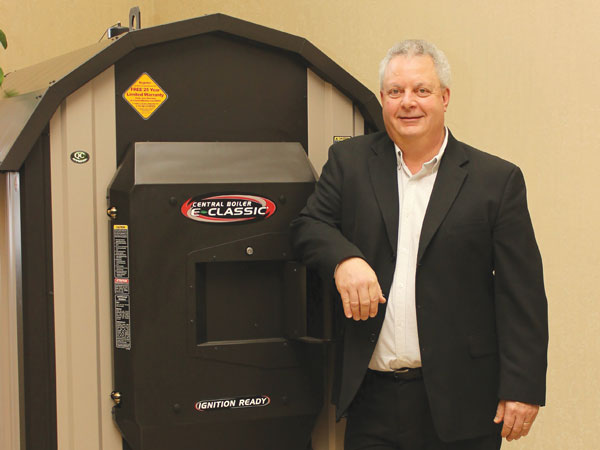
Steve Muzzy, head of Central Boiler.


Different emission standards for pellet and cordwood appliances

Some industry players see a solution to emission standards by holding pellet appliances, and possibly also catalytic appliances, to a stricter standard.  Central Boiler charged that the EPA was “negligent” to hold stick wood and pellet appliances to the same emission standard.

HPBA and industry leader Hearth & Home Technologies are not calling for a bifurcation of emission standards based on fuel type or whether a stove has a catalyst.  The first NSPS in 1990 originally set a 7.5 gram an hour standard for non-cat stoves and a 4.1 standard for catalytic stoves.  States and air agencies also do not support setting separate emission levels based on fuel or inclusion of a catalyst.  Tim Ballo, an Earth Justice attorney, commented, “EPA’s observation that more pellet stoves meet the Step 2 standards than crib or cord wood stoves does not support the adoption of weaker emission standards for crib or cord wood-fired heating devices.”
Bret Watson says Jotul is
doing "very well" in
certifying their 2020 models.

In an exasperated and testy comment, Blaze King accused Jotul of working with the State of Maine to “spread false, misleading and out of date information in an effort to secure market share.”  Jotul has been a strong advocate for non-catalytic stoves and was instrumental in distributing a form letter to retailers to submit to the EPA that severely criticized catalytic technologies.  An unspoken rule in the stove industry is never to criticize another manufacturer by name, but the Blaze King feud with Jotul has only become more intense as the NSPS revision process increased the stakes of the game.  It should be noted that in Jotul’s official comments to the EPA, they did not call for a bifurcation of emission standards. 

A renewable, low carbon energy source

The role of wood and pellets as a renewable, low carbon fuel is virtually lost by the EPA, industry, states and air agencies.  Technically, the renewability of wood plays no legal role in setting emission regulations or other EPA policies governing wood and pellet heating.  However, many industry comments referred to the important role that wood heating plays in the lives of rural, lower income households, allowing them an affordable alternative to fossil fuel heating.  While it didn't appear in their comments, many of the states urging the EPA to maintain cleaner emission standards are also providing incentives for more deployment of wood and pellet heaters.  New York, Vermont, Massachusetts, Maryland and others all have programs aimed at strengthening modern wood heating.  The Alliance for Green Heat was founded to promote the role of biomass as a low carbon fuel source and has tried to gain industry support for innovation leading to the automation of wood stoves.  But for now, the sides have been drawn on this issue based mostly on affordability vs. cleanliness, not on carbon.

What comes next?

The EPA has said that it may make a decision on whether to grant wood boilers and furnaces a two-year sell through in the spring of 2019.  As for all the other issues, including a two-year sell-through for stoves, they have only issued an advance notice and still have to decide if they will issue a formal proposal.  That proposal would also be followed by a public comment period and it is difficult to imagine a scenario that the EPA could announce any “relief” for manufacturers before winter of 2019/2020.
Bill Wehrum, in charge of weakening
air pollution rules at the EPA for the
Trump Administration, has little time
to deliver on wood heaters.

Industry came close to securing a more robust compliance extension from Congress in 2018 but fell short in the Senate.  With Democrats now in charge of the House, Congressional support for weaker or delayed emission standards is not an option in 2019 or 2020.

Clearly, the attempt to dilute the NSPS by the Trump Administration has coalesced and unified states and air agencies behind positions developed by NESCAUM and others.  They are looking to 2023 to regain the ascendancy that they lost under Administrator Pruitt and Wheeler’s leadership at the EPA.  If democrats take the White House in 2022, rewriting the NSPS starting in 2023 could be a possibility.  But a democratic White House and EPA would, in turn, energize Republican governors who seem to have been complacent during this comment process.  Under Republican Governor LePage, Maine was the one state that was emerging as a vocal supporter of the EPA’s deregulation of wood appliances, but during the comment process, a Democratic Governor was elected.  

At this point, time is critical as May 2020 approaches. It appears that the issue was not important enough for the EPA to put on a faster track and members of Congress supporting the hearth industry were not able to change that.  With a little more than a year to go, the question is – is it too late anyway?


Friday, May 16, 2014

One Chapter of Polluting Legacy of Outdoor Boilers Coming to Close

One chapter of the fight over outdoor wood boilers is on the verge of ending, as EPA regulations are prepared to ban the sale of unregulated boilers in the 38 states that still allow them.  And virtually all the  main stakeholder groups, from industry to air quality agencies, agree that this will be one of the best things about the upcoming residential wood heater regulations set to take effect in the spring of 2015.

A decision by the EPA in the mid 1980s to not regulate residential wood-fired boilers, also referred to as hydronic heaters, seemed reasonable at the time.  Fossil fuels were cheap and our nation was turning away from wood heating and quickly adopting electricity and gas as heating sources. But starting around the turn of this century, a boiler design emerged that became increasingly popular, spawning a few dozen small businesses, some running out of garages and barns.  The design appeared brilliant: put the boiler in the backyard next to your woodpile and pipe the hot water underground.  But they had one big drawback.  They had a water jacket around the firebox that continually cooled the fire, keeping it from reaching temperatures that combustion needs to be clean and efficient.

Outdoor wood boilers are one of the reasons that states and non-profits are demanding stricter EPA emission limits not just for boilers, but also for stoves and furnaces, which are all coming under more scrutiny.  In the absence of federal regulations, a dozen states either effectively banned them, or only allowed models that met stricter voluntary emission standards.  Vermont was the first state to require this in 2005 and Utah was the last in 2013 before federal regulations, known as New Source Performance Standards (NSPS) will take effect in 2015.

These regulations will close the chapter on installing new, unregulated boilers in the US, but the hundreds of thousands of existing boilers already installed still cast a pall over the wood heating community, reducing neighbors property values and forcing some families to leave their home, rather than breathe the dense smoke that often comes from these boilers.

New battles are already looming around outdoor boilers, as the Hearth Patio and Barbecue Association (HPBA) fights for a one- year period to sell off existing inventory of the unregulated boilers.  States and air quality groups oppose this additional year and the EPA will decide by February 3, 2015 whether to allow the additional year of sales, as well as how many pounds of particulate matter the boilers can emit in 2015, and how much tighter the standard should be by 2020.

Litigation is likely, but relief is not likely to come soon enough for companies like Central Boiler, the leading manufacturer of both unregulated boilers and the cleaner models.  Central Boiler has fought regulations in state after state to continue selling their unregulated models, while at the same time building cleaner EPA Phase 2 models for the dozen states that ban their unregulated ones. Their most popular models are the unregulated ones and currently, their dealers do not know if they can sell them after next spring.  Many dealers are telling customers to buy and install now, while they still can.

The outdoor wood boiler industry is also pitted against the importers of more sophisticated European technology, with the US importers fighting for test methods and emission standards that are geared towards European technologies, which are more likely to include oxygen sensors, thermal storage and high temperature combustion.

The battle over the future of outdoor boilers is a microcosm of many similar battles about our energy future.  More than a dozen Republican lawmakers are demanding that the EPA drop these regulations that they say will make this age-old American tradition of heating with wood prohibitively expensive.  Democrat lawmakers are more focused on reducing pollution.  Both sides claim they are they are supporting the future of a low carbon fuel source. 

But many battles will remain with the states, as property line set backs and stack heights are still considered vital by many states who don’t want outdoor boilers in suburban neighborhoods or where a neighbor’s house in only 100 or 200 feet away.  While the cleaner models are cleaner when used properly, they still can be misused by operators who load them with un-split wet wood, or even worse, with household garbage that cause plumes of smoke to blow through valleys shared by other families.


Update: In August 2014, Connecticut announced a outdoor wood boiler buy-back or replacement program. (The program is now closed.) What makes it significant is that they are only allowing boilers that emit no more than .06 lbs of particulates per MMBBTU, which is far lower than the current EPA voluntary standard of .32 lbs/MMBTU.  Woodmaster is one of the only company that makes boilers that clean, along with a number of European pellet boilers such as Maine Energy Systems and others.  The state does not require the replacement boilers to be part of the EPA voluntary program, but only requires that they meet the low emission requirement.

Wednesday, October 30, 2013

Meet the Contestants; Hiisi


With the first Wood Stove Decathlon only a couple weeks away, we are profiling the remaining teams in the competition. Take this opportunity to learn more about the design teams and their stove’s innovative features.

“It’s so Hiisi, anyone can do it!” The Finnish stove is marketed as easy to use, inspiring the homonymic name Hiisi. The Hiisi is Finnish company’s Tulikivi's smallest hybrid heat-retaining fireplace and is especially well suited to modern low energy construction projects. The upcoming 2015 wood emissions restrictions in Germany has challenged Tulikivi engineers and innovators to meet the high standards. After years of development the stove is ready meet the world's tightest emissions standards set for 2015 and to compete in the Wood Stove Decathlon this November.

Lab technician Onni Ovaskainen and a Hiisi prototype
The Hiisi differs from standard room-heating stoves in that typical wood stoves are not normally heat-retaining units. The Hiisi's heat-retaining soapstone releases heat more slowly, and in the form of soft, pleasant radiant heat and it can heat water. This is a major design point since this stove won't over heat new energy efficient homes. These types of homes are quickly becoming the norm so Tulikivi has worked to minimize the convection heat into the room using thermal radiation and a double glass door. Despite its compact size, the Hiisi is a hybrid fireplace, meaning that both pellets and wood can be burned in their firebox without the need for any further equipment, accessories or even electricity.

The model that Tulikivi is bringing to Washington D.C. has already been sold in Europe for the past 5 months. Only taking a brief pause to celebrate Hiisi’s success, Tulikivi is getting ready to launch the next generation of Hiisi models this coming January. The new model promises to burn even cleaner than the original.

Tulikivi hopes that their Hiisi stove will help promote the benefits of residential biomass heating. They work hard to ensure that consumers are aware of these benefits. While selling these masonry heaters in the US, Tulikivi educates their consumers of the long tradition of masonry heating and the pros and cons of thermal mass radiant heat compared to dry hot convection heat. Over the past two years, insight from consumers and Tulikivi’s importer network has led to developmental and design changes to get the look and feel of the Hiisi just right.

We are looking forward to seeing Hiisi in action at the Wood Stove Decathlon November 16-19, 2013. Vote for your favorite stove at Popular Mechanics

Sunday, April 1, 2012

Best of AGH Newsletter: March 2011 – March 2012

 The following stories from our monthly newsletter, Green Heat News, were the most popular stories amongst our readership. Our mailing list of about 4,000 people includes hundreds of state and federal regulators and policy makers, over a thousand in the wood and pellet stove industry and hundreds of consumers and non-profits.

The EPA has begun to release what will likely be their new proposed emission standards for wood and pellet stoves, boilers and other appliances. EPA is proposing to match the Washington State standards that they adopted in 1995 of 4.5 grams an hour for wood and pellet stoves and 2.5 grams and hour for catalytic stoves. Indoor and outdoor boilers would be held to 0.32 lb. / mmBTU heat output by 2014 and 0.15 lb. / mmBTU heat output for 2016.

The Maryland House of Delegates heard testimony on HB 829, the Renewable Energy Act for All. HB 829 was introduced by Delegate Heather Mizeur (right) who represents the Alliance for Green Heat’s district. The bill would provide a rebate to people buying the cleanest wood and pellet stoves, as part of a larger rebate program for solar, wind and geothermal. HB 829 combines important goals in Maryland, including promoting renewable energy, helping low and middle-income residents to affordably heat their homes, changing-out older wood stoves, etc.

April 2011 - Oregon Bans Phase 2 Outdoor Boilers
Oregon recently adopted a rule that prohibits the sale of any solid fuel-burning device that is not certified for sale by the DEQ or by the EPA. This mainly affects outdoor wood boilers and single burn rate wood stoves. These devices are no longer exempt in Oregon. Pellet stoves, masonry heaters, cook stoves, fireplaces and antique stoves continue to be exempt. This policy, similar to ones in Washington State, has the unfortunate result in also banning the cleanest indoor pellet boilers, including those that have so successfully started replacing fossil fuel boilers in Europe.


May 2011 - Solar Pellet Focus
The new pellet boiler OCTOplus by Solafocus recently received the "Energie Genie 2011" innovation award. The boiler combines solar and biomass technology into a fully automated system, with both a pellet burner and a 500-liter (130 Gallon) solar accumulator tank. System advantages include high efficiency (94%), compactness, simple hydraulic integration, an innovative control system, intuitive operation and a large removable ash pan. 

June 2011 - Are We Ready for Large-Scale Deployment of Pellet Stoves?
The EPA is currently undertaking regulations for New Source Performance Standards for wood stoves and for the first time ever, pellet stoves. The Alliance for Green Heat believes that if we want to see widespread deployment of pellet stoves in the US, like they have in Europe, a stricter standard is needed.

July 2011 - Commentary: Innovative Hydronic Heater Bill Stalls
Rhode Island residents and legislators have some innovative ways to combat the residential hydronic boilers that are often highly polluting. H5783 required anyone selling or renting property with a traditional hydronic heater to remove it. The Alliance supported this bill but opposition by outdoor boilers companies prevented its passage.

Biomass: Sustainable, but "Never Carbon Neutral"
Recently, Vermonters have begun to think about forests in a new way: As renewable energy from waste wood products that can heat homes, campuses, and more. How much of the region can-or should be-harvested?
 
August 2011 - Biolite campstove, with USB charging
The Biolite stove is not only being utilized by backpackers who look to cut down on the fuel they carry, but also the companion homestove is revolutionizing cooking in developing countries. The Biolite stove can charge cell phones and LSD lights as well as producing heat that increases its usefulness across the board. 

No Process for Resolving Air Pollution Problems
Many families are experiencing excessive wood smoke from a neighbor's outdoor wood furnace coming into their home. You would expect that there would be some agreed-upon process for resolving this kind of problem. There's not. Some families have been forced to move.

September 2011 - New Developments in European Stove Technology
European wood and pellet stoves are making technological advances, offering more options for consumers. From heating water, to syncing with heat pumps and solar thermal systems, to using ducts to heat adjacent rooms, there is clearly a renaissance of development in both wood and pellet stoves in Europe.

Hydronic Heater Ads Misleading Consumers
Through the hydronic heater Phase 2 Partnership Agreement, outdoor boilers were testing at up to 99% efficiency. The Alliance for Green Heat calls on the EPA to disassociate the Phase 2 program from the now discredited efficiency numbers that are still being used by some manufacturers.


Reliable Pellet Stoves
Objective ratings of pellet stoves are nearly impossible to come by, but Scott Williamson, an independent pellet stove technician, kept meticulous repair histories from more than 5,000 house calls. He rates what he found to be four of the most reliable pellet stoves. He includes a Harman, a Lopi, an Enviro and, pictured left, the England Stove Works model 25-PDV. 
Wood was the fastest growing heating fuel nationally but in some regions, electricity, natural gas, propane and even oil are experiencing rapid growth. Wood grew the fastest (+34.6%), followed by electricity (+26.8%) and natural gas (+4.9%), and both propane (-16%) and oil (-21.9%) declined. But regional differences abound. The map on the right shows where oil heat grew fastest in black, electricity in blue, gas in brown, propane in orange and wood in green. 

2010 Census Shows Wood is Fastest Growing Heating Fuel in U.S.
Recently released U.S. Census figures show the number of households heating with wood grew 34% between 2000 and 2010, faster than any other heating fuel. In two states, households using wood as a primary heat source more than doubled - Michigan (135%) and Connecticut (122%). And in six other states, wood heating grew by more than 90% - NH (99%), MA (99%), ME (96%), RI (96%), OH (95%) and NV (91%). Numerous outlets, including the AP, USA Today and many other papers, covered the analysis done by the Alliance for Green Heat.

How to Get the Best Firewood for Clean and Affordable Energy
A clean burning, EPA certified stove is only half the equation. John Gulland, member of the Alliance's Board of Advisers, spells out why firewood is equally important to heating your home. 

Nov/Dec. 2011 - How to Choose the Right Woodstove
Deciding which woodstove to buy can be tough, even if you've been heating with wood for years and are simply looking for a replacement stove. John Gulland, writing for Mother Earth News, brings a fresh, important and independent perspective to the subject. 


Senators Propose New Tax Credit up to $5,000
Senators Snowe, Bingaman and Feinstein introduced the "Cut Energy Bills at Home Act" which would give up to a $5,000 tax credit for performance-based home improvements. The bill, as written, makes biomass heaters eligible if savings can be calculated with approved energy efficiency software packages, such as RESNET, BPI or alternative software. The Alliance for Green Heat is working with Congressional offices and efficiency standards organizations to ensure that there will not be unforeseen barriers for biomass heaters. Currently, most energy efficiency software does not have sufficient ability to analyze performance and savings of biomass heaters.

February 2012 - Next Generation Wood Stove Design Challenge
The Next Generation Wood Stove Design Challenge will be launched later this month and run through the fall of 2013. We have been building an impressive list of partners to support it, lawyers to make sure we have dotted our "i"s and crossed our "t"s, and, maybe most importantly, reaching out to dozens of university engineering departments and stove manufactures.  

Why Wood Stove Change-Out Programs Underperform
Change-out programs are now commonplace in the wood stove community, but often provide fewer benefits than expected and are very expensive. In assessing the effectiveness of change-out programs, the Alliance for Green Heat found a lack of rigorous analysis or debate about how to best achieve air quality improvements. In response, we offer four strategies that might improve change-out programs.

ÖkoFEN Developing Residential CHP Boiler
ÖkoFEN is working on the development of an heat and electricity-generating pellet boiler for private homes. The small CHP plant works with a stirling engine integrated in the pellet heating system. It is expected to deliver 1 kW of electrical energy and to cover the majority of the daily electricity consumption in a household. The stirling engine has low noise and emission levels and is extremely low carbon when operated with sustainably produced biomass.


March 2012 - Year After Year "Miracle" Amish Fireplaces Find Unwitting Buyers
Don't be fooled by advertisements claiming to sell Amish "Miracle Heaters". The company, Heat Surge, runs expensive, full-page advertisements for these heaters in prominent magazines and had a booth at the Atlanta Expo to sell their wares to hearth dealers. Despite claims, the company's heaters that sell for $200 or $300 put out the same amount of heat as a regular $40 electric heater.

The 2012 Atlanta Hearth Expo
If you like wood and pellet stoves, Atlanta was the place to see clean ones last week, like the ones that are burning in the picture to the left. But if you were looking for innovative new stoves, you would have been disappointed. Many manufacturers are still waiting to make sure they know what the new EPA emission numbers will be before bringing out new products.