Showing posts with label Blaze King. Show all posts

Friday, May 15, 2020

May 15, 2020: a historic day for wood heat technology

The end of an era for some iconic stove models and the beginning for others
Quadrafire's Mt. Vernon AE is
one of many popular, iconic stove
lines going out of production 

Ten years in the making, modern wood heater emission standards are finally here, today on May 15. Hailed by many and derided by many, May 15 brings to a close a major chapter  in the book of wood heater regulation- though not the last chapter by any means. The EPA, industry and states continue to work on cordwood test methods, parts of the Hearth, Barbecue & Patio Association (HPBA) lawsuit are still outstanding, and public comment will soon be open about a likely proposal for a fall sell-through of Step 1 stoves.

To draw an analogy from biology, today marks a mass extinction of heater models unparalleled since the 1988 – 1990 period when even more heater models died off because they could not meet basic emission standards. The largest genus of stoves to die off back then was the Fisher family of stoves, though they live on in tens if not hundreds of thousands of American homes.  A few that go extinct today are also akin to famous dinosaurs, like the Ashley circulator line of stoves, that appear to lack a 2020 compliant version for wood.  Granted, some of the most iconic stove models quietly slipped out of production years ago, like the Acclaim, Intrepid and Vigilant, which have sold more units than most current models ever will, between their catalytic and non-catalytic versions.

For pellet stoves, May 15 marks the end of the Whitfield era.  Whitfield pellet stoves are still renowned for their simplicity and durability and they lived on via the Montage model made by Lenox and then by IHP.  As of May 16, Jerry Whitfield’s legacy is alive and well in the history books but gone from showroom floors.  The Mt. Vernon AE, another classic and popular pellet stove made by Quadrafire is also gone the way of the dinosaur, (the company continues to build the slightly similar Mt. Vernon E2).
The classic Jotul F 602 endures
with a 2020 compliant version

Then there are stoves like the classic Jotul F 602 that was popular when it was introduced in the 1930s. It’s virtually identical looking modern version is 2020 compliant, and still popular. 

The millions of dedicated, experienced wood stove enthusiasts in the US may be a nostalgic lot, who fondly remember the old models and the days when emissions limits were not as strict.  But May 15, 2020 is also a milestone in stoves becoming cleaner and more efficient, a point that often seems to get lost in the acrimony about the how the EPA is managing the process.  

It’s tempting to say that the 2015 wood stove rules, that culminated today in a 2 to 2.5 gram an hour standard, will give the stove industry a new lease on life, like the 1988 EPA regulations did.  The jury is still out on how much better these stoves are than the ones allowed to emit up to 4.5 grams an hour and some models were likely brought to market too quick, before they were sufficiently field tested.  Instead of touting the new prowess of these cleaners stoves, almost all industry leaders have  been saying there is no appreciable difference between a 2-gram standard and a 4.5 standard.  Part of this is a messaging tactic to oppose stricter standards or possibly they know more about how test labs can produce ever lower emissions data from virtually the same stove.   

The sell-through that kept falling through

The May 15 deadline was a sour one for many retailers and industry members who thought that there would be a sell through.  First, the EPA raised their hopes by proposing a sell-through in 2018, only to reverse course and deny it in March 2020.  The March ruling was a blow to industry morale even though the EPA agreed to publicly tell industry in October 2019 that they should stick to the original
Senator Carper (D-DE) has emerged
as a leading voice for stricter stove
regulations in the Senate
timetable.  Then HPBA rallied again in March 2020, apparently thinking they could get a Direct Final Rule, allowing a sell-through starting on May 16, and everyone’s hopes went back up again.  And, Mandy Gunasekara was back at the EPA, after more than a year absence. But Direct Final Rules are for non-controversial changes that won’t be opposed by any stakeholder.  Senator Carper from Delaware quickly made sure that they EPA knew how contentious a sell-through was.  

It wasn’t until early May that it became clear to HPBA that getting a Direct Final Rule was like threading a needle in a hurricane, even with some high-ranking friends in the Trump Administration.  Then, HPBA seemed to quickly change course, urging industry to ignore the possible sell-through that they had fought so hard to secure.  HPBA unveiled a promising  Stoves to Homes Initiative that would allow retailers to give away their unsold Step 1 stoves to a charity who would then install them in low-income homes.   [Update: At 5:00 PM on May 15, the EPA released the details of a proposed sell-through window in the fall, ending on Nov. 30, and after public comment and an online hearing.]

HPBA worked hard on behalf of its membership on all three branches of government: Congress, the courts and the Administration.  HPBA came extremely close to victory in Congress, passing a far-reaching three year delay Bill in the House, championed by Rep. Collin Peterson (D-MN) who represents Central Boiler's district.  This was far more than a retailer sell-through and industry could not secure support from key democrats in the Senate when the initiative failed.  Many assumed industry could secure relief from the Trump Administration, as so many other industries have, and the 2018 EPA sell-through proposal was the fruit of those efforts.  Some speculate that the 2018 departure of EPA official Mandy Gunasekara left HPBA without a high-ranking benefactor to shepherd through the sell-through proposal.  It may have been left to lower
As manufacturers tried to
assure their retailers they were or
would be ready for 2020 back in
2017 and 2018 with ads like this,
the EPA saw an industry that did
not need a sell-through
level EPA staff who sided with states and air agencies that the case for a sell-through was weak.  What the EPA may have failed to grasp, was that even through many stoves were certified to 2020 standards in 2016, 2017 and 2018, many manufacturers did not make those models available to retailers until later in 2019, leaving retailers no option but to continue buying Step 1 models until the very last heating season.  

Finally, in the third branch of government, the courts, HPBA’s legal strategy seemed to unravel as it requested extension after extension and as time passed, more and more stoves were certified to the 2020 standards, including the 2.5 gram an hour cordwood standard. HPBA had a strong claim the EPA lacked sufficient data to set a cordwood standard, but then its members began favoring the looser ASTM cordwood standard.  After 5 years of advocacy, industry had little to show to the retailers, many of whom are now angry.  

Fortunately, 2018 and 2019 were mostly good years for much of the manufacturing and retail industry, according to a number of detailed articles in Hearth and Home Magazine.  The wood and pellet heater industry entered 2020 on decent footing, though many manufacturers and retailers increasingly make profits from their gas and electric lines of appliances, not wood and pellet.  Then the coronavirus hit with a broadside slam that appears to be lingering not just through the spring and summer, but potentially could have a major negative impact in the fall of 2020 and well into 2021.  The pellet stove and boiler sector is also particularly susceptible to low oil prices, which simultaneously accompanied Covid-19 in its swath of destruction through the economy.

In addition, the industry’s right-leaning, anti-regulatory tilt has built friends in Congress and the Administration, but not necessarily with the leaders of the renewable energy movement, who seem to be increasingly looking to electrify residential heat. Privately, many HPBA members say they wish the association had not tried to fight the regulations so hard, even though the outdoor boiler and warm air furnace sectors were pushing them to do just that.  If Senator Biden is elected in November, industry would likely do well to try to quickly reposition themselves and be part of coalitions that could stand to benefit from a pro-renewable administration.  Pellet heating technologies should be best positioned to benefit from some form of green new deal and potentially help end the difficult, cyclical boom-bust nature of pellet heater sales.

Certified stoves on May 16
 
A screen shot of the EPA database on
May 15, showing 610 certified stoves.
The number of stoves on the EPA’s list certified room heaters is about to plummet downward, from 610 to 211 stove models.  Hundreds of models that design firms, engineers, lab technicians, production line workers brought to market, will be things of the past.  They represent millions upon millions of stoves that families gathered around in the evening, that kept them warm during power outages, and helped them save enough money for groceries and other essentials.  My grandparents, my parents and my family used many of those stoves, considered to be the best technology of their era.  One of them, a pellet stove made in 2014 and has worked beautifully since then, heats my home as a I write this.

So we put our faith again into the hands of the engineers and lab techs to come up with even better stoves, that will be even cleaner and more efficient. We won’t see the huge PM reduction and efficiency gains that we experienced in 1988- 1990, but chopping lab numbers in half, from 4.5 to 2 or 2.5 grams is no easy feat and should be embraced by all of us.  We should applaud the engineers who do this for us, and especially those who are working not just to achieve these numbers in a lab but who are trying to ensure stoves are cleaner in our living rooms.  
Both wood stoves up for
awards at the HPBA 2020
Expo were automated, a
sign that the stove industry
is movig forward.

Reducing average stove emissions by a gram or two or three per hour from a stove is a major achievement that will protect the lungs of not just those that buy stoves, but their kids, their parents, their grandparents – and their neighbors.  Granted it will take decades for these cleaner and more efficient stoves to be commonplace in homes across America.  After all, there are still millions of uncertified, pre-1988 stoves in homes.  

But we should not forget that the drop to 4.5 grams an hour actually happened more when Washington State changed their standards in 1995, than it did in 2015 when the EPA adopted that change.  Those two decades of sales of cleaner stoves all across America were a blessing that has had long-term ramifications.  Two decades from now, I hope we will be able to look back and appreciate the engineers who designed these cleaner 2020 appliances and gave a new lease on life to this vital renewable energy technology.

Tuesday, March 5, 2019

Wood stove industry faces unified opposition to deregulation

A 2018 portrait of the Western
Governors Association who
oppose delays in the NSPS timeline.

Amid the scores of comments filed in response to the EPA’s proposal to weaken Obama-era wood stove and boiler regulations, not a single state came out in support of the Trump Administration’s proposals.  

Attorney Generals from eleven states (CT, IL, MA, MD, MN, NJ, OR, NY, RI, VT & WA) filed detailed comments and are likely prepared to sue if the EPA tries to weaken the existing regulations.  Even Alaska and the Western Governors Association is backing the Obama-era timeline. A more troubling sign for the wood stove and boiler industry is an energized, engaged and knowledgeable array of states, air agencies and non-profit organizations that have lined up to oppose virtually all the changes that the stove and boiler industry is seeking from the Administration.

“We are seeing a polarization of stakeholders who once used to make alliances and find common ground,” said John Ackerly, President of the Alliance for Green Heat, an independent non-profit that promotes cleaner and more efficient wood and pellet heating. “The Trump Administration efforts has energized states and unified them across a range of issues, from compliance deadlines, to test methods, to regulation of wood pellet composition, to warranties and audits for stoves,” Ackerly said.

Key excerpts of stakeholder comments which this analysis is based on can be found here for those who don't want to download and read through hundreds of pages of comments.
John Ackerly, head of the Alliance
for Green Heat.  Photo courtesy of
Popular Mechanics magazine.

Trump Administration proposes a delay

The biggest issue on the table is whether the EPA will extend a deadline and allow retailers to sell dirtier wood boilers and furnaces – and possibly wood stoves – until 2022 instead of 2020. The EPA has indicated an interest to provide this relief to wood boiler and furnace manufacturers and retailers, but time is running is out and the agency has been moving slowly on this issue.  It’s also unclear if states would be able to get an injunction to prevent such a move while it was being litigated.  

Scores of comments submitted to the EPA depict an industry that has few friends standing up for it outside its own network of manufacturers and retailers.  Attorney generals from three states with Republican governors – Maryland, Massachusetts and Vermont – sided with democratic-led states in opposing any delay in stricter emission standards taking effect.  

Among industry, there is widespread unity to allow retailers two more years to sell Step 1 boilers, furnaces - and stoves - that are set to go off the market in May 2020, although a handful of small manufacturers and importers support the existing timeline.  

While manufacturers argue forcefully that they need a two-year sell-through, they are also having to assure their retailers that they will have 2020 compliant products.  For example, in comments submitted to the EPA, Jotul says it faces dire economic consequences with $2.5 million in raw cast iron at stake if a 2-year sell-through is not granted.  But in an industry magazine read by retailers, Jotul says they are doing “very well” certifying their 2020 models and expect to release their new 2020 models later this year.  Based on the EPA’s list of certified wood stoves, it appears that Jotul is one of the manufacturers who is far behind schedule, as they do not yet have a single 2020 compliant stove on the list.  Industry sources have said that the list of EPA certified stoves far underestimates the preparedness of many manufacturers who may be waiting to submit test data for 2020 compliant stoves until they are closer to the required date.
Richard Corey, CEO of
California's Air Resources
Board

While northeast and northwest states have been the principal state actors, California is making a big investment in challenging the EPA's deregulatory proposals.  They filed extensive comments to both the Proposed Rule Making (PRM) and the Advance Notice of Proposed Rule Making (ANPRM).  They and many of other states challenge the legality of the EPA's approach, setting the scene for what is likely to be a legal battle.  They argue:

"The [EPA's] requests for information with respect to the emission limit for wood heaters do not request the right information, are biased and outcome seeking towards collecting evidence for weakened standards and miss the opportunity to collect the data necessary to perform an accurate and complete economic and regulatory impact analysis.  Asking “whether Step 2 is achievable at a reasonable cost” is not the correct framing of the question. The answer to this question seems predetermined, particularly for those who ostensibly have “been unable to design a wood heater to meet the Step 2 standard.”
Letita James, the Attorney
General of New York, is the
lead among eleven attorney
generals opposing a sell-
through and other changes.

Perhaps the most detailed argument for a two-year sell-through came from North East Distributors, one of the largest distributors of stoves made by many manufacturers.  They say that they “are in favor of manufacturers having to meet the May 15, 2020 deadline for stopping production of non-2020 compliant models" but against "holding distributors and retailers to the same May 15, 2020 deadline for sales of already manufactured products. Having the one date for all entities (manufacturers, distributors, and retailers) inhibits the results you are trying to accomplish.” 

A push to deregulate outdoor wood boilers

The main regulatory focus has been on a sell-through for outdoor wood boilers, also known as hydronic heaters, and inexpensive indoor wood furnaces.  Leaders of those companies have been testifying to Congress and lobbying the administration. 

For central heaters like boilers and furnaces, the main industry association, the Hearth, Patio and Barbecue Association (HPBA) is calling on the EPA to “repeal those standards altogether.”  Strengthening emission standards for wood boilers and furnaces was one of the largest goals of the 2015 New Source Performance Standards (NSPS), and this call to deregulate that industry altogether represents a new front in the widening gulf between industry, states and air quality agencies.  

HPBA's John Crouch, an
architect and mediator of
HPBA policies.
US Stove, the dominant manufacturer of indoor wood furnaces is also calling on the EPA to repeal emission standards for furnaces because the “economic feasibility of meeting the standards is impractical” and the emission levels are “preposterous and unrealistic.”  However, a far smaller competitor, Lamppa Manufacturing already has a furnace that meets the 2020 standards.

When it comes to outdoor wood boilers, fringe voices are not uncommon. There is a group of retailers and consumers supporting the “Hawken Proposal”, which calls for getting rid of federal emission standards for outdoor boilers altogether and letting states and municipalities voluntarily adopt standards.  The proposal is being led by Hawken Energy, a Missouri based company that believes the federal government should not interfere with how people heat their homes. 

In contrast, Central Boiler took a more moderate position and refrained from calling on the EPA to repeal Step 1 and/or Step 2 standards, instead asking the agency to “revisit the cost effectiveness and feasibility of the Step 2 emission limit.”

Lack of enforcement undermines certified boilers
 
Warren Walborn, CEO of Hawken
Energy with Rep. Bill Huizenga (R-MI).
An important concern among the outdoor wood boiler community is that the EPA has no enforcement capability to rein in the many manufacturers of unregulated outdoor boilers.  Yoder Outdoor Furnace, a HeatMaster retailer in Virginia said, “until [EPA] enforcement actually happens no manufacturer can afford to invest heavily in testing as these cheap illegal models will not allow them to recoup costs.”  That sentiment was echoed in many comments from industry, and it would seem to be an issue of concern to states and air quality agencies as well.  However, states and air quality agencies did not mention this problem in their comments.  

By opening the door to changes in the compliance timeline for stricter emission standards, the EPA may have built far more momentum for a new NSPS process in 2023.  The NSPS is supposed to be reviewed every eight years, and states and groups are likely to sue again to keep the EPA to that timeline.  Virtually all the states and air quality agencies engaged in fighting EPA’s proposed changes are now calling for far-reaching changes in the 2023 NSPS. If a democrat is in the White House in 2023, this momentum may result in even stricter emission limits and test method changes.  A group of eleven Attorney Generals said the 2020 emission standards are already “too lax.” If President Trump is re-elected, industry is likely to keep the upper hand and consolidate its goals, barring defeats in court.
Lisa Rector, a leader at
NESCAUM on wood
smoke reduction.


In addition to seeking input on granting a two-year sell-through for retailers for boilers and furnaces, and possible stoves, the EPA identified a half a dozen other issues for which it wanted feedback, from cordwood test methods to compliance testing.

The transition to cord wood testing

One area on which industry, states, air quality agencies and other groups all agree is the need to move toward testing and certification that more closely represents in-field operating conditions and performance.  This means testing and certifying stoves with cordwood, instead of crib wood (2x4s and 4x4s), capturing start-up emissions and potentially making even more structural changes to how stoves are tested.  The agreement may end there, however, as states and air quality agencies have now coalesced behind a test protocol being developed by Northeast States for Coordinated Airshed Management (NESCAUM) and the New York State Energy and Research Development Authority (NYSERDA), called the Integrated Duty Cycle (IDC) method.  Industry is firmly behind the ASTM E3053 method that they developed through a consensus-based process from 2015 to 2018. 

VP Berger, one of Hearth &
Home Technologies senior
leaders on NSPS issues.
Neither side is proposing a rapid change to mandatory cord wood testing.  States and air quality agencies are looking to the next NSPS in 2023 to consolidate their positions and interests.  The State of Oregon, home to most of the test labs and the very first certification testing in the mid 1980s, submitted comments that were particularly critical of ASTM methods.  

Hearth & Home Technologies (HHT), whose comments were often more moderate than some of their peers, said, “HHT recommends using ASTM E3053 until such time there is data showing that the ASTM method doesn’t replicate real-world cord wood emissions or that a new Federal Reference Method is needed.” 

States want labs to start using TEOMs immediately

While states and air quality agencies say that they do not want to change the existing NSPS and believe that any changes to testing and emission standards should be taken up in the 2023 NSPS.  However, they are calling on EPA to “adopt a requirement now, to take immediate effect, for the concurrent use of a tapered element oscillating microbalance (TEOM) test method to measure real-time particulate matter (PM), using the NESCAUM Standard Operating Procedures.”  Such a requirement would seem to involve a change to the current NSPS, unless it were a voluntary measure that labs could undertake as part of a research effort outside of it.

Third-party certification of stoves 

Once stoves or boilers are tested by third party labs, those labs currently send the test reports to the EPA for review and then the EPA issues the certification allowing the manufacturer to make and sell the appliance.  

Industry urged the EPA to ask for comments about a change in this process, whereby the lab would test the appliance and grant the certification, bypassing review by the EPA. Industry points to delays and backlogs at the EPA enforcement office, which takes up to 90 days to grant certificates once the lab provides the necessary documentation.  
 EPA officials, including Amanda
Aldridge and Rochelle Boyd, listen
to testimony on Dec. 17, 2018
on proposals to revise the NSPS.

Again, states and air quality agencies have lined up to oppose this proposal, arguing that the same lab that is paid by the manufacturer to test the stove should not be paid by the manufacturer to issue the certification.  With cutbacks to EPA funding, it does not appear likely that the EPA would hire additional people to help streamline the certification process and at the same time provide other oversight and enforcement of the NSPS, such as cracking down on manufacturers of uncertified outdoor wood boilers. 

Compliance audit testing

Another topic on which the EPA solicited comments is how and when stoves could be retested and audited for emissions compliance.  Auditing the accuracy of the lab that did certification testing of a pellet stove is far easier, as the variability of emissions in pellet stoves is not nearly as great as in wood stoves.  Industry, led by HPBA and Central Boiler, took the position that an audit test should only happen “where there is suspected fraud in certification test results” not random spot checks.  HPBA took an even stronger position, saying that EPA should “prohibit audit testing for appliance categories until there has been a determination on variability for the applicable test.”
Blaze King's Chris Neufeld, an
ardent promoter of catalytic stoves.

Others in industry, such as Hearth & Home Technologies, took the position that if a stove is to be audited, it should be done by the same lab that tested it initially or another lab chosen by the manufacturer.  

States and air quality agencies are taking a uniform position that “only an independent, third-party lab should be selected to conduct all compliance audit testing so that there is consistency across the program and that a lab that conducts certification testing is not permitted to conduct audit testing.” NESCAUM proposed that Brookhaven National Lab be designed as the independent lab.

Warranty requirements

Currently, the NSPS has warranty requirements for catalytic stoves, but not for non-catalytic stoves.  The industry position is that the NSPS should not have any warranty requirements. Hearth & Home Technologies commented that “all manufacturers already have warranty language... [and] whether the EPA required it or not, it is standard warranty language for an appliance.”

This topic drew less attention from states and air agencies, but most supported the retention of warranty language for cat stoves and the addition of warranty requirements for non-cats, “particularly ones for key components related to controlling emissions from the device (including, among others, tubes).”  Blaze King, a vocal leader on this issue, agreed that if any type of stove is required to provide warranty language, then all stoves should have that requirement.   
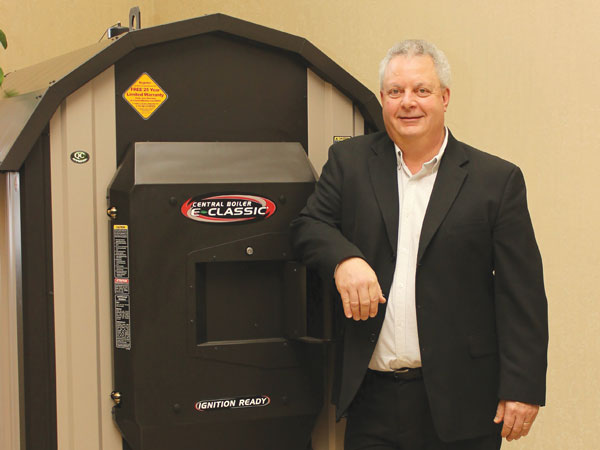
Steve Muzzy, head of Central Boiler.


Different emission standards for pellet and cordwood appliances

Some industry players see a solution to emission standards by holding pellet appliances, and possibly also catalytic appliances, to a stricter standard.  Central Boiler charged that the EPA was “negligent” to hold stick wood and pellet appliances to the same emission standard.

HPBA and industry leader Hearth & Home Technologies are not calling for a bifurcation of emission standards based on fuel type or whether a stove has a catalyst.  The first NSPS in 1990 originally set a 7.5 gram an hour standard for non-cat stoves and a 4.1 standard for catalytic stoves.  States and air agencies also do not support setting separate emission levels based on fuel or inclusion of a catalyst.  Tim Ballo, an Earth Justice attorney, commented, “EPA’s observation that more pellet stoves meet the Step 2 standards than crib or cord wood stoves does not support the adoption of weaker emission standards for crib or cord wood-fired heating devices.”
Bret Watson says Jotul is
doing "very well" in
certifying their 2020 models.

In an exasperated and testy comment, Blaze King accused Jotul of working with the State of Maine to “spread false, misleading and out of date information in an effort to secure market share.”  Jotul has been a strong advocate for non-catalytic stoves and was instrumental in distributing a form letter to retailers to submit to the EPA that severely criticized catalytic technologies.  An unspoken rule in the stove industry is never to criticize another manufacturer by name, but the Blaze King feud with Jotul has only become more intense as the NSPS revision process increased the stakes of the game.  It should be noted that in Jotul’s official comments to the EPA, they did not call for a bifurcation of emission standards. 

A renewable, low carbon energy source

The role of wood and pellets as a renewable, low carbon fuel is virtually lost by the EPA, industry, states and air agencies.  Technically, the renewability of wood plays no legal role in setting emission regulations or other EPA policies governing wood and pellet heating.  However, many industry comments referred to the important role that wood heating plays in the lives of rural, lower income households, allowing them an affordable alternative to fossil fuel heating.  While it didn't appear in their comments, many of the states urging the EPA to maintain cleaner emission standards are also providing incentives for more deployment of wood and pellet heaters.  New York, Vermont, Massachusetts, Maryland and others all have programs aimed at strengthening modern wood heating.  The Alliance for Green Heat was founded to promote the role of biomass as a low carbon fuel source and has tried to gain industry support for innovation leading to the automation of wood stoves.  But for now, the sides have been drawn on this issue based mostly on affordability vs. cleanliness, not on carbon.

What comes next?

The EPA has said that it may make a decision on whether to grant wood boilers and furnaces a two-year sell through in the spring of 2019.  As for all the other issues, including a two-year sell-through for stoves, they have only issued an advance notice and still have to decide if they will issue a formal proposal.  That proposal would also be followed by a public comment period and it is difficult to imagine a scenario that the EPA could announce any “relief” for manufacturers before winter of 2019/2020.
Bill Wehrum, in charge of weakening
air pollution rules at the EPA for the
Trump Administration, has little time
to deliver on wood heaters.

Industry came close to securing a more robust compliance extension from Congress in 2018 but fell short in the Senate.  With Democrats now in charge of the House, Congressional support for weaker or delayed emission standards is not an option in 2019 or 2020.

Clearly, the attempt to dilute the NSPS by the Trump Administration has coalesced and unified states and air agencies behind positions developed by NESCAUM and others.  They are looking to 2023 to regain the ascendancy that they lost under Administrator Pruitt and Wheeler’s leadership at the EPA.  If democrats take the White House in 2022, rewriting the NSPS starting in 2023 could be a possibility.  But a democratic White House and EPA would, in turn, energize Republican governors who seem to have been complacent during this comment process.  Under Republican Governor LePage, Maine was the one state that was emerging as a vocal supporter of the EPA’s deregulation of wood appliances, but during the comment process, a Democratic Governor was elected.  

At this point, time is critical as May 2020 approaches. It appears that the issue was not important enough for the EPA to put on a faster track and members of Congress supporting the hearth industry were not able to change that.  With a little more than a year to go, the question is – is it too late anyway?


Monday, December 17, 2018

AGH testimony on EPA's proposed sell-through for wood boilers and furnaces

On November 21, 2018, EPA proposed amendments to the New Source Performance Standards (NSPS) for Residential Wood Heaters issued in 2015. The proposed amendments would allow retailers an additional 2 years to sell the existing inventory of hydronic heaters and forced-air furnaces. EPA is also taking comment on a similar sell-through provision for wood stoves and on whether the pellet fuel requirements should be revised.  This is the statement delivered by John Ackerly, the President of the Alliance for Green Heat at the EPA hearing held on December 17, 2018.

Via Public Hearing

U.S. Environmental Protection Agency  
EPA WJC East Building
Room 1117A&B
1201 Pennsylvania Avenue NW
Washington, DC 20460

Attn:              Docket ID No. EPA-HQ-OAR-2018-0195

Re:                  Statement of the Alliance for Green Heat in response to EPA’s Proposed Standards of Performance for New Residential Wood Heaters, New Residential Hydronic Heaters and Forced-Air Furnaces, 83. Fed. Reg. 61,574 (Nov. 30, 2018).

Thank you for the opportunity to testify here today.  My name is John Ackerly and I am the President of the Alliance for Green Heat. We promote modern wood and pellet heating systems as a low-carbon, renewable and affordable energy solution. We just hosted the 4thWood Stove Design Challenge, highlighting R& D and innovation in the sector.  This industry has a lot to be proud of and some of people in the room today make some of the cleanest wood and pellet stoves in the country, enabling consumers to substantially reduce fossil fuel usage.  This is a critical juncture for the EPA with regard to residential wood heaters and there is a lot at stake with regard to air quality, energy and human health.
The Alliance for Green Heat strongly opposes the proposed amendmentsthat would allow manufacturers to sell Step 1 hydronic heaters and forced-air furnaces right up to May 2020 and retailers an additional 2 years to sell them.
I want to start by saying that this sell-through is a waste of EPA’s resources.  The agency has far more important things to consider, such as addressing how we transition to testing with cordwood.  The EPA does not have endless time and resources to regulate wood and pellet heating. Please spend EPA’s valuable resources on issues that will advance our industry and improve efficiencies, not prolong the old technology that threatens the health of rural communities.
Second, it is very surprising that the EPA would consider relief for outdoor wood boilers, hydronic heaters and furnaces.  Most of these heaters are the biggest source of the air quality problems from this industry.  Given the high levels of emissions from these units, they give a bad name to all the cleaner types of wood and pellet heating appliances currently available to consumers.  EPA should not reward a small part of the industry that has not invested in technology to improve performance and emissions of its heaters.  Tens of thousands of low-income and rural communities could be stuck with these higher polluting units for decades to come if EPA finalizes a sell-through.  
Third, EPA’s preamble says that the agency is proposing a sell-through because “it is reasonable to assume that retailers may become increasingly reluctant to purchase non-Step 2-compliant wood heating devices.”  But isn’t that the desired outcome? Improving air quality and human health by increasing the efficiency of the residential wood heater sector is a principal goal of the original regulation.  It is the intended result of the regulation to move retailers to focus inventory on Step 2-compliant devices.  There is evidence that some retailers would likely switch to manufacturers that are producing 2020 compliant models.
Lamppa Manufacturing is one such manufacturer.  Lamppa is a smaller manufacturer, and they are looking to connect with retailers.  Their unit is very affordable at a retail price of $5,295 and is compliant with the 2020 Phase 2 standard. Tarm Biomass, who makes 2020 compliant wood and pellet boilers is getting calls from dealers looking for 2020 product.  So are others who have 2020 compliant units. . Competition in the marketplace is fundamental to consumers having access to more efficient and cleaner burning appliances. This proposal works against these market forces, and in effect subsidizes the worst performing technologies.
Step 2 compliant Lamppa furnaces
being built

We all know that this isn’t just to help retailers sell stranded inventory.  After all, who are the retailers?  Some of them are Home Depot, Tractor Supply, Northern Tool and other chains that need no help. Increasingly, retailers are on E-bay and it’s hard to even tell who they are, much less monitor compliance. And a big problem is that many manufacturers want to keep selling these Step 1 units  and never intend to do the R&D to become Step 2 compliant.  Giving them 2 more years just undercuts those who have the ability to meet Step 2. 

It is important for the agency and all stakeholders to reflect on the impact of Step 1 units on air quality and energy use.  One such unit made by US Stove Company is rated as only 33% efficient, yet the EPA says that their “proposed actions are anticipated to have negligible impacts on energy costs or usage.” In fact, there is clear evidence that cleaner, more advanced units will lower energy costs by decreasing overall energy use and improve air quality.


Units made by US Stove are often improperly or illegally advertised by their dealers, like this one that says it can be used with wood or coal. (Dec. 13, 2018 screen shot)
Fourth, EPA should work to improve compliance of a sector that, at times, has been reluctant to change and at times, simply ignores regulations.  Currently, there are thousands of illegal, newly manufactured uncertified new outdoor wood boiler and furnaces being openly sold around the country.  A recent conversation with a manufacturer in the Midwest claiming it offers “the highest quality outdoor furnace available on the market” even though the manufacturer has no certified units and openly sells non-Step 1 units.  The manufacturer said that EPA’s laws and regulations may not apply in Missouri, and that the regulations may have already been overturned.  This manufacturer has 81 dealers in 21 states and no indication anywhere on their website that wood furnaces and boilers need certification. Even more concerning is that EPA’s compliance office indicated that the agency has no record of the manufacturer’s existence or continued operation.  Many smaller companies also continue to sell and advertise uncertified outdoor wood boilers. 
An uncertified Acme wood furnace currently on the market. (Dec. 13, 2018 screen shot)

The Alliance is concerned that establishing a 2-year sell-through would add another layer of work and complexity to a regulation that has already shown serious enforcement challenges.

Finally, by providing a last-minute sell through, EPA is moving the “goal posts” in the middle of the game.  Manufacturers and retailers require regulatory certainty to make business decisions that make the sector more efficient, cleaner, and safer. Putting those companies that took the EPA deadlines seriously and invested in cleaner technology at a competitive disadvantage is simply bad policy.    

Companies have shown that best available technology is available and affordable.  We need an EPA to craft a regulatory framework that supports efforts to modernize the sector and then stick to it.  Do not approve this proposal.

Wednesday, July 19, 2017

Vacuum left after one of nation’s top stove regulators and experts retires

When Rod Tinnemore was invited to speak about wood stoves, he didn’t sound like a regulator.  He spoke his mind, he made people laugh and he was never at a loss for words.  Rod was in charge of wood heater regulations in Washington State, the state with the toughest regulations in the country.  By the time he retired in April 2017, he left behind a far-flung community of stakeholders who admired him – or at least respected his judgment.

Rod Tinnemore became an Environmental Planner at the Department of Ecology in 2008, years after the state was pummeled by industry for the audacious move of requiring all heaters to meet a standard of 4.5 grams of particulate per hour.   Rod became the guy who enforced that decision, and it was one he was happy to enforce, because he felt stoves could and should be required to burn cleaner than the federal standard of 7.5 grams an hour.

Washington State also required that all stoves sold and installed in the state be EPA certified.  To enforce this, Rod regularly emailed residents residents trying to sell old, uncertified stoves on Craigslist.  “Most people didn’t know the regulations and were happy to discard the stove instead, but some just sold it another way.  Periodically, we found big box stores selling new, uncertified stoves and had to send them overnight certified letters as well,” Rod recalled.

Rod’s retirement leaves a vacuum among the regulator community, as there are very few non-federal stove regulators who have the depth of experience and expertise that Rod had.  He influenced policies in change out programs in Washington State and beyond and was one of the most influential state regulators in the EPA's process to develop the New Source Performance Standards (NSPSP).

“Rod was able to build bridges between different factions and he was a diplomat – but he also knew when to take a stand,” said Lisa Rector, a Senior Policy Analyst at the Northeast States for Coordinated Air use Management (NESCAUM).

Many key figures in the wood stove industry thought highly of Rod, in part because he was accessible, responsive and practical.  “Rod had a healthy appetite for knowledge and was a great listener with no preconceived bias.  He was always asking great questions so as expand his knowledge base,” said Chris Neufeld, a vice president at Blaze King and Co-chair of the solid fuel section of the Hearth, Patio and Barbecue Association (HPBA).

Some in industry butted heads with Rod because Washington State regulations prevented almost all outdoor and indoor wood boilers from being sold and installed in Washington.  But even companies representing those appliances often said that they he dealt with them fairly.

At least once, in 2013 when HPBA did not like an initiative Rod was spearheading, they had a lobbyist go to the legislature to send a message that Rod’s department’s funding could be in jeopardy if he pursued the initiative.  Rod ultimately had to back off, ending his exploratory work to start a consumer green label for wood stoves.

Rod was also considered one of the insiders of a small group of regulators in the United States who really knew what he was talking about.   Rachel Sakata, who did similar work for the State of Oregon as an Air Quality Planner, said that she continually relied on Rod’s expertise.  “Rod also was a champion for pushing for cleaner devices and thanks in part to him, we now have stricter regulations for wood heating devices that help protect the public,” said Ms. Sakata.  “And he continued to push for developing testing protocols that mimic real world conditions,” she said.

The Alliance for Green Heat also worked closely with Rod, recruiting him to serve as a convener and a judge for our Wood Stove Design Challenge events in 2013 and 2014.  He also served on a committee that we pulled together to integrate stoves into energy audits, leading to BPI adopting them in 2015.  The Alliance was also one of the stakeholders urging Rod to develop a consumer green label for stoves.

After Rod left office, the Alliance for Green Heat interviewed him, in between various trips and activities, for this blog.

Q. What do you consider one of your successes?
A. Working on and helping to fund a new cordwood test protocol that someday could become a Federal Reference Method (pdf) or possibly a state sanctioned cordwood protocol. We focused on testing various tree species to see which ones produced more PM, but most importantly we tried to get a protocol that resembled how homeowners start and use their stoves – which Method 28 did not. This initiative is now being managed by NESCAUM using Mark Champion’s lab in Vermont and I am very pleased with how it’s progressing.

Q. What was something that you did not succeed at?
A. Not being able to continue working on a consumer green label for wood stoves. This country needed a label to recognize high performing stoves and we still don’t have one that is robust and well recognized.

Q. Who were your closest colleagues?
A. Decades ago, West Coast regulators led the efforts to reduce wood smoke, but more recently, its shifted to the East Coast. California is very progressive but not influential on wood smoke issues because it is so fragmented into so many air districts. Other than Oregon, it was more fruitful for me to work with NESCAUM, NYSERDA, Brookhaven National Lab and the Wood Stove Design Challenge events.

Q. What was the best advice your boss ever gave you?
A. He told me early on that my job could be whatever I made of it.

Q. What was best guidance from your department?
A. The Department of Ecology had a policy of returning phone calls within 24 hours and emails within 48 hours. I thought that was good policy and I tried to live up to it every day.

Thursday, February 23, 2017

Wood and pellet stove prices rise 3% in wake of new EPA regulations


Since the EPA announced stricter emissions regulations for wood and pellet stoves, prices increased by an average of 3% over a two-year period when adjusted for inflation, based on a review of 77 popular stove models. Without inflation, prices increased by an average of 4%.


The Alliance for Green Heat, an independent non-profit focused on the wood and pellet heating sector, tracked retail prices for 77 wood and pellet stoves over a two-year period, from February 2015 to February 2017. The EPA announced new regulations on February 3rd and they took effect on May 15, 2015. Even stricter emission limits are set for 2020 and the Alliance will continue to track prices through 2020 and beyond.

We identified 77 stoves made by 7 popular brands with varying price points: Jotul, Blaze King, Harman, Quadrafire, Woodstock Soapstone, Hearthstone, US Stove, and Englander.

It is impossible to tell how much regulations contributed to the 3% price rise, although each of the 7 brands are going through periods of increased R&D as they work towards complying with the 2020 emission limits. The EPA set a maximum of 7.5 grams an hour in 1990, 4.5 in 2015 and 2.0 or 2.5 grams in 2020. Most stoves already met the 4.5 gram limit in 2015, but most do not meet the 2020 limits. It is possible that some companies are starting to pass those costs along to consumers.

There may be steeper price rises as 2020 approaches and companies have to begin more intensive R&D and certification testing.  However, industry is pushing a bill in Congress to delay the 2020 emission standards to 2023.  The Hearth, Patio & Barbecue Association is also suing the EPA to block the 2020 emission standards for boilers and furnaces, but not necessarily for stoves.  The bill in Congress is partially designed to give the litigation enough time to get through the courts.  

We tracked the retail prices of 59 wood stoves and 18 pellet stoves using the sale or final price of the stove listed on the retailer’s website. Overall, the 59 wood stove retail prices rose an average of 4% ($80) or 3% ($45) when accounting for inflation. The pellet stove category saw a greater average price increase of 5% ($106) or 3% ($66) per stove when accounting for inflation.
  • Four-fifths of the 77 wood and pellet stoves increased in price over the two years. Of these, the average price increase was 6% ($125) or 5% ($90) when adjusting for inflation.
  • About one-fifth of the 77 stoves did not go up in price between February 2015 and 2017. The majority of the Englander and Blaze King models we tracked stayed the same price.
  • Four wood stoves out of 77 wood and pellet stoves -- one Jotul, two Hearthstone, and one US Stove -- declined in price. The average decline was 6% ($250).
The EPA is required by law to do an economic regulatory impact analysis (PDF) and determine if the costs of the regulation outweigh the benefits. The EPA predicted slightly higher retail costs, and as a result, a slight decline in demand for new stoves. However, on balance they estimated that the overall health and other benefits vastly outweigh the costs.

Some commentators, members of Congress and editors claimed the EPA regulations would make wood stove prices rise sharply and be unaffordable for the average American.

The EPA also is required to assess the impact of the regulation on small businesses, since more than 90% of stove manufacturers and retailers are small firms. The U.S. Census Bureau reports that the industry employed 15,911 workers in 2011.

Price changes by brand and stove type

The wood stoves with the highest price decreases, Hearthstone’s Bari 8170 and Lima 8150, which declined in price by $620 and $300 respectively, were the priced the highest of any stove on our list in 2015 at $4,999 and $5,299. No pellet stove we tracked declined in price in 2017 and the only two pellet stoves did not increase in price in 2017 (both Englanders priced between $1,000 and $2,000).

Wood stove price increases ranged from 1% (Hearthstone Castleton 8030 and Craftsbury 8391) to 35% (US Stove’s Large Woodstove). Among the wood stoves that increased in price between 2015 and 2017, the average increase was around $125 or 6% more than the 2015 price. Seven of the nine pellet stoves that rose in price increased by an even $100, regardless of their 2015 price, which represented a 3-4% increase. All five of the Harman pellet stoves, which retailed between $2,999 and $3,999 retail in 2015, were listed $100 higher by the same retailer in 2017.

For the sake of consistency, we only used stove prices at one or at most two retailers per brand. We used final or sale prices rather than “suggested retail price” or “regular price” when given. The number of stoves we selected per brand varied based on the number of models available in 2015 and the number of models that continued to be sold by that retailer in 2017.

Englander and US Stove had some of the lowest prices stoves we began tracking in 2015, with a median price of about $1,000. At about the middle were the brands Woodstock Soapstone (median price of $2,400), Quadrafire ($2,550), and Jotul ($2,700). The more expensive stove brands included our study, based on median prices, were Hearthstone ($2,900), Blaze King ($2,950), and Harman ($3,000).

Four out of five Blaze King stoves, three out of four Englander wood stoves and all (two) Englander pellet stoves did not increase in price over these two years. The sixteen Hearthstone wood and pellet stoves we tracked declined in price by an average of 1% ($3.75) per stove, thanks in great part to large drop in price for two of the brand’s priciest ($5,000+) wood stoves.

As for the brands that increased their prices, Jotul’s 19 wood stoves increased by an average of 3% ($79) each. Quadrafire’s and Harman’s wood and pellet stoves both increased by an average of 4% each ($101 for Quadrafire, $122 for Harman). Harman’s wood and pellet stoves increased in price by an average of $122 per stove. US Stove and Woodstock Soapstone had the greatest average price increases of any brand at 15% each (Woodstock Soapstone has frequent sales which we did not take into account). US Stove’s stove prices increased by an average of $155 per stove and Woodstock Soapstone’s increased by an average of $408 per stove.

The EPA regulations had a much larger impact on prices on companies making unregulated outdoor wood boilers and unregulated wood furnaces.  Prices for boilers rose at a sharper rate than stoves, although we did not track those prices and cannot offer any estimates.